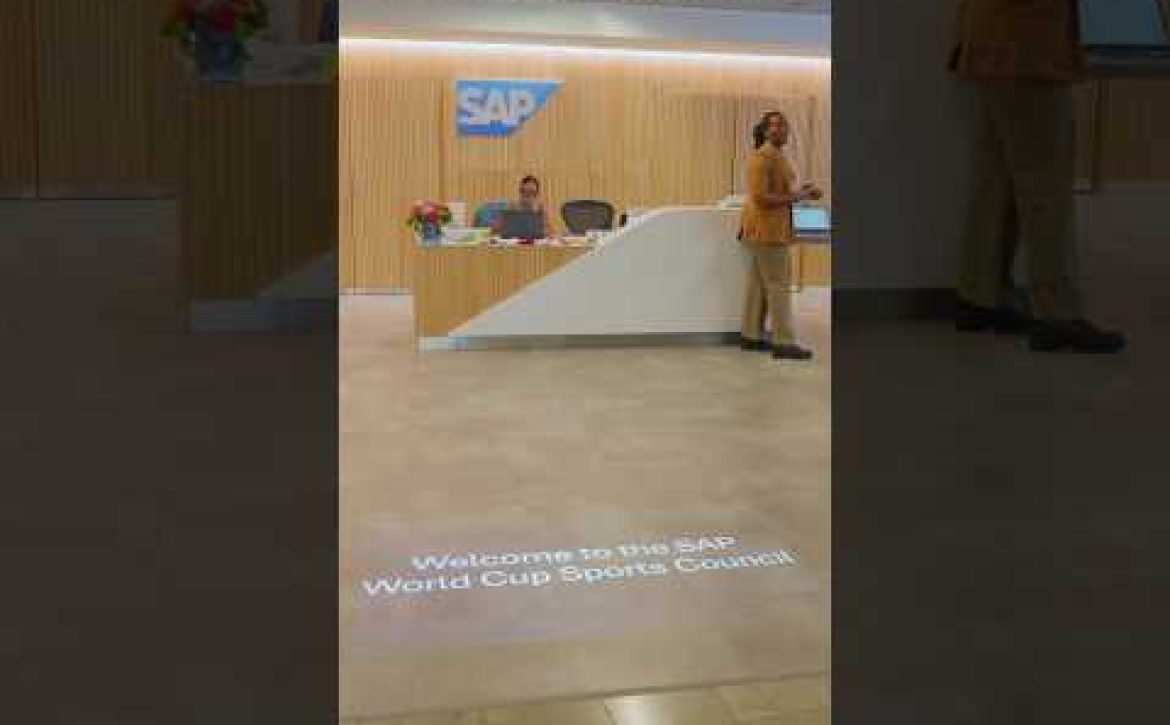
Scouting used to be guesswork. Not anymore. 👀

The secret to finding the next big talent for the world’s biggest pitch? ⚽️ Data.

SAP Sports One turns every sprint, touch, and decision into a clear picture, so coaches and scouts see the full potential in real time. https://sap.to/6053BEDGrD

Why AI makes leadership more human 🤝

Here’s the paradox of the AI era: the more we automate operational tasks, the more profoundly human leadership becomes.

For too long, leadership has been conflated with management, overseeing workflows, tracking progress, and running the operational engine. But AI is poised to take on much of that work, freeing up leaders to do what they were always meant to do: solve complex problems that require nuanced, critical, and uniquely human judgment.

The real work is navigating the leadership dilemmas and strategic challenges that no algorithm can solve. This shift doesn’t diminish the role of a leader; it elevates it.

In this clip, Muizz Bolanji of @danfoss shares his perspective on why this is the most exciting opportunity for leaders today. It’s time to move from managing processes to leading people.

Join the full conversation on SAP AI Voices: Join the full conversation on SAP AI Voices: https://youtu.be/rq5KpbaaZMY

#AIVoices #SAP #Leadership

A store that plays back. 🏟️ Inside the Home of Football, where retail meets AI. #CX

At the Home of Football, fans don’t just shop. They explore, personalize, and play with holographic try-ons and a live leaderboard that turns every purchase into a moment. https://sap.to/6052BEDGyM

Thirty-Five Degrees of Urgency: London Climate Action Week 2026

With a record-breaking heatwave gripping the UK in late June, the “action” in London Climate Action Week 2026 needed no explanation. Much like the temperatures outside, the conversations inside intensified, and the soaring mercury served as a live stress test for the very subjects under discussion: infrastructure, public health, business continuity, and the resilience of the systems everyone depends on.

Under the official banner of Climate Cooperation in a Fractured World, delegates spread across the city and the tone was noticeably different from previous years. Fewer pledges, more blueprints. Less “what should we aim for,” more “who is going to finance and build it.”

Sustainability is a driver of growth

If there was a single reframing that ran through the week, it was this: sustainability is not a cost of growth, it is a driver of it.

That shift was visible in how decarbonization was discussed. Conversations that once centered on targets now centered on operations: Scope 3 emissions, value-chain engagement, procurement and logistics decisions, energy demand reduction. Practitioners repeatedly pointed to an “execution gap”—the distance between climate strategies on paper and projects that are actually permitted, financed, and built—and to the unglamorous work of unblocking infrastructure and untangling supply-chain bottlenecks as the real frontier.

Electrification gave the growth argument its clearest expression. The launch of the Electrify Now initiative, which aims to lift electricity’s share of final energy demand from roughly 20% today to 35% by 2035, was framed as an industrial strategy. Nearly doubling electricity’s share of energy demand in under a decade is an acceleration, and the week’s energy-transition summits were clear about what it demands: scaling renewables at pace, doubling down on energy efficiency, and, above all, building out the grid infrastructure to carry it. Speeding up permitting and resolving supply-chain constraints were named repeatedly as the bottlenecks that will decide whether the target is met. 

Put sustainability at the core of your business with AI-driven solutions

The heatwave outside made that case tangible. As cooling demand surges and extreme weather stresses networks, a clean, resilient electricity system is fast becoming a precondition for business continuity and not just decarbonization. UK-focused sessions highlighted the substantial clean energy investment flowing into the country since 2024 as evidence that the low-carbon economy is now a growth story in its own right. 

The same logic ran through the finance agenda. Sessions on moving from risk to resilience and from risk to opportunity focused on mobilizing capital for adaptation and climate-resilient infrastructure, and on the practical challenge of connecting available capital with investable projects through better data, governance, and pipeline development.

Nature is now on the agenda

Perhaps the most striking development of the week was where nature sat on the agenda, and where it is headed. Speakers were blunt about the underlying problem: our economic system is very good at valuing what we take from nature and very poor at valuing nature itself. Worse, we actively pay to destroy it. Figures cited during the week put global investment flows that harm nature at around US$7.5 trillion a year, against roughly $250 billion flowing into activities that help it. As one speaker put it, the task is not to lament that imbalance, but to get the economics right and to start treating nature as something that can be measured, managed, and steered with the same discipline as carbon or financial risk.

That “getting the economics right” is fast becoming a data challenge for business. Work such as the LSE’s research on the economics of landscape restoration suggests that investing in nature can generate returns comparable to investing in factories, railways, or other conventional infrastructure. As nature-related risks and opportunities are codified into emerging frameworks and regulation, companies will have to treat nature as a set of measurable data points: impacts and dependencies per site, per supplier, and per product line, rather than a one‑off narrative in a sustainability report.

Governments have levers too, from requiring companies to stress test for nature-related risk, to shaping incentives so that capital flows toward restoration rather than degradation. For corporate leaders, that translates directly into new categories of information that need to be captured and governed: nature‑related financial exposure, land use and biodiversity metrics, and nature‑positive investment pipelines. What was once an externality is quickly becoming a set of operational KPIs.

Sir Andrew Steer, professor at the London School of Economics, noted that this was the first year nature was represented at the event, but also how far it still has to travel: “Today here in the outdoor tent, next year in the big room.” The implication for businesses is that the organizations that move nature into their core data models and decision frameworks now are better positioned when this topic inevitably moves from the tent to the board agenda.

The AI warning: get sustainability data in now

Underpinning nearly every theme was data. Location-specific climate analytics were described as “the new lens” for understanding financial risk, and AI featured in almost every discussion of how organizations can gain visibility and control over complex energy, water, and supply chain systems.

But the sharpest point made during the week was a warning. As Stephen Jamieson, chief marketing officer of SAP Sustainability, put it: “If we don’t get sustainability data into AI right now, AI will optimize around it. AI works within the systems, the data, and the constraints you give it. If your sustainability priorities live only in documents and presentations rather than in your data and processes, AI will optimize confidently in entirely the wrong direction.”

The logic is uncomfortable, but hard to argue with. Sustainability now plays out at the transaction level—such as carbon cost per shipment, Scope 3 exposure per supplier, packaging compliance per SKU—and the volume, granularity, and pace of those requirements exceed what manual processes and fragmented tools can manage. An organization whose carbon tool cannot see its financial constraints, or whose supply chain system cannot see supplier regulations, hands its AI a broken map.

SAP’s answer to this is the Autonomous Enterprise: a maturity journey that starts with intelligence based on trusted, transparent data; moves to optimization where AI is weighing trade-offs across cost, risk, and sustainability impact in real time; and progresses toward autonomy, where sustainability rules are embedded directly into enterprise workflows and executed within defined guardrails. Sustainability stops being a reporting activity and becomes a governing factor in how decisions are made. The architecture choices organizations make now will determine whether that automation can scale safely later.

From the tent to the big room

London Climate Action Week 2026 closed with an uncomfortable message delivered in 35-degree heat: the climate is not waiting for business strategies to mature. But a hopeful signal surfaced, too: the growth case, the nature case, and the technology case for climate action are converging, and each is being made in the language of returns, resilience, and competitive advantage.

The task for business leaders is to bring those cases inside capital allocation, procurement, and the data and systems where decisions are actually made. The organizations that thrive will be the ones that move the sustainability agenda into the big room, before the next heatwave makes the argument for them.

For more information on scaling sustainability for your business, visit SAP Sustainability.


Monica Molesag is global head of Sustainability Communications at SAP.

Get the latest SAP news delivered to your inbox once a week

SAP Welcomes European Commission Decision Concluding the Investigation Into On-Premise Maintenance and Support Policies

WALLDORF — SAP welcomes the European Commission’s decision to conclude its competition investigation into certain aspects of SAP’s on-premise maintenance and support practices through a commitment decision, following a constructive and cooperative dialogue.

SAP remains committed to open competition, customer choice and innovation. The commitments provide greater clarity, choice and safeguards for customers managing complex on-premise environments, while supporting flexible IT strategies aligned with business priorities.

As the only Fortune 50 technology company headquartered in Europe, SAP’s maintenance practices are aligned with industry standards and offer customers a broad range of deployment, licensing and maintenance options across on-premise and cloud environments.

The commitments strengthen customer choice and predictability by making policies more transparent, introducing targeted flexibility for exceptional shelfware situations and reinforcing consistent execution through improved guidance, training and independent oversight.

The decision relates solely to on-premise maintenance policies and does not concern SAP’s cloud offerings. However, the added clarity and flexibility support customers as they modernize toward an AI-enabled autonomous enterprise at their own pace. In closing this matter, SAP is able to move forward with a clear framework for customers, partners and investors.

Learn more here.

Subscribe to our newsletter to receive weekly news highlights from the SAP News Center

Evolving Our Maintenance and Support Practices to Deliver Greater Flexibility for SAP Customers

At SAP, our mission has always been to help the world run better and improve people’s lives. Thousands of organizations worldwide rely on SAP’s enterprise resource planning (ERP) and other software to manage their most critical business operations—from corporate finance and human resources to supply chain management and project delivery.

Discover the new success plans and services that deliver the results your business needs to be future-ready

Equally important to our customers are the on-premise maintenance and support practices that help safeguard the software’s ongoing performance and resilience, with regular updates and technical assistance that support business continuity.

As we continue to innovate across our portfolio, we also continue our efforts to let our commercial practices reflect the flexibility and transparency our customers need, and on engaging constructively with regulators around the world.

In a constructive dialogue with the European Commission, SAP has now agreed to a set of adaptations to these practices that will further improve this flexibility, transparency, and predictability. These measures reflect our broad commitment to continuously evolving our practices to serve customers better as their businesses and technology landscapes change.

Our updated policies will apply to all current and future SAP customers worldwide for all of SAP’s on-premise products. Taken together, they represent one of the most customer-friendly maintenance and support approaches in the business software industry, and they set a leading example of what customers can expect from SAP. This further flexibility will not come at cost of business continuity, reliability, and scale, of course.

Specifically, SAP is committed to the following adaptations:

Greater choice in maintenance and support

SAP understands that customers that run SAP on-premise software want the choice and flexibility to tailor their maintenance arrangements to match the way their business operates. In response, SAP is further enhancing how customers can organize their SAP system landscape by providing a clear, streamlined framework for splitting it into separate parts, known as commercial installations, for which customers can select different levels of SAP support, elect no support at all ,or make other choices outside of SAP Support for that particular installation. This gives organizations even greater ability to tailor their on-premise support arrangements across different parts of their SAP environment in a way that best fits their operational and commercial priorities, allowing them to scope their maintenance and support strategy to match their strategic positioning and unique business outlook.

Providing more flexibility on unused licenses

SAP already offers attractive programs to leverage unused licenses by reallocating on-premise licenses to cloud subscriptions, to other on-premise licenses, or simply to terminate them.

With additional commitments, SAP is offering even more flexibility to help customers terminate licenses, in objectively justified cases. This concerns severe workforce reductions, software products in customer specific maintenance, bankruptcy, divestiture, and implementation failure cases.

SAP is also expanding access to single-metric contracts, which provide an alternative and often simpler way of calculating license fees on which maintenance and support fees are based. Broader availability of these contracts will give customers an even more transparent and predictable basis for managing their ongoing costs. The maintenance and support fees for the single metric contract are scaling with the single metric, which allows better adjustment to changing business conditions.

Simpler contract terms and policies

Clarity in contractual terms and policies is essential for customers making long-term technology decisions. As part of these commitments, SAP will further clarify some of its key contractual provisions and applicable policies. This provides even greater predictability, ensuring that customers can plan their support obligations with full confidence as they expand their SAP deployments.

Easier terms for returning customers

When a customer returns to SAP maintenance and support, it benefits from the innovation and corrections that were deployed during that time. Our commitments introduce meaningful improvements to the terms for customers that resume SAP maintenance and support after a period of absence.

SAP will not charge any administrative fees for customers coming back and limit the back-maintenance fee to the minimum of six months or 50% of the fees for the time off. In addition, a defined set of outdated products will not trigger any back-maintenance at all. These improvements provide further confidence that returning to SAP maintenance and support will be straightforward and cost-effective.

All these commitments were developed in a close and constructive discussion with the European Commission, but also with SAP’s customer representatives, like the German-Speaking User Group (DSAG).

“From the perspective of DSAG member companies, this is an important step in the right direction. The provided flexibility will help more customers to make the right decisions regarding their SAP system architecture. Even with SAP’s cloud-based strategy, it is important to decide on your own how to proceed with systems that still have a positive impact on the company and there’s no need to shut them down,” said Jens Hungershausen, Chairman of the Executive Board of DSAG. “We see this development as the result of our effort to drive an ongoing dialogue and partnership between SAP and the customer community on such improvements. These commitments will deliver tangible benefits for customers and strengthen trust while keeping customer choice and flexibility at the center.”

Our teams are ready to help

To support a seamless experience for every customer, SAP account executives and customer-facing teams will be fully briefed on all the changes outlined above. They are equipped to walk customers through the details, answer questions, and apply these commitments in a fair, transparent, and predictable way. Whether a customer is looking to restructure their system landscape, explore single-metric contracts, terminate unused licences, or understand the improved terms for returning to SAP support, SAP teams stand ready to guide them through every step of the process. There will be a clearing structure set up by SAP in case a customer may contend the application of these new rules.

Looking ahead

At SAP, we are committed to empowering organizations with the enterprise software and services they need to thrive as they modernize toward an AI-enabled autonomous enterprise at their own pace. We champion customer choice and continuously work to maintain an open, vibrant ecosystem for our partners and customers alike. These commitments are the product of constructive and collaborative engagement with the European Commission, and they are designed to deliver real, meaningful benefits to our global customer base.

As noted above, these commitments relate to our on-premises maintenance and support services. Our cloud offerings continue to evolve through ongoing innovation in areas like SAP S/4HANA Cloud, RISE with SAP, and our broader cloud portfolio and are unaffected by these changes. However, the added clarity and flexibility support customers as they modernize toward an AI-enabled autonomous enterprise at their own pace

We believe these commitments establish a new benchmark for customer-friendly practices in the enterprise software industry.

For full details on the commitments, including the conditions for their application, please visit here.

The full text of the commitments as adopted by the European Commission is also available on the Commission’s competition website under case number AT.40823.

We look forward to continuing to support the success of our customers’ businesses in the future!


Stefan Steinle is executive vice president and head of Global Customer Support at SAP.

Subscribe to our newsletter to receive weekly news highlights from the SAP News Center

Previous Next
Close
Test Caption
Test Description goes like this