SAP Sapphire 2026: The Beginning of Better | AI, Joule & What’s Next

A bold new AI vision. A reimagined Joule experience. The future of how your business runs – revealed.

SAP Sapphire 2026 brings together SAP leaders, industry experts, and peers for our biggest announcements yet. See what’s next for enterprise AI, explore live demos, and discover how Joule is changing the way teams work.

What to expect:
0:00 – A bold new AI vision for enterprise transformation
0:10 – The reimagined Joule experience and specialized AI agents
0:20 – Role-based AI assistants built for how you actually work

Join us. The beginning of better starts here.

Register now: https://sap.to/6054BB1L6M

#SAPSapphire #Joule #AI

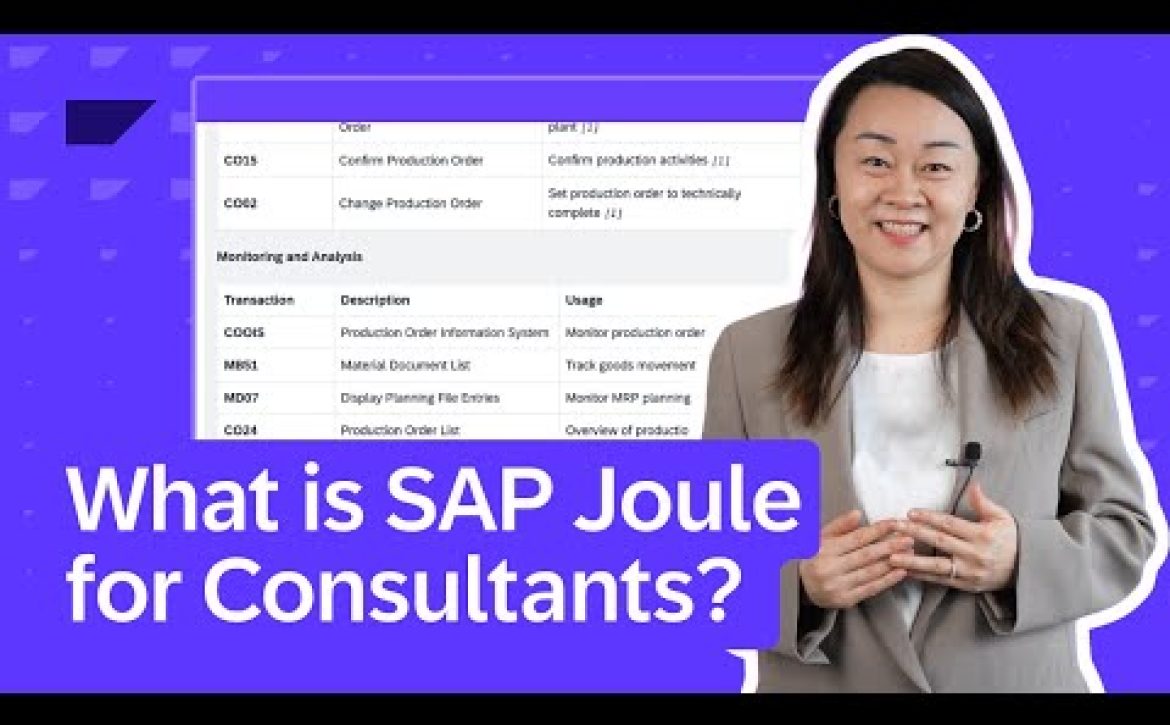
What is SAP Joule for Consultants?

Accelerate SAP project delivery by up to 14% with SAP Joule for Consultants, the conversational AI assistant built to help consulting teams move from questions to confident decisions, faster.

In this video, SAP expert Natalie Han explains how SAP Joule for Consultants can feel like a trusted senior consultant next to you 24/7, supporting everyone from junior consultants to architects with on-demand, up-to-date guidance from SAP’s most current knowledge base. Whether you are ramping up on an SAP cloud transformation, leading a complex program, or working through technical details, Joule helps you stay aligned with SAP best practices while keeping momentum high.

You will see practical examples across roles:

• Junior consultants can get immediate answers and clearer next steps, without waiting for someone to be available.
• Senior consultants and project leaders can use step-by-step guidance to navigate complexity and shape implementation strategy.
• Technical consultants can paste ABAP code to quickly understand what it does and the business process behind it, helping reduce delays and rework.

Natalie also highlights the customer outcomes that matter most: saving time with on-demand answers, improving decision quality, boosting productivity across experience levels, and driving faster time to value for clients. In some cases, consultants can save up to 1.5 hours per day, freeing more time for the strategic conversations that move transformation forward.

Explore SAP Joule for Consultants. 👉 https://sap.to/6053BB64x9

Follow us on social:
LinkedIn: https://sap.to/6057BB64xl
Instagram: https://sap.to/6059BB64xW
Facebook: https://sap.to/6050BB64xo
Threads: https://sap.to/6051BB64xU

About SAP:
As a global leader in enterprise applications and business AI, SAP stands at the nexus of business and technology. For over 50 years, organizations have trusted SAP to bring out their best by uniting business-critical operations spanning finance, procurement, HR, supply chain, and customer experience. For more information, visit: https://sap.to/6052BB64xq

#SAP #BusinessAI #CloudTransformation

SAP Cloud Infrastructure: Data Centers in Germany Achieve IT-Grundschutz Certification

Security and sovereignty have become operational prerequisites for digital technologies. Organizations in the public sector and regulated industries expect not only innovation and scalability, but verifiable proof that security controls align with national standards.

SAP Sovereign Cloud: Embrace the cloud without compromise

With the successful completion of ISO/IEC 27001 certification on the basis of IT-Grundschutz for the physical infrastructure of SAP-owned data centers in Germany, SAP has reached an important milestone. This achievement strengthens the foundation of the SAP Sovereign Cloud portfolio in one of the most security-conscious markets in the world.

IT-Grundschutz confirms secure operation of SAP’s German data center facilities

IT-Grundschutz is the German Federal Office for Information Security’s (BSI) structured security methodology, and serves as a reference framework in public tenders and supplier assessments.

The certification on the basis of IT-Grundschutz confirms that the secure operation of the physical infrastructure of SAP’s German data centers has been positively assessed against Germany’s defined security requirements. It validates that physical protections, environmental safeguards, and facility-level operational processes meet BSI expectations.

In short: The secure facility operation of SAP-owned data centers in Walldorf/St. Leon-Rot, Germany, has been independently audited and confirmed against Germany’s national security methodology.

Strengthening one of SAP’s key sovereign delivery options: SAP Cloud Infrastructure

The IT-Grundschutz certification strengthens one of SAP’s key sovereign delivery options in Germany: SAP Cloud Infrastructure.

SAP Cloud Infrastructure is an Infrastructure-as-a-Service (IaaS) platform, operated in SAP-owned data centers and co-locations worldwide. In the Walldorf/St. Leon-Rot region in Germany, these data centers are owned by SAP, a German company, operated by approved personnel with the required security clearance, and designed for high availability, scalability, and stringent security requirements.

These data centers are designed to support GDPR-compliant data processing and to meet heightened regulatory and security requirements in Europe and Germany, including standards relevant to critical infrastructure and the processing of sensitive and classified workloads.

In three independent availability zones across separate data centers, interconnected via SAP-owned fibre infrastructure and using BSI-authorized German security hardware components approved for processing information classified VS-NfD, this foundation is complemented by certifications such as C5 Type II, KRITIS/NIS 2, TSI Level 3 (extended), ISO 22301, SOC 1 Type 2 and SOC 2 Type 2, SOX, EN 50600 and ISO/IEC 22237 (AC 3), and the German federal data center requirement catalogue.

On top of this, SAP Cloud Infrastructure provides:

  • An open‑source‑based, API‑first IaaS platform: Offering self‑service provisioning, automation, and consistent resource management across deployment models
  • A Kubernetes‑based cloud environment: Enabling cloud‑native workloads, container orchestration, and modern development patterns
  • Open standards and proven open source technologies: Leveraging components used, developed, and refined for more than a decade in sensitive, large‑scale environments
  • Optimization for SAP cloud services: Supporting aligned operations, integrated security, and efficient execution of SAP workloads
  • Support for SAP and third‑party applications: Allowing SAP and customer-specific workloads to run on one coherent, secure, and compliant infrastructure

SAP Cloud Infrastructure is an SAP-developed and SAP-operated IaaS platform for SAP workloads and customer applications, ranging from global cloud scenarios to environments with high sovereignty and regulatory requirements, including an offering for the processing of classified information up to VS-NfD level in Germany. With the SAP Sovereign Cloud portfolio, it enables both sovereign SAP cloud services as well as the operation of customer workloads in a sovereign environment. At its core, it combines secure application operations with SAP Cloud Infrastructure, which is designed for regulatory and operational control.

Sovereignty through choice and control with SAP Sovereign Cloud

Digital sovereignty is frequently framed as a question solely of vendor origin, data residency, or the reduction of technical dependency. In practice, though, it is about demonstrable control. At SAP, we frame sovereignty across four interconnected capabilities:

  1. Data sovereignty: SAP stores data in local data centers or approved countries, avoiding unauthorized cross-border transfers and meeting critical infrastructure requirements.
  2. Operational sovereignty: Sensitive operations stay local. Administration and maintenance are performed only by authorized personnel — either nationally approved personnel or nationals of an approved country — with the required security clearance.
  3. Technical sovereignty: Control planes are hosted locally, with strict separation enforced through encryption or dedicated infrastructure.
  4. Legal sovereignty: Governance stays aligned. Cloud providers must be based locally or in approved countries, and foreign authorities must mitigate ownership, control, and influence risks.

SAP Cloud Infrastructure meets these requirements. On this basis, data, operations, architecture, and legal control are brought together under clearly defined requirements.

Importantly, SAP Cloud Infrastructure is embedded in SAP’s broader approach to offering customers choice in sovereign cloud. Different customers face different regulatory, operational, and transformation realities. Sovereign requirements cannot be met with a single model.

SAP Sovereign Cloud offers a range of delivery options to address different customer needs. Depending on specific requirements, customers can choose between the following options:

  • SAP Cloud Infrastructure: SAP’s IaaS platform is based on open-source technologies and is operated in SAP data centers worldwide. Depending on the selected operating model, customer data processing and storage can be restricted to defined regions, for example, within the EU or exclusively in Germany, to meet specific data protection and compliance requirements.
  • SAP Sovereign Cloud On-Site: With SAP Sovereign Cloud On-Site, SAP provides and manages the full SAP technology stack in a customer-designated data center, from hardware to SAP Cloud Infrastructure and the SAP Sovereign Cloud portfolio. It combines physical control on site with our operational expertise, for full autonomy while maintaining SAP’s support and compliance standards.
  • Sovereign hyperscaler-based delivery models: SAP partners with premium hyperscalers in specific markets to provide customers the ability to swiftly scale their resources based on their needs. This flexibility, paired with seamless integration, enables customers to innovate faster while maintaining operational efficiency.
  • National sovereign cloud platforms such as Delos Cloud: For public sector customers in Germany, Delos Cloud combines hyperscaler technology with sovereign ownership and a nationally defined operating model, helping ensure regulatory alignment and clearly structured operational control.

SAP enables customers to select the model that aligns with their regulatory requirements, risk profile, and operational strategy.

Sovereignty is built, not declared

For customers, digital sovereignty is not a theoretical aspiration; it is an operational requirement that must function under real-world conditions. The IT-Grundschutz certification of SAP-owned data centers in Germany marks an important step in that direction.

As regulatory expectations evolve and sovereign requirements become more differentiated, SAP continues to enable customers to choose the sovereign setup that aligns with their obligations and risk profile.

Sovereignty is ultimately measured by the ability to operate systems securely and reliably. With SAP Cloud Infrastructure, that capability is deliberately embedded into the operating model.


Martin Merz is president of SAP Sovereign Cloud.
Jonathan Bletscher is head of Global Cloud Infrastructure & Delivery for Global Cloud Operations at SAP.

Get news, stories, and highlights delivered straight to your inbox each week via the SAP News Center newsletter

Solution Order Management in SAP Cloud ERP 2602 | Release Highlights

See what’s new in Solution Order Management for SAP Cloud ERP 2602, with three highlights that bring hierarchy-based pricing, expanded sales process variants for complex deals, and stronger subscription validations.

Join Greg Hutcheon as his digital twin walks you through three major highlights that enhance pricing, support complex sales, and improve subscription integrations.
Discover how these updates enable more flexible, transparent, and efficient end-to-end processes, from quote to invoice.

🤝 Customer and product hierarchy pricing — Native support for customer and product hierarchies in solution orders, so hierarchy-based pricing is applied consistently from quote to invoice (no custom development).

🧩 Expanded sales process variants — New item categories and process variants support configurable products, sales kits, and third-party sales, plus milestone billing and down payment requests for complex, high-value deals.

🔄 Subscription item enhancements — Support for the subscription validation extension point helps catch incomplete or incorrect subscription data during simulation and release, reducing rework later.

Chapters:
00:09: Introduction
00:25: Customer and product hierarchy related pricing in solution orders
01:48: Expanded sales process variants in solution orders
03:03: Subscription item enhancements
03:48: Where to learn more

• Read more about the latest Solution Order Management innovations in SAP Cloud ERP 2602: https://community.sap.com/t5/user/viewprofilepage/user-id/131650

• Check out the SAP Cloud ERP Community: https://sap.to/6055CIrvT
• Explore SAP Cloud ERP innovations: https://sap.to/6056CIrvp

Follow us on social:
LinkedIn: https://www.linkedin.com/company/sap/
Instagram: https://www.instagram.com/sap
Facebook: https://www.facebook.com/SAP/
Threads: https://www.threads.com/@sap

About SAP:
As a global leader in enterprise applications and business AI, SAP stands at the nexus of business and technology. For over 50 years, organizations have trusted SAP to bring out their best by uniting business-critical operations spanning finance, procurement, HR, supply chain, and customer experience. For more information, visit: https://www.sap.com/index.html

#SAPCloudERP #SolutionOrderManagement #CloudERP #AI

Go all-in on AI. Join us in person or online. #SAPSapphire

AI is changing the way businesses run, and it’s all happening at #SAPSapphire. Join us in person or online. https://sap.to/6054hAXCq

Unify SAP and Non-SAP Data | SAP Datasphere in SAP Business Data Cloud

Stop chasing data across silos. Unify SAP and non-SAP data, with business context intact, to accelerate insights and AI.

SAP Datasphere in SAP Business Data Cloud is a fully managed SaaS solution built to help data professionals deliver business-ready, trusted data faster. It brings SAP and third-party data together in a single view while preserving the business context and logic that make insights reliable, so teams can make faster, more confident decisions.

With capabilities for data integration, cataloging, semantic modeling, and virtualization, SAP Datasphere helps simplify complex hybrid and cloud landscapes. Search across your data catalog, trace lineage, and use knowledge-graph-driven relationships to understand how information connects, so the data powering analytics and AI is grounded in trusted context.

When building something like a cash flow forecast, SAP Datasphere makes it easier to combine SAP data with non-SAP and partner ecosystem data for deeper insights, while keeping governance and context intact. And because not all data needs to move, you can choose when to replicate for performance and when to virtualize to keep data fresh – reducing duplication and risk.

Chapters:
00:00 – SAP Datasphere in SAP Business Data Cloud overview
00:19 – Unify SAP + non-SAP data with business context
00:40 – Catalog search, lineage, and knowledge graph discovery
00:57 – Enrich with partner ecosystem data (cash flow example)
01:25 – Replicate or virtualize across hybrid + cloud
01:47 – Wrap-up: trusted data to accelerate insights and AI

Learn more about SAP Datasphere in SAP Business Data Cloud 👉 https://sap.to/6058h4kio

#SAPDatasphere #SAPBusinessDataCloud #DataFabric

SAP Datasphere & SAP Business Data Cloud: Top New Features | February 2026

Learn about the feature highlights in February 2026 with SAP Datasphere and SAP Business Data Cloud!

We delivered two new releases this month, so let’s check out the top features presented by Klaus-Peter Sauer:
00:30 Data Pipeline Analyzer
01:17 Task Chain Output Parameter
01:42 Transformation Flow Object Versioning
02:18 Local Table (Files) Delete Inbound Buffer
02:56 Visibility of Data Access Controls Applied to Sources
03:18 Sharing of Analytic Models
03:49 SAP Analytics Cloud Feature Highlights QRC1 2026
04:29 Summary and outro

Learn more about SAP Datasphere: https://www.sap.com/products/technology-platform/datasphere.html
Join our SAP Datasphere community to stay up to date: https://community.sap.com/topics/datasphere
Check out our product roadmap for SAP Datasphere: https://roadmaps.sap.com/board?PRODUCT=73555000100800002141

#SAPDatasphere #DataFabric #BusinessAI

Why Customer-Specific AI Will Define the Next Era of the Automotive Ecosystem

The automotive industry has always been a bellwether for technological change. From mass production to lean manufacturing, from embedded software to connected vehicles, each wave of innovation has reshaped not just cars but entire ecosystems. Today, artificial intelligence is doing the same—quietly, decisively, and at scale. While much of the public conversation around AI in automotive focuses on autonomous driving or in-car experiences, the real transformation is unfolding behind the scenes, in how vehicles are designed, launched, serviced, and sustained over their lifecycle.

According to industry estimates, auto executives expect AI to boost product value by 22% and digital service value by 37% within three years. As vehicle portfolios expand—electric, hybrid, software-defined, and increasingly customized—the operational complexity for automakers and suppliers has risen sharply. Nowhere is this more evident than in service parts management and new product introduction (NPI).

Solve business challenges with innovations aligned with suite-first and AI-first strategies

Service parts planners sit at the intersection of engineering, supply chain, manufacturing, and customer service. Their task is deceptively simple: ensure the right parts are available at the right time and place across a vehicle’s lifecycle. In reality, they grapple with fragmented data, limited inventory visibility, unpredictable demand signals, and compressed timelines—especially as new models and components are introduced at unprecedented speed. High data quality, tight orchestration across systems, and rapid decision-making are no longer nice to have, they are business-critical.

This is where customer-specific AI becomes transformative. Instead of treating NPI as a linear, manual, and reactive process, AI agents can fundamentally reimagine how service parts planning is executed. By embedding AI directly into the planning workflow, service parts planners are supported—not replaced—by intelligent systems that operate with full contextual awareness. These AI agents can monitor real-time data across inventories, supplier readiness, historical demand patterns, external risk factors, and engineering changes, as well as orchestrate the NPI process end to end.

In practice, this means planners move from firefighting to foresight. AI agents can automate sequential NPI steps, flag potential bottlenecks before they materialize, and dynamically adjust plans as conditions change. A single, unified dashboard provides transparency across the entire process, while built-in what-if simulations allow planners to test scenarios—supplier delays, demand spikes, geopolitical disruptions—before decisions are locked in. Crucially, humans remain firmly in control. AI augments judgment, improves speed, and enhances confidence, rather than operating in a silo.

Platforms like SAP Business Technology Platform (SAP BTP), combined with Joule and the agent builder capability in Joule Studio, can enable this multi-agent approach at enterprise scale. By integrating AI seamlessly with core business processes, automakers can ensure that intelligence flows across functions, rather than being trapped in silos. The result is not just automation, but orchestration—where systems, data, and people work in concert.

The impact is tangible. Automakers can significantly reduce planning cycle times and improve time-to-market for new products. Planning risk is lowered through continuous what-if analysis that incorporates both internal and external variables. Service readiness improves, ensuring that customers experience continuity and reliability even as product complexity increases. At an ecosystem level, this translates into greater resilience, lower costs, and higher customer satisfaction.

More broadly, this use case points to a shift in how we should think about customer-specific AI in automotive. The future will not be defined solely by smarter vehicles, but by smarter enterprises—where AI agents support decision-making across the value chain, from product inception to end-of-life service. In an industry under pressure to innovate faster, operate leaner, and remain sustainable, AI-driven operations are fast becoming a competitive necessity. The automotive ecosystem is evolving. Those who embrace AI not just as a technology but as a new operating model will be best positioned to lead it.


Sindhu Gangadharan is head of Customer Innovation Services and managing director for SAP Labs India.

Get the latest SAP news delivered to your inbox once a week

Behind the scenes of the big game at Levi’s Stadium 🏈

When the world is watching, Levi’s Stadium relies on SAP to run game day operations. https://sap.to/6054hyOls

@49ers #levisstadium #football

5 Things You Should Know About the Transportation Planning with SAP Rheinwerk Courses Series

In this blog post, learn about our upcoming Rheinwerk Course entitled Transportation Planning with SAP: Mastering Transportation Modes, Settings, and the TM Optimizer from the course instructor, Anton Karnaukhov.

Previous Next
Close
Test Caption
Test Description goes like this