The Pattern Emerging Across AI Transformations

For decades, enterprise transformation followed a familiar playbook. Digitize processes. Move to the cloud. Standardize operations. Then optimize them over time.

Those investments are critical. But they weren’t the finish line. They were the foundation. And today, they’re paying off in new ways as organizations adopt AI to drive measurable business outcomes.

Welcome to the Autonomous Enterprise

But there’s another part of that foundation which is becoming just as important: data. The organizations best positioned to compound their value from AI are those that have invested in data foundations that give AI the trusted business context it needs to reason, recommend, and act.

Now, in conversations with customers across the Americas and around the world, I’m seeing a new pattern emerge. The discussion is shifting from where AI can be applied to what happens when intelligence becomes embedded into the core of how the business operates.

While every transformation is different, three common shifts keep coming up.

1. From AI use cases to intelligent business processes

The first wave of AI adoption focused on proving value. Organizations identified high-impact use cases, delivered measurable results, and built confidence that AI could make a difference.

That work isn’t finished. But increasingly, customers are asking how intelligence can become part of the business processes employees use every day. We’re already beginning to see what this looks like in practice.

For example, HR Path Brazil, a Brazilian company specializing in recruiting and managing talent for international firms, is using Joule embedded in SAP SuccessFactors HCM to automate routine HR interactions. It is helping employees find the information they need faster while allowing HR teams to focus on more strategic work. The company has reported a seven percent reduction in standard HR support cases and two hours of HR support workload eliminated each week, which quickly adds up. It’s one example of how embedded and connected AI is becoming part of how work gets done.

2. From measuring AI use to measuring the business outcomes it creates

One of the biggest changes I’m seeing is how organizations define success. ROI is becoming a given and that is reflected in the data, especially in Oxford Economics research out just this week. It showed that organizations investing in AI expect to see an average return of 21% this year but increasing to 38% in two years. And as agentic AI continues scaling, it is projected to deliver $17.6 million in returns, more than quadrupling last year’s estimates (US$4.3 million).

This is allowing organizations to focus more on business outcomes from their AI. They are asking questions like can we shorten cycle times? Can we improve decision-making? Can we free employees to spend more time creating value? Can we become more resilient and responsive as a business?

This is an important shift because it changes the conversation from implementing technology to improving how the business performs.

3. From systems of record to the new operating system for the enterprise

The third shift is the one I believe will have the greatest long-term impact. For decades, enterprise software primarily captured transactions, standardized processes, and automated routine work. Now it’s beginning to help organizations anticipate change, recommend actions, coordinate work across functions, and increasingly execute routine decisions with human oversight.

That’s why I believe the Autonomous Enterprise represents more than the next phase of automation. It represents a new operating model for business.

Instead of people spending time connecting information across finance, supply chain, procurement, HR, and customer operations before deciding what to do next, intelligent systems can increasingly provide context, surface recommendations, orchestrate work, and help teams execute.

People remain firmly in control. But they’re supported by enterprise software that is becoming an active participant in how the business operates and executes, not simply a system that records what already happened.

Where we go from here

The organizations creating the greatest long-term advantage won’t just be the ones deploying the largest number of AI use cases. They’ll be the ones that use those early successes to rethink how work gets done across the enterprise.

The journey to the Autonomous Enterprise won’t happen overnight, and it won’t replace the need for strong leadership, governance, or talented people. If anything, those become even more important.

We’ll likely look back on today’s AI projects much the same way we now look back on the early days of cloud transformation; not as the destination, but as the foundation for a fundamentally new way of operating and innovating continuously.

The true winners from this shift will be the ones who continuously become more intelligent, more adaptive, and ultimately more autonomous.


Jan Gilg is a member of the Extended Board of SAP SE and global president of Customer Success & Americas.

Sign up for our newsletter to receive weekly highlights from the SAP News Center

What Is ABAP Unit?

In 1998, Kent Beck designed the first unit testing framework that could be used to pro­vide common elements necessary for building and running automated unit tests.

How Cyberwave uses SAP Embodied AI for SAP Logistics Management (LGM)

See how SAP Logistics Management and Joule help logistics teams detect delivery risks, resolve warehouse bottlenecks, and keep fulfillment on track.

In this demo, demand for event kits spikes just days before SAP Sapphire, creating pressure on outbound packing capacity. A logistics clerk uses SAP Logistics Management to identify delivery risks in real time, then consults Joule to assess the backlog, prioritize urgent shipments, and recommend a mitigation plan.

With SAP Embodied AI running on SAP Business AI Platform, Joule triggers an SAP Embodied AI Agent that translates delivery requirements and warehouse context into robot tasks. Through Cyberwave, autonomous robots are dynamically reassigned to restore packing capacity, reduce backlog, and support on-time fulfillment during peak demand.

The result is a closed loop from risk detection to execution: faster response, stabilized throughput, and more resilient logistics operations.

Streamline logistics with SAP Logistics Management: https://sap.to/6054BEJLVC

Chapters:
00:00 – Delivery Risk During Peak Demand
00:38 – Joule Recommends a Mitigation Plan
01:05 – SAP Embodied AI Triggers Robot Tasks
01:41 – Partner-Enabled Robot Training
02:21 – Closed-Loop Logistics Execution

Follow us on social:
LinkedIn: https://sap.to/6058BEJLn8
Instagram: https://sap.to/6059BEJLnD
Facebook: https://sap.to/6051BEJLn1
Threads: https://sap.to/6053BEJLnH

About SAP:
As a global leader in enterprise applications and business AI, SAP stands at the nexus of business and technology. For over 50 years, organizations have trusted SAP to bring out their best by uniting business-critical operations spanning finance, procurement, HR, supply chain, and customer experience. For more information, visit: https://sap.to/6054BEJLny

#SAPBusinessAI #Joule #LogisticsManagement

Asset Management in SAP Cloud ERP | Expert Talk

Discover how SAP Asset Management in SAP Cloud ERP helps asset-heavy organizations reduce unplanned downtime, control total cost of ownership, and improve operational resilience with integrated ERP processes and AI.

Join host Fernanda Rodrigues with SAP experts Akif Ünal from Product Management and Amar Kumar from Product Marketing as they explore why asset management is a strategic business priority, how SAP supports maintenance processes end to end, and what’s next for AI-powered maintenance planning in SAP Cloud ERP.

In this video, you’ll:
✔️ Learn why asset management helps protect revenue, reduce unplanned downtime, and control total cost of ownership
✔️ Understand the full SAP Asset Management scope, including reactive, proactive, improvement, and overhead maintenance
✔️ See how asset management connects with logistics, procurement, inventory, finance, and workforce-related processes
✔️ Hear a real-world customer example from a Middle East gas company moving from legacy ERP to SAP Cloud ERP
✔️ Explore new innovations including the Asset Overview app, Manage Maintenance Notifications, and Permit to Work
✔️ See how Joule and AI agents can support supervisors, planners, and technicians with faster maintenance decisions

Whether you’re already running SAP Cloud ERP or evaluating how to modernize asset-heavy operations, this Expert Talk shows how SAP Asset Management can help teams move from reactive maintenance to more resilient, AI-supported operations.

💬 Join deeper conversations in the SAP Community: https://community.sap.com
📧 Contact us anytime at insides4@sap.com

Chapters:
00:18 – Welcome and introduction
01:05 – Why asset management is a strategic business priority
03:38 – SAP Asset Management scope and ERP integration
07:01 – Customer success: Middle East gas company
10:06 – New Asset Overview app in release 2602
14:38 – Manage Maintenance Notifications and Permit to Work
17:40 – AI vision for asset management
18:47 – AI for supervisors, planners, and technicians
21:27 – Operational maintenance planning agent demo
25:26 – 2026 and 2027 roadmap highlights
26:03 – Wrap-up and key takeaways
27:06 – Contact SAP and join the community

Follow us on social:
LinkedIn: https://www.linkedin.com/company/sap/
Instagram: https://www.instagram.com/sap
Facebook: https://www.facebook.com/SAP/
Threads: https://www.threads.com/@sap

About SAP:
As a global leader in enterprise applications and business AI, SAP stands at the nexus of business and technology. For over 50 years, organizations have trusted SAP to bring out their best by uniting business-critical operations spanning finance, procurement, HR, supply chain, and customer experience. For more information, visit: https://www.sap.com/index.html

#SAP #SAPCloudERP #AssetManagement

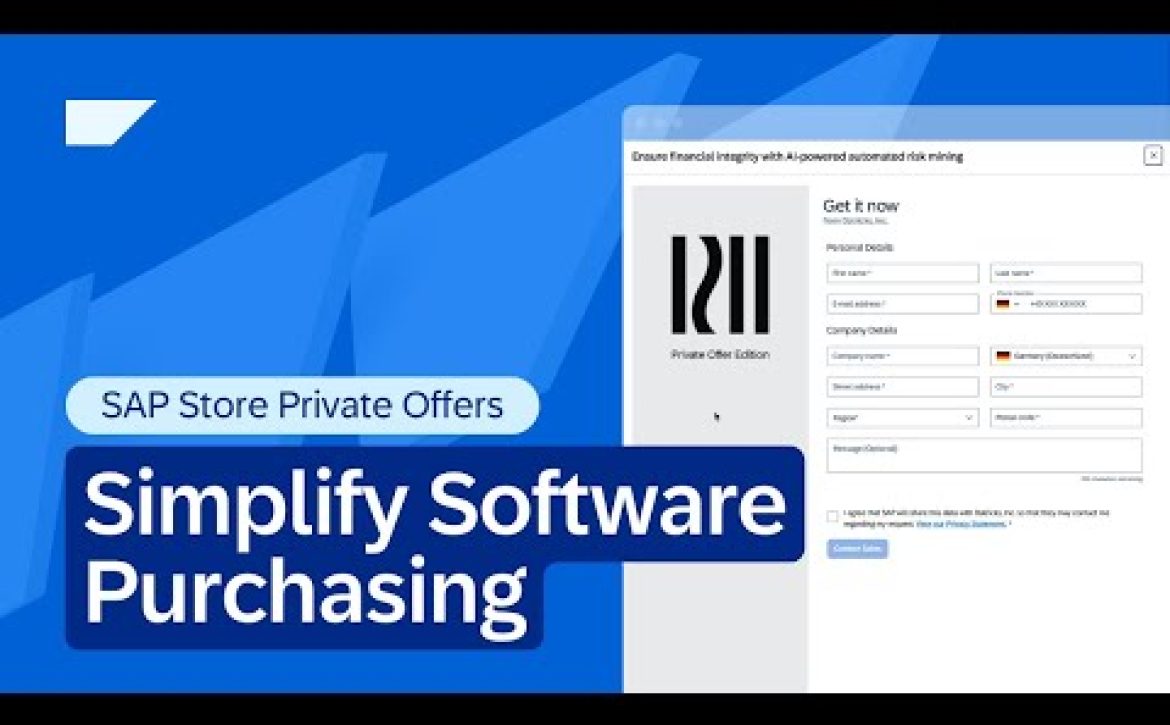
SAP Store Private Offers: Simplify Software Purchasing

Complete enterprise software purchases faster with SAP Store Private Offers, built to simplify negotiated pricing and terms.

SAP Store Private Offers help customers and partners streamline the way enterprise software is purchased. Instead of managing quotes, contracts, signatures, and approvals across disconnected steps, your SAP partner or account team can create a custom private offer with your pre-negotiated pricing and terms directly in SAP Store.

In this video, see how customers can review, approve, and purchase securely within SAP Store. With fewer back-and-forth emails, no offline signatures, and less manual quote tracking, SAP Store Private Offers support a faster, more transparent buying experience. Customers also gain visibility through SAP for Me, helping teams stay in control from offer review to purchase.

Ask your SAP account team or partner about SAP Store Private Offers.

Explore SAP Store: https://sap.to/6057B8U0Ib

Follow us on social:
LinkedIn: https://sap.to/6059B8U0Id
Instagram: https://sap.to/6051B8U0I5
Facebook: https://sap.to/6053B8U0I9
Threads: https://sap.to/6056B8U0IY

About SAP:
As a global leader in enterprise applications and business AI, SAP stands at the nexus of business and technology. For over 50 years, organizations have trusted SAP to bring out their best by uniting business-critical operations spanning finance, procurement, HR, supply chain, and customer experience. For more information, visit: https://sap.to/6059B8U0IW

#SAP #SAPStore #EnterpriseSoftware

Enabling Autonomous Spend Management with AI and Connected Processes

Procurement and finance leaders are facing a nearly impossible mandate. Cost control is no longer enough.

SAP Sapphire in 2026: Advancing the Autonomous Enterprise

They are expected to manage risk, ensure compliance, and deliver strategic value, all while navigating talent shortages and increasing operational complexity. And most are doing it without the end-to-end visibility they need.

Workflows are disconnected, decision-making is reactive, and policies are inconsistently enforced. I have heard this from customers across every industry and, frankly, it is a problem that traditional approaches to procurement technology haven’t fully solved.

That’s what makes this moment different. At SAP Sapphire, we introduced the Autonomous Enterprise, a fundamental shift in how businesses operate, with AI assistants and agents powering end-to-end execution at scale, with governance built in. Critically, this isn’t just about adding AI features to existing tools. It is about moving from AI in applications to AI on applications—intelligence that works across your entire landscape, not just inside individual products.

Autonomous Spend Management: From concept to reality

Autonomous Spend Management is a core pillar of the Autonomous Enterprise vision, designed to address the fragmentation that holds procurement and finance teams back. By applying agentic AI across procurement, travel, expenses, and external workforce processes, we’re creating continuity where disconnection exists today—intelligent systems that orchestrate activities, connect context, and surface the right insights at the right moment.

What this means for the people doing the work is equally significant. When AI handles routine execution, decision-makers get time and clarity back. They can intervene earlier, with better information, and focus on more strategic work that actually moves the needle.

To bring this to life, we are introducing a new set of Joule Assistants, AI-powered teammates designed to support procurement and spend management across the full life cycle:

  • Category Management Assistant: Analyzes spend patterns, delivers market intelligence, and helps build sharper category strategies
  • Sourcing Assistant: Manages the entire sourcing life cycle, from drafting RFPs and bids to recommending negotiation strategies
  • Supplier Management Assistant: Provides comprehensive oversight of the supply base, from intelligent classification to continuous multi-dimensional risk monitoring
  • Contract Assistant: Streamlines contract authoring, flags renewal opportunities, and connects supplier selection through to contract execution
  • Requisition Assistant: Guides users to the right buying channel, auto-fills fields, and uses advanced trade-off analyses to help maximize volume discounts
  • Buying Assistant:Helps professional buyers identify spend leakage, surface optimal suppliers, and automate order consolidation
  • Receiving Assistant: Auto-creates goods receipts and service entry sheets and guides users through quality tracking so nothing falls through the cracks
  • Invoicing Assistant: Handles invoice capture, duplicate detection, and payment proposals so finance teams can close faster with fewer errors
  • Services Procurement Assistant: Manages the full SOW life cycle from creation through compliance tracking
  • Travel Assistant: Simplifies trip planning with pre-spend estimates, streamlined approvals, and built-in compliance guidance
  • Expense Management Assistant: Automates expense reporting, capturing details, flagging errors, and keeping everything compliant

The Autonomous Spend Management capabilities run across our cloud ERP application portfolio, including SAP Cloud ERP Private, for end-to-end coverage across business processes and systems.

Why connected processes are critical

Connection is just as powerful as intelligence, and that conviction runs through everything we  announced this week. AI can only do so much if the underlying processes are still fragmented.

In next-gen SAP Ariba Buying, new Joule Agents support purchasing and policy management through a more intuitive, persona-driven experience, guiding users toward compliant, contract-linked options while improving catalog management and document traceability. Deeper integration with SAP S/4HANA Private Cloud Edition and SAP ERP Central Component means these capabilities work with existing ERP investments, not around them.

SAP Ariba Contracts now brings contract creation, approvals, and compliance tracking into a single unified workspace. AI-assisted drafting lets teams create contracts using natural language, while centralized visibility into terms, pricing, and key dates keeps data consistent and connected to downstream procurement processes.

We also introduced a new Joule Agent in SAP Ariba Intake Management to automate how procurement requests are captured and routed across SAP and non-SAP systems. And expanded supplier evaluation capabilities in SAP Ariba Supplier Lifecycle and Performance let teams segment performance data by geography, business unit, or category – with insights feeding directly into 360-degree supplier profiles to inform sourcing and procurement decisions.

Expanding visibility into services spend and supporting adoption

Nowhere is the need for connected processes more apparent than in asset-intensive industries. In oil and gas, mining, and utilities, external workers can make up 40% of the workforce, yet most organizations are still managing them through manual processes and disconnected systems. The risks are real: expired certifications, overpayments, and poor visibility into work billed versus work actually done.

New SAP Fieldglass capabilities address these challenges by bringing together the full contractor life cycle, from the moment a worker arrives on site through to final payment. Organizations can now automate time tracking, verify worker credentials and safety requirements before granting site access, maintain tighter controls over equipment, and dramatically reduce the manual effort involved in invoicing.

We’re also using AI to accelerate SOW creation by automatically recommending worker roles based on the SOW description and historical buyer data, which reduces manual setup and improves consistency from the start. And to support adoption, WalkMe Premium is now integrated with SAP Fieldglass and SAP Ariba, providing in-app guidance for tasks such as creating statements of work, approving timesheets, and hiring candidates.

The future of spend management

Autonomous Spend Management marks a fundamental shift from managing processes to delivering business outcomes. From chasing cost savings to actively shaping resilience, margin, and growth. From reacting to events to anticipating them.

The real strategic implication is this: Spend does not happen in isolation. Every contract and invoice has a downstream effect on financial performance. When those decisions are made in context—with AI connecting procurement, supply chain, and finance—the enterprise doesn’t just run more efficiently, it runs as one system.

That’s what we are building, and what we announced this week marks a significant step forward.

For more details on this week’s announcements, see the SAP Sapphire Innovation News Guide. For more details on the latest updates in travel and expense, please refer to the SAP Concur Fusion 2026 announcements.


Etosha Thurman is co-business lead and chief marketing officer for SAP Finance & Spend Management.

SAP Sapphire in 2026: Discover our bold new vision for how businesses will run from now on

How SAP S/4HANA Supports Inventory Optimization

Supply chain management requires constant refinement and adjustment of the company’s business processes. If this isn’t done, the supply chain isn’t operated at an optimal level, and the operating profit is reduced.

How Südzucker Group Fuels Digitalization with SAP Signavio & SAP LeanIX

A smoother SAP S/4HANA migration starts with process transparency and a user experience people actually want to use.

Südzucker Group is present in roughly 100 locations across 31 countries and supports 19,000 employees with a diverse portfolio spanning food products (including frozen pizza), starch, animal feed, and ethanol from renewable resources. With growth through acquisitions over a 100-year history, process complexity increased across the organization. The team needed a clear overview of end-to-end processes, process documentation and modeling, plus visibility into the applications in use.

In this customer story, Südzucker shares how they looked for a single source of truth for processes and applications, along with capabilities like process mining to analyze performance in more detail. By using SAP Signavio together with SAP LeanIX, they improved cross-functional alignment and established a common glossary to make collaboration easier across teams. They also used pre-built content, including value accelerators, to compare SAP best practices with current processes and identify opportunities to harmonize.

The impact includes greater process transparency across the company and €500,000 in cost optimization potential to implement. This structured approach also helped Südzucker evaluate tools with clearer selection criteria grounded in real user needs, supporting a culture of continuous innovation and improved user experience.

Learn more about Südzucker Group’s journey with SAP Design 👉 https://www.sap.com/design/stories-resources/how-sap-signavio-drives-500k-cost-savings-for-the-sudzucker-group

Follow us on social:
LinkedIn: https://www.linkedin.com/company/sap/
Instagram: https://www.instagram.com/sap
Facebook: https://www.facebook.com/SAP/
Threads: https://www.threads.com/@sap

About SAP:
As a global leader in enterprise applications and business AI, SAP stands at the nexus of business and technology. For over 50 years, organizations have trusted SAP to bring out their best by uniting business-critical operations spanning finance, procurement, HR, supply chain, and customer experience. For more information, visit: https://www.sap.com/index.html

#SAP #SAPSignavio #SAPS4HANA

Trending Chats: Data Products: The Key to Faster Insights and AI

In this episode of Trending Chats, Kunnal Khanna unpacks what it takes to scale AI and data across the enterprise.

From aligning technology with business outcomes to navigating real-world transformation challenges, this conversation explores how organisations can move from ambition to execution.

Chapters:
00:00 – Welcome + what are Data Products?
00:21 – The data reality: SAP + non-SAP for AI
00:50 – The challenge: losing business context outside SAP
01:15 – SAP Business Data Cloud + Data Products overview
01:38 – What you get: business-ready data + metadata
01:57 – How to consume: SQL, APIs, Delta Sharing
02:30 – Data Products vs. business content templates
03:08 – Benefits + wrap-up / connect

Explore SAP Business Data Cloud: https://www.sap.com/products/data-cloud.html

🎧 More episodes of the Trending Chats podcast:
Watch on YouTube: https://sap.to/6059CrDMW
Listen on Spotify: https://sap.to/6050CrDMo
Listen on Apple Podcasts: https://sap.to/6051CrDMU

How to Set Up User Access and Authorizations in SAP DRC

Setting up user access and authorization for SAP Fiori apps in SAP DRC involves a comprehensive understanding of the authorization model, configuring user roles, and managing access through business catalogs and app authorization variants.

Previous Next
Close
Test Caption
Test Description goes like this