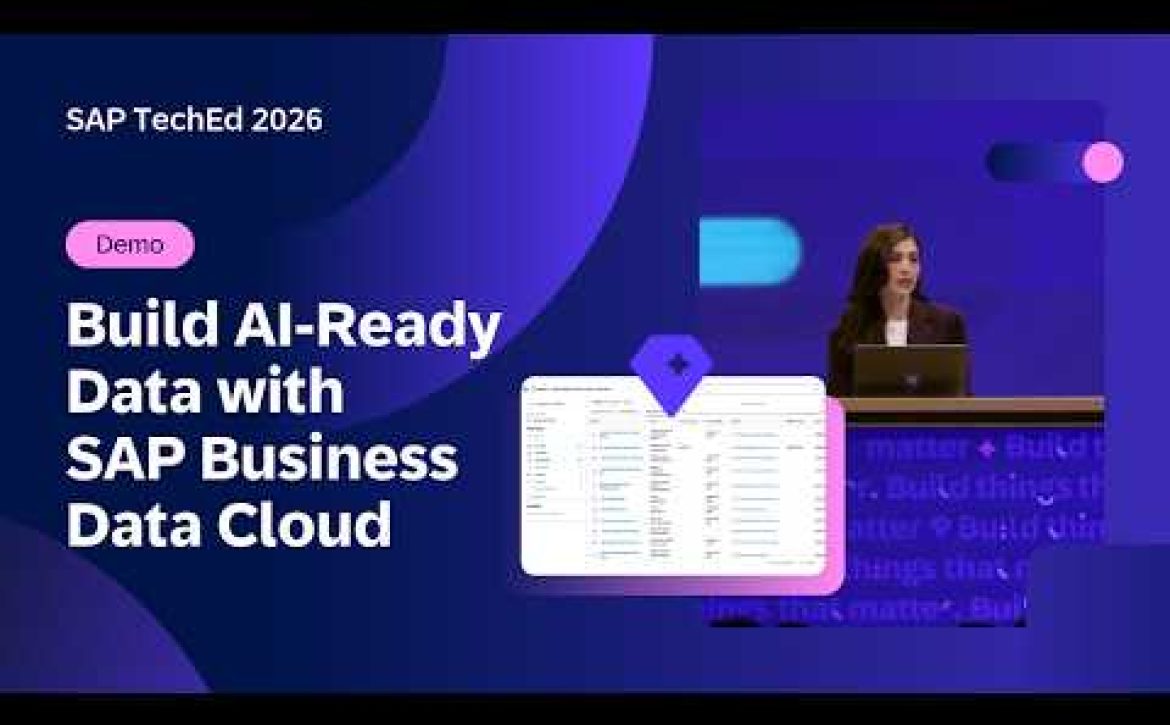
Build AI-Ready Data with SAP Business Data Cloud | SAP TechEd 2026

How do you turn disconnected enterprise data into AI-ready insights? See how SAP Business Data Cloud connects, harmonizes, and prepares business data for intelligent AI agents.

In this live demo from SAP TechEd 2026, Niyousha from SAP demonstrates how SAP Business Data Cloud brings together SAP and third-party data without unnecessary duplication. Starting with SAP Lakehouse, discover how data from a third-party manufacturing system can be connected with SAP S/4HANA and SAP Integrated Business Planning, while SAP Reltio helps harmonize supplier information into a trusted golden record.

See how Joule Studio simplifies the creation of a unified data product using natural language, and how developers can extend an AI agent in Visual Studio Code with Joule and Claude. The demonstration brings everything together with predictive capabilities for manufacturing, showing how connected business data and AI can help organizations make more informed production decisions.

Chapters:
00:00 – SAP Business Data Cloud Demo
00:20 – Connecting SAP and Third-Party Data with SAP Lakehouse
01:18 – Harmonizing Supplier Data with SAP Reltio
01:53 – Creating AI-Ready Data Products with Joule Studio
03:11 – Developing AI Agents in Visual Studio Code
04:19 – Adding Predictive AI for Manufacturing
05:22 – Testing AI Agents and Prediction Results

• Explore SAP Business Data Cloud: https://sap.to/6058BHYLNM
• Watch the full SAP TechEd 2026 opening keynote: https://sap.to/6050BHYLNO

Follow us on social:
LinkedIn: https://sap.to/6052BHYLNu
Instagram: https://sap.to/6053BHYLNR
Facebook: https://sap.to/6054BHYLNr
Threads: https://sap.to/6055BHYLNT

About SAP:
As a global leader in enterprise applications and business AI, SAP stands at the nexus of business and technology. For over 50 years, organizations have trusted SAP to bring out their best by uniting business-critical operations spanning finance, procurement, HR, supply chain, and customer experience. For more information, visit: https://sap.to/6057BHYLNV

#SAPTechEd #SAPBusinessDataCloud #BusinessAI

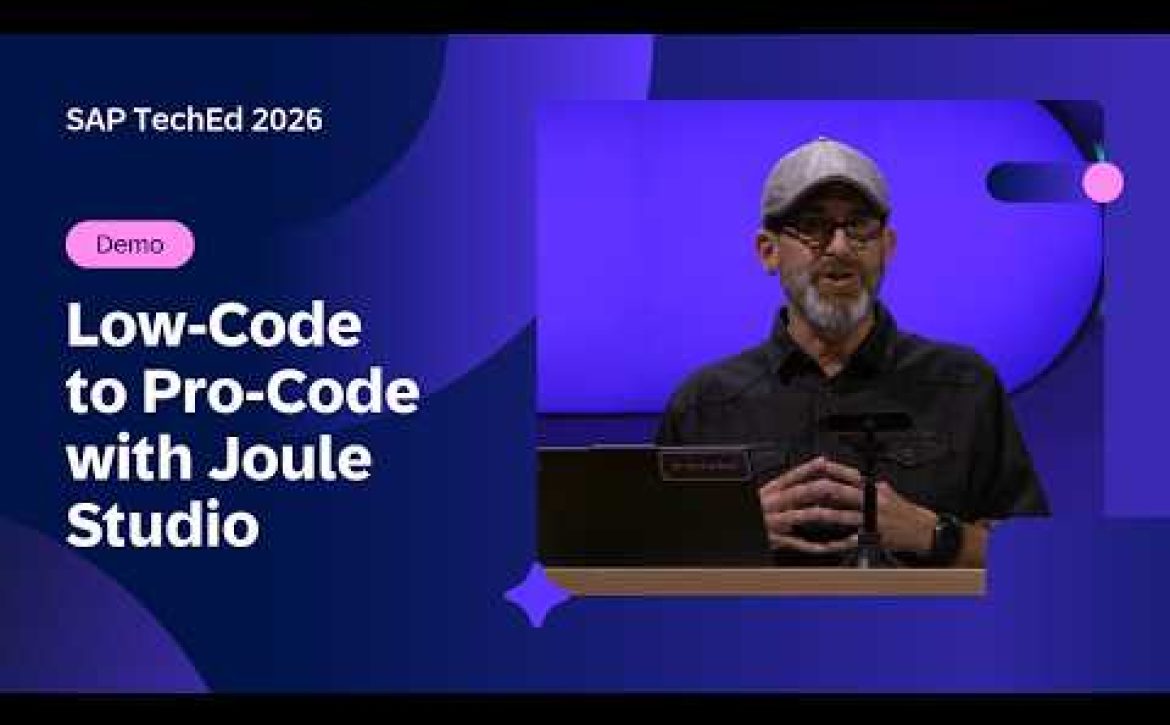
From Low-Code to Pro-Code with Joule Studio | SAP TechEd 2026

What happens when you take an AI agent from Joule Studio into your favorite coding environment? Discover how pro-code development and AI-assisted engineering help developers turn individual agents into connected enterprise applications.

At SAP TechEd 2026, Rich Heilman, Developer Advocate at SAP, demonstrates how to extend an intelligent agriculture agent originally created in Joule Studio. Using Joule Studio CLI, Visual Studio Code, GitHub, and Claude, Rich builds on the existing solution to create a multi-agent application with a farm management dashboard and a mobile app for field workers.

See how agent-to-agent (A2A) communication, Model Context Protocol (MCP), and SAP Integration Suite connect the application to live SAP Intelligent Agriculture data. Follow a demonstration of AI-powered crop disease detection, treatment recommendations, and agent reasoning, all presented through a practical enterprise application.

Rich also shares how AI-assisted development helped him build the extended solution in just seven hours, illustrating how developers can combine their expertise with AI to accelerate implementation while staying in control of their tools and code.

Chapters:
00:00 – Pro-Code Development with Joule Studio
00:19 – Extending an AI Agent with Joule Studio CLI
00:37 – Using Claude and MCP Tools in VS Code
01:29 – Building a Multi-Agent Application
02:17 – Live Demo: Farm Management Dashboard
02:52 – Agent-to-Agent Communication and Crop Disease Detection
03:48 – Connecting to Live SAP Intelligent Agriculture Data
04:31 – Building a Mobile App for Field Workers
04:54 – From Low-Code to Pro-Code with AI
05:42 – Developing Enterprise Applications Faster
06:27 – The Future of Agentic Engineering

• Explore SAP Business AI and Joule Studio: https://sap.to/6058BHmSpa
• Watch the full developer keynote replay: https://sap.to/6059BHmSpx

Follow us on social:
LinkedIn: https://sap.to/6050BG0v3M
Instagram: https://sap.to/6052BG0v3O
Facebook: https://sap.to/6053BG0v3P
Threads: https://sap.to/6054BG0v3u

About SAP:
As a global leader in enterprise applications and business AI, SAP stands at the nexus of business and technology. For over 50 years, organizations have trusted SAP to bring out their best by uniting business-critical operations spanning finance, procurement, HR, supply chain, and customer experience. For more information, visit: https://sap.to/6055BG0v3R

#SAPTechEd #JouleStudio #AgenticAI

How Have Intercompany Sales and Stock Transfers Evolved in SAP?

Most of the large and multinational organizations run SAP, and more than 70% of the world’s transactions happen in SAP.

Would You Let AI Run Your Supply Chain? 🤔

AI is moving beyond chatbots.
The next frontier is the Autonomous Supply Chain: systems that continuously optimise planning, manufacturing, logistics, assets, and business networks with minimal human intervention.

Find out more on https://sap.to/6050BHEC5M

#SAP #SupplyChain #BusinessAI

From AI-Enabled Payroll to Autonomous Payroll: The Next Evolution of Workforce Trust

As AI becomes more deeply embedded across HR and business operations, one question continues to surface: how can organizations maintain employee trust while increasing automation? For payroll leaders, it’s an especially important question.

Payroll presents a unique paradox. It’s one of the business functions most suited to AI and automation because it’s highly structured, data-intensive, and compliance-driven. At the same time, it’s one of the most trust-sensitive functions in the enterprise because even small errors can have immediate consequences for employees’ financial well-being and confidence in their employer.

Payroll professionals often joke that nobody notices payroll when it goes right, and everyone notices when it goes wrong. Behind that observation is an important reality: every payroll run becomes a moment of trust between employer and employee. That trust has measurable consequences. According to new research* by SAP’s Future of Work Research Lab, 38% of employees worldwide have experienced a payroll error. These employees are significantly less likely to trust both their organization (13% lower trust) and their payroll function (17% lower trust). Trust declines even further with each additional payroll error experienced.

Replace fragmented HR systems by automating processes, simplifying tasks, and strengthening compliance

As National Payroll Week takes place across both the U.S. and the UK, we have an opportunity to recognize the payroll professionals who earn and maintain that trust every day, while reflecting on the transformation taking place across the payroll function itself.

As payroll teams navigate growing complexity, they’re being asked to do more with less while maintaining the accuracy, compliance, and reliability employees depend on. Employees increasingly expect faster, more flexible payroll experiences, including more frequent pay cycles and greater visibility into earnings and deductions, while tax laws, wage rules, leave requirements, and reporting obligations continue to evolve across countries, states, and local jurisdictions. At the same time, today’s workforce is more dynamic than ever, with employees changing roles, locations, schedules, and compensation arrangements in ways that can create downstream payroll impacts. Managing these changes manually is becoming increasingly difficult and raising the risk of errors, delays, and compliance gaps, positioning payroll not simply as an administrative process, but as strategic infrastructure supporting employee experience, compliance, finance, and business operations.

This combination of rising complexity and rising expectations is driving the next evolution of payroll: autonomous payroll.

Scaling trust in an era of complexity

Autonomous payroll is designed to help organizations navigate growing payroll complexity while maintaining accuracy, compliance, and confidence at scale. By combining AI, intelligent automation, integrated data, and real-time payroll monitoring, organizations can move beyond reactive payroll operations and proactively identify issues before they affect employees.

The goal isn’t to remove people from payroll, but to enable them to focus on higher-value activities by reducing manual effort and increasing visibility. Our global research suggests that employees do not see AI and human involvement as mutually exclusive. In fact, nearly half (49%) say they would trust AI in payroll more if they still had access to a human when AI fails. Additionally, 43% of employees say that the ability to request a human review of AI-generated outcomes would increase their trust in the use of AI in payroll. Trust is built not only through accuracy and efficiency, but also through the confidence that employees can escalate concerns, seek clarification, and access human support when needed.

Emerging capabilities such as AI-powered payroll agents and continuous payroll are helping organizations move from processing payroll to actively managing it. These capabilities can assess payroll readiness, detect anomalies, validate changes, and monitor workforce events across HR, payroll, and time data. By identifying how changes in roles, locations, schedules, compensation, or leave may affect payroll outcomes, organizations can anticipate impacts and resolve exceptions before they become costly errors. The result is improved reliability, stronger compliance, and greater trust across the workforce.

The shift is significant. Rather than finding errors at the end of a payroll cycle, organizations can increasingly investigate and resolve them throughout the cycle. But technology alone isn’t enough. As payroll becomes more autonomous, organizations must ensure intelligent systems operate with appropriate oversight, transparency, and accountability.

Automation requires accountability

As AI becomes more embedded in payroll operations, the conversation shifts from adoption to accountability. Trust becomes paramount, raising important questions about where AI can operate autonomously, where human review adds value, and where human accountability must remain visible.

Our global research shows that employee comfort with AI varies by payroll task. Employees are most comfortable with AI supporting calculation-heavy activities such as payroll calculations and anomaly detection, while they prefer human involvement for tasks requiring judgment, investigation, or employee interaction. Final decisions on payroll disputes remain the area where employees most strongly prefer a human. These findings reinforce an important point: the goal is not to replace human expertise, but to apply AI where it adds the most value while preserving human oversight where trust and judgment matter most.

The most successful applications of AI in payroll won’t simply automate tasks. They’ll strengthen trust by improving consistency, reliability, transparency, and the overall payroll experience employees depend on.

In other words, the future of payroll isn’t human or AI. It’s human expertise amplified by AI.

Building the foundation for Autonomous HCM

The implications of autonomous payroll extend well beyond payroll operations.

At SAP, we believe autonomous payroll is a key enabler of Autonomous HCM. Trusted AI experiences depend on trusted data, connected processes, and embedded intelligence, and payroll plays a critical role in making that vision possible.

Every hiring decision, compensation adjustment, promotion, workforce change, or organizational initiative ultimately affects payroll. As a result, payroll remains one of the most trusted and comprehensive sources of workforce data across the enterprise.

Realizing the full potential of autonomous payroll requires a unified foundation across HR, payroll, and time data. When organizations establish a single source of truth, they can reduce complexity, improve payroll accuracy, strengthen compliance, and enable AI to deliver more meaningful insights and recommendations.

This foundation is essential because AI cannot solve payroll challenges if it’s simply layered on top of fragmented systems and disconnected processes. Instead, organizations need connected data and integrated workflows that allow intelligence to operate across the entire workforce lifecycle.

When payroll, HR, and time data come together on that foundation, organizations can create more intelligent workforce experiences, make better decisions, and increase organizational agility.

Looking ahead

National Payroll Week is an opportunity to celebrate the professionals who keep one of the most important business functions running every day. It’s also an opportunity to recognize how dramatically that function is evolving.

For decades, payroll was viewed primarily as an administrative necessity. Today, it is increasingly recognized as a strategic capability that influences employee experience, compliance, operational resilience, and organizational trust.

The organizations that lead in the years ahead won’t simply process payroll more efficiently. They’ll create payroll operations that are more intelligent, more connected, and better positioned to support both employees and the business.

As payroll continues its evolution from a transactional function to a strategic business capability, the opportunity is not simply to automate existing processes. It’s to build payroll operations that can scale trust, resilience, and confidence in an increasingly complex world.

Because when payroll works, it does more than deliver pay. It helps build confidence in the organization behind it.

Discover how SAP SuccessFactors helps organizations simplify payroll, reduce complexity, and accelerate their journey to autonomous payroll.


*Data from a global survey of 1,576 full-time employees in July 2026.

Get weekly updates from the SAP News Center, delivered straight to your inbox

How Illumina Technology Automates Logistics to Deliver Time-Critical Health Diagnostics with SAP

See how Illumina Technology uses SAP Transportation Management and SAP Business Network for Logistics to automate logistics for time-critical diagnostics.

Illumina Technology’s mission is to improve human health by unlocking the power of the genome. Its genomic sequencing technology supports breakthroughs in rare disease diagnosis, oncology treatment, and clinical research. But for that mission to succeed, temperature-sensitive products must reach hospitals and laboratories on time.

To move away from fragmented, manual, email-based transportation planning, Illumina Technology implemented SAP Transportation Management and SAP Business Network for Logistics. With tighter integration across SAP systems, the company can improve transportation visibility, automate carrier coordination, and support data-driven decisions across its logistics operations.

Today, Illumina Technology has onboarded 15 to 20 bulk carriers through SAP Business Network, enabling carriers to validate booking details and send confirmations electronically. With a more integrated foundation, Illumina Technology can better manage customer demand, reduce manual bottlenecks, and support the reliable delivery of products where delays of hours or days can have a real human impact.

Learn how Illumina Technology cuts out manual bottlenecks to speed genomic delivery: https://sap.to/6051B1apRB

Follow us on social:
LinkedIn: https://sap.to/6053B1apRD
Instagram: https://sap.to/6054B1apRE
Facebook: https://sap.to/6055B1apR1
Threads: https://sap.to/6056B1apRG

About SAP:
As a global leader in enterprise applications and business AI, SAP stands at the nexus of business and technology. For over 50 years, organizations have trusted SAP to bring out their best by uniting business-critical operations spanning finance, procurement, HR, supply chain, and customer experience. For more information, visit: https://sap.to/6057B1apRH

#SAP #SupplyChain #Logistics

Two-Tier ERP in SAP S/4HANA Cloud Public Edition 2608 | Release Highlights

SAP S/4HANA Cloud Public Edition 2608 brings new Two-Tier ERP innovations to help organizations strengthen collaboration between headquarters and subsidiaries, streamline cross-tier processes, and improve decision-making across distributed ERP landscapes.

In this release highlights video, Chandrashekhar introduces the latest Two-Tier ERP updates delivered with SAP S/4HANA Cloud Public Edition 2608. See how SAP Joule, AI-assisted planning, cross-system available-to-promise checks, and enhanced warehouse integration can help organizations reduce manual effort, improve operational transparency, and connect business processes across headquarters and subsidiaries.

You’ll see how Joule-powered cross-system ATP check and order execution helps sales teams respond faster when local stock is not sufficient. In the example, a subsidiary receives an order for 300 EV batteries but has only 100 units available to promise. Joule checks local availability, then checks available stock at headquarters running SAP Cloud ERP Private, confirms the remaining quantity and expected delivery date, and can trigger creation of a purchase order for fulfillment.

The video also introduces AI-assisted visibility for Predictive Material and Resource Planning across tiers. Planners can use natural language to ask Joule how much supply headquarters can commit for upcoming planning periods. Joule retrieves flexible material constraints from headquarters, compares them with supplier constraints at the subsidiary, and can update or create supplier constraints where needed. This helps keep planning data aligned across systems and reduces manual coordination.

Finally, Chandrashekhar highlights warehouse integration with decentralized Extended Warehouse Management and integrated quality inspection. Inbound deliveries can be distributed to decentralized EWM for warehouse execution, directed to quality inspection when required, and tracked through the Warehouse Management Monitor and Quality Work Center. This supports controlled inbound processing, inventory visibility, and collaboration between ERP, EWM, and Quality Management.

Highlights include:
🤖 Joule-powered cross-system ATP check — Check stock availability across subsidiaries and headquarters in one guided, conversational experience.

📦 Automated order execution — Confirm available quantity, expected delivery date, and trigger purchase order creation for fulfillment from headquarters.

📊 AI-assisted material and resource planning — Use natural language to retrieve, compare, and synchronize planning constraints across tiers.

🔄 Supplier constraint synchronization — Update existing supplier constraints or create new constraints for planning periods where data is missing at the subsidiary.

🏭 Decentralized EWM integration — Support warehouse execution across a two-tier landscape with inbound delivery distribution and warehouse task creation.

✅ Integrated quality inspection — Direct relevant stock to quality inspection, record inspection results, trigger follow-up actions, and view resulting stock status.

Chapters:
00:00 – Introduction and release overview
00:28 – Joule-powered cross-system ATP check and order execution
01:20 – AI-assisted material and resource planning across tiers
02:24 – Warehouse integration with decentralized EWM and quality inspection
03:26 – How SAP S/4HANA Cloud Public Edition 2608 advances Two-Tier ERP
03:43 – Release summary and key takeaways
03:50 – Closing remarks

• Read Chandrashekhar’s blog on Two-Tier ERP release highlights in SAP S/4HANA Cloud Public Edition 2608:
https://sap.to/6056B1aDcy
• Explore SAP Community:
https://sap.to/6055CIrvT
• Learn more about SAP Cloud ERP:
https://sap.to/6056CIrvp

Follow us on social:
LinkedIn: https://www.linkedin.com/company/sap/
Instagram: https://www.instagram.com/sap
Facebook: https://www.facebook.com/SAP/
Threads: https://www.threads.com/@sap

About SAP:
As a global leader in enterprise applications and business AI, SAP stands at the nexus of business and technology. For over 50 years, organizations have trusted SAP to bring out their best by uniting business-critical operations spanning finance, procurement, HR, supply chain, and customer experience. For more information, visit: https://www.sap.com/index.html

#SAP #SAPCloudERP #TwoTierERP

Subscription Billing in SAP S/4HANA Cloud Public Edition 2608 | Release Highlights

SAP S/4HANA Cloud Public Edition 2608 brings new SAP Subscription Billing innovations to help organizations manage subscription-based business models, support recurring revenue streams, simplify implementation, and give finance teams greater visibility into contract accounting data.

In this release highlights video, the AI version of Greg Hutcheon from SAP Cloud ERP and SCM Product Success Enablement introduces the latest SAP Subscription Billing updates delivered with SAP S/4HANA Cloud Public Edition 2608. See how new capabilities for subscription ramps, SAP-managed provisioning and integration, and general ledger item visibility in Contract Accounting can help companies improve efficiency, scalability, and control across subscription-based businesses.

You’ll see how Subscription Ramps help organizations manage evolving B2B subscription contracts. Businesses can define up to 10 ramp periods directly on a subscription at the point of creation, with independent configuration for quantities, prices, discounts, rate plans, and products. Ramp periods can be defined by calendar duration or exact date, and the ramp data feeds into billing forecasts, helping revenue recognition reflect planned contract evolution from day one.

The video also introduces SAP-managed provisioning and integration for SAP Subscription Billing. With guided setup through SAP for Me, SAP provisions and monitors infrastructure such as Master Data Integration, SAP Event Hub, and SAP BTP formations. This helps reduce setup complexity, lower implementation risk, and support a faster path to value by reducing the need for lengthy infrastructure projects.

Finally, Greg highlights the new analytical app for Display of General Ledger Items in Contract Accounting. Finance and accounting teams can access general ledger line items with filters such as period, GL account, company code, profit center, cost center, and segment. The app also supports grouping and drill-down, helping accountants validate financial data more efficiently and gain visibility into posting amounts before transfer to the General Ledger.

Highlights include:
📈 Subscription Ramps — Define up to 10 ramp periods on a subscription to model evolving B2B contracts with changing quantities, prices, discounts, rate plans, or products.

📊 Billing forecast integration — Reflect planned contract evolution in billing forecasts and revenue recognition from day one.

⚡ SAP-managed provisioning and integration — Set up SAP Subscription Billing infrastructure through a guided SAP for Me wizard in just a few clicks.

☁️ Reduced implementation complexity — SAP provisions, operates, and monitors infrastructure such as Master Data Integration, SAP Event Hub, and SAP BTP formations.

💰 Display of General Ledger Items in Contract Accounting — Give finance teams direct access to general ledger line items behind contract accounting postings.

🔎 Flexible accounting analysis — Filter, group, and drill down by period, GL account, company code, profit center, cost center, segment, and more.

Chapters:
00:00 – Introduction to Subscription Billing 2608
00:30 – Subscription Ramps preview
00:43 – Managing complex B2B subscription contracts
01:44 – SAP-managed provisioning and integration
02:17 – Automated setup and infrastructure management
03:10 – New General Ledger Items app
03:25 – Display of GL items in Contract Accounting
04:08 – Release 2608 highlights recap
04:27 – Further resources and closing remarks

• Learn more about SAP Subscription Billing, including the latest updates and release information:
SAP Subscription Billing | SAP Community
• Explore SAP Community:
https://sap.to/6055CIrvT
• Learn more about SAP Cloud ERP:
https://sap.to/6056CIrvp

Follow us on social:
LinkedIn: https://sap.to/6056B1tlf8
Instagram: https://sap.to/6057B1tlfD
Facebook: https://sap.to/6058B1tlfE
Threads: https://sap.to/6059B1tlf1

About SAP:
As a global leader in enterprise applications and business AI, SAP stands at the nexus of business and technology. For over 50 years, organizations have trusted SAP to bring out their best by uniting business-critical operations spanning finance, procurement, HR, supply chain, and customer experience. For more information, visit: https://sap.to/6050B1tlfG

#SAP #SAPCloudERP #SubscriptionBilling

Quality Management in SAP S/4HANA Cloud Public Edition 2608 | Release Highlights

SAP S/4HANA Cloud Public Edition 2608 brings a new Quality Management enhancement to help quality teams make faster usage decisions with critical batch information visible in one place.

In this release highlights video, Ashish Kakade from the Cloud ERP and SCM Product Success team showcases a key Quality Management innovation in SAP S/4HANA Cloud Public Edition 2608. See how enhanced batch visibility in the Manage Usage Decisions app helps quality inspectors and quality managers review inspection results alongside batch details, reducing the need to switch between apps or navigate to separate transactions.

You’ll see how the Manage Usage Decisions app now displays Batch, Batch Status, and Best Before Date directly alongside inspection results. For quality inspectors, this provides the context needed to evaluate batch status and shelf life when making usage decisions. For quality managers, it helps create a more complete view of inspection information in one place.

By bringing batch information into the usage decision process, this enhancement helps streamline quality inspections, improve visibility, and support faster, more informed decisions across quality operations.

Highlights include:

📦 Enhanced batch visibility — View batch identifier, batch status, and best-before end date directly in the Manage Usage Decisions app.

✅ Manage Usage Decisions app enhancement — Review batch fields alongside inspection results without navigating to separate transactions.

🔍 Better inspection context — Give quality inspectors the information they need to consider batch status and shelf life during usage decisions.

⚡ Reduced app switching — Help quality teams work more efficiently by keeping critical batch information in one place.

📈 Faster, more informed decisions — Improve visibility and streamline the quality inspection process for quality managers and inspectors.

Chapters:
00:00 – Introduction
00:16 – Quality Management innovation highlight for release 2608
00:24 – The challenge: accessing batch information during usage decisions
00:38 – New enhancement in the Manage Usage Decisions app
00:54 – Batch, Batch Status, and Best Before Date overview
01:06 – Benefits for quality managers and inspectors
01:14 – Faster decisions and improved visibility
01:21 – Join the SAP Community
01:25 – Share the product update

• Read Ashish’s blog on Quality Management release highlights in SAP S/4HANA Cloud Public Edition 2608:
https://sap.to/6056BEv2JC
• Explore SAP Community:
https://sap.to/6055CIrvT
• Learn more about SAP Cloud ERP:
https://sap.to/6056CIrvp

Follow us on social:
LinkedIn: https://sap.to/6059BEv2KB
Instagram: https://sap.to/6050BEv2K8
Facebook: https://sap.to/6051BEv2KD
Threads: https://sap.to/6052BEv2KE

About SAP:
As a global leader in enterprise applications and business AI, SAP stands at the nexus of business and technology. For over 50 years, organizations have trusted SAP to bring out their best by uniting business-critical operations spanning finance, procurement, HR, supply chain, and customer experience. For more information, visit: https://sap.to/6053BEv2K1

#SAP #SAPCloudERP #QualityManagement

Connect anything. Achieve everything. Register now. | SAP Connect 2026

Join us for Success Connect, Spend Connect, Finance Connect, Supply Chain Connect and Customer Experience Connect to discover how to maximize your SAP solutions across every line of business along your journey to become an Autonomous Enterprise.

What you can expect:
– Learn how Joule’s central workspace unifies processes with AI agents.
– Experience expert-led sessions and hear real customer stories.
– Connect with peers to talk AI strategy and gain insights.

Join us October 5–7, 2026 in Las Vegas or virtually: https://sap.to/6051BDQ9Xc

Follow us on social:
LinkedIn: https://sap.to/6052BDQ9XY
Instagram: https://sap.to/6054BDQ9Xm
Facebook: https://sap.to/6057BDQ9XU
Threads: https://sap.to/6059BDQ9XS

About SAP:
As a global leader in enterprise applications and business AI, SAP stands at the nexus of business and technology. For over 50 years, organizations have trusted SAP to bring out their best by uniting business-critical operations spanning finance, procurement, HR, supply chain, and customer experience. For more information, visit: https://sap.to/6052BDQ9XQ

#SAPConnect

Previous Next
Close
Test Caption
Test Description goes like this