How Retail Media Can Make Cash Registers Ring

German city centers are fighting for survival, and they need to reinvent themselves. How? With innovative technologies that improve efficiency, boost customer loyalty, and unlock new revenue streams for retailers. Retail media is the name of the game here. According to the Interactive Advertising Bureau (IAB) Europe, it will generate some €25 billion in revenue in 2026—more than twice as much as in 2022.

It’s the same story everywhere: Germany’s downtown shopping streets are struggling with high retail vacancy rates. Holstenstraße, one of the country’s oldest pedestrian shopping zones, is no exception. Here, in the heart of the Baltic Sea coast city of Kiel, capital of the state of Schleswig-Holstein, the store vacancy rate is 38.5%. In an effort to revive the city’s retail scene, its marketing department launched an innovative initiative known as Zukunftsraum (“future space”). In the brick-and-mortar shopping environment of a pop-up store, retailers can explore the opportunities that new technologies bring. “Collecting data and using it effectively is central to gaining a better understanding of customer requirements and to unlocking new revenue streams,” Käthe Fleischer says. As an interim manager for business development on the Kiel pilot project, she knows that data collected in stores is the key to more effective and personalized marketing.

Grasping the power of a new business model

Enter retail media, an opportunity for retailers to generate additional revenue and bolster their cash-strapped coffers by selling physical and digital advertising space. “Many retailers have not yet recognized the value that this new form of advertising can unlock,” says Marlene Lohmann, head of Marketing Research at Germany’s EHI Retail Institute. Referring to the results of a recent study, she reports that while some front-runners—including leading German retailers REWE, Lidl, OBI, dm, and Douglas—have adopted this new business model, the retail landscape as a whole has a lot of catching up to do. “Retail media is still very much in its infancy,” she says.

Address specific retail industry needs to help achieve cost-effective transformation and sustainable growth

Yet its potential for the sector is immense. And ultimately, it’s a win-win for everyone: retailers profit from new sources of revenue and manufacturers can target potential buyers with greater precision. Quoting a consumer study by Kantar, Dirk Sperrfechter, an expert at the market research firm, says: “Consumers rate contextually relevant advertising at the point of sale as particularly authentic and helpful.” The number of touchpoints, he adds, also plays a key role in how retail media advertising is perceived.

Retail media unlocks a multitude of benefits

Retailers should be using these findings to their advantage. And, indeed, more and more are doing so, at least online. Sponsored ads are everywhere these days—in web shops, on social media, and in online newsletters—but they still leave much to be desired in terms of personalization. But the potential of in-store solutions such as screens and digital totems often remains untapped as well. This is probably partly because different sales channels are often poorly integrated, making it difficult to consolidate the first-party data they generate.

“What retailers need most of all if they want to unlock the added value of retail media are powerful technologies for collecting, cleansing, and enriching customer data,” Lohmann says. Ultimately, they need to be able to analyze their first-party data in detail and segment it. If they do not have reliable metrics at their fingertips, they will struggle to persuade interested manufacturers and brands of the potential of the advertising space they want to sell.

Smart technology and SAP Business Data Cloud as enablers

This is where SAP comes in. “Our cloud solutions for retail help retailers generate and provision relevant data about customer behavior, clearance sales, promotions, and prices,” explains Stefan Binkowski, vice president, Retail & Wholesale Advisory, SAP Deutschland. In the newly launched SAP Business Data Cloud (SAP BDC) solution, retailers can consolidate data from manifold sources with ease. First presented at SAP Business Unleashed, SAP BDC can integrate all SAP and non-SAP business data and, in so doing, helps provide a foundation from which to get up and running with retail media.

SAP offers what enterprises need to build and implement a robust retail media strategy: smart store technologies for tracking customer frequency rates, interactions, and so on with ease; intelligent analyses for gaining detailed insights into customer behavior, preferences, and needs; a data platform for collating all the relevant information; and, last but not least, an omnichannel customer engagement platform for planning and implementing targeted retail media campaigns. “Generating added value from data is central to SAP’s strategy,” Binkowski says. “Once retailers recognize the value of their data, they can take full advantage of the untapped potential that retail media offers.”

Retail media is one of the topics on the agenda for the German-speaking SAP User Group’s retail conference (DSAG-Handelstagen) on July 1 and 2 in Osnabrück, Germany. The event will look at the technological aspects of leveraging customer data and retail media in the industry, which smart technologies come into play, and how SAP BDC can contribute to the success of this marketing concept. Sign up today.

This also appeared on the German SAP News Center.

Get weekly news highlights from the SAP News Center

Game-Changing AI: Team Liquid and SAP Join Forces for Next-Gen Esports Analytics

In the fast-paced world of esports, victory isn’t just about reaction time and skill—it’s about making the right decisions at the right moment and picking the right strategy. Team Liquid, one of the most decorated organizations in competitive gaming, has consistently pushed the boundaries of performance, secured more than 140 major titles, and started 2025 with winning the League of Legends Championship of the Americas (LTA).

With major tournaments generating millions of data points every minute, esports has become increasingly data-driven. League of Legends is one of those highly strategic games, which generates vast amounts of data. Team Liquid faced the challenge of quickly analyzing and interpreting complex statistics without having to search different dashboards and making the data available to more users across the business. But how can players, coaches, and analysts efficiently access the information in natural language without slowing down decision-making?

Drive productivity with omnipresent, always-on, and proactive AI

AI-powered insights as a game-changer

To perform at the highest level in professional gaming, Team Liquid is constantly thinking of new ways to gain more insights from its data. Traditionally, Team Liquid analysts manually gathered data from multiple sources, slowing decision-making and limiting real-time strategy adjustments. In the Next Level Esports Center built on SAP Business Technology Platform (SAP BTP), Team Liquid centralizes its game data, ensuring a single source of truth for performance analysis. However, accessing insights remained a challenge for non-technical users like players, coaches, and marketing teams, who needed a more intuitive way to extract even more meaningful data.

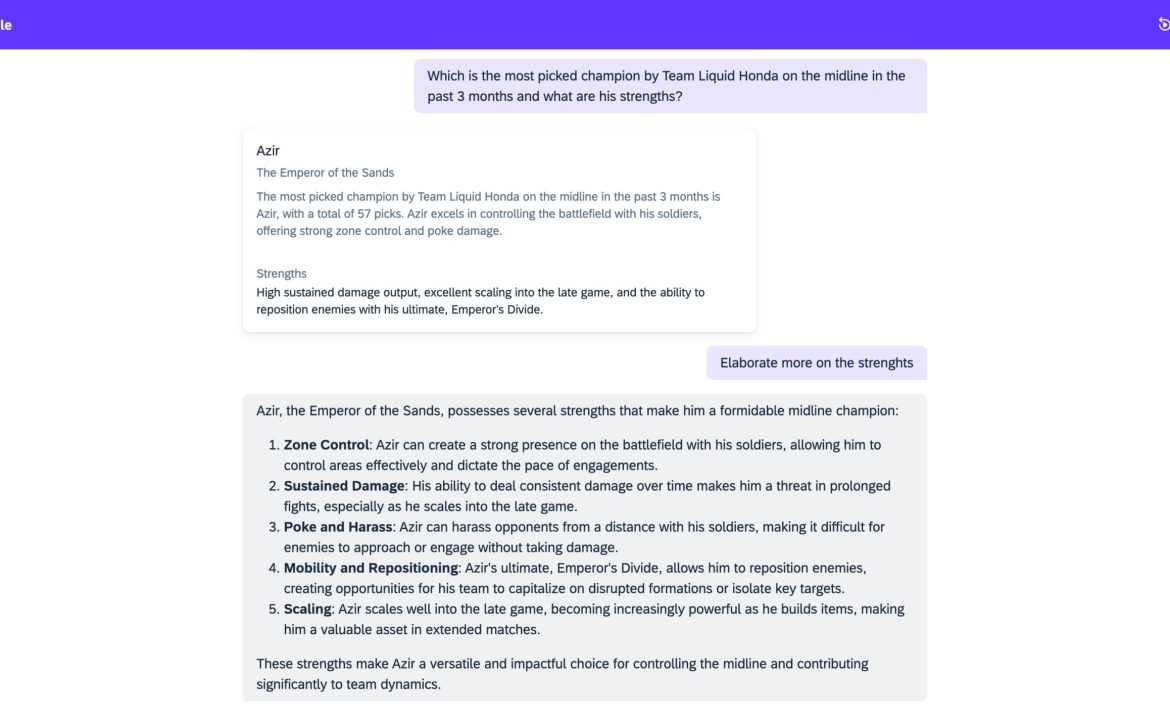
With agents in SAP’s AI copilot Joule, Team Liquid is entering a new world of getting fast and precise insights out of its existing database. By simply typing in a question about a respective player or team, the agents can go through more than 1.6 terabytes of game data from 10 million games to find the right answer to the question and can even suggest strategies to beat the opponent. This allows both analysts and non-technical users to request insights using natural language, eliminating the need for manual data retrieval. With seamless integration of SAP HANA Cloud and SAP Analytics Cloud, Team Liquid gains a robust and scalable data infrastructure, ensuring fast, actionable insights. Joule enables users to instantly access game statistics, player performance trends, and strategic comparisons, making critical information available within seconds.

The impact of Joule Agents can be truly game-changing:

  • Faster data access: Analysts can retrieve and analyze data instantly, which saves valuable time and enhances preparation for upcoming matches. With easy access to insights, different departments from coaching teams, marketing, or communications can align their strategies or content based on data-driven narratives.
  • Empowered users: Players, coaches, and staff can effortlessly access insights through AI-driven queries, improving their ability to make data-informed decisions.
  • Enhanced strategy: Real-time data comparisons can enable precise, data-backed decisions, giving Team Liquid a competitive edge in one of the most dynamic gaming environments.
  • Proactive pattern recognition: The agents can uncover patterns in the large data sets that might not have been discovered in manual data analysis.

With agents in SAP’s AI copilot Joule, Team Liquid is preparing to unlock AI-driven analytics that will make critical insights instantly accessible. “Thanks to SAP’s AI copilot Joule and the upcoming Joule Agents, even non-technical users like our players and coaches will be able to ask for the data they need using natural language queries. What once took hours of manual work will become available instantly, driving our strategies and enhancing team performance,” said Haitham Algbory, head of Analytics & Data, League of Legends at Team Liquid. “This partnership is setting a new standard in esports, proving that AI and data integration are the future of competitive gaming.”

Team Liquid embraces AI-powered analytics and pushes the boundaries of innovation, proving that the future of esports is data-driven and that AI can play a crucial role. As competitive gaming continues to evolve, AI solutions like Joule will be critical in unlocking the full potential of esports teams and maintaining competitiveness.

SAP Sapphire 2025 | Event Recap Video

Innovation, inspiration, and more at this year’s #SAPSapphire! Relive the memories now.

Access over 400 hours of on-demand learning: https://sap.to/6057NxXSH

SAP Adjusts Non-Financial KPIs

WALLDORFSAP SE (NYSE: SAP) today announced that it has adjusted the company’s non-financial key performance indicators (KPIs), which are a component of the Executive Board’s compensation.

With this, SAP also adjusts its non-financial guidance. The guidance for Women in Executive Roles will be replaced with the Business Health Culture Index (BHCI). SAP has measured and reported the BHCI, which is based on the results of the company’s employee engagement surveys, since 2009. In 2025, SAP expects a BHCI score in the range of 80% to 82%.

The other non-financial KPIs remain unchanged. In 2025, SAP continues to expect:

  • A Customer Net Promoter Score of 12 to 16.
  • The Employee Engagement Index to be in a range of 74% to 78%.
  • To steadily decrease carbon emissions across the relevant value chain.

SAP remains committed to creating an inclusive workplace where all employees have equal opportunities, so that the company fully complies with the legal requirements in every country in which it operates.

Visit the SAP News Center. Get SAP news via LinkedIn and Bluesky.

Media Contacts:
Joellen Perry, +1 (626) 265-0370 joellen.perry@sap.com, PT
Bridget Carroll, +1 (267) 615-3589, bridget.carroll@sap.com, PT
Daniel Reinhardt, +49 6227 7-40201, daniel.reinhardt@sap.com, CEST
SAP Press Room; press@sap.com

Subscribe to the SAP News Center newsletter and get stories and highlights delivered straight to your inbox each week

This document contains forward-looking statements, which are predictions, projections, or other statements about future events. These statements are based on current expectations, forecasts, and assumptions that are subject to risks and uncertainties that could cause actual results and outcomes to materially differ. Additional information regarding these risks and uncertainties may be found in our filings with the Securities and Exchange Commission, including but not limited to the risk factors section of SAP’s 2024 Annual Report on Form 20-F.
© 2025 SAP SE. All rights reserved.
SAP and other SAP products and services mentioned herein as well as their respective logos are trademarks or registered trademarks of SAP SE in Germany and other countries. Please see https://www.sap.com/copyright for additional trademark information and notices.

KMD Brings the Public Sector to the Cloud with RISE with SAP

WALLDORF SAP SE (NYSE: SAP) today announced KMD A/S, one of Denmark’s largest IT companies and a subsidiary of NEC Corporation, is moving its KMD Opus platform to SAP S/4HANA Cloud through its RISE with SAP journey on Microsoft Azure.

Modernize your SAP ERP and unlock business value by leveraging the full potential of SAP Business Suite

“The agreements with SAP and Microsoft primarily ensure long-term stability for our Opus solution. Opus customers will benefit from the most innovative technologies and a secure and compliant data and cloud setup. This will empower us to enhance the quality of our solution, and to provide even greater value in public administration, whether it concerns payroll, debtors or finances,” said Jan Gaardboe Jensen, Senior Vice President, KMD.

As a major player in the Danish IT market with operations in various European countries, KMD develops and delivers IT solutions and services, focusing on digitalization and IT infrastructure for municipal, state and business segments. By entering into a technology and cloud agreement between KMD, SAP and Microsoft, KMD will be enabled to elevate the operation of KMD Opus, its ERP system offering used by thousands of public employees in Denmark for managing payroll, debtors and finances.

By migrating to SAP S/4HANA Cloud, KMD is looking to develop a new user interface with increased AI integration to bring more automation to repetitive tasks and greater access to data-driven insights, making reporting easier and more accessible to users.

“For the past 27 years, KMD and SAP have worked together to digitize the public sector,” said Mikkel Stavnsbo, Managing Director, SAP Denmark. “It’s exciting to see KMD embark on its next chapter with a focus on new innovative technologies and automation with cloud services from SAP, such as AI. The shift to the cloud unlocks more opportunities for us to work together to contribute to an even better run society,” he added.

Visit the SAP News Center. Follow SAP at @SAPNews.

Media Contacts:
Ellen Vig Nelausen, +45 292 332 34, ellen.vig.nelausen@sap.com, CET
Lesa Plingen, +49 622 776 9000, lesa.plingen@sap.com, CET
SAP Press Room; press@sap.com

Sign up for the SAP News Center newsletter to get highlights delivered straight to your inbox each week

This document contains forward-looking statements, which are predictions, projections, or other statements about future events. These statements are based on current expectations, forecasts, and assumptions that are subject to risks and uncertainties that could cause actual results and outcomes to materially differ. Additional information regarding these risks and uncertainties may be found in our filings with the Securities and Exchange Commission, including but not limited to the risk factors section of SAP’s 2023 Annual Report on Form 20-F.
© 2025 SAP SE. All rights reserved.
SAP and other SAP products and services mentioned herein as well as their respective logos are trademarks or registered trademarks of SAP SE in Germany and other countries. Please see https://www.sap.com/copyright for additional trademark information and notices.

Previous Next
Close
Test Caption
Test Description goes like this