Since the signing of the cooperation agreement in 2024, SAP and the German Federal Office for Information Security (BSI) have been working together to translate secure digitalization into concrete solutions.
As a global player in the software and technology industry, SAP is a key enabler of digital sovereignty in Germany and across Europe. With the introduction of the BSI’s new C3A criteria and the growing importance of resilient cloud infrastructures, digital sovereignty is now entering a phase of practical implementation.
I spoke with Thomas Caspers, vice president of the BSI, about these developments and the role of the technology partnership with SAP.
Martin Merz and Thomas Caspers; photo courtesy of SAP.
Q: Digital sovereignty is currently one of the central themes in German and European digital policy. Why is this topic gaining such strong momentum right now?
A: The debate is clearly driven by geopolitical factors. For us, the key issue is ensuring that Europe remains capable of taking action. That is precisely what digital sovereignty is about and, by the way, what cybersecurity in general is about as well: being prepared rather than reacting only when a crisis occurs.
The question is not limited to where data is stored. We take a systemic view of the overall picture: Will critical data centers remain operational? Is qualified personnel available? Are supply chains secured? Can services continue to be used even if the underlying conditions change suddenly? This ability to act is at the heart of the debate.
With the C3A, we are now consolidating the criteria that, from our perspective, enable the self-determined and secure use of cloud services, not only in public administration but far beyond that.
Q: With the C3A criteria catalogue, the BSI is now making its requirements for autonomous and self‑determined cloud usage public. What is new or distinctive about this?
A: Much of this is not fundamentally new for cooperation partners such as SAP, with whom we have worked closely for many years. We have been applying these criteria in practice for a long time and continuously refining them as technology evolves. What is new is that we have now systematically documented them and made them publicly available as a guiding framework.
The C3A do not have direct regulatory effect, but for the first time they create a high level of transparency for the market. It becomes clear which requirements cloud providers must meet if cloud customers or public authorities want to use cloud services in a self‑determined and secure manner. These requirements include technical, operational, and now also legal criteria. This comprehensive, systematic perspective is what is new and particularly important.
Q: What role does cooperation with technology providers such as SAP play when translating these requirements into concrete architectures and operating models?
A: A very important one. SAP was one of the first partners with whom we intensified cooperation in this context. Of course, there are formal rules and defined exchange formats for this collaboration. But in practice it quickly became clear that we are in almost continuous dialogue.
In developing the C3A, we also drew on experience gained from projects such as Delos Cloud and SAP Cloud Infrastructure. This kind of direct cooperation is essential, especially as technology, security requirements, and sovereignty considerations are evolving so dynamically.
For us, it is crucial to work with companies where implementation can happen closely, trustfully, and quickly. This applies equally to established cloud topics and to new technologies. If we want innovation to be usable in a secure and controlled way and if Germany is to remain competitive in digitalization, this kind of early and reliable coordination between supervisory authorities and industry is indispensable.
SAP Sovereign Cloud: Embrace the cloud without compromise
Q: From your perspective, what demonstrates that digital sovereignty is more than just a political concept and can actually be implemented in practice?
A: For me, this is evident wherever requirements are not only defined, but actually tested and implemented in practice and where the resulting products and services then succeed in the market. This applies, for example, to the question of how cloud infrastructures can be brought to a level where they are suitable even for particularly critical environments.
It must be absolutely clear which criteria apply and how they are fulfilled technically, organizationally, and not least physically.
A concrete example is Delos Cloud as a sovereign cloud for public authorities in Germany. In cooperation with SAP, the BSI is working to transfer Microsoft cloud technology into a model that can be operated securely and self‑determinedly under German requirements. This clearly demonstrates that digital sovereignty is not merely claimed, but must and can be implemented architecturally, organizationally, and regulatorily.
That is where the value of cooperation lies. When requirements are clear, we can work together with companies on architectures, operating models, and security measures.
Q: Resilience is a key topic in the current debate. What must a sovereign cloud model be capable of in the event of geopolitical disruptions or failures?
A: It must remain operational. For us, resilience means having options and being prepared for difficult scenarios so that operations can be maintained in the event of a crisis. In our current scenarios, we assume that a minimum level of operation must be ensured over an extended period.
This explicitly includes situations in which original providers or supply chains are no longer available in their existing form at short notice.
In other words, we must consider not only normal operations, but also exceptional circumstances. Anyone who takes digital sovereignty seriously must also be prepared for scenarios that no one hopes to see. That is precisely why issues such as continuity of operations, availability of personnel, and supply‑chain resilience play such a central role in the C3A.
Q: How important is the interaction of national standards such as between Germany’s BSI and France’s ANSSI for a shared European understanding of digital sovereignty?
A: This interaction is essential. Germany and France play a special role in the European debate because both countries are working very concretely on criteria, standards, and implementation models and are putting them into practice.
What we learn in Germany feeds into the European discussion, and of course we also benefit from exchanges with our partners in France and other European countries. If Europe is to make progress on digital sovereignty, it needs national innovative strength, reliable partnerships, and at the same time a shared strategic direction. This is also crucial for creating a scalable market for European companies such as SAP one that encourages investment in innovation.
Q: What should public authorities, companies, and cloud providers prepare for in the coming years?
A: The requirements will become more concrete, more verifiable, and more systemic. The first question is what is technologically possible, but this must be followed by the question of how robust, transparent, and controllable an offering actually is. This applies to technical aspects as well as operational and legal ones. We have to consider the entire stack.
If we are able to make technologies usable in a secure and sovereign manner, then we should do so. That means clear standards, a holistic approach, and the ability to bring new technologies into use in a controlled way across the full stack.
Martin Merz is president of SAP Sovereign Cloud.
Get news, stories, and highlights delivered straight to your inbox each week via the SAP News Center newsletter
Welcome to the SAP Business AI product updates for Q1 2026. I’m new in the chief AI officer role, but the mission hasn’t changed: helping our customers get real value from AI.
Joule is now live across 35 solutions and will continue to meet our customers where they are: across the applications they use, with a firm understanding of their business context and data. That’s why in Q1 we are embedding Joule into more applications—from SAP Datasphere, where it can now execute tasks or explain specific functionalities, to SAP Intelligent Clinical Supply Management, where users can use natural language to retrieve critical data and navigate to relevant applications.
Achieve company-wide ROI and transform how work gets done with agents grounded in your business data
Joule Agents, such as the Tender Analysis Agent, are boosting customer revenue growth by extracting critical requirements and flagging risks in complex documents. While project managers in SAP S/4HANA Cloud Public Edition are saving time setting up projects with the new Project Setup Agent. Plus, there are many more agents to discover below.
Agents are becoming a key new user—and enabler—of enterprise software, joining humans as the only other non-deterministic operators while simultaneously expanding enterprise software’s scope and usefulness. Our agents will continue to deliver trustworthy, repeatable, and auditable results every time.
We now have over 40 specialized agents and more than 2,400 Joule Skills. The agent-to-agent protocol means our agents work across SAP and non-SAP systems. As the number of agents grows across both, SAP AI Agent Hub already today provides customers with the essential infrastructure and guardrails to manage, govern, and discover agents in this new ecosystem.
Some highlights from Q1 2026:
SAP Joule for Consultants is a conversational AI solution that provides expert guidance on cloud transformations, drawing on SAP’s knowledge base. To improve trust and traceability, citations are now displayed in a dedicated side panel and can be grouped for clarity. Administrators can enable web search, allowing Joule to draw from public content while maintaining clear source attribution. For tailored answers to problems where the system may not have customer-specific documentation, consultants can now upload up to 10 PDF or text files directly into the chat. This is further enhanced by the inclusion of content from the SAP Enterprise Architecture Reference Library, which provides more complete and accurate answers to complex queries. Get started here.
SAP Business AI for supply chain minimizes disruptions and simplifies planning. The Project Setup Agent allows project managers to rapidly establish new projects by drawing on data from past initiatives. SAP Integrated Business Planning users can now generate complex formulas in Microsoft Excel with natural language. SAP Digital Manufacturing can distill complex manufacturing issues into clear descriptions. Joule is also helping SAP Integrated Product Development users create problem reports and requirement models with simple, natural-language commands. Explore more below.
SAP Business AI for finance offers greater efficiency and insight across critical processes. Joule now translates complex e-invoicing errors into plain language. The Dispute Resolution Agent automates root-cause analysis for invoice disputes, while payment advice processing significantly reduces document processing time. Unstructured data, such as PDFs, can now be automatically transformed into sales orders, and accountants can access natural language explanations for complex fixed asset calculations. Users can personalize their home page and easily understand system errors using natural language across SAP S/4HANA Cloud Public Edition. Learn more below.
SAP Business AI for procurement and customer experience enhances the entire commercial journey with new capabilities. In procurement, automated statement of work (SOW) creation in SAP Fieldglass reduces the time to define deliverables. The Catalog Optimization Agent means e-commerce managers can continuously improve product data quality. In retail, managers can get instant, conversational answers from Joule on order management data. There’s so much more to learn below.
SAP Business AI for IT and developers puts the latest tools and greater control directly into the hands of developers and data professionals. Joule is now generally available in SAP Datasphere, enabling users to navigate the platform, get answers, and execute tasks using simple conversational language. The generative AI hub in AI Foundation continues to expand, offering developers access to the newest models, including OpenAI GPT 5.2, Gemini 3.0 Pro, Anthropic Claude Opus 4.6, and Claude Sonnet 4.6. Developers also gain greater power through enhancements such as advanced prompt optimization, metadata filtering, and declarative orchestration configurations in the prompt registry. Additionally, SAP Document AI now offers more granular control with custom confidence thresholds and expanded document support. Dive into everything below.
SAP Business AI for industries delivers specialized intelligence to solve unique business challenges. Sales teams can accelerate their response process with the new Tender Analysis Agent, which automates the review of complex RFQ documents to improve win rates. Joule now works with SAP Commodity Management to turn verbal or written negotiations directly into detailed draft deals. In life sciences, clinical supply professionals can use predictive analytics to reduce inventory waste costs, and Joule dramatically cuts information search time. SAP Self-Billing Cockpit automates invoice data extraction from any format, significantly reducing manual processing time. Discover more for industries below.
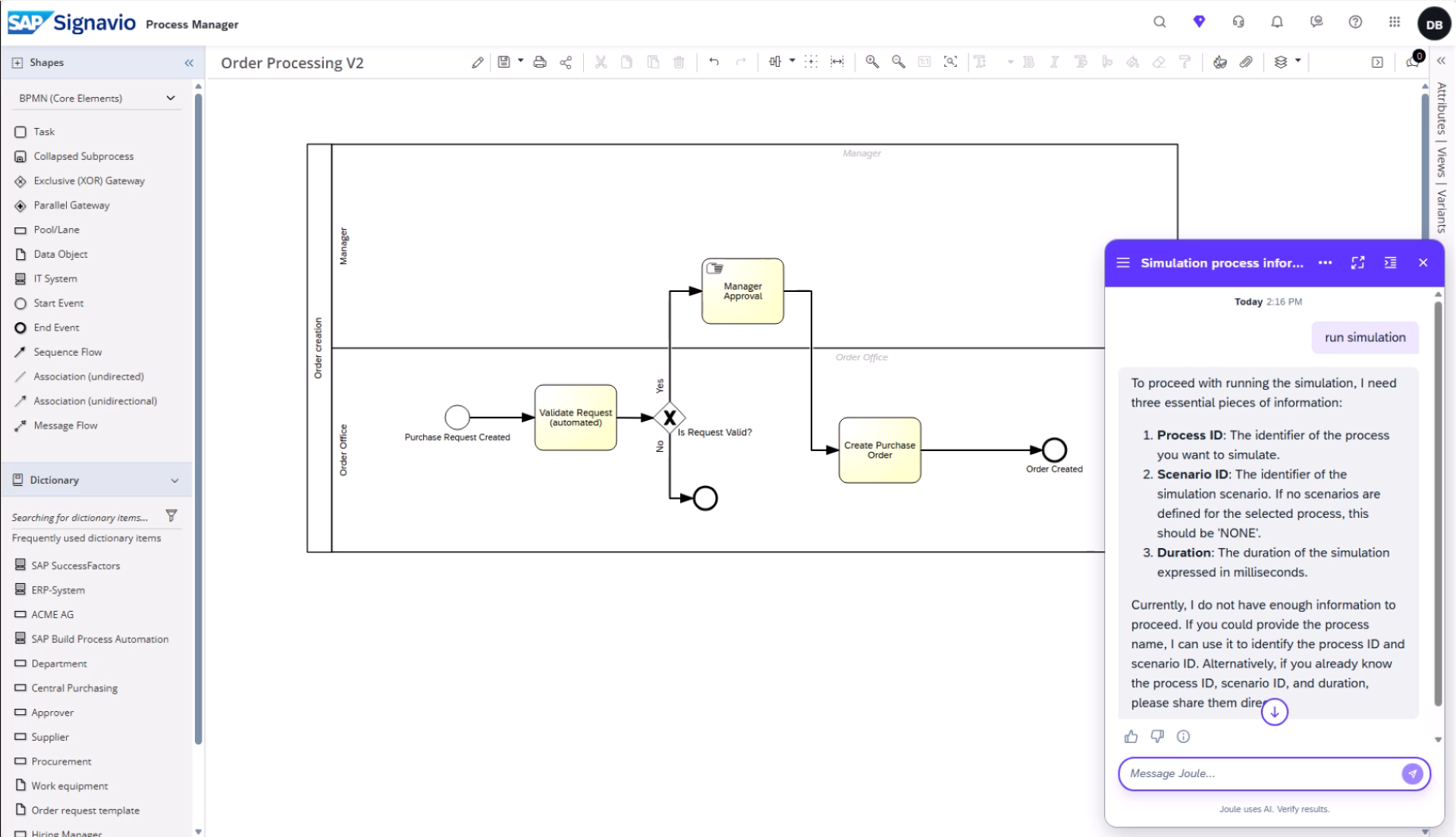
SAP Business AI for business transformation management provides the critical insights needed to navigate and accelerate organizational change. Joule is now in SAP Signavio, enabling natural-language searches that cut information discovery time. Business process model and notation simulations in SAP Signavio provide clear, actionable summaries directly within process diagrams. Meanwhile, enterprise architects can leverage guidance in SAP LeanIX to surface actionable insights directly from their architecture inventory, accelerating transformation execution and reducing the time to uncover them. Read more about transformation management below.
Joule
Joule, enhancements
User experience is improved by streamlining startup times and introducing cross-thread search functionality that lets end users find information across all conversation threads without manually checking individual histories. The document grounding capability has also seen a substantial upgrade, now supporting seamless integration with Google Drive.
Furthermore, scalability has been greatly improved, as the system now supports up to 8,000 documents per pipeline, enabling large-scale data repositories to be processed and utilized efficiently.
Enhanced Citation Visibility SAP Joule for Consultants has improved how citations are displayed for all identified sources returned by the product. Citations have been relocated to the right side in a dedicated panel for clearer visibility, and now also include public web search results when applicable (see below).
A new grouping feature has also been added, allowing citations to be grouped. This update provides users with a more transparent view of where information originates, strengthens trust, and improves traceability across all responses.
To see the sources and panel, click the sources button below each message; the panel will open on the right, showing all grouped sources.
Enable Web Search Administrators can now enable/disable web search via the control panel for all assigned end users in SAP Joule for Consultants.
When enabled, SAP Joule for Consultants will consider public web content in its reasoning and cite relevant public sources in responses when they contribute to the answer. This enhancement gives organizations greater flexibility and transparency by enabling broader coverage of information while maintaining clear source citations for all sources used.
File Uploads in the Joule Message Input End-users can now upload up to 10 files directly from the conversational message input box and reference them throughout the entire conversation.
Supported file types include PDF and TXT. Each file should be no more than 10 MB/600K characters; for PDFs, an approximation. A 100-page limit applies; if your file is larger, split it into multiple documents. Image files are currently not processed and will be ignored. We are working diligently to make this feature even more useful to end users. This enhancement enables richer, context-aware interactions by allowing you to incorporate your uploaded documents into its conversational responses throughout the session. Please be aware that the standard data privacy terms apply. See also the help documentation for additional information on the free user quota.
Content: SAP Enterprise Architecture Reference Library SAP Enterprise Architecture Reference Library data has been ingested and is now available for use in conversations. As more data is added, relevant portions may be included in SAP Joule for Consultants’ responses, enabling more complete, accurate, and context-rich answers to user queries. Since SAP Enterprise Architecture Reference Library content cannot be link-referenced, you won’t see the additional content listed under sources, even though it will be referenced.
Project managers can now rapidly establish new projects by drawing on data from similar past initiatives. The agent bypasses complex interfaces and reduces reliance on the project management office (PMO) to facilitate the swift allocation of key resources needed to launch projects effectively. With a 10% reduction in project creation time, 16% faster resource allocation, and 30% less time spent reworking projects due to incorrect templates, teams can shift focus from operational coordination to improving project profitability and driving efficiency.
SAP S/4HANA Cloud Private Edition, AI-assisted retrieval of equipment information in service management General availability
Service managers using the AI-assisted retrieval feature in SAP S/4HANA Cloud Private Edition gain a complete 360-degree view of customer equipment. The feature provides instant access to warranty information and a full history of service transactions, complemented by an AI summary and actionable recommendations. This allows service managers to more efficiently oversee service schedules, reduce potential downtime, and ensure customer equipment operates at peak performance.
SAP S/4HANA Cloud Public Edition, AI-assisted input recommendations for returns order creation General availability
Returns clerks can accelerate the creation of customer returns with data field recommendations powered by historical data. This feature analyzes past return documents with similar process variants to automatically suggest the most common input values and return reasons, minimizing manual data entry and reducing errors. Organizations benefit from a one percent reduction in data management costs and a five percent decrease in business and operations analysis expenses, enabling returns teams to process orders more efficiently while maintaining accuracy.
SAP Integrated Business Planning, AI-assisted MRO inventory analysis General availability
Inventory planners get a new analytical assistant in the MRO inventory analysis feature for SAP Integrated Business Planning. The feature accelerates root cause analysis by generating clear, natural-language summaries that explain the key drivers behind recommended safety stock and reorder points. By translating complex calculations into understandable insights, this capability enables planners to reduce time spent analyzing inventory runs by 30%, leading to faster adoption of outputs and ensuring that inventory parameters align with strategic business goals.
SAP Integrated Business Planning, add-in for Microsoft Excel, AI-assisted planning General availability
Supply chain planners can now simplify their work with a new AI-assisted planning add-in for Microsoft Excel. Instead of manually creating complex formulas or formatting rules, which often require technical expertise, they can simply describe their needs in natural language, and the system automatically generates the correct syntax. This intuitive way of interacting with the system removes technical barriers and improves a planner’s efficiency by 10%, freeing them to focus on strategic analysis rather than implementation details.
SAP Integrated Business Planning, AI-assisted system security check General availability
Supply chain planners and security analysts gain a robust way to assess system configurations against established security recommendations. The feature evaluates compliance states and provides clear guidance on required adjustments, helping administrators identify and address potential gaps while aligning configurations with SAP best practices. Organizations can expect a 27% increase in compliance with hardening guidelines and a 32% reduction in the effort required to meet security recommendations. This feature strengthens the protection of sensitive data and reduces the risk of security breaches.
SAP Integrated Product Development, AI-assisted problem report creation General availability
Maintenance engineers can simplify the creation of formal problem reports by leveraging AI capabilities in SAP Integrated Product Development. By describing an issue in their own words to Joule, it intelligently extracts key details like the problem name, tags, and priority, and then automatically generates a structured report. This streamlined process dramatically reduces manual data entry and ensures all reports are consistent and compliant with organizational standards, improving overall efficiency.
SAP Integrated Product Development, AI-assisted requirements model creation General availability
Requirements managers now have a more direct path to creating requirement models within SAP Integrated Product Development by using natural language commands with Joule. This feature allows them to initiate new models, specify names, and apply templates in a single step, completely bypassing the need to navigate through complex folder structures. This streamlined approach provides a much faster starting point for new projects and empowers users to begin their work immediately without requiring deep knowledge of the repository layout.
SAP Field Service Management, AI-assisted automated scheduling analytics General availability
Field service dispatchers and consultants can now access clear, on-demand explanations of auto-scheduling results that demystify complex system logic. The new feature interprets scheduling reports and translates technical scoring details into business-friendly insights, explaining why specific technicians were assigned, why alternatives were passed over, and why certain activities remained unscheduled. This transparency drives a 12.5% increase in dispatcher productivity and a five percent reduction in erroneous resource allocations, strengthening trust in automated decisions while significantly reducing analysis time.
SAP Digital Manufacturing, AI-assisted description enhancement General availability
Quality managers documenting complex manufacturing issues can now generate clear, objective, and structured descriptions with minimal effort. SAP Digital Manufacturing for issue resolution offers description generation that refines rough initial inputs, removes bias and subjective language, and produces balanced, factual problem statements. With support for multilingual translation and enhanced clarity, organizations can achieve up to five percent improvement in quality engineer efficiency during issue handling and up to 10% reduction in errors throughout the problem resolution process.
Dispute Resolution Agent (for SAP S/4HANA Cloud Public Edition) Beta release
When invoice disputes arise, accounts receivable specialists need to act quickly without sacrificing accuracy. SAP S/4HANA Cloud Public Edition introduces an agent that automates root-cause analysis, scanning invoices, sales orders, delivery records, pricing agreements, and tax rules to identify the source of discrepancies. The agent detects incorrect charges and recommends compliant solutions, such as credit memo creation, enabling finance teams to resolve disputes faster, minimize manual investigation, and cultivate stronger vendor relationships through transparent, efficient processes.
SAP S/4HANA Cloud Public Edition, AI-assisted smart personalization of my home for applications General availability
SAP S/4HANA Cloud Public Edition users can easily configure their home page with the most relevant applications through AI-assisted smart personalization. By describing their task in natural language, the system identifies the appropriate app, which can then be added to their home screen with a single click. This intuitive capability reduces the cost of personalizing the home page by 33%, shortens the learning curve for new users, and improves satisfaction by keeping frequently needed tools readily accessible.
SAP S/4HANA Cloud Public Edition, AI-assisted error explanation General availability
When encountering system errors, SAP S/4HANA Cloud Public Edition users can turn to a new feature that generates clear, natural language explanations and resolution recommendations. This capability transforms cryptic error messages into easy-to-understand guidance, helping users of all experience levels quickly rectify issues and continue with their work. By reducing error resolution time by five percent, organizations benefit from increased productivity, improved data quality, and shorter training cycles for new team members.
SAP S/4HANA Cloud Public Edition, AI-assisted sales order creation from unstructured data General availability
Sales representatives benefit from a streamlined order creation process in SAP S/4HANA Cloud Public Edition that handles unstructured data like PDF or image-based purchase orders. After uploading a file, SAP Document AI automatically extracts the relevant information and proposes the data for a corresponding sales order request. This automation significantly reduces manual data entry, minimizes errors, and improves overall operational efficiency, allowing teams to process orders faster and enhance customer satisfaction.
SAP S/4HANA Cloud Public Edition, AI-assisted processing of payment advices with SAP Document AI General availability
Accounts receivable clerks can accelerate their workflow using the SAP Document AI-powered payment advice processing feature in SAP S/4HANA Cloud Public Edition. The system automatically extracts payment amounts, references, and currencies from diverse invoice formats across multiple languages, with a self-learning capability that continuously improves recognition accuracy. Organizations implementing this feature can reduce document processing time by 70%, cut template maintenance time by 83%, and decrease value loss from manual processing delays by 40%.
SAP S/4HANA Cloud Private Edition, AI-assisted fixed asset key figures explanation General availability
Asset accountants gain clarity on complex fixed asset calculations through a new AI feature in SAP S/4HANA Cloud Private Edition. The feature generates natural-language explanations that detail the origins of displayed values and how figures such as depreciation are calculated; for example, illustrating the impact of mid-year acquisitions with specific depreciation keys. This transparency reduces the effort required to analyze asset values, enables faster responses to asset-related questions, and helps mitigate compliance risks.
SAP S/4HANA Cloud Private Edition, AI-assisted settlement rule proposal for asset capitalization General availability
Overhead and asset accountants can now streamline the complex process of creating settlement rules for investment measures, eliminating the traditionally time-consuming, error-prone manual configuration. The solution automatically determines receivers, calculates percentages, and proposes feasible rules based on contextual data and user-defined instruction profiles. Organizations reduce the effort required to create full settlement rules by 50% while simultaneously improving accuracy in asset capitalization and enhancing overall operational efficiency across their financial processes.
SAP Document and Reporting Compliance for SAP S/4HANA Cloud Private Edition, AI-assisted electronic document error handling General availability
Tax accountants navigating the growing complexity of e-invoicing mandates across multiple countries gain an easy way to decode technical errors without wading through intricate XML or JSON formats. Joule, integrated with SAP Document and Reporting Compliance, delivers plain-language explanations of electronic document errors, enabling faster root-cause identification and more efficient resolution. Organizations get an 80% reduction in time spent understanding and resolving errors, dropping from 150 minutes to approximately 30 minutes. This results in faster processing cycles, reduced penalty risks, and improved cash flow.
SAP S/4HANA Cloud Public Edition, AI-assisted error resolution for cost accounting General availability
Operations managers in retail organizations can now access Joule via SAP Order Management Services, enabling them to query order data and receive real-time, role-specific operational guidance across order processing, orchestration, sourcing, availability, returns, and fulfillment flows. Joule surfaces instant insights and recommended actions directly in the workflow, reducing the need to navigate multiple systems. This enables proactive intervention before issues escalate. The feature offers faster transaction access, improved responsiveness and accuracy, and lower operational risk, which support smarter, quicker decisions across the order lifecycle.
Expense Report Validation Agent General availability
Business travelers can enjoy a smarter, guided approach to expense report completion with an agent that proactively identifies missing items, prompts for necessary details, and clarifies confusing alerts throughout the submission process. By simplifying how users understand and resolve issues, the agent ensures accurate, policy-compliant reports with minimal effort required. This means a 30% reduction in time spent preparing and submitting reports, a 24% increase in first-pass approvals, and a noticeably improved employee experience that removes friction from the expense management process.
Expense Pre-Submit Audit Agent SAP Early Adopter Care
Expense report submitters can now catch receipt accuracy issues and policy breaches before hitting the submit button, avoiding the frustration of rejected reports and delayed reimbursements. This agent automatically reviews expenses during creation, surfacing compliance problems and offering smart suggestions for quick corrections. The agent uses a non-blocking design that keeps users in control of final decisions. Organizations benefit from a 10% decrease in sent-back expense reports, reduced rework for travelers, managers, and auditors alike, and a noticeably smoother reimbursement process that enhances the overall employee experience.
Employees burdened by the administrative chore of creating expense reports can now delegate the heavy lifting to a Joule Agent. This agent automatically builds expense reports by aggregating transactions, populating custom fields based on contextual details and user history, and preparing everything for a quick review before submission. The outcome is up to 30% reduction in time on task for auto-generated expense reports. This offers a modern expense management experience that slashes manual data entry, accelerates the submission process, and frees employees to focus on high-value work rather than paperwork.
Concur Expense, AI-assisted configuration for audit rules General availability
Expense administrators responsible for managing complex audit rule setups can now interact with their configuration environment in plain language, eliminating the need for deep technical expertise or tedious manual adjustments. This AI-assisted feature enables admins to search existing rules, create new ones, and receive real-time explanations simply by asking questions like “What rules apply to meals in France?”, delivering clear, actionable guidance instantly. The outcome is a 40% reduction in audit rule configuration effort, fewer support tickets, and empowered administrators who work with greater independence, accuracy, and confidence in maintaining compliance logic.
Business travelers seeking quick answers to company travel and expense policies no longer need to sift through lengthy documents or wait for admin responses. Policy navigator in Joule allows employees to ask questions in natural language and receive clear, contextual guidance grounded in approved policies, whether planning a trip, in the middle of a journey, or completing an expense report. The result is in-the-moment policy clarity that prevents non-compliant spend before it happens, reduces support tickets, and empowers travelers to make confident, compliant decisions without disrupting their workflow.
SAP Fieldglass Services Procurement, AI-assisted SOW deliverables creation General availability
Procurement specialists can accelerate the development of their statements of work using the deliverables feature in SAP Fieldglass Services Procurement. The feature analyzes the defined project scope and automatically generates precise, relevant deliverables that ensure tight alignment between buyer expectations and supplier commitments. By adopting this capability, organizations can reduce the time required to manually create SOW deliverables by 70% and cut the risk of poor outcomes by 50%, while fostering stronger collaboration during the negotiation process.
E-commerce product managers tasked with maintaining large SAP Commerce Cloud catalogs gain an always-on agent that continuously reviews product descriptions, attributes, and translations against company quality standards. This agent pinpoints merchandising gaps and delivers actionable recommendations to enhance catalog accuracy, ensure consistency across languages, and improve product discoverability. The business impact is a 70% reduction in time to translate catalog data, 65% less time spent adding descriptions per asset, and a five percent reduction in data quality costs, all of which contribute to higher conversion rates and a more agile merchandising operation.
SAP Revenue Growth Management, AI-assisted trade promotion creation General availability
Key account managers in consumer industries can benefit from a streamlined, single-view promotion-creation experience in which simply naming a promotion automatically populates key fields. Drawing on master data, historical promotions, and learned preferences specific to each retailer, the system suggests dates, types, durations, and sell-in periods, then continuously refines its recommendations based on user edits over time. The impact is a 75% reduction in promotion setup time, 30% fewer data-entry errors and rework, and increasingly personalized suggestions that eliminate repetitive manual effort across promotion cycles.
Building on the transformative capabilities of Joule studio low-code, SAP is expanding the Joule studio family with two powerful new offerings designed to meet developers exactly where they work: Joule Studio code editor, a Visual Studio Code IDE extension, and Joule Studio CLI, a versatile command-line interface. Together, these tools deliver a unified, AI-assisted development experience that spans the full spectrum of development personas and preferences on Joule.
Joule Studio code editor brings the intelligence of Joule directly into Visual Studio Code, the world’s most popular development environment, empowering pro-code developers with AI-guided scaffolding, contextual code generation, intelligent recommendations, and seamless integration with Joule, all without leaving their preferred IDE.
Joule Studio CLI extends this same power to the terminal, enabling developers and DevOps teams to automate project creation, manage configurations, execute deployments, and orchestrate CI/CD workflows through scriptable, command-line commands—ideal for headless environments, automation pipelines, and teams that value speed and precision at the command line.
Data professionals working within SAP Datasphere can now accomplish informational, navigational, and transactional tasks through natural conversation with Joule. Whether asking how to use specific functionalities, retrieving details about a SAP Datasphere instance, or switching system settings like language preferences, users receive instant answers with direct references to product documentation. Joule can even execute tasks directly from the conversation without requiring interaction with the standard interface. This direct execution reduces reliance on internal IT support and enables faster, more intuitive navigation throughout the platform.
Document level confidence Customers now set confidence ranges for fields in the Schemas feature. When customers edit field settings, they can define their own thresholds for low, medium, and high confidence. These custom settings are reflected in the extraction results displayed for the relevant fields on the document details screen. See Settings for Fields and View and Edit Documents Needing Review.
Expanded Transportation Management Customers can now use the Transports feature to export and import channels and workflows. See Supported Objects.
Metadata Customers can now manage metadata for documents, collections, and chunks created with the Vector API to enable advanced filtering and organization of their content. For more information, see Metadata.
Retrieval API Customers can merge and rank search results across multiple data repositories using the Retrieval API’s post-processing capabilities. For more information, see Retrieval Search.
Prompt optimizations Custom metrics are supported in prompt optimizations, enabling customers to define and optimize prompts based on their specific evaluation criteria. Only LLM-as-a-judge metrics with numerical or Boolean output types can be used in optimization tasks.For more information, see Create a Custom Metric and Create a Configuration for a Prompt Optimization. Customers can provide separate test and train datasets for prompt optimization. For more information, see Create a Configuration for a Prompt Optimization.
Prompt registry The prompt registry now enables customers to create and manage orchestration configurations declaratively, allowing them to version and track complex AI workflows alongside their prompts for better governance and reproducibility.For more information, see Create an Orchestration Config (Imperative).
Secrets Customers can now enter generic secrets using a form instead of JSON. The form appears in the Add Generic Secret dialog when you activate document grounding. A dropdown menu lets them choose the type of document repository. Depending on their selection, the remaining fields adjust dynamically, allowing them to complete the data. Some fields are already prefilled.If they prefer working directly with JSON, switch to the code view by clicking the icon. For more information, see Add a Secret.
New models available New models are supported, including OpenAI GPT 5.2, Gemini 3.0 Pro, Perplexity Deep Research, and Anthropic Claude Opus 4.6.For more information on new and deprecated models, see the SAP Note.Try generative AI hub for free for 30 days.
SAP Joule for Developers, ABAP AI capabilities, enhancements
New ABAP AI capabilities mean developers can expect a 20% reduction in time and effort to write ABAP/JAVA code, 25% reduction in time and effort to test ABAP/JAVA code, and 4.4% faster time to realized value.
This quarter, developers can now easily generate ABAP Unit tests for:
Public, protected, and private methods of global ABAP classes
Public methods of local classes within global class pools
In addition, the documentation chat allows developers to interact with documentation on the SAP Help Portal, providing context-aware answers and links to relevant documentation. This capability enhances productivity by offering quick access to related documentation directly within the development environment. See Documentation Chat.
Sales teams can elevate their tender response process with the Tender Analysis Agent, which automates the review of complex RFQ documents. The agent extracts critical product requirements, flags potential risks and policy gaps, and suggests optimized configurations tailored to customer needs. By reducing the effort to process incoming tenders by five percent and improving win rates, organizations can achieve measurable revenue growth while accelerating sales cycles and uncovering valuable cross-sell and up-sell opportunities.
SAP Commodity Management, AI-assisted commodity work center General availability
Commodity traders can transform how they capture and manage complex deals using the commodity work center in SAP Commodity Management. Working alongside Joule, the feature converts verbal or written negotiations into detailed draft deals, automatically populating the numerous fields that traditionally require extensive manual entry. This enables traders to redirect their focus toward negotiating better commercial outcomes, while improving data accuracy and driving greater operational efficiency across their trading activities.
SAP Intelligent Clinical Supply Management, AI-assisted predictive subject dynamics General availability
Clinical trial coordinators seeking to boost their supply planning capabilities will find a powerful ally in SAP Intelligent Clinical Supply Management. The predictive subject dynamics feature analyzes historical and real-time data to forecast patient enrollment trends and dropout rates, automatically generating insights that would otherwise require extensive manual analysis. This enables supply chain teams to redirect their focus to strategic decision-making, while reducing clinical inventory waste costs by up to two percent and improving demand forecasting accuracy across their trial operations.
Joule with SAP Intelligent Clinical Supply Management General availability
Clinical supply professionals juggling multiple tasks and complex systems need quick access to information without disrupting their workflow. Together with Joule, SAP Intelligent Clinical Supply Management delivers an intuitive, conversational interface that understands natural-language requests, enabling users to retrieve critical data and navigate to relevant applications effortlessly. This streamlined experience results in an 83% reduction in time spent on information searches, freeing teams to concentrate on higher-value activities and significantly boosting overall productivity.
SAP Self-Billing Cockpit, AI-assisted document processing General availability
Billing clerks managing self-billing workflows frequently encounter invoices arriving in a mix of formats—Excel, PDF, CSV, or text files—often unstructured and spanning multiple languages. SAP Self-Billing Cockpit addresses this challenge by leveraging intelligent document processing to parse and extract invoice data from virtually any format, converting it into structured payloads ready for automated billing. The result is significantly reduced time spent processing invoice line items, fewer customer-specific interfaces for integration specialists to build and maintain, and improved extraction accuracy through minimized manual intervention.
SAP Business AI for business transformation management
Joule with SAP Signavio solutions General availability
Process analysts and optimization specialists working across complex organizational workflows require rapid access to diagrams, documentation, and performance metrics. SAP Signavio solutions integrate with Joule to enable natural-language keyword searches across process diagrams, dictionary items, and help resources. At the same time, best-practice KPI recommenders guide users to the most relevant success measures. This intuitive approach delivers 50% faster information searches and navigation, ensuring teams make data-driven decisions with improved search quality and an enhanced overall user experience.
SAP Signavio solutions, AI-assisted business process model and notation simulation insights General availability
Process analysts leveraging SAP Signavio can now access embedded business process model and notation simulations directly within their process diagrams, eliminating the need for fragmented tools and manual interpretation. Key metrics such as costs, cycle times, and resource utilization are automatically translated into clear, actionable summaries that highlight bottlenecks and opportunities for improvement. This streamlined approach reduces time to access process modeling insights by 50%, empowering teams to compare scenarios effortlessly and communicate findings to stakeholders with greater confidence and clarity.
SAP LeanIX solutions, AI-assisted architecture guidance General availability
Enterprise architects seeking to accelerate transformation initiatives can leverage SAP LeanIX to surface actionable insights directly from their architecture inventory. The feature analyzes enterprise architecture data to identify opportunities and guides users through the workflows and tasks needed to efficiently act on recommendations. Organizations benefit from a 95% reduction in time to discover insights, 80% faster transformation execution, and a five percent reduction in value erosion from delayed action. Overall, this feature drives greater architectural productivity and more agile decision-making.
*Disclaimer: This article provides estimated benefits. All calculations are estimates based on SAP customer case studies, SAP benchmarks, and other research. Actual benefits may vary and may be affected by additional factors not considered by this article. The information is provided “as is” without warranty of any kind, expressor implied, and in no event shall SAP be liable for any damages whatsoever in relation with the use of this article. See Legal Notice on https://www.sap.com/legal-notice for use terms, disclaimers, disclosures, or restrictions related to this material.
Team Liquid, the world’s largest eSports organization, is turning to Joule to transform how it manages the vast amounts of data generated in competitive gaming.
Learn more about “Team Liquid and Joule”: https://sap.to/6042B6j2cC
00:00 – Too Much Data
00:19 – Team Liquid
00:42 – Manual Entry
01:01 – Partnering with SAP
01:20 – Winning with Joule
01:49 – What’s Next?
Data binding is one of the cornerstones of SAPUI5 development, and understanding how to use it effectively can make the difference between an application that feels alive and one that requires constant manual intervention.
How do you turn data into real business value in an AI-driven world? Jon Gooding shares insights in the latest episode of Trending Chats.
🎧 More episodes of the Trending Chats podcast:
Watch on YouTube: https://sap.to/6050Cr6Qi
Listen on Spotify: https://sap.to/6052Cr6QY
Listen on Apple Podcasts: https://sap.to/6053Cr6Ql
Take advantage of greater control, accuracy, and efficiency in global compliance with SAP Cloud ERP 2602, helping teams streamline safety data sheet (SDS) processes and manage dangerous goods with more confidence.
In this highlight tour, Claudia Rosbach and her digital twin walk through key Product Compliance innovations designed to reduce manual effort, improve data accuracy, and support smoother global shipments; especially when products, regions, and regulations get complex.
📄 Extension of SDS generation + public APIs — Use a more comprehensive EU SDS starter template and public APIs to create, update, or read key GHS labeling information, supporting integration of your own calculations and helping speed SDS authoring for requirements such as Germany and France.
🏷️ SDS management for branded products — Maintain branded-product specific data (for example, UFI for EU poison center notifications or a Korean SDS number).
🧩 Fallback safety data sheet logic — Configure an automatic fallback SDS (for example, an international version) when a region-specific SDS isn’t available, helping prevent shipment delays and reducing manual work for product stewards.
⚠️ Dangerous goods for multi-component products — Classify two or more components within a single product (such as kits) as dangerous goods, supporting a more complete assessment and stronger compliance with DG regulations.
00:00: Introduction to Product Compliance 2602
00:29: Extension of SDS generation
01:19: SDS management for branded products
02:04: Definition of a fallback safety data sheet
02:45: Dangerous goods for multi-component products
03:27: Release recap
03:54: Learn more and get connected
• Read more about the latest Product Compliance innovations in SAP Cloud ERP 2602: https://sap.to/6059C7dNL
• Check out the SAP Cloud ERP Community: https://sap.to/6055CIrvT
Explore SAP Cloud ERP innovations: https://sap.to/6056CIrvp
Alexia Bayyouk explains how a clean core helps reduce cost, simplify upgrades, and keep innovation moving.
Explore SAP’s clean core: https://sap.to/6057Cr8db
Clean core in driving innovation: https://sap.to/6051Cr8d5
Getting started with a clean core: https://sap.to/6052Cr8dg
🎧 More episodes of the Trending Chats podcast:
Watch on YouTube: https://sap.to/6053Cr8d9
Listen on Spotify: https://sap.to/6054Cr8di
Listen on Apple Podcasts: https://sap.to/6055Cr8dc
Discover the essentials of ESG reporting and how it aligns your company with sustainability goals and enhances transparency, accountability, and value creation.
Done properly, sustainability reporting helps you manage risks, improve efficiency and build trust with regulators, customers, investors and employees. Done poorly or ignored, it can risk your reputation, result in missed opportunities or incur regulatory penalties.
Start early by identifying what ESG data you already collect and use SAP Solutions to drive its management and reporting in line with global standards.
The U.S. federal technology landscape is entering a new era, one defined not by migration alone, but by modernization with purpose. For decades, progress meant upgrading infrastructure or shifting workloads to the cloud.
Unify every mission-critical function to drive government efficiency and innovation
As the pace of digital demand accelerates and mission priorities grow more complex, it is clear that traditional modernization approaches can no longer keep pace.
To deliver on rapidly evolving government missions, agencies must move beyond lifting and shifting legacy systems. The true transformation lies in reimagining operating models to support continuous, secure, and scalable innovation.
Shift from modernization to transformation
Legacy IT structures, designed for predictability and control, often limit progress. Risk-averse approaches that once provided stability now constrain agility and innovation. Federal agencies leading the way are adopting future-ready, cloud-native architectures that emphasize interoperability, flexibility, and resilience. These architectures do more than modernize technology; they modernize how agencies work, collaborate, and deliver results.
Reducing technical debt has become a strategic imperative, but emerging technologies also demand a balance of governance and innovation. Federal leaders are reframing their approach to modernization as an ongoing process, a state of persistent transformation where technology, mission, and operations evolve in sync.
Measuring what matters: from cost to capability
As agencies embrace new models of delivery, success must be evaluated through a dual focus:
Total cost of ownership (TCO): Sustaining efficiency by lowering infrastructure costs and simplifying operations
Total cost to innovate (TCI): Accelerating value creation by enabling teams to activate, test, and scale new capabilities with minimal risk and complexity
This broader lens allows agencies to view modernization as an investment in agility, resilience, and readiness—ensuring they can respond to what’s next, not just what’s now.
Partnering for a smarter, more agile government
Driving this shift requires strategic collaboration across the public and private sectors. Programs such as the U.S. General Services Administration’s OneGov initiative are redefining how government acquires and deploys technology. By consolidating procurement and engaging directly with technology providers, OneGov helps create greater transparency, efficiency, and long-term value for taxpayers.
In alignment with this vision, SAP has partnered with GSA to provide federal agencies with expanded access to both SAP licensed-based products and white glove migration, all while avoiding data egress fees. These initiatives help agencies reduce technical debt, accelerate digital transformation, and establish a secure, cloud-native foundation for the future.
Building the innovation-ready enterprise
Modernization is not a destination, it is a capability. Agencies that continually adapt their operating models will define the next generation of public service. The path forward is clear:
Reimagine modernization as operating model transformation, not just technology refresh
Balance efficiency with innovation by measuring both cost savings and speed to value
Build future-ready enterprises where mission and IT operate as one, powered by cloud, automation, and AI
Together, we are shaping a smarter, more secure, and more agile federal enterprise, one that is ready to meet the demands of a rapidly changing world and deliver enduring value to citizens.
David Robinson is president of Cloud ERP and acting managing director of U.S. Public Services at SAP.
Get news and highlights delivered straight to your inbox each week via the SAP News Center newsletter