Today, most companies are experimenting with AI. Many of them can point to demos that impressed, pilots that worked, and tools that saved time in narrow tasks. Far fewer can say AI has changed their business across functions, processes, and teams.
Autonomous Enterprise: Meet the accelerating demands of business profitably, strategically, and safely
The difference is not the model. It is context: the ability for AI to understand how a business actually runs.
Much of today’s AI discussion centers on agents, along with models and benchmarks. Which model performs best? Which system completes the most tasks? Which interface feels most natural? These factors matter, but they do not solve the central enterprise challenge.
Companies run workflows that cut across teams, policies, approvals, authorizations, and data. They plan, source, produce, hire, pay, and serve through systems that carry real business consequences. AI only creates durable value at scale when it operates inside this reality.
Models generate answers. An agent can complete a task. But running a business requires something more. It requires an understanding of how work gets done, who is authorized to act, which rules apply, and how decisions connect across functions. Without that context, AI simply can’t deliver on its promise.
That is one reason I believe AI raises the premium on software with deep business context. It allows companies to fundamentally reinvent how work gets done. When AI agents understand end‑to‑end processes, they can operate across functions, execute workflows autonomously, and coordinate actions in real time. Instead of automating individual steps, AI can run processes end to end, freeing employees from repetitive coordination and enabling them to focus on higher‑value judgment, oversight, and strategy.
This is what we describe as the Autonomous Enterprise, a fundamental shift from systems of execution to systems that can reason, decide, and act. A vision where SAP is poised to lead.
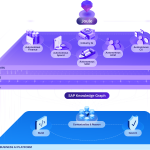
For more than five decades, we have powered the core processes that run the world’s leading organizations. Our systems don’t just store data; they encode how businesses actually operate: their processes, rules, and decisions. Our ERP is the institutional memory and the brain of many companies across industries and around the globe. Our new SAP Business AI Platform brings together enterprise data, processes, and governance into a unified context for AI.
Building on this foundation, Joule is the interaction layer that connects people with AI and redefines how they interact with software. Joule Assistants collaborate with users, while Joule Agents execute business workflows end to end. This is how intelligence becomes embedded directly into operations, not added on top. We call this the SAP Autonomous Suite.
“Show me how my financial forecast for the year could change based on the latest pipeline and supply chain data.” On the surface, this looks like a simple prompt directed to a large language model. But disconnected from enterprise systems, the answer is mere speculation.
Grounded in the full context of the business, the system first identifies the correct business process from hundreds of mission‑critical processes and understands the specific configuration that governs how this process runs in your organization. It then selects exactly the right data from millions of data fields stored across the ERP landscape. Finally, every step is checked against identity, authorization, and access controls, ensuring the result is accurate, compliant, and trustworthy. This is how enterprises move beyond generic, probabilistic answers toward decisions they can rely on.
Reaching this state requires more than adding a chatbot or layering AI on top of existing systems. Many enterprises still operate with fragmented landscapes, data spread across systems, and processes shaped by years of incremental change. In this environment, AI cannot simply be “bolted on” or layered onto fragmented, outdated systems. It does not accelerate progress. It amplifies inefficiency and risk. Companies must rethink how their processes, data, and infrastructure work together and how humans and AI share responsibility. This is not only a technical shift. It is a change‑management challenge.
New technology only creates value when it is accompanied by real change. AI does not replace transformation. It raises the return on transformation done well. And it comes to life only when every element of the system—the agent, the process, and the human—works together by design. People need to understand how to work with AI agents, and processes must be intentionally shaped to embed intelligence where decisions and execution happen.
This is why change management is foundational. It means reskilling employees, re‑engineering processes to connect them directly with data and AI, and modernizing the underlying landscape.
That is why we are introducing new AI-led RISE with SAP and SAP GROW offerings and fundamentally resetting our services model: to help companies modernize, navigate change, and turn AI from potential into sustained business value at their own pace.
This marks the beginning of a new era of enterprise software: where intelligence is not separate from operations but embedded within them. The companies that lead will not be those with the most advanced models in isolation, but those that connect AI to the way their business actually runs—with context, governance, and trust.
This is the dawn of the Autonomous Enterprise, and SAP is uniquely positioned to help the world’s leading organizations realize its full potential.
Christian Klein is CEO of SAP SE.
Get news, stories, and highlights about SAP delivered straight to your inbox each week