



Check how complex the migration of your SAP Business One to the cloud really is.

SAP Advances Finance Operations with Embedded Payments, New Consolidation Capabilities, and Expanded AI
New innovations in payments, enterprise performance management, and AI automation help finance teams move quickly from insight to execution while maintaining governance and control.
Finance leaders today are expected to do far more than report results. They’re expected to shape business outcomes, guide decisions, and respond quickly to change. Yet many finance processes still operate in isolation rather than in concert. Invoice approval and payment execution happen in separate places.
Planning, consolidation, and reporting often rely on separate systems and workflows. And governance often misses critical information by operating in a silo. The result is delays between identifying an issue, making a decision, and taking action.
This year at SAP Connect, SAP announced new capabilities designed to help close those gaps. These include SAP Pay, a new payment service embedded in SAP Cloud ERP; SAP Enterprise Financial Consolidation, a new addition to SAP’s enterprise performance management portfolio; and an expanded set of Joule Assistants that bring AI-powered support to finance, governance, and compliance processes.
While each innovation addresses a different challenge, they share a common objective. Finance teams should spend less time moving information between systems and more time acting on insights.
Embedding payments into finance operations
One of the most persistent sources of friction in finance is the payment process itself.
An invoice may be approved in the ERP system, but completing the payment often still involves banking portals, payment files, middleware, and reconciliation activities. Each additional handoff introduces complexity and can slow execution.
SAP Pay is designed to simplify that process by embedding payment execution directly into SAP Cloud ERP. When an invoice is approved, payment and reconciliation can occur within the same workflow and the same business context.
The launch also marks SAP’s entry into payment services through Tereina, a wholly owned SAP subsidiary established earlier this year. As a regulated payment-service provider, Tereina enables SAP to deliver services natively within finance workflows rather than relying solely on third-party providers. This helps keep payment execution, reconciliation, controls, and auditability connected to the underlying business transaction.
The service supports EFT, wire transfers, checks, and stablecoin-based settlement for cross-border transactions. More broadly, SAP offers customers a wide range of payment options, spanning bank API integrations, connectivity to more than 10,000 financial institutions through SWIFT, digital-currency payments, and now natively embedded payment services.
For finance organizations, the opportunity is not simply faster payment execution. It is reducing the effort required to connect systems, manage exceptions, and reconcile information after the fact while keeping payment processing, reconciliation, controls, and auditability within a single workflow.
SAP Pay is now generally available in the United States and the United Kingdom.
Connecting performance management across the enterprise
The same challenge appears across enterprise performance management.
Planning, consolidation, close processes, and external reporting all rely on the same financial reality. Yet they are often managed through separate tools, data models, and processes. Maintaining a consistent view of performance can become increasingly difficult as organizations grow and business conditions change.
At SAP Connect, we announced SAP Enterprise Financial Consolidation to help address that challenge.
Built on SAP Business Data Cloud, the solution brings together statutory and management consolidation with close and disclosure capabilities on a common governed data foundation. By connecting these activities more closely, finance teams can spend less time reconciling information and more time understanding performance and responding to change.
The solution also includes new Joule Assistants for consolidation and disclosure processes. These assistants help identify anomalies, resolve exceptions, and support disclosure preparation while maintaining auditability and human oversight.
For organizations operating mixed environments–some SAP, some non-SAP environments–SAP Enterprise Financial Consolidation provides flexibility by supporting data from multiple sources. It also offers a path forward for customers looking to modernize existing consolidation environments and adopt a more AI-enabled approach to performance management.
SAP Early Adopter Care is planned for the first quarter of 2027.
Expanding AI across finance and governance
AI’s potential in finance extends beyond answering questions or generating summaries. The larger opportunity is helping teams complete work that has traditionally required significant manual effort, specialist knowledge, and cross-functional coordination.
At SAP Connect, SAP expanded its portfolio of Joule Assistants to address these opportunities.
The new assistants support areas including accounting, revenue recognition, pricing, disclosure management, project operations, governance, and trade compliance. Embedded directly into existing workflows, they are designed to help teams complete tasks more efficiently while preserving review processes and accountability.
Some focus on helping finance professionals understand complex calculations and reporting requirements. Others support pricing decisions, disclosure preparation, project execution, and continuous monitoring of risks and controls.
Just as important is governance.
As organizations deploy more AI agents across business functions, they need assurance that those agents operate within the same boundaries that govern human users. New governance, security, and compliance assistants are designed to extend existing controls, access management, and monitoring capabilities to AI-driven activities, helping organizations apply consistent oversight across both human and digital actors.
General availability for the Governance Assistant and International Trade Assistant is planned for Q4 2026.
From financial insight to immediate action
Finance has always played a central role in helping organizations understand performance. Increasingly, it is also expected to help organizations respond in real time.
That makes speed, visibility, and execution just as important as reporting accuracy.
The innovations SAP announced at SAP Connect reflect that shift. Whether simplifying payments, connecting performance management processes, or embedding AI directly into everyday finance work, each reduces the operational distance between identifying an issue and acting on it.
For finance teams, the ultimate goal is not simply faster processes or faster reports. It is making better decisions with greater confidence and executing those decisions with less friction.
Learn more about how SAP is helping organizations modernize finance operations across ERP, planning, treasury, payments, and accounting here.
Lawrence Martin is general manager and chief product officer for SAP Finance & Spend.
David Imbert is chief marketing officer for SAP Financial Management.

How EssilorLuxottica Runs Global Operations with SAP S/4HANA Cloud and AI
EssilorLuxottica — home to brands like Ray-Ban and Oakley, shapes how millions of people see and experience the world. Hear how SAP S/4HANA Cloud and AI helps them drive global operational excellence.
Read the full story → https://news.sap.com/?p=247588
When Sustainability Data Meets Finance-Grade Rigor: Winning Under IFRS S1 and S2
Trusted sustainability data is becoming one of the most valuable assets an enterprise holds. It shapes investor confidence, influences access to capital, and increasingly steers the decisions that determine long-term resilience. That shift is being accelerated globally by the IFRS® Sustainability Disclosure Standards, IFRS S1 and IFRS S2, now being adopted across more than 40 jurisdictions representing roughly 60% of global GDP.
As they take hold, organizations are expected to produce sustainability information that is as accurate, traceable, and decision-useful as their financial information. Sustainability reporting, in short, is becoming finance-grade, and the organizations that treat it that way will be the ones that turn disclosure into an advantage.
The challenge: establishing trusted sustainability data
The pressure to disclose has not eased. According to PwC’s Global Investor Survey, more than 70% of investors say sustainability must be integrated into corporate strategy. Sustainability data, in other words, is now central to safeguarding enterprise value.
For most organizations, the challenge is establishing a trusted data foundation that can support reporting, assurance, performance management, and decision-making at enterprise scale.
Too often, sustainability data remains fragmented across systems, functions, and geographies. Many companies still rely on disconnected processes and manual reporting, even as assurance expectations rise. EY’s 2024 Global Corporate Reporting Survey found that 96% of finance leaders have concerns about the integrity and reliability of their organization’s non-financial data.
Reporting can no longer sit within a single function. Finance, sustainability, operations, procurement, and risk teams must work from a common, governed foundation. And with some organizations reporting against IFRS S1 and S2 for the first time, while others must now map IFRS S1 and S2 requirements onto existing European Sustainability Reporting Standards (ESRS) or Global Reporting Initiative (GRI) disclosures, building a separate process for every framework only multiplies effort, cost, and complexity.
This is a data foundation problem, and it is where SAP is positioned to help.
How SAP helps organizations meet IFRS S1 and IFRS S2
SAP provides a sustainability suite that helps take organizations from compliance obligation to business value, spanning ESG frameworks and regulatory requirements while embedding sustainability insight into operations and business models.
At its center, SAP Sustainability Control Tower can serve as the single-entry point for audit-ready ESG reporting and sustainability performance management. It helps organizations manage disclosures across IFRS S1 and IFRS S2, ESRS, and other frameworks from one governed foundation that connects sustainability, financial, and operational data. With SAP-provided IFRS S1 and IFRS S2 metrics available within the solution, organizations can reduce manual effort and strengthen reporting confidence.
SAP Sustainability Footprint Management complements this by helping to calculate the emissions, energy, and environmental data relevant to IFRS S2 climate disclosures and other ESG reporting frameworks. Crucially, it draws on the same ERP data that runs finance, supply chain, and operations, grounding footprint calculations in verified business transactions rather than estimates or manual inputs.
The principle is configure once, report across frameworks. Emissions and energy data calculated in SAP Sustainability Footprint Management, together with master data configured once in SAP Sustainability Control Tower, can serve multiple disclosure obligations. Because IFRS S2 and ESRS E1 are highly interoperable for climate disclosures, a single data-collection scope can serve both. And as reporting requirements expand globally, SAP continuously evaluates regulatory developments and makes the most relevant frameworks available out of the box, so organizations can scale as requirements grow and stay focused on performance and outcomes. For IFRS S1/S2 jurisdiction-specific requirements, SAP’s partner ecosystem is well positioned to extend these capabilities to address local reporting needs.
AI extends this further. The Sustainability Regulatory Readiness Agent helps translate materiality assessment outcomes into reporting-scope decisions, while the SAP Sustainability Control Tower AI-assisted ESG report generation capability can generate structured, complete report drafts from validated metrics already in the system. Teams retain full control to review, refine, and finalize before publication, so organizations can scale efficiently while maintaining governance, transparency, traceability, and human oversight.
We see this in what our customers are doing. KNAPP AG, a value chain technology leader based in Austria, transformed its sustainability reporting with SAP Sustainability Control Tower and SAP Sustainability Footprint Management, implemented with KPMG Austria. Integrating about 200 to 250 metrics, the company completed its first round of CSRD reporting well ahead of the 2027/2028 mandate.
As Bernhard Bischof, solution reporting architect at KNAPP AG, put it: “Through our collaboration with SAP and KPMG, we are able to realize a resource-efficient and automated approach to sustainability reporting. We rely on innovative software solutions, in particular SAP Sustainability Control Tower and SAP Sustainability Footprint Management, to make our reporting efficient and sustainable.”
As organizations expand reporting beyond CSRD to include IFRS S1 and S2, the same trusted sustainability data foundation can help reduce duplication, improve consistency, and support more efficient reporting across frameworks.
From audit-ready reporting to performance management
With audit-ready ESG reporting as the starting point, the best value is derived from what trusted data enables beyond disclosure: understanding actual performance, identifying where action is needed, and making sustainability a genuine input to business decisions.
That value shows up across the organization. Trusted sustainability data strengthens governance and risk management, supports investor confidence and transparency, improves business steering, and shapes access to finance, cost of capital, and long-term resilience. KPMG’s ESG Assurance Maturity Index 2025 found that 60% of CSRD Wave 1 companies expect ESG assurance to expand their market share or client base.
SAP Sustainability solutions help move organizations from reactive reporting to proactive performance management. Embedded initiatives can turn strategy from a set of intentions into a portfolio of tracked, measured, and accountable actions, each linked to the metrics and targets that define an organization’s ESG commitments. With that foundation in place, sustainability becomes embedded in enterprise processes rather than a stand-alone reporting activity, applied where decisions are made rather than as a downstream task. This is the foundation of SAP’s vision for the Autonomous Enterprise, where sustainability is embedded in the decisions that run the business.
What organizations should do now
Two priorities stand out for leaders today. First, build a trusted sustainability data foundation, with governance, traceability, and auditability established from the start. Second, prepare to report across multiple frameworks and jurisdictions from one common foundation, rather than building parallel processes for each.
Organizations that establish trusted sustainability data foundations today will be better positioned to meet IFRS Sustainability Disclosure Standards, strengthen governance, support investor confidence and access to capital, and create long-term business value.
For more information, visit: www.sap.com/products/scm/sustainability-control-tower
Gunther Rothermel is SAP Sustainability chief product officer.
Why Data Integration is the Ultimate AI Strategy You’ve Been Looking For
Most AI problems are actually data problems.
Fragmented sources, inconsistent formats, no shared context. Until that’s fixed, the model doesn’t stand a chance.
We decoded data integration here: https://sap.to/6057BEDOiF

Introducing Autonomous Spend Management | #SAPSapphire
At SAP Sapphire 2026, SAP Supply Chain Management takes a major leap – from visibility to autonomous execution.
With Joule and expanded Joule Agents, supply chain teams can now detect disruptions faster, act with confidence, and orchestrate action across the entire supply chain in real time.
This isn’t just automation. It’s intelligent, connected execution – powered by trusted business data.
See what’s new in Autonomous SCM: https://sap.to/6057B8UJNT
#SAPSapphire #SupplyChain #Joule
Moving SAP Business One to the cloud: Cloud Assessment
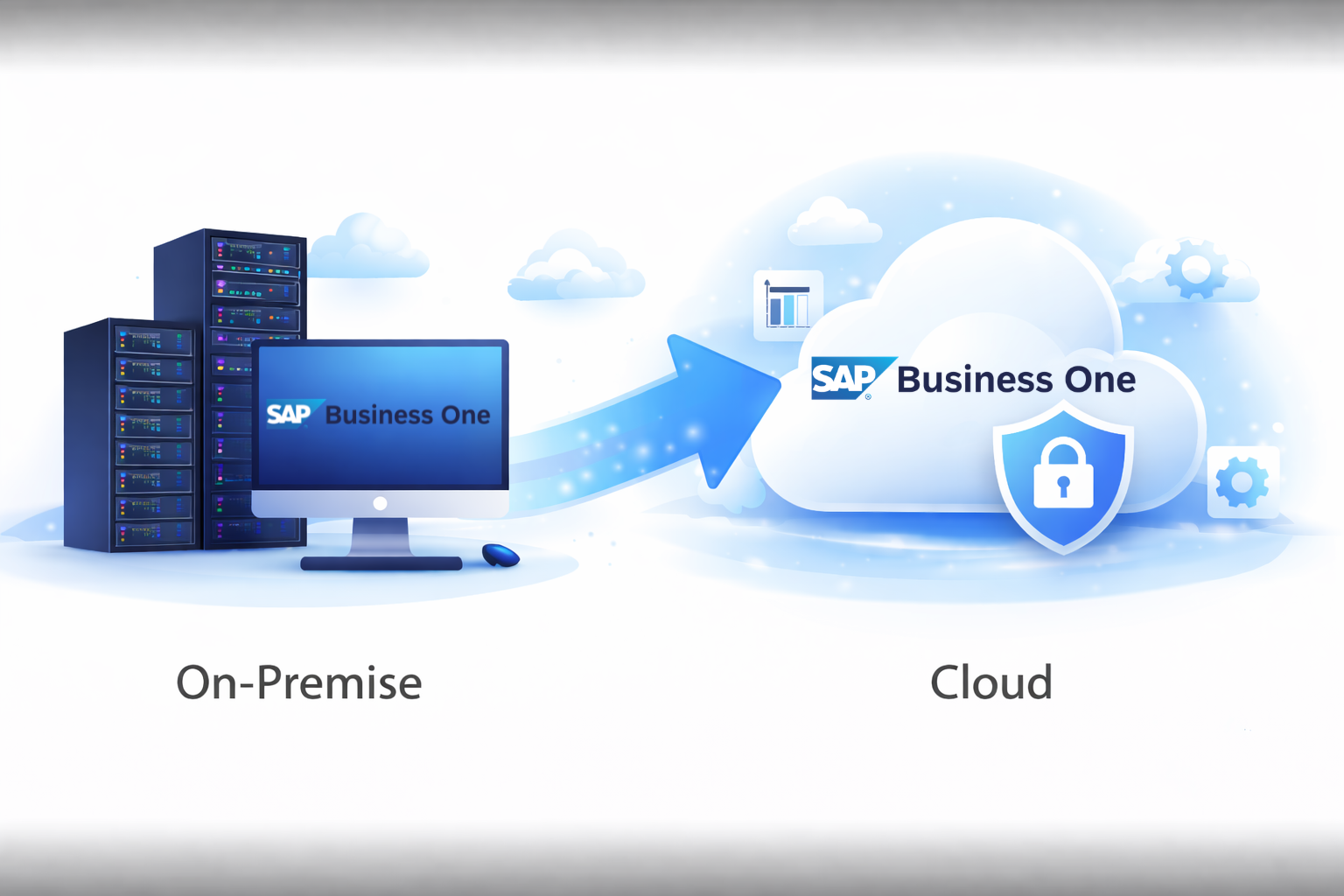
SAP Business One: From the server to the cloud
A cloud assessment helps companies determine how their existing system can be securely migrated from server operation to the cloud.
Who is this relevant for?
For companies that
-
Run SAP Business One on your own servers
-
want to check if your existing system is cloud-compatible
-
want to reduce the costs for hardware, maintenance and operation
-
Looking for more flexibility regarding locations, mobile working and home office
-
want to prepare a clean transition to the cloud
What is a cloud assessment about?
Many companies have been running SAP Business One stably on their own server infrastructure for years. At the same time, the desire is growing to simplify technical operations, work more flexibly, and relieve the burden on their own IT department.
Migrating to SAP Business One Cloud is generally quite feasible. In practice, however, the effort required depends heavily on the existing system’s architecture: Which version is in use? Which database is being used? What add-ons, customizations, and interfaces are present?
This is precisely where the Cloud Assessment comes in. It creates a reliable basis for decision-making and shows how well your current SAP Business One system is suited for operation in the cloud, which technical requirements are met, and which steps are advisable before a migration.
Every SAP Business One system is different.
Migrating from an existing on-premise installation to the cloud is often portrayed as straightforward. However, many SAP Business One systems have evolved over years and contain individual customizations, interfaces, and unique features that should be considered before migration.
-
Different SAP Business One versions in use
-
Different Database technologies such as Microsoft SQL or SAP HANA
-
Individual Add-ons, extensions and modifications
-
Existing Integrations with third-party systems
-
Open questions regarding cloud capability, upgradeability and technical adaptation needs
Without this review, it often remains unclear how complex a change will actually be and what risks need to be considered in the project.
How does the cloud assessment for SAP Business One work?
With the Cloud Assessment, SAP partners systematically examine how well your existing SAP Business One installation is suited for operation in the cloud and what preparatory work is necessary for a secure migration.
-
Analysis of your initial situation and the current use of SAP Business One
-
System environment check including database type, release status and technical requirements
-
Evaluation of the company database regarding consistency, upgradeability and migration readiness
-
Review of add-ons, extensions and customizations cloud compatibility
-
Evaluation of existing interfaces and external system connections
-
Preparing for a migration-ready state, provided that technical steps are necessary beforehand
-
Test migration to the cloud with import of the database into the SAP Business One cloud environment
-
Provision of a test system, so that specialist departments and users can realistically assess the environment
This does not result in a theoretical assessment, but rather a sound basis for deciding whether and how the migration of your existing system from server operation to the cloud can be implemented effectively.
The result: From server to cloud
After the cloud assessment, it becomes clearer how your existing SAP Business One system should be classified technically and how a potential migration can be planned effectively. Risks become apparent early on, necessary preparatory work is transparent, and the next step can be reliably planned.
-
More clarity about the technical condition of your system
-
More security in migration planning
-
transparency about add-ons, interfaces and potential hurdles
-
A realistic basis for decision-making for the move to the cloud
-
A structured approach from the existing on-premises environment to the future cloud operation
This transforms a basic cloud idea into a concrete, technically sound project.

Is your SAP Business One ready for the cloud?
With a Cloud Assessment, we check how well your existing installation is suited for moving to the cloud – including database, add-ons, interfaces and technical migration path.
Why companies run SAP Business One in the cloud
If the technical requirements are met, running SAP Business One in the cloud offers noticeable advantages in everyday use:
-
Less in-house infrastructure costs: No need to operate your own servers for SAP Business One
-
Relief for internal IT: Maintenance and operational tasks are reduced
-
More flexibility: Access from the office, home office, or other locations
-
Scalable operating environment: Resources can be more easily adapted to demand.
-
A stable foundation for continued operation: Backups, availability, and security standards are clearly regulated.
Especially for medium-sized companies, this is often an important step to continue using SAP Business One in the long term with less technical operating effort.
Does our SAP Business One Cloud fit with your existing system?
In an initial consultation, we will jointly review your current situation: current version, database, add-ons, interfaces and possible requirements for a move to the cloud.
This will quickly give you a realistic picture of whether a cloud assessment makes sense for your company and what the next steps could be.
[contact-form-7 404 "Not Found"]The post SAP Business One in die Cloud wechseln: Cloud Assessment appeared first on SAP Business One Consulting.
The Next Era of Business AI
Today, most companies are experimenting with AI. Many of them can point to demos that impressed, pilots that worked, and tools that saved time in narrow tasks. Far fewer can say AI has changed their business across functions, processes, and teams.
The difference is not the model. It is context: the ability for AI to understand how a business actually runs.
Much of today’s AI discussion centers on agents, along with models and benchmarks. Which model performs best? Which system completes the most tasks? Which interface feels most natural? These factors matter, but they do not solve the central enterprise challenge.
Companies run workflows that cut across teams, policies, approvals, authorizations, and data. They plan, source, produce, hire, pay, and serve through systems that carry real business consequences. AI only creates durable value at scale when it operates inside this reality.
Models generate answers. An agent can complete a task. But running a business requires something more. It requires an understanding of how work gets done, who is authorized to act, which rules apply, and how decisions connect across functions. Without that context, AI simply can’t deliver on its promise.
That is one reason I believe AI raises the premium on software with deep business context. It allows companies to fundamentally reinvent how work gets done. When AI agents understand end‑to‑end processes, they can operate across functions, execute workflows autonomously, and coordinate actions in real time. Instead of automating individual steps, AI can run processes end to end, freeing employees from repetitive coordination and enabling them to focus on higher‑value judgment, oversight, and strategy.
This is what we describe as the Autonomous Enterprise, a fundamental shift from systems of execution to systems that can reason, decide, and act. A vision where SAP is poised to lead.
For more than five decades, we have powered the core processes that run the world’s leading organizations. Our systems don’t just store data; they encode how businesses actually operate: their processes, rules, and decisions. Our ERP is the institutional memory and the brain of many companies across industries and around the globe. Our new SAP Business AI Platform brings together enterprise data, processes, and governance into a unified context for AI.
Building on this foundation, Joule is the interaction layer that connects people with AI and redefines how they interact with software. Joule Assistants collaborate with users, while Joule Agents execute business workflows end to end. This is how intelligence becomes embedded directly into operations, not added on top. We call this the SAP Autonomous Suite.
“Show me how my financial forecast for the year could change based on the latest pipeline and supply chain data.” On the surface, this looks like a simple prompt directed to a large language model. But disconnected from enterprise systems, the answer is mere speculation.
Grounded in the full context of the business, the system first identifies the correct business process from hundreds of mission‑critical processes and understands the specific configuration that governs how this process runs in your organization. It then selects exactly the right data from millions of data fields stored across the ERP landscape. Finally, every step is checked against identity, authorization, and access controls, ensuring the result is accurate, compliant, and trustworthy. This is how enterprises move beyond generic, probabilistic answers toward decisions they can rely on.
Reaching this state requires more than adding a chatbot or layering AI on top of existing systems. Many enterprises still operate with fragmented landscapes, data spread across systems, and processes shaped by years of incremental change. In this environment, AI cannot simply be “bolted on” or layered onto fragmented, outdated systems. It does not accelerate progress. It amplifies inefficiency and risk. Companies must rethink how their processes, data, and infrastructure work together and how humans and AI share responsibility. This is not only a technical shift. It is a change‑management challenge.
New technology only creates value when it is accompanied by real change. AI does not replace transformation. It raises the return on transformation done well. And it comes to life only when every element of the system—the agent, the process, and the human—works together by design. People need to understand how to work with AI agents, and processes must be intentionally shaped to embed intelligence where decisions and execution happen.
This is why change management is foundational. It means reskilling employees, re‑engineering processes to connect them directly with data and AI, and modernizing the underlying landscape.
That is why we are introducing new AI-led RISE with SAP and SAP GROW offerings and fundamentally resetting our services model: to help companies modernize, navigate change, and turn AI from potential into sustained business value at their own pace.
This marks the beginning of a new era of enterprise software: where intelligence is not separate from operations but embedded within them. The companies that lead will not be those with the most advanced models in isolation, but those that connect AI to the way their business actually runs—with context, governance, and trust.
This is the dawn of the Autonomous Enterprise, and SAP is uniquely positioned to help the world’s leading organizations realize its full potential.
Christian Klein is CEO of SAP SE.
Cirque du Soleil soar into the future with SAP Business AI
Cirque du Soleil transforms finance operations with SAP Business AI, automating invoices and enhancing supplier experiences.
Creativity meets intelligence in Cirque du Soleil’s journey with SAP. Known for reimagining live entertainment, Cirque du Soleil also innovates behind the scenes—streamlining operations and scaling global finance processes with SAP Business AI.
With more than 4,000 employees and 50 shows running worldwide, Cirque du Soleil needed a faster, smarter way to manage complex supplier relationships and financial transactions. The company adopted the AI Invoice Assistant, powered by SAP Business AI, to simplify invoice processing, reduce manual workloads, and deliver faster response times with multilingual support.
Now, finance teams can focus on strategic work while automation handles repetitive tasks—improving accuracy, consistency, and supplier satisfaction. With SAP Business AI, Cirque du Soleil has achieved new levels of operational agility, enabling them to continue inspiring audiences through innovation both on and off the stage.
“AI is helping us simplify, scale, and automate,” says Marianne LaRochelle, Vice President of Marketing, Cirque du Soleil. “With SAP, we’re embracing the next chapter of intelligent business.”
This partnership demonstrates how SAP Business AI integrates seamlessly into enterprise processes, combining intelligence with trusted business data. From finance and procurement to HR and supply chain, SAP helps organizations work smarter, faster, and more creatively.
00:00 – Introduction
00:26 – The Challenge: Complex Global Finance Operations
01:05 – Introducing the AI Invoice Assistant
02:02 – Automation and Multilingual Efficiency
02:48 – Supplier Experience Transformation
03:30 – The Future of Business AI at Cirque du Soleil
Discover how Cirque du Soleil brings creativity and intelligence together with SAP: https://sap.to/6056B8GRX6

Introducing the New Joule Studio: Build AI Agents, Apps, and Workflows | Overview
Meet Joule Studio, SAP’s AI-first development environment for building AI agents, apps, and workflows with enterprise control.
Joule Studio helps teams move from business intent to enterprise-ready development faster. In this short overview, see how SAP’s new AI-first development environment supports the creation and operation of AI agents, applications, and workflows designed for real business processes.
Built for people at every level, Joule Studio brings together development, automation, and AI agent capabilities in one environment – grounded in SAP business context, governance, security, and lifecycle control. It is part of SAP’s broader vision for the Autonomous Enterprise, where people set direction, and AI helps execute trusted, end-to-end work across the business.
00:00 – Introducing Joule Studio
00:10 – Build AI agents, apps, and workflows
00:25 – Develop with SAP business context
00:40 – Scale with governance and control
Try Joule Studio: https://sap.to/6055BBlrbc
Follow us on social:
LinkedIn: https://sap.to/6056BBlrbY
Instagram: https://sap.to/6057BBlrbl
Facebook: https://sap.to/6058BBlrbm
Threads: https://sap.to/6059BBlrbW
About SAP:
As a global leader in enterprise applications and business AI, SAP stands at the nexus of business and technology. For over 50 years, organizations have trusted SAP to bring out their best by uniting business-critical operations spanning finance, procurement, HR, supply chain, and customer experience. For more information, visit: https://sap.to/6050BBlrbo
#SAPBusinessAI #JouleStudio #AI