SAP Business AI Platform is opening new ways for enterprises to build, extend, and adopt AI agents at scale.
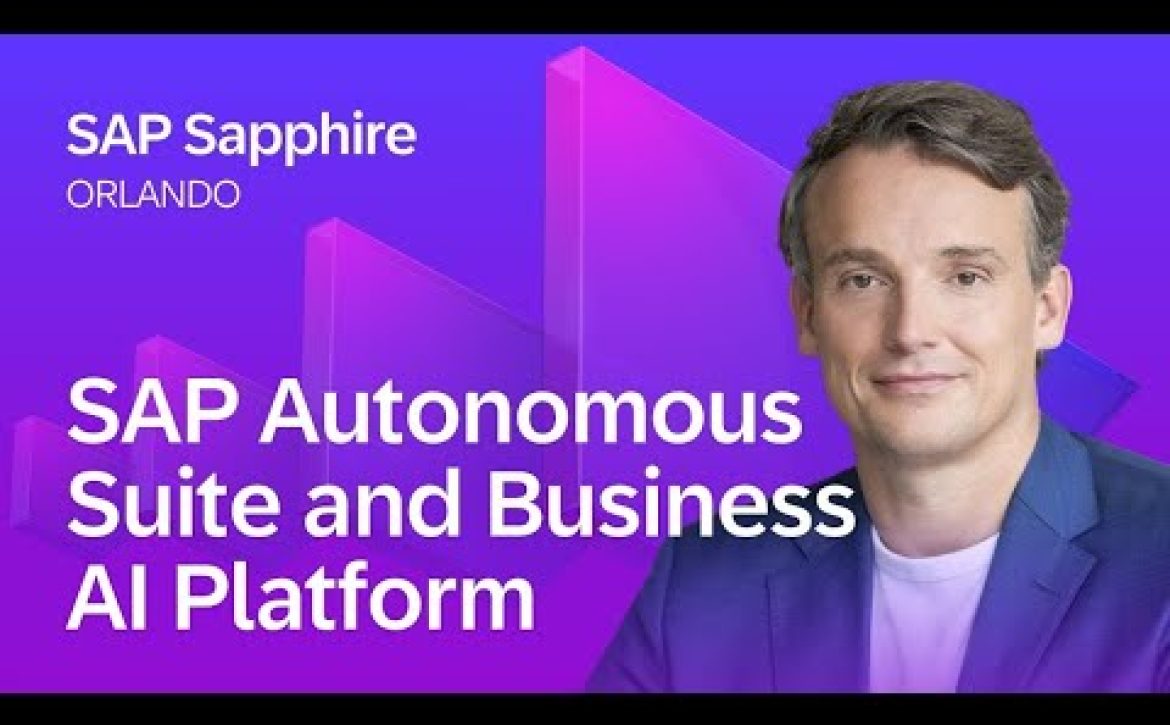
In this SAP Sapphire Orlando 2026 keynote segment, Christian Klein, SAP’s Chief Executive Officer, announces three updates to help customers and partners accelerate AI adoption: open data exchange between SAP AI agents and third-party agents, free AI development with Joule Studio 2.0, and more than €100 million in ecosystem investment to build agents and drive adoption.
The video also introduces SAP Autonomous Suite, a major evolution of SAP’s application business. Spanning Autonomous Finance, Spend, Supply Chain, HCM, and CX, the suite is designed to help businesses move from systems of execution to systems that can listen, understand, steer, and manage work with people in the loop.
With role-centric Joule Assistants, outcome-based agents, audit-ready traceability, extensibility by design, and open orchestration across SAP and non-SAP agents, SAP is reimagining how enterprises run in the age of AI.
Watch the full Global Keynote: https://sap.to/6053BBLz7t
Watch all SAP Sapphire replays on demand: https://sap.to/6054BBLz7Q
Follow us on social:
LinkedIn: https://sap.to/6055BBLz7v
Instagram: https://sap.to/6056BBLz7a
Facebook: https://sap.to/6058BBLz7I
Threads: https://sap.to/6050BBLz70
About SAP:
As a global leader in enterprise applications and business AI, SAP stands at the nexus of business and technology. For over 50 years, organizations have trusted SAP to bring out their best by uniting business-critical operations spanning finance, procurement, HR, supply chain, and customer experience. For more information, visit: https://sap.to/6051BBLz7F
Partnership opens new pathways for enterprise data migration with SAP AI-supported tooling complemented by Palantir’s AIP for data migration scenarios to simplify an expedite digital transformation for SAP customers, with Accenture as a co-innovation partner for joint customers
SAP Sapphire in 2026: Advancing the Autonomous Enterprise
This year at SAP Sapphire, SAP and Palantir announced an expansion of their strategic partnership focused on delivering new data migration capabilities designed to help enterprise customers succeed in the AI era and realize SAP’s vision of the Autonomous Enterprise.
The enhanced partnership is designed to facilitate joint customers’ cloud migrations, with the most complex data migration scenarios moving quickly, securely, and confidently through their business transformation journeys.
AI embedded across the migration life cycle
The expanded partnership builds on SAP’s broader agentic migration strategy, uniting SAP’s deep expertise in enterprise applications and SAP Business AI with Palantir’s AIP to deliver AI-driven data migration capabilities that accelerate timelines, secure cost efficiencies, and fundamentally transform how organizations operate. SAP customers can now leverage Palantir’s AIP for data migration scenarios alongside the agent-led toolchain from SAP, which includes business transformation tools and the new migration and modernization assistants to accelerate their transformations to SAP Cloud ERP.
“To turn the vision of the Autonomous Enterprise into reality, organizations need trusted partners to help them transform their core operations and unlock the power of business data and AI,” said Christian Klein, CEO of SAP SE. “Together with Palantir, we are enabling customers to move to the cloud with speed and confidence through complementary capabilities that accelerate innovation across the enterprise.”
“We are proud to partner with SAP and Accenture to bring the power of advanced AI and data migration to the world’s most important operations. This partnership is designed to help customers realize the full value of their data, accelerate cloud migrations and AI adoption, and build more resilient and efficient operations,” said Alex Karp,co-founder and CEO of Palantir Technologies.
Accenture as global strategic services partner
Accenture plays a key role in bringing this joint effort to life as the first global strategic services partner for this initiative, helping their clients translate these capabilities into large-scale business-led programs. Together, SAP, Palantir, and Accenture can help joint customers identify acceleration opportunities across SAP and non-SAP systems sooner, achieve faster time-to-value, and drive continuous innovation by fundamentally redefining the approach to SAP Cloud ERP migrations.
By embracing AI from day one, organizations can automate migration analysis, planning, remediation, testing, and impact assessment—moving from tracking project timelines to creating measurable business value at every stage.
“In today’s world, speed to value is critical for our clients,” said Julie Sweet, chair and CEO of Accenture. “We are excited to co-innovate with SAP and Palantir to help our clients accelerate their journey to ERP modernization with SAP, which is the foundation for reinventing core operations and using AI to achieve new performance frontiers.”
New SAP-validated deployment options
SAP is making Palantir AIP for data migrations scenarios available as an SAP Endorsed App on the SAP Store, and soon as an SAP Solution Extension, establishing a trusted, SAP-validated path for accelerating complex data migrations, including migrations to SAP Cloud ERP. The new SAP Solution Extension unites SAP’s deep expertise in mission-critical business processes and semantically rich data with Palantir AIP to securely accelerate data migrations for SAP customers. With the new offering, customers can gain faster insights and more intelligent, data-driven business outcomes.
Together, SAP and Palantir are redefining SAP data migrations, including ERP modernization through complementary solutions, transforming a traditionally complex migration process into an effort that enables faster value realization.
Availability
Palantir AIP for data migration scenarios is now available as an SAP Endorsed App on the SAP Store. The SAP Solution Extension is planned to be generally available to SAP customers in Q3 2026.
Jan Gilg is a member of the Extended Board of SAP SE.
SAP Sapphire in 2026: Discover our bold new vision for how businesses will run from now on
AI agents are no longer confined to demos and copilots. They are beginning to act inside real enterprise systems: executing tasks, invoking tools, and operating continuously across business processes.
SAP Sapphire in 2026: Advancing the Autonomous Enterprise
For SAP customers, this shift promises step-change productivity. But it also raises a hard requirement: Enterprise AI agents must be safe, governable, and auditable by design.
This is the context for SAP’s deep technical collaboration on SAP Business AI Platform with NVIDIA OpenShell, an open source secure runtime for autonomous AI agents. This collaboration is not about SAP “adopting” a runtime. It is about SAP actively shaping, hardening, and productizing the execution layer for enterprise agentic AI—together with NVIDIA.
Why this matters to SAP customers
For SAP customers, the value of this collaboration is concrete and practical. It enables:
AI agents that operate inside SAP processes without bypassing governance
Security models aligned with enterprise IAM and compliance frameworks
Clear audit trails for agent actions across systems
Confidence to move from pilots to production
Most importantly, it avoids a false choice between innovation and control. Customers do not have to bolt security on later, or redesign their risk models to accommodate AI agents. Instead, security and governance are built into the execution model from the start.
The real enterprise challenge: Trusting agents that act
When AI systems move from generating responses to executing actions, the risk profile fundamentally changes. Agentic systems can touch systems of record, cross application and data boundaries, and operate without human review at every step.
In all enterprise environments, especially regulated ones, this makes execution safety and governance the defining challenge. Traditional chatbot-era controls are insufficient once agents can access shells, files, networks, credentials, and APIs.
SAP customers know this reality well. Business AI is only valuable if it can be:
Inspected and audited
Constrained by policy
Trusted by security and compliance teams
Solving this problem requires more than infrastructure primitives or application-level rules alone.
NVIDIA OpenShell: The foundation
NVIDIA OpenShell addresses a critical layer of the problem: secure, sandboxed execution of autonomous agents.
As an open source runtime, OpenShell introduces strong capabilities, including:
Isolated execution environments
Policy enforcement for filesystem and network access
Runtime-level containment that limits blast radius even when agent logic fails
These capabilities form a foundational layer for autonomous agents to execute safely. In practice, enterprises need that execution layer aligned with business context and governance.
Enterprises expect clarity on questions such as:
Which business role authorizes an action?
Which process context applies?
How actions map to enterprise policies and audit trails?
This is where SAP’s contribution becomes decisive.
What SAP brings: Enterprise semantics, governance, and scale
SAP is co-developing and contributing to OpenShell based on enterprise reality.
1. Enterprise-driven runtime requirements
SAP operates at a level of scale and responsibility that few software providers do: mission-critical processes, regulated industries, and millions of transactions per hour.
By bringing real SAP agentic workloads into the collaboration, SAP provides the operational proving ground that OpenShell needs to mature from a powerful runtime into an enterprise-hardened one.
This includes shaping requirements around:
Isolation boundaries that match enterprise risk models
Policy enforcement aligned with real business constraints
Auditability that stands up to customer and regulatory scrutiny
2. Co-development of OpenShell capabilities
SAP is committing engineering capacity to the OpenShell open-source code base, with a focus on areas that matter specifically to enterprises: runtime hardening, policy modeling, enterprise identity integration, and auditing and governance hooks.
SAP is helping define how secure agent execution must work for enterprises; not just theoretically, but in production.
3. Joule Studio runtime: From runtime safety to enterprise control
Where OpenShell secures execution, Joule Studio runtime provides the enterprise harness that makes agents usable and governable in business systems:
Business-aware policy semantics like roles, skills, life cycle
Enterprise identity and access control
Observability and auditability across agent behavior
Deployment and operational governance across landscapes
This ensures that agent autonomy is always framed by business intent and accountability, not just technical permissions.
OpenShell answers: “Can this action safely execute?”; Joule Studio runtime answers: “Should this action happen at all?”
Raising the bar for enterprise agentic AI
This collaboration represents more than an integration. It reflects a shared intent to define what “enterprise-grade” actually means for autonomous AI systems.
By combining NVIDIA’s runtime and security innovation and SAP’s enterprise productization, governance expertise, and operational scale, SAP and NVIDIA are working toward an integrated solution for trusted agent execution—one that enterprises can inspect, govern, and rely on.
For SAP customers, this means AI agents that are not just powerful, but designed to earn trust in the environments where trust matters most.
Andre Lamego is senior vice president and chief product officer of SAP BTP Fabric
SAP Sapphire in 2026: Discover our bold new vision for how businesses will run from now on
WALLDORF and AUSTIN — SAP SE (NYSE: SAP) and Dremio today announced that SAP has agreed to acquire Dremio, an open, high-performance data lakehouse platform built to accelerate agentic AI and expand SAP Business Data Cloud’s ability to combine SAP and non-SAP data to more effectively run analytical and AI workloads in real time.
Terms of the deal were not disclosed. The transaction is still pending regulatory approval.
Most enterprise AI projects fail to deliver value not because of the AI itself, but because the underlying data is fragmented, locked in proprietary formats and stripped of the business context that makes it meaningful. The result is a familiar and costly pattern: pilots that cannot scale, slow integration of new data sources, duplicated engineering work and compliance risk when organizations cannot explain how an AI-driven decision was reached. Dremio helps eliminate that data fragmentation and integration friction. The acquisition will complement the SAP Business Data Cloud and SAP HANA Cloud offerings to ensure seamless data integration across SAP and non-SAP data with high performance and low cost to accelerate AI-ready context and time-to-value for AI.
“Enterprise AI doesn’t stall because the models aren’t good enough; it stalls because the data isn’t ready for AI agents,” said Philipp Herzig, CTO, SAP SE. ” Dremio eliminates that bottleneck. Combined with SAP Business Data Cloud, we can now take customers from raw, fragmented data to governed, AI-ready intelligence on a single open platform.”
With Dremio, SAP Business Data Cloud will become an Apache Iceberg-native enterprise lakehouse that unifies SAP and non-SAP data to power agentic AI at enterprise scale. Apache Iceberg is the industry-standard open table format, and SAP Business Data Cloud will natively support it as its foundation. This means no data movement or format conversion will be necessary. SAP and non-SAP data can coexist on the same open foundation, with federated analytical reach across every enterprise data source, combined with SAP HANA Cloud’s in-memory engine for real-time transactions and operational performance.
The Dremio lakehouse platform is set to vastly improve the economics of enterprise analytics. It is serverless and elastic, scaling up automatically when demand spikes and scaling back down when it subsides, meaning no fixed capacity to provision and no performance ceiling when it matters most.
With Dremio, SAP will deliver a universal, open catalog built on Apache Polaris and the open Apache Iceberg REST Catalog API. It serves as both the discovery and semantic layer of SAP Business Data Cloud, giving every connected engine – SAP or non-SAP – a single point of access to unified business context: meaning, relationships, access rights and data lineage. This catalog will form the foundation of the SAP Knowledge Graph, embedding business relationships, organizational hierarchies, regulatory classifications and cross-system lineage as native properties.
Dremio has been a leading steward of open-source projects at the heart of its platform: Apache Iceberg, Apache Polaris and Apache Arrow, and SAP is fully committed to continuing to invest in and prioritize these contributions.
The transaction is expected to close in Q3 of 2026, subject to customary closing conditions, including regulatory approvals.
Dremio is the Agentic Lakehouse: the only Iceberg-native data platform built for agents and managed by agents. Every knowledge worker and AI agent gets instant, governed access to enterprise data through any LLM or tool of their choice. Federated queries reach any source without ETL pipelines. An AI Semantic layer adds business context so every agent draws from the same source of truth. The lakehouse manages itself, running clustering, optimization, and compaction autonomously. The result: trusted insights that drive better business outcomes, without the infrastructure complexity or overhead. A lead contributor to Apache Iceberg and co-creator of Apache Arrow and Apache Polaris. Trusted by Shell, TD Bank, Michelin, and thousands of organizations worldwide. www.dremio.com
About SAP
As a global leader in enterprise applications and business AI, SAP (NYSE:SAP) stands at the nexus of business and technology. For over 50 years, organizations have trusted SAP to bring out their best by uniting business-critical operations spanning finance, procurement, HR, supply chain, and customer experience. For more information, visit www.sap.com.
Sign up for the SAP News Center newsletter to receive stories and highlights each week
Note to editors: To preview and download broadcast-standard stock footage and press photos digitally, please visit www.sap.com/photos. On this platform, you can find high resolution material for your media channels.
For customers interested in learning more about SAP products: Global Customer Center: +49 180 534-34-24 United States Only: 1 (800) 872-1SAP (1-800-872-1727)
Across industries and geographies, organizations are operating in an environment defined by uncertainty. Geopolitical volatility, supply chain disruption, regulatory complexity, and accelerating technological change are no longer exceptional circumstances. They are the new baseline.
In this context, innovation is not about experimentation on the sidelines. It is about building the operational foundation required to remain effective, trustworthy, and competitive under pressure.
For many years, enterprise technology focused primarily on optimization, improving efficiency, reducing cost, and increasing speed. These goals still matter, but they are no longer sufficient for business success. Today, leaders must ensure that their organizations can adapt in real time, integrate seamlessly across ecosystems, and maintain control over their most critical data and processes.
Recognizing organizations innovating with purpose and achieving meaningful outcomes with SAP technologies
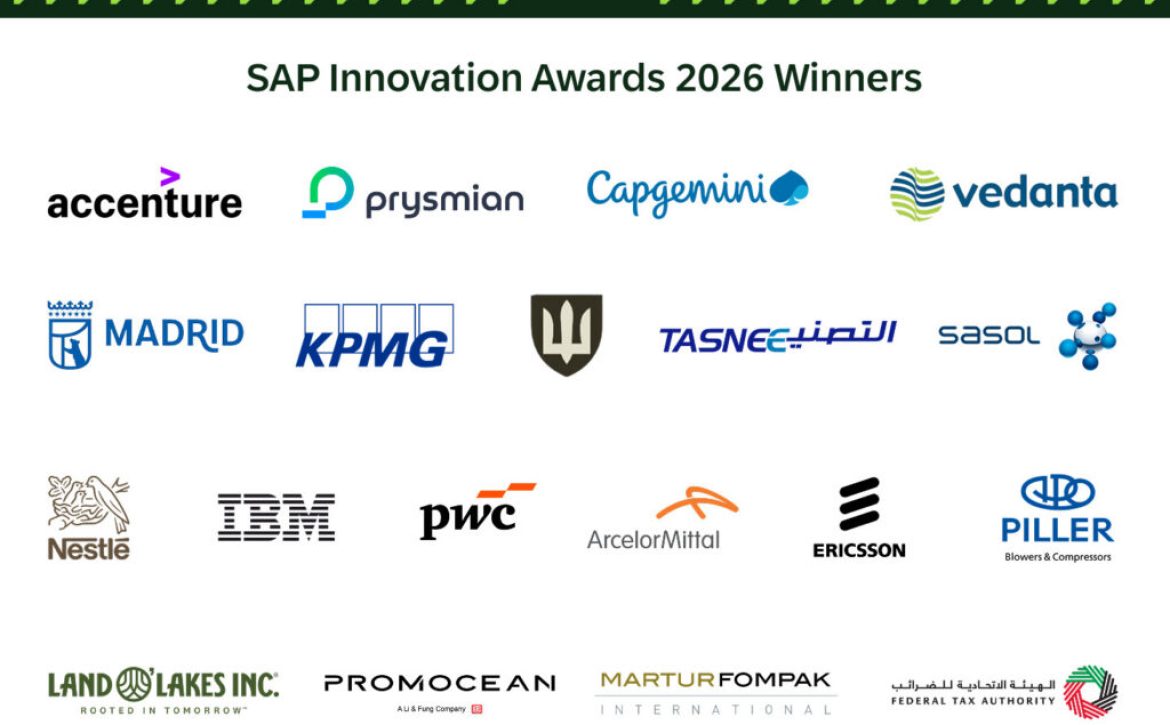
This shift, from readiness for known scenarios to resilience in the face of the unknown, is what unites the 19 winners of the 2026 SAP Innovation Awards.
From technology adoption to institutional capability
Earlier this month, we announced the finalists for this year’s awards. Today, it is my privilege to recognize the winners, organizations that have moved decisively from ambition to execution.
What distinguishes these companies, public institutions, and organizations is not the novelty of the technologies they use, but the way they apply them. They treat business processes as strategic assets. They design for interoperability, transparency, and trust. And they understand that digital transformation is ultimately about strengthening institutional capability, not simply deploying software.
Across hundreds of submissions, the winning projects consistently demonstrated three priorities that are increasingly inseparable:
Operational effectiveness, where strategic intent is translated into measurable outcomes
Control and sovereignty, ensuring compliance, security, and ownership of data while operating at global scale
Ecosystem orchestration, connecting partners, suppliers, and stakeholders to reduce fragmentation and increase responsiveness
By leveraging the depth and breadth of the SAP portfolio, from cloud ERP and business AI to industry solutions and SAP Business Technology Platform, these organizations have shown that stability and innovation are no longer mutually exclusive.
The 2026 SAP Innovation Award winners
The following organizations represent the action side of transformation. Each demonstrates how disciplined execution and a clear architectural vision can deliver tangible value for customers, employees, and society.
AI Excellence
Harnessing SAP Business AI to fundamentally improve productivity and decision-making:
Martur Fompak International
Cloud ERP Champion
Embracing cloud ERP as the backbone for long-term agility and scalability:
PricewaterhouseCoopers (PwC)
Vedanta Limited
Customer Experience Innovator
Redefining customer engagement through integrated, cloud-based business processes:
IBM
Financial Futurist
Modernizing financial operations to increase transparency, resilience, and trust:
Ministry of Defence of Ukraine
Industry Leader
Applying multiple SAP solutions to transform business models, collaborate across ecosystems, and generate societal or environmental impact:
Accenture (Service and Financial Services Industries)
People Experience Pioneer
Reimagining the employee experience through data-driven and human-centric transformation:
Capgemini
Procurement Visionary
Using automation and insight to strengthen spend control and supplier collaboration:
TASNEE (National Industrialization Company)
Services Superstar
Accelerating business outcomes through the effective use of SAP services:
Federal Tax Authority, United Arab Emirates
Supply Chain Catalyst
Building resilient, compliant, and transparent supply chains:
Sasol
Ericsson
Sustainability Hero
Leveraging data to enable responsible decision-making and support a more sustainable economy:
ArcelorMittal SA
Technology Pathfinder
Solving complex business challenges with measurable impact using SAP Business Technology Platform:
Promocean The Netherlands BV
Land O’Lakes, Inc.
Transformation Impact
Driving enterprise-wide change and strengthening long-term transformation capability:
KPMG International
Recognition and responsibility
All of our winners have set a clear benchmark for what resilient, future-ready organizations look like in practice.
We look forward to recognizing their achievements at SAP Sapphire, where customers and partners from around the world will come together to share insights, compare experiences, and continue shaping the ecosystems that underpin global business.
Looking ahead
The SAP Innovation Awards are more than just a moment of recognition. They signal that digital sovereignty, operational resilience, and responsible innovation are achievable across industries, sectors, and regions. The organizations recognized this year demonstrate what is possible when technology choices are guided by clear priorities and long-term thinking.
May these examples encourage others to take the next step, moving with confidence from readiness to resilience.
Welcome to SAP BTP Innobytes, your quick-hit series for the latest platform updates that help teams build, integrate, automate, and innovate faster, while keeping governance and security front and center.
In this first 2026 edition, we highlight new capabilities across data, integration, automation, and Joule experiences on SAP Business Technology Platform (SAP BTP). You’ll see how these updates can help developers, data users, and ops teams reduce friction, cut ambiguity, and move from insight to action faster, including:
✅ Explore data in SAP HANA Cloud using Data and Discovery Agents, even without deep knowledge of underlying objects
✅ Use a knowledge graph and Joule to translate questions into executable SQL and return results quickly
✅ Expand connectivity with new SAP Integration Suite adapters, including BambooHR and Microsoft Outlook, plus Edge Integration Cell additions
✅ Make automation more predictable with deterministic API error handling in SAP Build Process Automation
✅ Work more naturally in SAP Build Work Zone by asking Joule to create workspaces, invite colleagues, and upload files
✅ Turn repeatable ops tasks into agent-driven execution with SAP Automation Pilot, MCP servers, and a Joule Ops Agent
Chapters
00:00 – Intro
00:11 – SAP BTP Innobytes: Q1 2026 kickoff
00:37 – Data and Discovery Agents overview
00:42 – Data products, prediction table, and conversion probability
01:17 – Knowledge graph + ask Joule in natural language
02:03 – Beta availability note
02:16 – New SAP Integration Suite adapters
02:59 – Edge Integration Cell updates: File + OFTP2 adapters
03:35 – Deterministic API error handling in SAP Build Process Automation
05:31 – Joule in SAP Build Work Zone: create, invite, upload
07:35 – Agentic ops with SAP Automation Pilot, MCP servers, and Joule
👉 Register for the SAP HANA Cloud Data & Discovery Agents beta: https://sap.to/6058B6vGye
👉 Explore integration adapters for SAP Integration Suite: https://sap.to/6059B6vGy5
👉 Learn how to work with Joule in SAP Build Work Zone: https://sap.to/6050B6vGyg
👉 Read From Automation to Agentic Ops (MCP servers in SAP Automation Pilot): https://sap.to/6051B6vGy9
Follow us on social:
LinkedIn: https://sap.to/6052B6vGyi
Instagram: https://sap.to/6053B6vGyc
Facebook: https://sap.to/6054B6vGyY
Threads: https://sap.to/6055B6vGyl
About SAP:
As a global leader in enterprise applications and business AI, SAP stands at the nexus of business and technology. For over 50 years, organizations have trusted SAP to bring out their best by uniting business-critical operations spanning finance, procurement, HR, supply chain, and customer experience. For more information, visit: https://sap.to/6057B6vGyW
Join Andrea Miranda and SAP HANA Cloud experts for a deep dive into the latest SAP HANA Cloud innovations in Q1 2026. In this release overview, you’ll get a guided look at new capabilities that help teams explore enterprise data faster, streamline administration, improve performance analysis, and build intelligent applications with SAP HANA Cloud.
This Q1 2026 update covers key enhancements across AI and agents, machine learning and NLP, calculation view modeling, and SAP HANA Cloud Central (HCC). Use the chapters below to jump directly to the topics most relevant to your role, whether you’re a database administrator, developer, data engineer, or analytics professional.
Chapters:
00:00 – Introduction
01:59 – General update
06:45 – SAP HANA Cloud Agent Procedures – BETA
10:25 – Machine Learning NLP services updates
18:21 – Calculation View Modeling Updates
38:44 – SQL Tools for Administration in SAP HANA Cloud Central
43:31 – Introduction of a performance analysis application in HCC
50:28 – Multi-Region Disaster Recovery Update
56:47 – Further contents
👉 Learn more about SAP HANA Cloud: https://sap.to/60574iQZP
👉 Read Thomas Hammer’s blog post to learn more about the innovations here: https://sap.to/6052B6mzhK
👉 Join the SAP HANA community to stay in the know: https://sap.to/6053B6mzhz
Follow us on social:
LinkedIn: https://sap.to/6054B6mzhM
Instagram: https://sap.to/6055B6mzh3
Facebook: https://sap.to/6056B6mzhO
Threads: https://sap.to/6057B6mzhP
About SAP:
As a global leader in enterprise applications and business AI, SAP stands at the nexus of business and technology. For over 50 years, organizations have trusted SAP to bring out their best by uniting business-critical operations spanning finance, procurement, HR, supply chain, and customer experience. For more information, visit: https://sap.to/6059B6mzhR
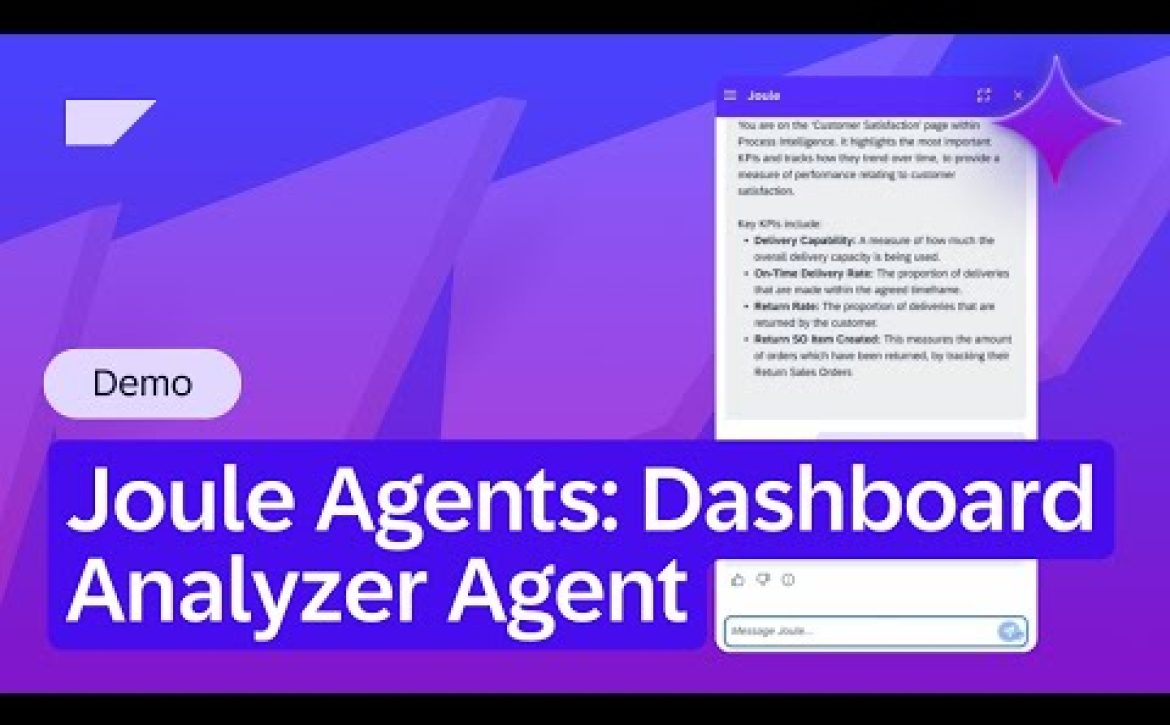
Discover how the Joule Dashboard Analyzer Agent for SAP Signavio solutions turns complex process mining dashboards into clear, actionable insights – instantly interpreting charts in natural language and highlighting the KPIs that matter most.
See how the agent summarizes KPI purpose and performance, pinpoints the metric driving the biggest impact (like rejection rate), and guides analysts to the areas with the greatest opportunity – so teams access insights up to 80% faster and spend less time interpreting dashboards, and more time acting on results.
Follow us on social:
LinkedIn: https://www.linkedin.com/company/sap/
Instagram: https://www.instagram.com/sap
Facebook: https://www.facebook.com/SAP/
Threads: https://www.threads.com/@sap
About SAP:
As a global leader in enterprise applications and business AI, SAP stands at the nexus of business and technology. For over 50 years, organizations have trusted SAP to bring out their best by uniting business-critical operations spanning finance, procurement, HR, supply chain, and customer experience. For more information, visit: https://www.sap.com/index.html
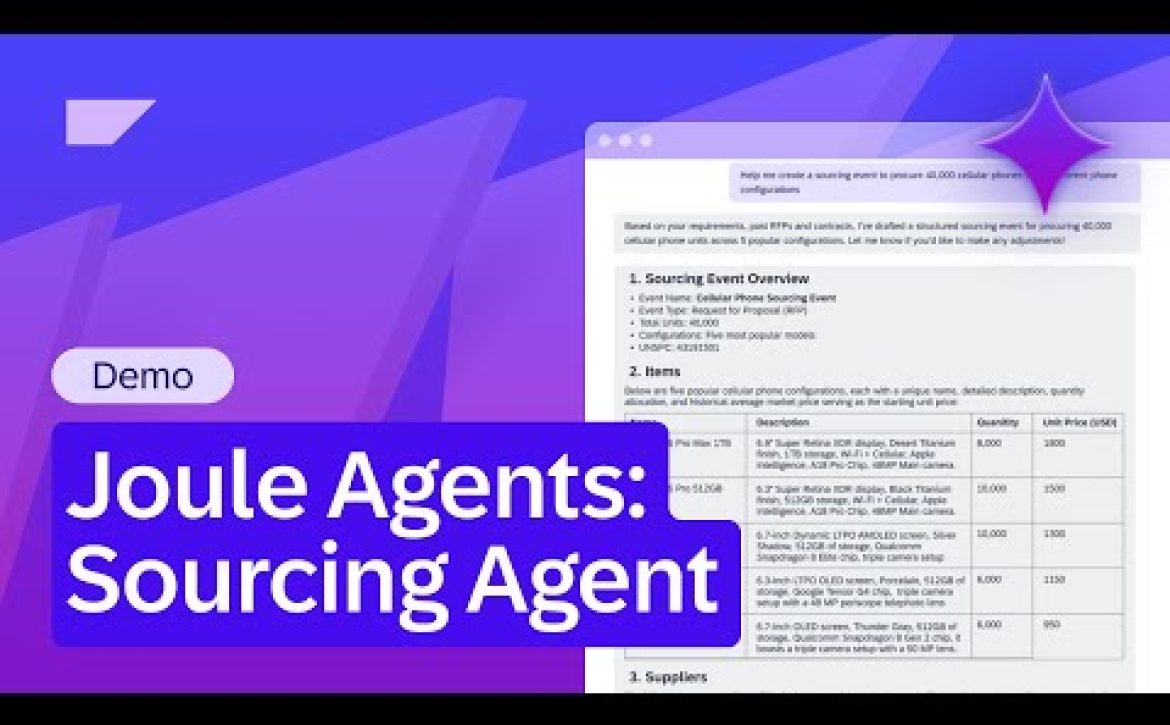
Discover the key features of Joule’s Sourcing Agent. Understand how you can automate sourcing events and make real-time adjustments to match the speed of business.
With Sourcing Agent, you can run smarter sourcing events faster, with less effort. Create events at speed, adapt them in real time, and automate smart updates, helping your business stay agile.