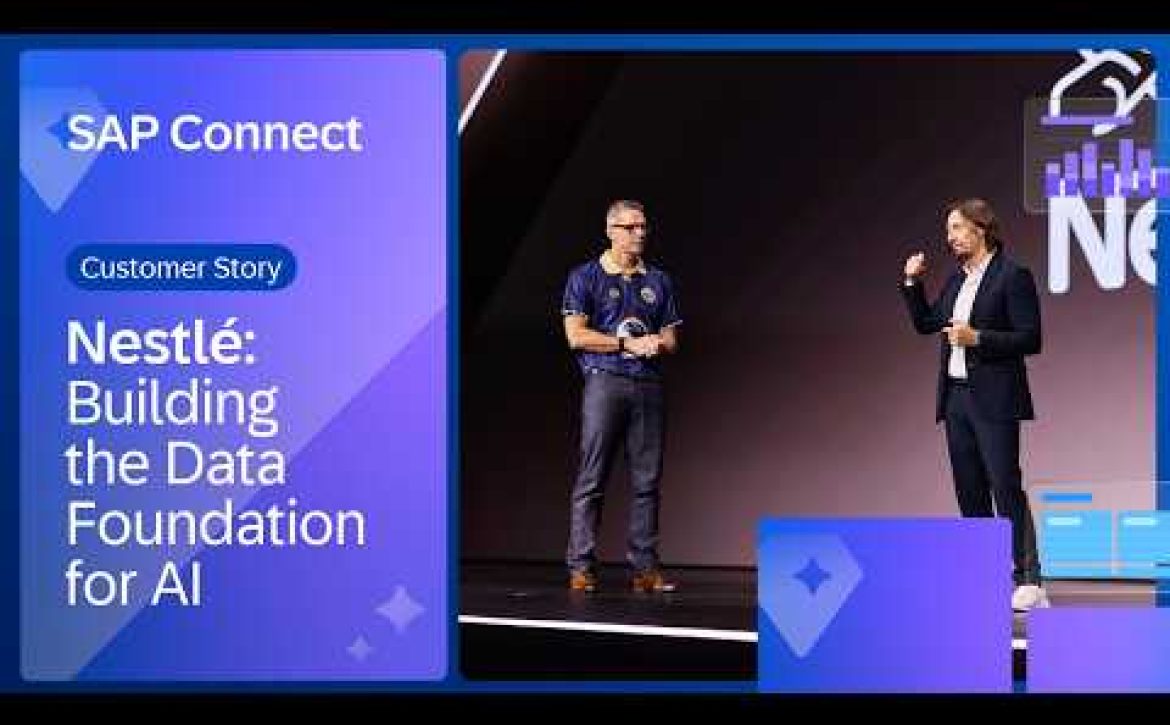
See how Nestlé is using RISE with SAP, SAP S/4HANA, and Joule to connect business processes, strengthen trusted data, and create a foundation for AI at a global scale.
At SAP Connect 2026, Luca from Nestlé shares how the company completed a record-breaking SAP S/4HANA RISE conversion across more than 140 countries. For Nestlé, the transformation was not about technology for its own sake. It was about strengthening the core, operating as one connected enterprise, and creating consistent processes, trusted data, and greater visibility across markets and functions.
The conversation explores why harmonized data is essential for AI. When data is fragmented across legacy systems, AI has limited context to work with. By moving to a clean, unified core with SAP S/4HANA, Nestlé is creating the foundation for Joule to reason across connected business processes and support AI at enterprise scale.
Nestlé also discusses how the Accounts Receivable Assistant can help prioritize collections work based on risk, relationship history, and invoice value, while recommending next-best actions such as a call, email, escalation, or hold. The discussion also touches on touchless order management, working capital, days sales outstanding, continuous planning, and the compounding value of business context when AI is built on a connected SAP foundation.
Watch the full keynote. 👉 https://sap.to/6059BG4VRt
Watch all SAP Connect replays on demand. 👉https://sap.to/6050BG4VRQ
Chapters:
00:00 – Nestlé’s record-breaking SAP S/4HANA RISE conversion
00:19 – Transformation beyond technology
00:39 – Why harmonized data matters for AI
00:55 – SAP S/4HANA across more than 140 countries
01:13 – Joule on a clean, unified core
01:28 – Accounts Receivable Assistant and collections prioritization
01:47 – Next-best actions for finance teams
02:00 – Touchless order management
02:16 – Working capital and days sales outstanding
02:43 – Business transformation at scale
02:58 – Continuous planning and faster response to change
03:16 – The compounding effect of business context
03:39 – SAP Autonomous Suite and enterprise context
Follow us on social:
LinkedIn: https://sap.to/6050BG0v3M
Instagram: https://sap.to/6052BG0v3O
Facebook: https://sap.to/6053BG0v3P
Threads: https://sap.to/6054BG0v3u
About SAP:
As a global leader in enterprise applications and business AI, SAP stands at the nexus of business and technology. For over 50 years, organizations have trusted SAP to bring out their best by uniting business-critical operations spanning finance, procurement, HR, supply chain, and customer experience. For more information, visit: https://sap.to/6055BG0v3R
SAP Pay is the first payment solution embedded directly in SAP Cloud ERP – powered by Tereina, a regulated payment-service provider and wholly owned SAP subsidiary.
When an invoice is approved in your SAP Cloud ERP application, SAP Pay automatically executes the payment and reconciles it against the corresponding invoice or purchase order. No manual bank file handling. No external payment processing dependencies. No reconciliation delays.
What SAP Pay supports:
→ EFT (including ACH), wire, and check payments
→ Stablecoin-based settlement for cross-border transactions
→ Fraud screening and sanction checking
→ Payment processing, reconciliation, controls, and auditability – all within the ERP environment
Learn more about SAP Pay: https://sap.to/6057BG0v3J
Follow us on social:
LinkedIn: https://sap.to/6050BG0v3M
Instagram: https://sap.to/6052BG0v3O
Facebook: https://sap.to/6053BG0v3P
Threads: https://sap.to/6054BG0v3u
About SAP:
As a global leader in enterprise applications and business AI, SAP stands at the nexus of business and technology. For over 50 years, organizations have trusted SAP to bring out their best by uniting business-critical operations spanning finance, procurement, HR, supply chain, and customer experience. For more information, visit: https://sap.to/6055BG0v3R
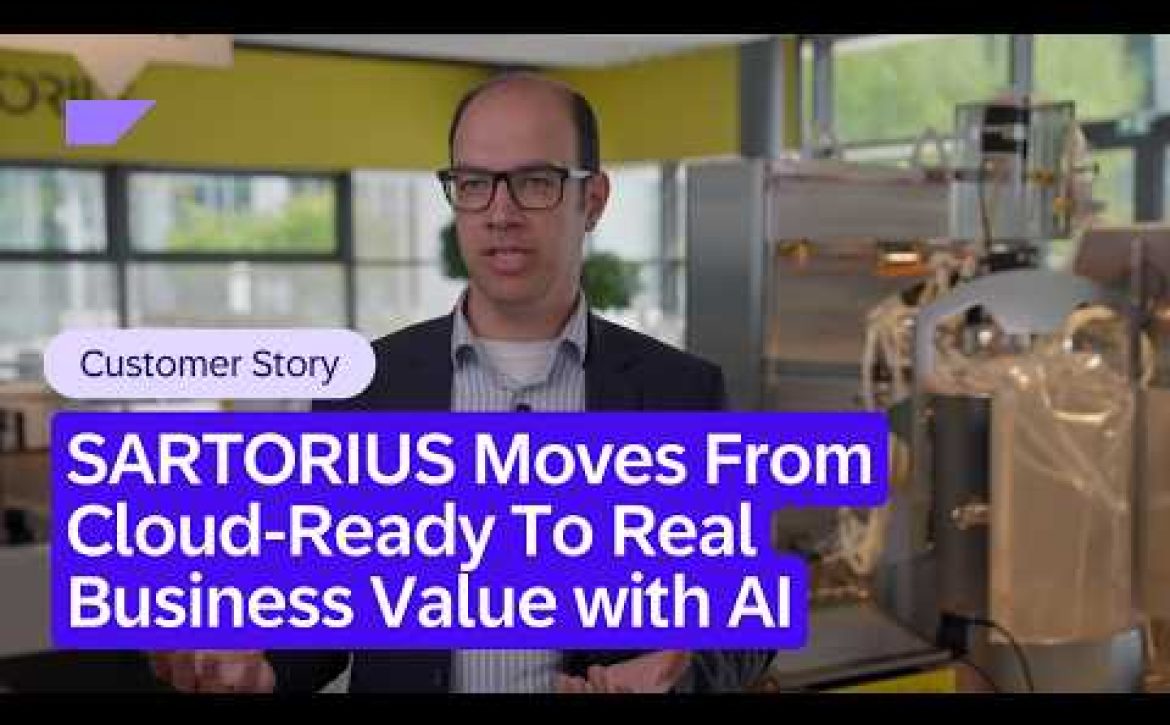
See how SARTORIUS is embedding SAP Business AI into everyday workflows with SAP Joule, Document Grounding, and custom Joule Skills.
For SARTORIUS, AI is becoming a game changer by making intelligent capabilities accessible in the business processes employees use every day. In this video, SARTORIUS shares how its teams are working with SAP Services to identify high-value use cases, bring business and IT experts together, and move from AI exploration to practical outcomes.
You’ll hear how SARTORIUS is using SAP Joule for Consultants to help IT teams interpret error messages, find relevant SAP Notes, and work more efficiently. The team also explains how Document Grounding helps connect internal development guidelines directly into Joule, supporting clean core principles and helping ensure proposed solutions follow company standards. Another example shows how a custom Joule Skill can help sales teams automate product availability checks, reducing manual effort and saving time.
The collaboration with SAP Services plays a central role, helping SARTORIUS connect with SAP experts, evaluate use cases, navigate product direction, and resolve challenges quickly. The result: higher efficiency, better quality, and AI-powered processes designed for daily use across the business.
Explore AI from SAP: https://sap.to/6052BG5EaE
Follow us on social:
LinkedIn: https://sap.to/6053BG5Ea1
Instagram: https://sap.to/6054BG5EaG
Facebook: https://sap.to/6055BG5EaH
Threads: https://sap.to/6056BG5Eay
About SAP:
As a global leader in enterprise applications and business AI, SAP stands at the nexus of business and technology. For over 50 years, organizations have trusted SAP to bring out their best by uniting business-critical operations spanning finance, procurement, HR, supply chain, and customer experience. For more information, visit: https://sap.to/6057BG5EaJ
Because AI built externally does not incorporate the full business context. What gets left behind in AI pilots is the full process logic, business rules, security constraints, and relationships that make the data meaningful and allow users to interact with it securely.
SAP’s context-native AI approach means AI has direct access to business rules, relationships, and logic that make business data meaningful. Transforming your entire workflow and business. https://sap.to/6055BGTjpX
Every business wants to move faster, make better decisions, and empower its people to focus on what matters most.
This year at SAP Sapphire, we shared our vision for the Autonomous Enterprise — the next evolution of how businesses run, where AI agents execute critical workflows so people can focus on innovation, customer value, and business growth.
This vision comes to life through a reimagined Joule Work, evolving from an AI assistant into the central workspace for enterprise AI. We also introduced the SAP Autonomous Suite, bringing AI agents and assistants across core business functions to execute complex workflows with human oversight. With SAP Business AI Platform, customers and partners can build, manage, and govern AI agents. And by expanding Industry AI, we’re delivering AI grounded in deep business context and domain expertise to solve industry-specific challenges.
Capture business-wide AI value with speed and confidence
Customers are already benefiting. Bosch’s IT division, Bosch Digital, integrated SAP Joule for Developers directly into their coding workflows. Developers saw a 20% increase in productivity using Joule to automate routine coding tasks and optimize code. Joule also generates test cases, speeding up unit testing by 15% to 20% and freeing senior developers for high-value tasks. Aeropuertos Argentina, the country’s leading airport operator, defines safety thresholds, service levels, and playbooks, and its agent, Smart Network for Operative Winter (SNOW), executes them. The SNOW agent is a winter operations system that integrates real-time weather, runway, and operations/maintenance data to automatically orchestrate work at Patagonian airports. The agent has improved runway safety, cut direct costs by 16%, and reduced administrative effort by 90%.
PwC built a tool using AI Foundation so its clients can better handle international tax rules by developing and managing their own custom AI agents and solutions. This way, PwC’s clients can focus on strategy while AI handles tax. PwC’s tool helped one pharmaceutical company handle VAT on international transfers 60% more efficiently.
Another customer, LC Waikiki, a global fashion retailer, used an AI agent, built on SAP Joule, to cut HR process cycle times by 40% to 60%. The agent helps employees quickly handle HR transactions, such as leave requests and payroll queries, through natural language conversations. Reducing time spent on administrative tasks allows HR teams to focus on strategic talent management. These are just some of the customers getting value. There are many more.
Now let’s dive into the releases from Q2 2026.
Please note that this article covers only AI offerings released from April 1, 2026, to June 30, 2026.
Joule
Joule Work SAP Early Adopter Care program (registrations closed)
Joule Work redefines how people interact with and execute end-to-end business processes. As the user engagement component of the Joule solution, it moves the user experience beyond fragmented, transactional interfaces toward a unified, intelligent way of working across SAP and non-SAP systems. Its dynamic workspace adapts to users’ intent, helping them focus on outcomes rather than spending time finding information. And because it can delegate execution to AI, users will no longer need to coordinate work across multiple application interfaces manually.
Joule Work will allow users to express in natural language what they want to accomplish, triggering Joule Assistants to coordinate teams of Joule Agents that will surface the right insights and automate routine work across business domains and systems to achieve the goal. This happens in intent-driven, adaptive workspaces built in real time that keep teams focused on driving decisions and impact. Joule Work can help reduce manual handoffs, shorten cycle times, and enable teams to turn decisions into actions faster. A key function of Joule Work is to connect users with Joule Assistants, which are like smart teammates organized by function. These assistants use context to intuit people’s intent and act by coordinating the appropriate Joule Agents across the business. Joule Assistants understand organizations deeply and can automate complex tasks within and across functions, freeing employees to address more strategic work.
Business travelers increasingly experience work trips through two competing realities, according to findings from the eighth annual SAP Concur Global Business Travel Survey. While 93% of business travelers say work trips improve their mental or physical well-being, 67% report feeling hesitant to travel for business this year due to factors such as safety concerns, disruptions, and growing unpredictability.
The findings arrive as companies pour more resources into travel programs. Eighty-two percent of CFOs plan budget increases this year, while geopolitical tensions and cybersecurity risks reshape the travel landscape. Organizations are challenged to meet rising employee expectations while managing unprecedented complexity.
SAP Concur: simple, connected spend and travel management
Business travel still delivers value, but expectations are evolving
Despite ongoing disruption relative to global travel, 93% of business travelers say that work trips positively impact their mental or physical well-being. The reasons are varied: 45% appreciate the break from their usual work environment and 44% experience a change of scenery as mental recharge. For 36%, business travel offers opportunities for face-to-face interactions with colleagues and customers that aren’t possible day-to-day.
Parents feel this even more acutely. Thirty-three percent say business travel provides a break from family or personal obligations, compared to 26% of non-parents. Parents were also more likely to cite access to hotel wellness amenities (33% vs. 25%) and fitness opportunities they don’t usually have (22% vs. 14%).
In an era shaped by burnout and digital fatigue, many workers see travel as an opportunity to reconnect with colleagues, customers, and themselves—suggesting employees increasingly view business travel as more than a transactional business function.
Yet the value employees place on travel exists alongside mounting uncertainty. Sixty-seven percent of business travelers say they are hesitant to travel for business this year, driven by safety concerns around geopolitical conflicts or tension (31%), the likelihood of travel disruptions such as flight delays or cancellations (28%), and worries over visas, immigration status, and digital IDs (16%).
Overtourism: the hidden cost of peak season travel
Nearly one in four travelers (24%) say overcrowding or overtourism has negatively impacted a business trip. In response, 87% deliberately avoid staying in tourist-heavy areas while travelling for business.
The impact is real: 43% of business travelers report higher costs in crowded destinations, 38% struggle with transportation in over-touristed areas, and 33% can’t book preferred options due to overbooking or limited supply. Additionally, 27% cite discomfort being surrounded by so many people, and 26% note greater safety risks or concerns about hostility toward tourists.
On the road: employees expect more support
The survey also reveals a fundamental shift in how employees view employer responsibility during business travel. More than a quarter (27%) of business travelers now hold their employer most accountable for protecting their safety while traveling for work, up from 18% in 2020 when a similar question was asked. This expectation is even more pronounced among younger generations, with only 35% of millennials and 33% of Gen Z holding themselves primarily accountable, compared to 47% of baby boomers.
Confidence in employer preparedness is mixed: only 58% of travelers are mostly or completely confident their organization could successfully extract them if trapped in a country due to a dangerous situation or emergency.
From the travel manager’s perspective, the situation is serious: 86% are concerned their organization is not doing enough to protect employee safety while traveling. Interestingly, only 38% of CFOs say their organization is completely responsible for ensuring employee safety while traveling for work—the majority view this responsibility as falling primarily on employees.
The greatest threat to business travel, according to travel managers, is the risk of sensitive information being hacked when traveling abroad (44%)—more common than geopolitical conflicts (43%), last-minute delays (39%), or severe weather disruptions (39%).
Location tracking can help increase employee safety. While travelers are willing to share location data in general, there are conditions. Seventy-nine percent say they are at least somewhat comfortable with employers tracking their location while traveling for work to better protect their safety. But trust remains fragile: nearly one-third (29%) say real-time monitoring of location and expenses would cause them to lose trust in their organization’s leaders.
The findings highlight a growing balancing act: employees increasingly want reassurance and support from employers during travel, while also expecting transparency around how traveler data is used.
Rising budgets, missing tools, and backup
Finance leaders continue to recognize business travel’s strategic value. Nearly all CFOs surveyed (97%) say business travel is important to their organization’s overall growth strategy, and 82% expect their company’s travel budget to increase this year. But growing investment is also bringing greater scrutiny. Nearly nine in ten CFOs (89%) agree that travel managers need to better justify how business travel helps their organization to meet business goals.
Travel managers, however, say they are being asked to prove ROI without adequate organizational support. Eighty-four percent agree it’s impossible to fully meet their organization’s business goals without more backing from finance leadership. Their top needs include better data and insights to demonstrate ROI (44%), training on effective AI use (43%), greater buy-in on policy changes or new initiatives (42%), and updated technology solutions (40%).
This disconnect reveals a critical challenge: as organizations invest more in business travel, they risk undermining that investment by failing to equip travel managers with the tools and support needed to deliver measurable results.
The trust equation
The 2026 findings show business travel continues to deliver significant value for growth, collaboration, and employee experience. But they also reveal widening gaps between what organizations expect from travel programs and how employees experience business travel on the ground—gaps that increasingly affect traveler well-being, duty of care, compliance, and confidence in leadership.
Organizations that can close those gaps through clearer communication, better governance, stronger traveler support, and tools employees want to use will be better positioned to build travel programs that employees trust and leadership teams can confidently support.
Explore more insights in the eighth annual SAP Concur Global Business Travel Survey.
Charlie Sultan is president of Concur Travel at SAP Concur.
Get the latest SAP news delivered to your inbox once a week
The SAP Concur Global Business Traveler Survey was conducted by Wakefield Research between April 1-20, 2026, among 3,300 business travelers in 21 markets: ANZ (Australia, New Zealand), Benelux (Belgium, Netherlands, Luxembourg), Brazil, Canada, Denmark, Finland, France, Germany, India, Italy, Japan, Mexico, Norway, Portugal, Saudi Arabia, Singapore, Spain, Sweden, Switzerland, UK, and U.S. The SAP Concur Global Travel Manager Survey was conducted by Wakefield Research between April 1-20, 2026, among 800 travel managers, defined as those who direct or administer travel programs for businesses, across eight markets: ANZ (Australia and New Zealand), Canada, Germany, India, Italy, Japan, UK, and U.S. The SAP Concur Global CFO Survey was conducted by Wakefield Research between April 1-20, 2026, among 700 CFOs across seven markets: ANZ (Australia and New Zealand), Canada, Germany, Italy, Japan, UK, and U.S.
Put simply, talent acquisition at SAP is complex. Hiring 20,000-25,000 people annually across 160 countries creates a complicated landscape that requires streamlined workflows, clear communication, and scalability.
“Last year, we were in the process of planning the optimization of our talent discovery tech stack and then something happened,” Eric Goldstein, global head of Talent Discovery for SAP, said. “We acquired SmartRecruiters in September, so we had to pivot in an agile way.”
SmartRecruiters for SAP SuccessFactors enables enterprises to manage the entire hiring lifecycle, from sourcing to onboarding, with AI-enabled recruiting capabilities that can result in faster time-to-hire, improved candidate experiences, and deeper analytics for workforce planning.
For SAP, this means adding much-needed rigor and precision to its global talent acquisition operations. This will not only elevate the quality of hires but also the candidate experience, which Goldstein identified as the “biggest game changer.”
SAP runs SAP
SAP uses its own software to operate its global enterprise, acting as its own primary reference customer. By deploying its applications across 100,000 employees worldwide, SAP tests, refines, and showcases its products in real-world scenarios.
Building a more intelligent hiring process
SmartRecruiters for SAP SuccessFactors helps optimize processes, increasing transparency and personalization. This means improved experiences and processes for candidates, hiring managers, and recruiters. “We have been through a time where we focused solely on the recruiter experience. Then it was fashionable to focus only on the candidates. Now we really see that with SmartRecruiters, it really is an enhanced experience for all stakeholders that are involved in the recruiting process,” Ilka Sagner-David, global head of Talent Discovery Solutions and Innovations at SAP, said.
Candidate perspective
Seventy percent of candidates that apply for jobs are mindful to take their valuable time to do so, Goldstein shared, reiterating that it is important for companies to match that commitment when shaping and delivering the candidate experience. With SmartRecruiters for SAP SuccessFactors as the foundation, it becomes possible for every pre-qualified applicant to interview, receive personalized and constructive feedback post-interview, and maintain 24×7 interaction with agentic AI built into SmartRecruiters.
Simplify global hiring with an intelligent, end-to-end talent acquisition solution that supports any hiring need
“In our opinion, only responding with polite, automated rejection notes is not enough. [Candidates] need to be provided with some constructive, actionable feedback—and that’s what we [at SAP] are going to be able to do,” Goldstein said.
Hiring manager perspective
SmartRecruiters for SAP SuccessFactors can give hiring managers a more precise and consistent way to identify strong candidates, helping to reduce time-to-hire while improving hiring quality. AI-prompted interview questions focused on skills can support more relevant and structured conversations while greater transparency across interview panelists can create better alignment throughout the evaluation process. In addition, AI-supported feedback collection can make it easier for interviewers at SAP to capture timely, consistent insights, enabling its hiring teams to make more informed decisions with greater confidence.
Recruiter perspective
Recruiters are often bogged down by manual tasks, such as outreach, prospect identification, and candidate screening, making it nearly impossible for them to step into the role of a trusted advisor. With SmartRecruiters for SAP SuccessFactors, recruiters can experience automated internal and external prospect identification, personalized outreach and prioritization of candidates, and, therefore, the ability to focus on higher value-add advisory and relationship management.
“It’s going to allow the recruiters to focus on relationship management with candidates and hiring managers, really challenging the feedback of how well the interview panel measures skills proficiency,” Goldstein said.
Bringing AI into the candidate journey
A key to the successful delivery of these benefits is SmartRecruiters Winston for SAP SuccessFactors, an AI-driven, candidate-facing agentic experience. At SAP Sapphire Orlando, Karl Baert, global head of People Solutions for SAP, demonstrated how Winston can facilitate the application experience for candidates.
In the demo, he acted as a candidate applying for an open position at SAP, showing how through a natural language conversation with Winston, he completed his application by uploading his CV and verifying some personal details with Winston. “All that information is very, very quickly brought together so with just a few questions my application is done,” Baert said, adding that “there’s also a few checks happening along the way because we want to make sure the data we are collecting is the right quality.”
Winston also collects feedback from the applicant. “Measuring the quality of your agent and what’s happening with it is important. It’s something that really needs to be actively monitored just to ensure that the information provided by the agent is accurate,” Baert said.
“The implementation of SmartRecruiters is the foundation for infusing AI into our processes,” Sagner-David said. But, she added, “we shouldn’t just plan to transfer everything tomorrow, but ensure we’re liberating AI when it makes sense.”
The next step
Currently, SmartRecruiters for SAP SuccessFactors is being implemented into SAP’s HR systems for two phases of user acceptance testing, with the global go-live expected in September.
SAP bringing SmartRecruiters for SAP SuccessFactors to life across its own organization is more than a technology rollout, it’s a glimpse into the future of hiring at scale: more intelligent, more human, and more connected. By combining AI, better experiences, and real-word enterprise rigor, SAP is not only transforming how it hires but also helping to define what modern hiring can look like for companies everywhere.
This year at SAP Sapphire, SAP introduced Autonomous CX as a core pillar of the Autonomous Enterprise, including the principle that every customer promise must be backed by operational reality.
Turn transformation strategies into action through a coordinated set of services and guidance for every stage of your journey
The proactive, expert-led engagement model is built to de-risk transformation, accelerate time to value, and sustain measurable outcomes across customer experience initiatives. It combines guided adoption, prescriptive functional and technical assistance, AI-powered best practices, and continuous value realization aligned to the realities of modern customer experience (CX): AI at the core, unified data, omnichannel at scale, retention over acquisition, service-led growth, and persistent skills gaps in a rapidly evolving digital landscape.
At its heart, the Advanced Success Plan for SAP Customer Experience brings together the right expertise at the right time, program governance, solution experts, value advisors, and adoption specialists. This helps teams execute faster and smarter with SAP Customer Experience.
What sets the Advanced Success Plan apart
Outcome-based: Business outcomes and key value indicators are co-defined with teams, with milestones and workstreams aligned to deliver measurable Autonomous CX results.
Proactive by design: AI Assistants, adoption checks, and innovation accelerators are embedded throughout, reducing risk and compressing time to value as agentic capabilities evolve.
Continuous enablement: Role-based best practices and coaching are tied directly to the Autonomous CX road map, closing skills gaps at pace as new AI and platform capabilities become available.
Cross-solution orchestration: Unified processes and shared business context across marketing, commerce, sales, and service break silos and enable enterprise-scale execution.
This is the first of a planned series to deep dive on the topics below. Here, we start with introducing how the Advanced Success Plan for SAP Customer Experience helps operationalize seven macro trends shaping modern customer experience.
1. AI‑powered customer experiences
AI now underpins everything from next best engagement to intelligent service resolution. The Advanced Success Plan embeds AI adoption patterns directly into the delivery approach, identifying high value use cases, calibrating data prerequisites, and guiding model governance.
The results are prioritization of high‑impact starting points, a plan to scale with guardrails, accelerating time from pilot to production and grounding every decision in SAP’s CX AI capabilities and product road map.
2. Hyper‑personalization at scale
Personalization demands more than algorithms; it requires clean, consent‑aware data, robust decisioning, and experimentation discipline. The Advanced Success Plan delivers:
Data readiness assessments and integration patterns to enrich customer profiles and segments
Governance and testing playbooks to validate personalization hypotheses at scale
Prescriptive journeys to operationalize next best action across every customer channel
The result: hyper personalization moves from proof of concept to standard operating model.
3. Unified customer data and breaking down silos
Siloed data undermines CX. We help establish a unified data foundation and harmonized identities, aligning business, data, and integration teams. With technical guidance and adoption accelerators, users can move faster toward a single view of the customer to fuel analytics, personalization, and service excellence.
The results are unified profile use cases, data quality baselines, and source‑of‑truth decisions to reduce duplication and latency.
4. Omnichannel commerce and B2B digital transformation
Modern buyers expect seamless journeys across web, mobile, marketplace, and partner portals, especially in B2B. The plan accelerates omnichannel capability build‑out by uniting commerce, order sourcing, pricing, and fulfilment patterns, supported by outcome‑based governance.
The result: Channel consistency, catalogue and contract complexity, and the alignment of service and sales motions are all addressed, driving measurable improvement in conversion rates and repeat purchase.
5. Customer retention over acquisition
Acquisition costs are rising and retention is the new growth engine. The Advanced Success Plan helps operationalize retention strategies, churn prediction, intelligent engagement, loyalty, and proactive service across the CX stack.
The result: We align metrics such as retention rate, customer lifetime value, and service‑to‑revenue contribution, and ensure the data foundation supports them.
6. Service as a revenue driver
Service is no longer a cost center; it’s a growth channel. We guide users to productize services, monetize value‑added offerings, and embed outcome‑based contracts. The plan includes:
Playbooks for cross‑sell/upsell from service interactions
Knowledge and field service patterns to improve first‑time fix and attach rates, KPI frameworks for service‑led growth
The result: With prescriptive governance and AI‑driven intelligence, service organizations move from reactive cost management to consistent, measurable contribution to top‑line revenue and customer retention.
7. Navigating digital transformation complexity and skills gaps
Large transformation programs falter on orchestration and capability enablement. The Advanced Success Plan addresses both by:
Establishing a cadence of value sprints and decision forums
Providing role‑based enablement covering functional and technical assistance, data, product ownership, end-user adoption, and change management
AI-guided best practices embedded throughout delivery to eliminate rework and accelerate quality outcomes across Industry AI scenarios
Organizations execute with confidence, even amid shifting requirements, resource constraints, and rapidly evolving agentic AI capabilities.
Measurable outcomes
Accelerated time to first value through prioritized, AI-ready use cases aligned to Autonomous CX capabilities
Higher adoption and sustained performance via continuous enablement
Reduced program risk through proactive governance, telemetry, and structured decision forums
Measurable gains in conversion rates, customer retention, and service-led revenue contribution across the full CX stack
Getting started
Define Autonomous CX priorities: Identify two to three priority outcomes for the next two quarters facilitated by the SAP Value Management service.
Assess readiness: Evaluate data, integration, governance, and enablement gaps to define a 12 to 18 month engagement plan.
Engage the Advanced Success Plan: Align workstreams, milestones, and metrics with our expert team.
Industrialize and scale: Convert proven delivery patterns into reusable accelerators, deployable across regions and lines of business.
This series will examine each of the seven trends in depth, demonstrating how the Advanced Success Plan for SAP Customer Experience translates CX strategy into repeatable execution and measurable business outcomes.
Tara Tracey is a global product owner at SAP.
Autonomous CX: Harmonize CRM and CX with a single autonomous system, where AI acts on the full truth of business to power every customer experience
SAP Sapphire Madrid 2026 marks a new chapter for enterprise AI: the Autonomous Enterprise, where people set the direction, and AI executes.
In this keynote, SAP shares how Joule, Joule Work, Joule Assistants, Joule Agents, SAP Autonomous Suite, SAP Business AI Platform, SAP Business Data Cloud, SAP AI Agent Hub, and RISE with SAP come together to help businesses move from fragmented work to connected, governed, AI-enabled execution. The keynote frames this vision around human-led, AI-enabled transformation, grounded in business context and built with governance from the start.
Hear from SAP leaders and guests, including:
• Christian Klein, Chief Executive Officer, SAP
• Dr. Philipp Herzig, Chief Technology Officer, SAP SE
• Sebastian Steinhaeuser, Chief Operating Officer, SAP SE and Member of the Executive Board
• Pavan Srivastava, Global SAP Chief Technology Officer, Deloitte
• Jan Oberhauser, Chief Executive Officer, n8n
• Arthur Mensch, Co-founder and Chief Executive Officer, Mistral AI
Hear how SAP Business AI is designed to help organizations automate routine work, improve decision-making, and transform end-to-end processes across finance, spend management, supply chain, HR, customer experience, and industry-specific operations. Joule Work enables users to express goals in natural language, while Joule Assistants coordinate Joule Agents to surface insights, automate workflows, and help teams act faster across SAP and non-SAP systems.
The keynote also highlights how SAP is helping customers scale AI with trust through governed business data, SAP Business AI Platform, Joule Studio, SAP AI Agent Hub, SAP Business Data Cloud, RISE with SAP, and migration and modernization capabilities designed to support cloud transformation. Discover how the Autonomous Enterprise can help businesses run faster, work smarter, and unlock value across the enterprise.
Chapters:
00:00 – Opening: The Beginning of Better
02:33 – Welcome to SAP Sapphire Madrid 2026
04:00 – Why Business AI Needs Accuracy and Trust
07:03 – ERP as the Brain of the Enterprise
09:13 – Introducing SAP Business AI Platform
12:28 – Building with Business AI
15:48 – Deloitte and Joule Studio 2.0 Demo
25:31 – SAP Business Data Cloud and Business Context
30:31 – SAP AI Agent Hub and Enterprise Governance
34:33 – Partner Ecosystem Announcements
40:13 – Mistral AI and European AI Sovereignty
46:07 – Introducing SAP Autonomous Suite
51:49 – Joule Assistants, Agents, and Autonomous Domains
01:02:49 – Financial Closing Assistant Demo
01:09:00 – Joule Work and Spaces
01:13:32 – Customer Outcomes with SAP Business AI
01:24:41 – H&M and Industry AI
01:31:16 – Keynote Wrap-Up and Takeaways
Learn more about the reimagined Joule experience. 👉
https://www.sap.com/products/artificial-intelligence.html
Watch all SAP Sapphire replays on demand. 👉
https://www.sap.com/events/sapphire.html
About SAP:
As a global leader in enterprise applications and business AI, SAP stands at the nexus of business and technology. For over 50 years, organizations have trusted SAP to bring out their best by uniting business-critical operations spanning finance, procurement, HR, supply chain, and customer experience. For more information, visit: https://www.sap.com/index.html
Follow us on social:
LinkedIn: https://www.linkedin.com/company/sap/
Instagram: https://www.instagram.com/sap
Facebook: https://www.facebook.com/SAP/
Threads: https://www.threads.com/@sap