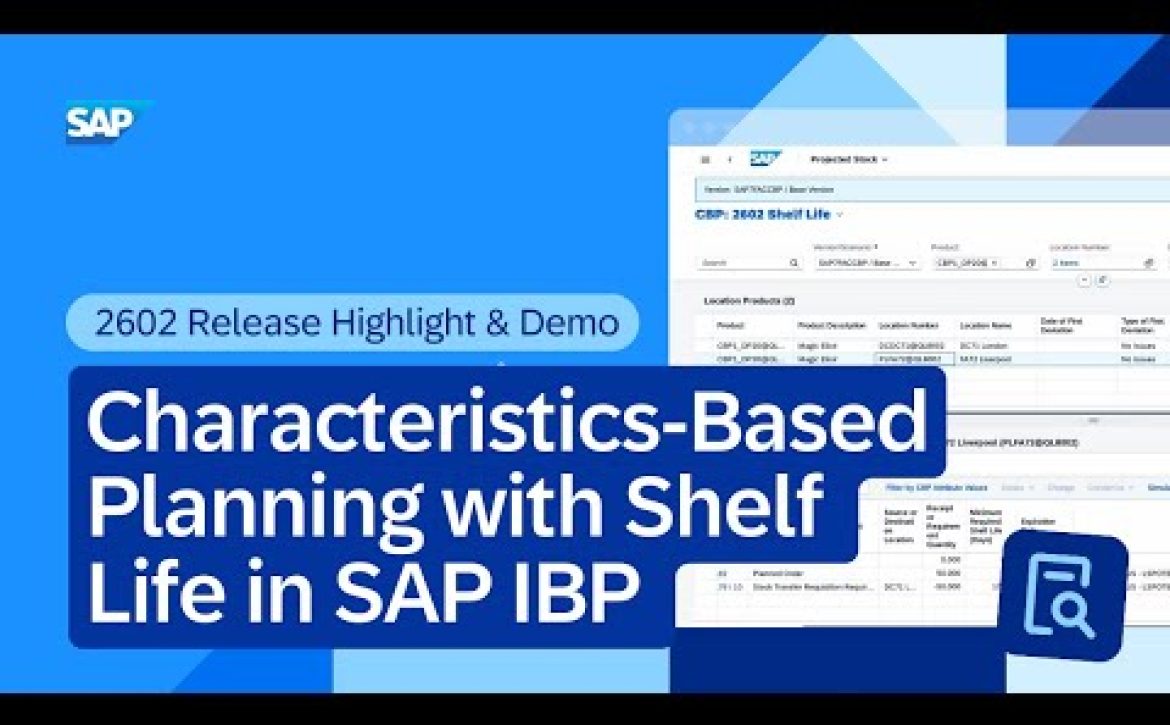
Characteristics-Based Planning with Shelf Life in SAP IBP | 2602 Release Highlight & Demo

Learn how SAP IBP 2602 streamlines complex inventory decisions with characteristics-based planning (CBP) and shelf life, so planners can meet compliance requirements while protecting product quality and reducing waste from expired stock.

In this highlight tour, you’ll see a real planning scenario where demand requires specific CBP attributes (market qualification and potency) plus a minimum remaining shelf life. Instead of running separate checks and making risky trade-offs, the planning run evaluates all constraints at once, automatically selecting suitable inventory and creating the right supply to fulfill demand.

🧬 Plan with CBP attributes + shelf life together — Link demand to a specific attribute combination (for example, market qualification and potency) with a required minimum remaining shelf life.

📦 Automatically identify suitable batches — The system considers batch qualification and remaining shelf life to select inventory that meets both compliance and quality needs.

⚙️ One run, all constraints — A single supply planning run evaluates constraints simultaneously and can trigger new compliant supply (for example, stock transfer requisitions and planned orders) with shelf-life parameters applied.

Chapters:
00:00 – Introduction: CBP with shelf life
00:18 – Scenario + requirements (market + potency + 100 days)
00:46 – Forecast includes CBP + shelf life constraint
00:57 – Stock details: which batches qualify
01:47 – Run supply planning: constraints evaluated together
02:10 – Results: STR created + compliant supply
02:24 – Order network: how demand is fulfilled
03:15 – Wrap-up: compliance + optimal utilization

• What’s new (Help Portal): https://sap.to/6059hBRgF

• Learn more about SAP Integrated Business Planning: https://sap.to/6053cGTA3

A C-Suite Framework for Climate Capability in 2026

For decades, climate adaptation lived on the fringes of corporate strategy. It was typically addressed through insurance coverage, emergency protocols, and risk registers. These tools were helpful at the time as they helped organizations respond to disruption, but they often positioned climate considerations as something to manage episodically, rather than as part of how a business operates day-to-day and plans for growth.

In 2026, that distinction is becoming increasingly blurry. Extreme heat, water scarcity, flooding, wildfires, and energy volatility are affecting cost structures, disrupting supply chains, and constraining labor productivity and capital planning. These factors increasingly show up in routine operational and financial decisions and interact with broader economic dynamics. Climate impacts intersect with geopolitical competition, supply-side volatility, and regional fragmentation. At the same time, the transition to a low-carbon economy continues to progress unevenly across markets, with carbon increasingly subject to pricing, regulation, and disclosure expectations.

Together, physical climate impacts and transition pressures are influencing how companies plan, invest, and operate. Many organizations are approaching adaptation and mitigation as an integrated business capability, on par with financial management, supply chain planning, or cybersecurity.

Why adaptation and mitigation demand sustained leadership attention

S&P Global Energy Horizons projects that physical climate risks could more than triple corporate financial exposure by 2050, driven by asset damage, supply disruptions, and productivity losses. Despite this growing exposure, however, fewer than one in five companies have implemented adaptation measures at scale.

This widening gap between risk and readiness has profound implications for CEOs and boards, who recognize this threat. A new report from WEF found that business leaders identified extreme weather events as the greatest long-term business risk, with cascading effects across economic stability, supply chains, and social cohesion. Climate risk is now:

  • Financial, affecting margins, asset values, insurance availability, and cost of capital
  • Operational, disrupting production, logistics, and workforce availability
  • Strategic, influencing where companies invest, source, and grow
  • Reputational, shaping trust with investors, customers, regulators, and employees

For many leadership teams, climate adaptation and mitigation have become part of the broader challenge of enterprise readiness. In some cases, they are also influencing access to capital, insurance terms, talent attraction, and long-term market positioning.

Put sustainability at the core of your business with AI-driven solutions from SAP

Going beyond the contingency mindset

A common constraint on progress is how climate adaptation is still framed inside organizations.

When it is treated primarily as contingency planning, it tends to be reactive and episodic. Plans are developed, documented, and revisited only after disruption occurs, while ownership is often spread across risk, sustainability, operations, and finance teams with limited integration into core decision-making.

A capability-based approach works differently. Business capabilities are embedded and inform everyday decisions, supported by data, systems, governance, and incentives.

Climate capability emerges when organizations integrate climate risk, resilience, and carbon considerations into the core of how the enterprise runs.

The four pillars of climate capability

1. Supply chains designed for disruption

Global supply chains are increasingly exposed to climate volatility and regulatory pressure. Highly optimized, linear supply chains designed primarily for cost efficiency have shown limitations under these conditions. Many organizations are adjusting value chains to improve resilience and address emissions. Supplier diversification, regionalization, circular material flows, and better data sharing can reduce exposure to physical disruption and, in many cases, lower Scope 3 emissions. In practice, efforts to improve decarbonization and resilience often reinforce one another.

What this requires is more reliable, timely data across supply chains, so that COOs are empowered to turn insights into meaningful outcomes.

2. Assets and infrastructure built for a changing climate

Facilities, equipment, and logistics networks are increasingly exposed to chronic stresses, such as heat and water scarcity as well as acute events like flooding. At the same time, carbon-intensive assets face growing transition risk as energy systems and regulations evolve.

A capability-based approach evaluates assets through a dual lens: physical climate exposure and carbon intensity. This informs where companies locate facilities, how they maintain them, and when they invest in retrofits, electrification, or renewable energy.

Investments in energy efficiency and clean energy can reduce emissions while also moderating exposure to energy price volatility and supply disruptions.

3. Workforce resilience as a business priority

Climate impacts are also affecting people. Rising temperatures and extreme weather are already reducing labor productivity and increasing health and safety risks in many roles and regions.

The International Labour Organization estimates that heat stress alone could result in the equivalent of 80 million full-time jobs lost globally by 2030 under a 1.5°C warming scenario. Organizations that treat workforce resilience as a core business issue are adjusting schedules, working conditions, training, and safety protocols, protecting people while maintaining productivity.

4. Financial decision-making informed by climate reality

Despite growing awareness, climate data is often still disconnected from financial planning and analysis. CDP reports that while 67% of companies identify climate-related risks with potential financial impact, only a fraction can quantify those risks with enough precision to guide investment decisions.

A capability-based approach incorporates carbon and climate risk into financial models. This allows leaders to assess physical risk, transition risk, and return on investment together, turning climate action into a disciplined, value-driven decision process. SAP’s carbon accounting solutions, like SAP Green Ledger and SAP Green Token, can empower organizations to drive actionable climate strategies and unlock measurable impact by helping them integrate sustainability into core business processes through the combination of trusted financial data and granular carbon insights.

A C-suite framework for climate capability in 2026

Across industries, five leadership actions will define those organizations building true climate capability:

  1. Embed climate and carbon assumptions into core business planning and governance.
  2. Redesign value chains for resilience and emissions reduction.
  3. Protect assets and people with predictive, forward-looking insight.
  4. Align mitigation and adaptation with financial strategy.
  5. Measure resilience and emissions together, not in isolation.

Together, these actions help shift climate efforts from parallel initiatives into a managed enterprise capability, one that determines operational continuity, financial resilience, and long-term competitiveness.

Learn more about how you can build a more compliant, sustainable, and resilient business with SAP Sustainability solutions.


Sophia Mendelsohn is chief sustainability and commercial officer at SAP.

Get the latest and greatest SAP news delivered to your inbox once a week

New Research from SAP and Forrester Consulting Reveals the State of Global Transformation Readiness

New research from Forrester Consulting, commissioned by SAP, has revealed that 74% of organizations plan to increase investment in transformation. But when it comes to the maturity required to execute transformation effectively, only 6% qualify as leaders.

Competitive pressures, systemic risks, technological disruption, and workforce shifts are reshaping the modern business landscape constantly, meaning most organizations already run multiple transformations simultaneously. In fact, Forrester’s research reveals that 72% of organizations are pursuing four or more transformation initiatives annually.

However, despite its continuous nature, many still treat business transformations as a series of disconnected projects, limited to specific functions or technology upgrades—a fragmented approach that slows execution, reduces impact, and prevents organizations from realizing the full value of their investments.

That’s why SAP partnered with Forrester Consulting to deliver a comprehensive survey of enterprise-level global organizations, assessing levels of business transformation management maturity.

Better navigate constant change by turning business transformation from a project into a core capability

The results clearly show that developing a repeatable, scalable transformation capability is how organizations best prepare themselves to address the challenges mentioned above and transform successfully again and again. Building and growing such a capability means bringing together strategy, processes, technology, and culture into a cohesive and strategic framework that accelerates execution, improves measurement, and enables ongoing innovation.

The 6% club

Conducted online with over 1,000 cross-industry senior decision-makers at organizations in APAC, EMEA, Latin America, and North America, the “From Ambition To Execution: Building Repeatable Business Transformation” survey was able to segment respondents into four maturity tiers—beginner, intermediate, advanced, and leader—based on their strengths across five dimensions: strategy and leadership, applications and technology, process, data, and people and culture.

Only 6% of the surveyed firms qualified as transformation leaders, with most organizations still facing significant gaps in execution, governance, and cultural alignment. The findings also showed:

  • Transformation is now ‘business as usual.’ Over half of organizations (52%) plan to increase transformation investments by 11% to 20% in the next 12 months; another 22% expect to boost spending by more than 20%. Only 1% plan to reduce investment.
  • Barriers to success are common. Fifty-six percent of respondents struggle with poor data, 55% encounter persistent organizational silos, and 52% highlight employee fatigue from continuous change
  • Governance is lacking. Only 24% of organizations have a cross-functional transformation governance board, and just 25% embed transformation goals into KPIs. 

Fortunately, even organizations that haven’t yet reached the leader stage are conscious of the benefits of building a transformation capability, with respondents highlighting the following expected outcomes:

  • Increased ability to pivot in response to market shifts or disruptions (68%)
  • Faster upskilling and reskilling of the workforce (66%)
  • Faster execution of strategic initiatives (65%)
  • Increased consistency and reliability in process execution (65%)
  • Increased leadership alignment and accountability (64%)

Unlocking the benefits

Overall, survey respondents were committed to transformation at scale, but fragmented execution and the lack of an overall strategy have hampered their efforts. This missing piece of the puzzle is where business transformation management solutions from SAP can be of most use.

“Transformation challenges will always exist, particularly in aligning localized execution with an enterprise-wide approach,” Dee Houchen, head of Marketing for SAP Signavio and SAP LeanIX, says. “Our research shows that true transformation leaders embed change into their organization’s DNA. That means prioritizing early employee involvement, building dedicated change functions, and putting a high premium on digital adoption management.”

SAP Signavio,  SAP LeanIX, and WalkMe solutions offer clarity and transparency in business transformation, helping organizations turn transformation from isolated plans into comprehensive action across the entire organization,” Houchen adds. “This report is an invaluable resource for anyone wondering how they can build repeatable transformation capability and become transformation leaders in their own right.”


Lucas de Boer is global marketing program lead for SAP Signavio.

Get the latest SAP news delivered to your inbox once a week

Will AI Replace Jobs or Boost Productivity? | Dr. Stephen King

AI can automate tasks without replacing people — if we apply it well.

Dr. Stephen King (Productivity Commission of Australia) explains what AI could mean for government and services.

Explore the impact of AI in healthcare: https://sap.to/6054CrBrp
Make the most of the AI opportunity: https://sap.to/6055CrBrV
Access data & digital insight: https://sap.to/6057CrBrX

🎧 More episodes of the Trending Chats podcast:
Watch on YouTube: https://sap.to/6050CrBrw
Listen on Spotify: https://sap.to/6051CrBrb
Listen on Apple Podcasts: https://sap.to/6052CrBrj

#TrendingChats #SAPBusinessAI #Healthcare

SAP BTP: Maintaining a Clean Core with Alexia Bayyouk | Trending Chats

In this episode of Trending Chats, we explore the concept of a “clean core” and its importance for modern businesses. Joined by Alexia Bayyouk, Solutions Specialist at SAP, we unpack how keeping your ERP system free from unnecessary customizations ensures smoother upgrades, easier adoption of innovations, and reduced maintenance costs.

Discover how SAP Business Technology Platform (BTP) empowers businesses to create new applications, extend capabilities, and grow with AI-driven solutions—all while keeping the core ERP efficient and agile. Plus, learn actionable steps to start your clean core journey and leverage BTP to meet your unique business needs.

Tune in to find out how a clean core can drive flexibility and innovation for your organisation!

00:04 – Welcome + why a clean, strong core matters
00:30 – Clean core explained: fewer customisations, faster innovation
01:14 – Use SAP BTP to extend outside the core (create, extend, grow)
02:03 – How to start: assess legacy and your current landscape
02:23 – Make it real: get sponsorship + map customisations to BTP

Explore SAP’s clean core: https://sap.to/6057Cr8db
Clean core in driving innovation: https://sap.to/6051Cr8d5
Getting started with a clean core: https://sap.to/6052Cr8dg

🎧 More episodes of the Trending Chats podcast:
Watch on YouTube: https://sap.to/6053Cr8d9
Listen on Spotify: https://sap.to/6054Cr8di
Listen on Apple Podcasts: https://sap.to/6055Cr8dc

#TrendingChats #SAPBTP #CleanCore

Transform Product Development with AI-Driven PLM Solutions from SAP

Bringing innovative products to market has never been more complex, or more critical.

PLM solutions from SAP empower businesses in both discrete and process industries to connect people, data, and processes in one intelligent workflow, helping you design, develop, and deliver products faster and with greater confidence.

With SAP’s solutions for product lifecycle management (PLM), teams can collaborate seamlessly, from engineering and formulation through production and compliance, all supported by built-in AI capabilities that simplify work and accelerate innovation.

Discover how PLM solutions from SAP can help your business unlock innovation, respond to change faster, and deliver high-quality products that succeed in the marketplace.

Chapters:
0:00 – The challenges of modern product development
0:24 – Overview of SAP’s portfolio of PLM solutions
0:48 – Collaboration in discrete manufacturing
1:03 – Managing formulations in process industries
1:32 – AI and Joule: accelerating product innovation
1:55 – Business outcomes with PLM solutions from SAP

Learn more. 👉 https://sap.to/6050CrWeC

SAP Leads the Way in Sovereign Cloud

The need in Europe and elsewhere for sovereign cloud offerings is one of the hottest enterprise IT topics this year.

Recent geopolitical shifts and technological advancements have heightened the challenges for organizations responsible for society’s most critical functions, such as government, defense, and essential infrastructure.

As AI expands and global data exchange accelerates, the question of who controls the data that shapes economies and national strategies has become paramount, spurring interest in sovereign cloud offerings. Governments and industries need to know exactly where their data lives, because that determines what laws apply.

Sovereign clouds answer this need by providing the foundation of digital trust and national resilience. SAP pioneered the development of sovereign cloud services through its SAP Sovereign Cloud offerings, which address all four pillars of digital sovereignty: data, operational, legal, and technical architecture.

Create Your Own AI Agents with SAP Build | feat. Maria Kondratyeva

Host Niklas Siemer is joined by Maria Kondratyeva (Product Manager, Joule Studio in SAP Build) for a hands-on look at the newly announced SAP Build Agent Builder. They explore how teams can move from deterministic Joule skills to goal-driven AI agents, and why both approaches matter when you are scaling automation across SAP Business Technology Platform (SAP BTP).

In this episode, you will learn:

✅ What’s new in SAP Build Agent Builder and how it fits into Joule Studio
✅ The difference between deterministic skills and goal-driven agents, plus where each works best
✅ How to approach design, testing, and deployment with enterprise needs in mind
✅ What scalable value looks like when agents and skills work together across SAP BTP

Chapters:
00:00 – Skills vs. agents: what changes with Agent Builder
01:12 – Welcome + meet Maria (Joule Studio, SAP Build)
04:13 – Joule Studio recap and Skill Builder foundation
06:03 – Skills vs. agents explained with real examples
10:18 – Benefits and top use cases for custom AI agents
17:45 – How to get started: prerequisites, personas, low-code
25:17 – Integrations and guardrails: APIs, MCP, LLMs, grounding
31:24 – Governance, responsible AI, release date, and next steps

Start building with SAP Build: https://sap.to/6054CMD2r

Airbus: Safety, UX & Innovation in Cabin Design | SAP Design Talks

How do you turn engineering constraints into great passenger experiences? Airbus’s Paul Edwards explains.

In this SAP Design Talks episode, Paul Edwards, Head of Advanced Design at Airbus Commercial, shares how cabin design finds the “sweet spot” of desirability, feasibility, and viability. He explores why safety-first constraints spark creativity, how cross-functional collaboration with airlines drives outcomes, and why the best ideas often come from outside aviation, furniture, architecture, and interiors.

You’ll also hear how AI and augmented reality speed visualization, support faster iteration, and help teams design more sustainable, accessible cabins, blending physical and digital touchpoints into truly “phygital” journeys.

Chapters
00:00 – Intro: Paul Edwards (Airbus)
00:10 – Why cabin design matters
00:33 – Good design = balance
00:54 – Safety & constraints
01:39 – Collaboration + outside inspiration
02:33 – Trends: sustainability & accessibility
02:44 – AI/AR & the phygital future

Learn more and explore the full SAP Design Talks series 👉 https://sap.to/6053CDaOJ

Airbus: Safety, UX & Innovation in Cabin Design | SAP Design Talks

Paul Edwards of Airbus on balancing experience and efficiency. Explore more: https://sap.to/6058CDagm

Previous Next
Close
Test Caption
Test Description goes like this