On Modify or On Save? A Practical Decision Model for RAP Determinations

If you have written more than a handful of ABAP RAP behavior definitions, you have declared a determination and had to make a choice: should it run on modify or on save?



If you have written more than a handful of ABAP RAP behavior definitions, you have declared a determination and had to make a choice: should it run on modify or on save?
Discover why event-driven architecture is the essential foundation for scalable,
responsive agentic AI and how SAP Integration Suite, advanced event mesh makes it possible.
Join Udo Paltzer, Head of Product Management for SAP Integration Suite, as he explains
how real-time business events empower AI agents to move beyond historical analysis and
act intelligently at the exact moment it matters.
In this video, you’ll learn:
✅ Why AI is only as intelligent as the data and events it receives
✅ How fragmented, delayed, or siloed data prevents real-time AI decisions
✅ What event-driven architecture is and why it’s essential for agentic AI
✅ How SAP Integration Suite, advanced event mesh enables reliable, secure, real-time event streaming across distributed SAP and non-SAP systems
✅ How real-time event ingestion strengthens contextual grounding for LLMs and AI agents
✅ How to accelerate scalable AI adoption and build the autonomous enterprise of the future
Trusted, real-time data is no longer a competitive advantage – it’s an imperative for
enterprise AI. SAP Integration Suite provides the integration foundation that connects
agents, applications, business processes, APIs, and data across your entire landscape.
🔗 Learn more on the SAP Community: https://sap.to/6055BGzHnb
🔗 Explore SAP Integration Suite, advanced event mesh: https://sap.to/6056BGzHnj
Chapters:
00:41 The Fundamental Truth: AI is Only as Smart as Its Data
01:08 What is Event-Driven Architecture?
01:43 SAP Integration Suite: The Foundation for Agentic AI
02:22 Real-Time Event Ingestion for AI Agents & LLMs
02:45 Building the Autonomous Enterprise of the Future
What’s your take on event-driven AI? Share your thoughts in the comments!
Follow us on social:
LinkedIn: https://sap.to/6057BGzHnd
Instagram: https://sap.to/6059BGzHn5
Facebook: https://sap.to/6050BGzHng
Threads: https://sap.to/6051BGzHn9
About SAP:
As a global leader in enterprise applications and business AI, SAP stands at the nexus of business and technology. For over 50 years, organizations have trusted SAP to bring out their best by uniting business-critical operations spanning finance, procurement, HR, supply chain, and customer experience. For more information, visit: https://sap.to/6052BGzHni
#SAPIntegrationSuite #AIagents #EnterpriseAI


A huge part of an organization’s SAP environment is now cloud-based due to the inherent flexibility, on-demand access to scalable resources, simplified management, accelerated innovation, reduced costs, and reduced upfront implementation effort in cloud computing.

SAP just announced 7 AI migration and modernization assistants at SAP Sapphire, and they’re designed to do one thing: fundamentally simplify ERP migration at scale.
In this episode of Rise into the Future, host Pratibha sits down with Sören and Sonja – two SAP product leaders building the next evolution of the RISE with SAP transformation journey – to unpack what agent-led transformation actually means, how it works, and when customers can get access.
You’ll see a live demo of the full journey: from project setup through custom code remediation, powered by Joule, the SAP IDE, and a new migration cockpit, all with human-in-the-loop control throughout.
Here’s what we cover:
• Why SAP launched agent-led transformation now – and what it adds to RISE
• All 7 migration & modernization assistants, explained clearly
• Live demo: SAP ECC to SAP S/4HANA transformation across three roles
• How agents work alongside existing tools (SAP Signavio, SAP LeanIX, WalkMe)
• Real customer feedback and early outcomes
• Availability roadmap: what’s live now, what’s coming by year-end
0:00 – Introduction & series welcome
1:28 – Why now? The RISE journey and the AI dimension
3:07 – Overview: 7 migration & modernization assistants
4:04 – Assistant 1: System Analysis
4:27 – Assistant 2: Data Management
4:57 – Assistant 3: Custom Code
5:42 – Assistant 4: Configuration
6:08 – Assistant 5: Test Management (+ Tricentis partnership)
6:51 – Assistant 6: Rollout
7:17 – Assistant 7: Project Management
8:03 – Live demo: ECC to S/4HANA transformation in action
15:03 – Key demo insights: familiar tools + human-in-the-loop
15:45 – How agents complement existing SAP tools
17:17 – Early customer results and business outcomes
20:37 – Availability roadmap: what ships when
21:34 – Wrap-up and next steps
Watch the Rise into the Future video series on demand: https://sap.to/6051BDQeu5
Follow us on social:
LinkedIn: https://sap.to/6052BDQeug
Instagram: https://sap.to/6054BDQeui
Facebook: https://sap.to/6055BDQeuc
Threads: https://sap.to/6056BDQeuY
About SAP:
As a global leader in enterprise applications and business AI, SAP stands at the nexus of business and technology. For over 50 years, organizations have trusted SAP to bring out their best by uniting business-critical operations spanning finance, procurement, HR, supply chain, and customer experience. For more information, visit: https://sap.to/6057BDQeul
#RISEwithSAP #SAPS4HANA #ERPMigration
Imagine building high-voltage transmission lines across remote terrain on volcanic ground with steep escarpments, earthquake-prone areas, and geothermal hotspots. Then, add the challenge of building on protected wildlife areas and engaging with inhabitants of politically sensitive community lands.
These are just some of the challenges facing KETRACO, Kenya’s electricity transmission company, as Africa’s energy sector is undergoing a shift from a centralized power system to a more diversified, renewable-energy-based grid.
“Renewable energy is abundant. The real challenge is how to manage, integrate, and stabilize it,” Dr. Njogu Kimando, energy expert at KETRACO, said, speaking at the TAC Insights conference for SAP for Energy and Utilities in Toulouse. “The energy transition is not constrained by capacity, but by our ability to manage complexity in real time.”
Geothermal power generated in the Great Rift Valley provides about 40% of electricity in the region, making Kenya Africa’s largest geothermal producer. About 24% is generated by hydro power from rivers. The rest of the demand is met by wind power coming mostly from Lake Turkana, Africa’s largest wind farm, as well as solar. The fastest growing sector, solar is widely used in rural homes and businesses. Kenya has one of the highest household solar adoption rates in the world.
While renewables reduce costs, support climate alignment, and provide energy security, challenges include drought-induced water shortages, sun and wind variability and grid instability.
In the traditional grid, power is generated at a few centralized plants, creating a stable source of supply that is easy to control based on demand forecasts. The renewables (REN) grid, on the other hand, fluctuates with the weather, requiring real-time monitoring, rapid balancing, and more dynamic system control.
The core challenge in modern power systems is not the absence of data, but the lack of unified, real-time visibility across fragmented systems. This lack limits the ability to make timely and coordinated operational decisions.
“We’re constantly balancing supply and demand,” Kimando explained. “We have limited real-time visibility across generation sources, transmission assets, and demand patterns.”
As renewables expand, KETRACO’s role has evolved from simply building and operating transmission lines to managing power flows in real time, coordinating variable energy generation, and ensuring grid stability and reliability. The company is relying on digital systems to accomplish these tasks.
Kimando outlined the company’s new, integrated smart grid infrastructure. Forming an end-to-end digital value chain, it functions as the digital twin foundation for the grid and links operational technology with enterprise systems and advanced analytics.
Data is captured by SCADA, an industrial control system for infrastructure and utility networks, and is securely routed through SAP Business Technology Platform middleware to SAP S/4HANA, which serves as the enterprise backbone. It is here that operational data is translated into structured business processes.
“We’re relying on SAP technology to transform that raw data into predictive, actionable intelligence,” said Kimando, citing asset lifecycle management and outage reduction metrics as examples of ways to shift from reactive maintenance to predictive grid reliability. “Digital transformation is no longer a technology choice, but a strategic necessity. It’s a balancing game: values versus risks.”
For KETRACO, the goal is to unlock the full value of renewable energy while avoiding the escalating risks of operating in a complex and dynamic power environment. Inaction leads to grid instability and operational inefficiency, underutilization of energy investments, rising costs, and exposure to regulatory and compliance risks. Action based on data analytics leads to improved financial efficiency and better CAPEX decisions. It also leads to enhanced operational resilience with reduced outages and faster system recovery.
“Together, this strengthens our strategic positioning for the energy transition and ESG compliance,” Kimando explained.
At KETRACO, AI is considered a capacity multiplier, enabling a crucial shift from resource-intensive grid expansion to intelligence-driven grid optimization.
“AI is helping us achieve more with the same workforce. We’re enabling engineers, not replacing them,” the expert shared. “Automation is enabling our people to focus more on predictability and decision making.”
In addition, AI supports long-term sustainability goals because simulating scenarios before investing reduces errors and costs. It also enables self-optimized grid operations, reducing manual interventions and improving collaboration and integration among regional power systems and cross-border energy flows.
KETRACO’s role is to transmit electricity across Kenya and connect the country to the wider East African power market. Its importance is growing as Kenya has become a REN hub, expanding its geothermal, wind, and hydropower generation. Without its transmission infrastructure, much of Kenya’s renewable energy could not be delivered efficiently to consumers or neighboring countries.
In closing, Kimando summarized how digital transformation is changing the way power is managed, stabilized, and optimized: REN presents a system challenge, not a technological one. Technology must align to operations and strategy, control is achieved through visibility and integration, and partnerships accelerate scale and execution.
“The future grid will not be defined by how much power we generate, but by how intelligently we manage it,” he concluded.


Knowing what the available SAP integration patterns are is one thing. Knowing which one is right for a specific scenario is another.

Business leaders are being asked to make faster, better decisions in an environment that is becoming harder to predict.
Demand shifts quickly, supply networks are more exposed to disruption, cost and margin pressure remain constant, and the decisions that determine whether a company can respond with confidence rarely sit inside one function.
The enterprise is left with a critical question: How do you move fast enough to capture opportunity without putting fulfillment, margin, or customer trust at risk?
Many of the world’s largest organizations navigate this challenge on a regular basis. It is exactly the kind of moment that exposes the limits of how enterprises currently operate. Connecting the dots across functions, systems, and decisions still takes too much time, too much manual effort, and too much stitching across fragmented landscapes. By the time teams have gathered the data, aligned the functions, modeled the trade-offs, and agreed on a response, the environment has already shifted.
This is why we introduced the Autonomous Enterprise at SAP Sapphire. The goal is to sense change earlier, understand its impact across the enterprise, coordinate the right response, and keep people in control of important decisions. This is a fundamental shift in how businesses can operate: intelligence that is continuous, decisions grounded in real-time context, and an enterprise that moves as a connected system rather than a collection of disconnected parts.
An Autonomous Enterprise is an organization that can continuously sense what is happening across its operations, reason over those signals using business context and established rules, and act across end-to-end processes without depending on manual coordination at every step. AI assistants and agents advance work across the enterprise in alignment with the goals, policies, and constraints defined by humans.
Every AI-driven action is auditable and traceable. Human judgment is deliberately embedded in decisions that require accountability and exceptions that fall outside defined parameters.
Three principles underscore the Autonomous Enterprise:
Beneath it all is the SAP platform, ensuring every layer works in concert, every agent operates within guardrails, and every outcome can be traced back to a decision made by a human.
The average business landscape probably doesn’t look like one system, one vendor, or one clean stack. Your processes still have to run end to end across all of it: record to report, plan to make, source to pay, hire to retire, order to cash. If AI is going to work in the enterprise, it has to work across this landscape, not inside one application or vendor boundary.
IDC shows that more than 50% of business decisions still take between one and seven days. That is the gap we are closing—from days to moments.*
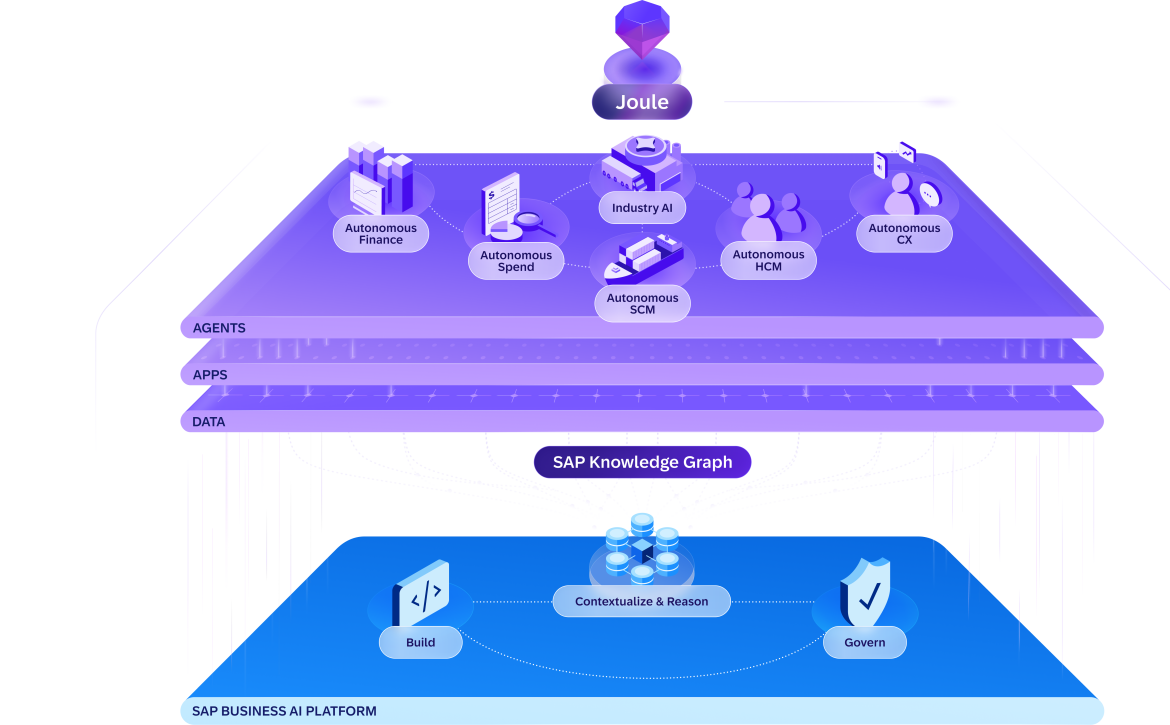
At the core of the Autonomous Enterprise is the SAP Autonomous Suite. Joule becomes the way you interact, as a single entry point into your business. In the middle, the SAP Autonomous Suite connects your core domains: finance, supply chain, spend, HCM, and customer experience. And underneath, everything is grounded in your business context, your data, your processes, your rules, your governance.

With SAP’s unified foundation of applications, data, and business context, AI is embedded directly into how work gets done, enabling autonomous, end-to-end execution rather than isolated use cases.
The operating model behind this is built on a clear division of responsibility: people set priorities, policies, and guardrails. Assistants understand role and process context and coordinate activity across domains. Agents carry out the defined work, detecting signals, triggering actions, and resolving routine tasks continuously in the background.
And while automation is a part of this, the bigger shift is intelligence and optimization. The system is no longer following predefined workflows. It is using business context to understand what is happening, and what should happen next. This is the shift from systems of record to systems that help run the business.
Finance offers a clear example of how this model changes the work itself. Many finance organizations still contend with manual steps, fragmented data, and slow cycles. In a volatile environment, that lag translates directly into slower responses to risk, missed opportunities, and diminished confidence in the decisions that shape performance.
With Autonomous Finance, more of that work can be handled by the system, allowing finance teams to spend less time chasing numbers and more time shaping decisions. The function begins to move from reconciling the past to shaping the future.
Autonomous Finance is not one capability, one agent, or one use case. It is built across the entire finance process, from planning to revenue management, treasury, closing, compliance, and tax. Within each area, assistants are supported by specialized agents working continuously in the background. Some focus on forecasting, some on billing, some on cash, and some on closing. The important point is that these capabilities are connected, so decisions in one area can flow into the others. Connected assistants, specialized agents, continuous optimization. That is the model.
The impact across these areas compounds. Finance teams reclaim meaningful capacity as manual reporting, reconciliation, and transaction processing give way to continuous intelligence. Cash cycles compress. Close timelines shorten. Forecasting becomes more accurate and more responsive to changing conditions.
Because these capabilities are connected, improvements in one area reinforce the others: faster billing flows into better cash visibility, which flows into stronger planning confidence, which flows into more decisive action at the executive level. Compliance strengthens as well, not through added controls, but through better intelligence embedded in the process itself, supporting requirements across ISO, SOC, and SOX with greater accuracy and less manual effort.
The result is not incremental improvement in isolated tasks. It is a fundamentally different operating posture for the finance function, one where the system handles orchestration and people direct outcomes.
Autonomous domains give breadth across business functions, while Industry AI provides the depth of knowledge. The same supply chain problem looks very different in life sciences, in industrial manufacturing, in agribusiness, in retail, or in energy. The rules, regulations, data models, and value chains are different.
SAP is not starting from generic AI and trying to teach it how an enterprise works. We start with decades of industry and process knowledge, already embedded in the systems that run the world’s most complex businesses. Our AI is grounded in sector-specific processes, end-to-end value chains, operational realities, and compliance requirements. And our ecosystem extends this with specialized expertise, so organizations can adapt the intelligence to their markets and their industries.
This is not AI for the sake of AI. This is AI applied to the real operating model of each industry.
That is the real shift: not AI operating in isolated tasks, but AI helping the enterprise continuously sense, reason, act, and learn. People remain in control throughout, while the system handles the orchestration required to bring together the right data, context, and decision at the right moment.
The Autonomous Enterprise marks a shift from managing processes to directing outcomes. It moves organizations from reacting to events to anticipating them, and from stitching together decisions after the fact toward helping the business move as one connected system.
This does not require waiting for a perfect, fully transformed landscape. Organizations can begin by applying AI on top of existing landscapes and evolving their business as they go. That work is already underway with many of our customers. What they have in common is that they are starting now, moving faster, making better decisions, and building the foundation for a more autonomous enterprise, step by step.
This is a journey. And it begins with the recognition that the enterprise of the future will not be defined by how efficiently it executes predefined processes, but by how intelligently it can sense change, weigh trade-offs, and move with confidence when it matters most.
For more on SAP’s broader Autonomous Enterprise announcement, read The Future of the Enterprise Is Autonomous. For more details on 2026 SAP Sapphire announcements, see the SAP Sapphire Innoation News Guide.
Manoj Swaminathan is general manager and chief product officer of SAP Autonomous Suite, Finance & Spend, and member of the Extended Board of SAP SE.
Eric van Rossum is chief marketing officer of SAP Global Product Marketing and chief product officer of SAP Industries and Globalization.
*IDC Resource Map for SAP, SAP Custom Survey 2026: Enterprise Process Automation Survey– April 2026, sponsored by SAP, doc #US54531626 _RMD , May 2026
See how ZF Group is using SAP RISE, SAP Business Data Cloud, and AI to modernize a complex global manufacturing landscape.
At SAP Sapphire Madrid 2026, Thomas Buck, Chief Information Officer at ZF Group, shares how ZF Group is preparing for AI at scale while transforming a highly customized SAP ECC environment shaped by years of growth and acquisitions. With more than 150,000 employees across 29 countries and 160+ plants, ZF is using RISE with SAP and SAP Business Data Cloud to move toward clean core, make data AI-ready, and build a stronger foundation for innovation.
The conversation explores how ZF is applying AI to an industry-specific quality management challenge: the 8D problem-solving process. Today, teams manually review historical reports, search for similar cases, identify root causes, and assess whether issues could recur across other products. Working with SAP through a forward-deployed engineering approach, ZF built a custom AI framework with four agents to help analyze historical data, compare current cases, support root cause analysis, and propose solutions based on past cases.
ZF also shares the expected business value, including faster processes, improved quality, and potential savings in the mid double-digit millions of euros. The discussion closes with how WalkMe helps users adopt new AI-enabled ways of working and how SAP Max Success Plan supports ZF’s broader transformation journey.
Chapters:
00:00 – Welcome and ZF’s AI journey
00:28 – ZF’s global manufacturing scale
01:13 – Moving from complex ECC landscapes to clean core
01:56 – RISE with SAP and SAP Business Data Cloud
03:08 – Industry AI and the 8D quality process
04:24 – Building a four-agent AI framework
05:07 – Forward-deployed engineering with SAP
06:05 – AI value and expected savings
07:14 – Driving adoption with WalkMe
08:31 – What’s next for ZF and SAP
Watch the full Customer Success Keynote. 👉https://sap.to/6050B8GXnq
Watch all SAP Sapphire replays on demand. 👉https://sap.to/6052B8GXns
Follow SAP:
LinkedIn: https://sap.to/6054B8GXnQ
Instagram: https://sap.to/6057B8GXnx
Facebook: https://sap.to/6058B8GXnI
Threads: https://sap.to/6059B8GXnL
About SAP:
As a global leader in enterprise applications and business AI, SAP stands at the nexus of business and technology. For over 50 years, organizations have trusted SAP to bring out their best by uniting business-critical operations spanning finance, procurement, HR, supply chain, and customer experience. For more information, visit: https://sap.to/6050B8GXn0
#RISEwithSAP #SAPBusinessAI #SAPSapphireMadrid2026
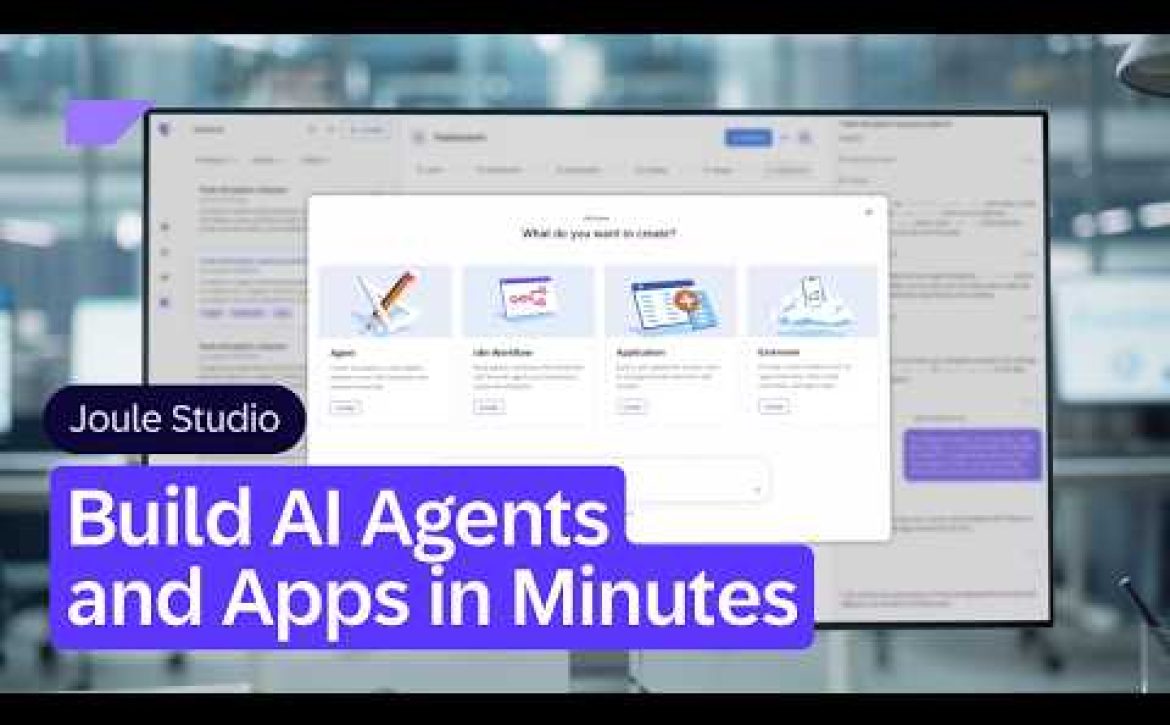
See how Joule Studio turns a single business prompt into an enterprise-ready AI solution – from agent to workflow to deployment.
In this demo, Joule Studio shows what AI-first development can look like for the enterprise. Starting with one business prompt, Joule Studio helps create a complete solution that includes an AI agent, coordination workflows, and a real-time dashboard – then tests and deploys it to production in minutes.
Joule Studio is SAP’s development solution for building AI agents, apps, and workflows on an SAP-managed runtime. It is designed to help teams move from business intent to working solutions faster, using natural language to shape requirements, specifications, and code-first development outputs.
The demo also highlights how Joule Studio supports enterprise needs beyond speed. Built-in SAP business context helps ground generated solutions in how real business processes run, while governance, lifecycle management, agent observability, and inherited controls help teams build and scale with confidence.
For developers and business builders, Joule Studio brings agents, apps, and workflows into a single AI-first experience – so custom enterprise solutions can move from idea to execution without adding unnecessary complexity. It is part of SAP’s broader vision for the X, where people set direction and AI helps execute trusted work across the business.
00:00 – Start with a business prompt
00:15 – Generate the solution plan
00:35 – Build the AI agent
00:55 – Create coordination workflows
01:15 – Add a real-time dashboard
01:35 – Test the solution
01:55 – Deploy to production
Try Joule Studio: https://sap.to/6052BBlr0q
Follow us on social:
LinkedIn: https://sap.to/6053BBlr0S
Instagram: https://sap.to/6054BBlr0s
Facebook: https://sap.to/6055BBlr0t
Threads: https://sap.to/6056BBlr0Q
About SAP:
As a global leader in enterprise applications and business AI, SAP stands at the nexus of business and technology. For over 50 years, organizations have trusted SAP to bring out their best by uniting business-critical operations spanning finance, procurement, HR, supply chain, and customer experience. For more information, visit: https://sap.to/6057BBlr0v
#JouleStudio #SAPBusinessAI #AIAgents
Today at SAP Sapphire in Orlando, SAP and Amazon Web Services (AWS) announced plans to build SAP Business Data Cloud (SAP BDC) Connect for Amazon Athena, a new offering that will provide bi-directional zero-copy integration between Amazon Athena and SAP Business Data Cloud.
Building on their long-standing partnership, AWS and SAP are making it easier for customers to access mission-critical SAP data products across AWS services, including Amazon Bedrock, Amazon Quick, and Amazon SageMaker. This will allow teams to deliver self-service analytics and build AI agents across all lines of business—without waiting for IT teams to replicate, prepare, and provision SAP data.
“The next era of business will be defined by how well organizations turn intelligence into action at scale,” said Muhammad Alam, member of the Executive Board of SAP SE, SAP Product & Engineering. “By bringing together SAP Business Data Cloud and widely adopted AWS AI and analytics capabilities, customers can unlock the true potential of data and AI.”
Enabled by SAP BDC Connect, the integration delivers near real-time, zero-copy access to semantically rich SAP data products directly through Amazon Athena, keeping data in place, preserving its original business context, and eliminating replication delays. Customers can query and analyze this data immediately, or choose to store and transform it for use across the broader AWS environment. This gives teams a governed, secure environment within AWS to easily build reports, dashboards, and AI agents.
“SAP and AWS share a commitment to helping customers put their most valuable data to work,” said Ruba Borno, vice president of Global Specialists and Partners at AWS. “By combining SAP Business Data Cloud with the AWSsecure, global infrastructure and advanced AI services, organizations can unlock mission-critical SAP data and act on it at the speed and scale their business demands.”
With SAP BDC Connect for Amazon Athena customers can:
SAP Business Data Cloud is already available on AWS in the U.S. East (N. Virginia), Europe (Frankfurt), Asia Pacific (Tokyo), Canada (Central), Asia Pacific (Sydney), South America (São Paulo), Asia Pacific (Seoul), Asia Pacific (Singapore) Regions, and the AWS European Sovereign Cloud.