E.ON Digital Technology’s Cloud ERP Journey: Driving Transformation Through Speed, Trust, and Agility

E.ON Digital Technology, one of Europe’s largest energy companies, operates across energy distribution networks, infrastructure solutions, and retail. As the company grew, so did the complexity of its data and operations. Legacy ERP systems, combined with decentralization and ambitious green transformation goals, could no longer keep pace.

Cloud ERP: Be ready to seize opportunities and secure success with an integrated suite of solutions

The solution was clear: implement a cloud-based ERP architecture designed to adapt, scale, and drive a full-scale transformation.

Building strategy on speed and people

E.ON Digital Technology’s move to the cloud was never about chasing modernity for its own sake, but about seizing control in a fast-moving world. The company understood that transformation is not only about technology; it’s about people and their needs.

Together with employees, E.ON Digital Technology crafted a strategic vision to keep pace with rapid technological change while empowering teams to deliver real solutions. At the core of this transformation was the Digital Lighthouse Project, which became the guiding force through the complexities of digitization.

As Athanasios Tabakis, the lead of the Digital Lighthouse technology at E.ON Digital Technology, explained, “We’re not just implementing isolated solutions; we’re building a platform that integrates speed, planning, reporting, cost transparency, and AI into one seamless ecosystem.”

This cloud ERP foundation shattered old habits, igniting true transformation by putting agility and speed at the heart of the business.

Today, E.ON Digital Technology boasts an intuitive, adaptive, finance-first design, built around how people actually work. The company’s guiding principle remains unchanged: transformation doesn’t start with systems; it starts with trust and clarity.

Max Englisch, manager of Finance Transformation at PwC Germany, emphasized the human and scalable nature of the project: “This has never just been about technology. It was about creating a vision that scales, brings people in, and drives real impact — not only for E.ON Digital Technology, but also across the entire company.”

PwC Germany continues to support E.ON Digital Technology in rolling out this vision, ensuring the Digital Lighthouse remains a catalyst for change.

Beyond technology: culture, process, mindset

Standardizing across a complex group like E.ON Digital Technology involves far more than technical upgrades. It requires navigating cultural, operational, and political layers. The S/4 United Program, the backbone of Digital Lighthouse, launched the company’s journey toward SAP S/4HANA Cloud Private Edition as the “mother ship” guiding the entire enterprise.

Innovation layers were carefully added on top to balance strategic consistency with the flexibility to differentiate. Early work focused on identifying where processes could deliver efficiency and value, laying a solid foundation for future-proof operations. As Tabakis put it, “The future of ERP is invisible. It anticipates your needs, speaks your language, and acts when it truly matters. It is not just digital; it is almost human.”

E.ON Digital Technology’s transformation challenges the entrenched mindset of “this is always how we’ve always done it.” In a heavily regulated and complex energy sector, data consistency is critical for both compliance and for confident decision-making. By building a semantic layer aligned with business logic, the company moves from fragmented inputs to coherent, faster decisions with increased accountability.

“Success comes from those who relentlessly pursue their vision until it becomes a reality,” Englisch added. “That’s exactly what E.ON Digital Technology has achieved.”

E.ON Digital Technology embraces AI and flexibility for the future

E.ON Digital Technology’s innovation journey did not stop at cloud ERP. Early adoption of generative AI transformed data into conversational insights. Now, the company is advancing toward agentic AI, where AI proactively supports decision-making by alerting teams to deviations and nudging interventions before the issues arise. In energy finance, where timing is everything, this responsiveness is a game changer.

Trust in AI remains paramount. Tabakis noted that “true confidence in AI comes when it aligns with how people think and work. Our mission is to build that trust step-by-step, helping people see AI not as a threat, but as a powerful ally to accelerate their work.” This human-centered approach is essential in a world where half embrace AI’s promise and half fear its impact.

The energy transition itself demands agility. Renewables introduce volatility, and new consumption patterns like heat pumps and electric mobility add complexity. The grid must balance supply and demand in real time, pushing E.ON Digital Technology’s business units — and adding their IT teams — to stay flexible.

To manage this, E.ON Digital Technology relies on SAP Profitability and Performance Management, a real-time financial management engine that mirrors actual usage, supports dynamic modeling, and scales with demand within the ERP. This technology allows the company to trace billions in value flows accurately and auditable, ensuring flexibility and compliance go hand in hand.

Englisch summarized the future vision: “The future of ERP lies in creating an open, connected data foundation that integrates SAP and non-SAP sources, enabling scalable data products and AI-ready architectures. It’s about moving beyond process efficiency to real-time insights that empower business users to unlock true value.”

E.ON Digital Technology’s transformation journey shows how cloud ERP, combined with human centered approach and cutting-edge AI, can drive speed, trust, and agility in the complex, rapidly evolving energy landscape. It is a blueprint for how companies can not only adapt but also lead in the digital age.

Sign up for the SAP News Center newsletter to get stories and highlights delivered to your inbox each week

SAP’s Core Applications, Data, and AI Come Together in SAP Business Suite | Introduction

Discover SAP Business Suite, our most significant announcement in the past decade. Explore the power of AI Agents, SAP Business Data Cloud, and the next evolution of unified business applications with SAP Business Suite.

Learn more about SAP Business Suite: https://sap.to/6054fqtOm

#SAPBusinessSuite

Introducing the SAP @NHL Front Office App

Every @NHL season starts off the ice 🏒🏆

From roster planning to contract negotiations, the SAP-NHL Front Office App helps all 32 NHL clubs stay ahead of the game with the right data, at the right time.

Learn more: https://news.sap.com/2025/03/sap-nhl-unveil-front-office-app-transform-hockey-operations/

Advanced Intercompany Sales in SAP Cloud ERP | Expert Talk

Are you navigating the complexities of intercompany transactions across multiple entities? You’re not alone—and SAP has a solution for you. In this insightful session, Maria Silipo is joined by SAP experts Jakob Schneller (Product Marketing), Matthias Barth (Product Management), and Markus Oertelt (Product Success) to explore how advanced intercompany sales in SAP S/4HANA Cloud Public Edition streamlines operations, enhances transparency, and reduces reliance on custom developments.

This video, which includes a real-world forklift delivery scenario and a live demo showcasing automated workflows, variant configuration, and value chain monitoring, is packed with practical insights and future roadmap highlights.

00:00 – Introduction & Business Challenges
03:19 – Real-World Scenario: Forklift Delivery
06:02 – System Demo: Advanced Intercompany Process
14:23 – Key Capabilities & Business Benefits
21:00 – Roadmap & Getting Started

🎥 Watch the video
Advanced intercompany process: https://sap.to/6052fi2Hr
🧪 Explore the demos
🔗 Interactive value journey: https://sap.to/6054fi2Hp
🔗 Partner demo access (5D2 & 2F4): https://sap.to/6056fi2Hn
🧭 SAP Signavio Process Explorer
🔗 Scope Item 5D2: https://sap.to/6057fi2HX
🔗 Scope item 7DM: https://sap.to/6058fi2Hk
📚 Documentation
🔗 SAP S/4HANA Cloud help: https://sap.to/6059fi2HZ
🔗 Test script for scope item 7DM: https://sap.to/6050fi2Hw
📝 Blogs
🔗 Advanced intercompany sales and stock transfer: https://sap.to/6051fi2Hb
🔗 Insights into the value chain: https://sap.to/6052fi2Hj
📌 SAP notes
🔗 Restrictions and general info for advanced intercompany sales: https://sap.to/6053fi2Hd

💬 Join the conversation
Let us know your thoughts in the comments below!
👍 Like, 💬 comment, and 🔁 share this video with your peers.
📧 For more info, reach out to us at insides4@sap.com

Job Scheduling with Joule in SAP IBP | 2508 Release Highlights & Demo

Explore this powerful new capability in Joule, which brings job execution and monitoring right to your fingertips – no app-switching required.

With this update, you can list your saved jobs with a simple ask and schedule jobs directly through Joule. You can also check job statuses, including your own jobs, failed jobs from today, or jobs created by colleagues.

Additional information about SAP Integrated Business Planning 2508 can be found in the What’s new section of the Help Portal: https://sap.to/6051fzrnt

Learn more about SAP Integrated Business Planning: https://sap.to/6052fzrnQ

SAP’s 30-Year History of Supporting Artists

Since 1994, SAP has showcased publicly accessible art exhibitions at its Walldorf training center while simultaneously building its own collection of now more than 2,000 works. SAP’s art historian Alexandra Cozgarea has been responsible for art at headquarters since 2008.

Learn more about the collection and virtual tours

On a cold day in February 2023, Cozgarea stood alone in building one on the Walldorf campus. In just a few days, the building’s renovation was set to begin. Workstations and meeting rooms has already been cleared, heating and water had been shut off.

About 400 pieces of artwork were still on the walls, all of which she needed to personally take down, document, and have professionally packed — a logistical masterpiece that demonstrates the importance of art at SAP.

From Hasso Plattner’s vision to corporate collection

SAP’s art collection traces back to co-founder Hasso Plattner, a passionate art collector. “He was the driving force behind bringing art to SAP,” Cozgarea explains. Until his departure from operational business, Plattner was involved in art selection decisions for SAP. “At the time, art at SAP was handled at the Executive Board level, specifically by Hasso’s staff.”

But the company didn’t just acquire its own art objects. As early as 1994 and 1995, the first of now 60 exhibitions of contemporary artists took place at the Walldorf training center. What made it special was that the exhibitions were publicly accessible from the beginning, a deliberate step to promote interest in art in the region and encourage exchange with SAP and its employees.

“We opened ourselves to everyone who wanted to visit SAP,” Cozgarea emphasizes. “Art is a good way to start conversations.”

External visitors were able to gain an unusual insight into a technology company while simultaneously experiencing contemporary art.

Encounters between company and society

The exhibitions create a special place of encounter. An average of 400 to 600 visitors attend the opening receptions, a mix of about 30 percent SAP employees and 70 percent external guests.

“What’s beautiful is that people come together and talk with each other,” Cozgarea explains. “Whether about art or other topics – art creates connections.”

These encounters extend across various target groups: school classes use the exhibitions for workshops, students from Heidelberg University of Education develop their own projects based on the themes shown, and corporate groups incorporate tours into their team days.

From South Africa to NFT art: 60 exhibitions

Since 2008, Cozgarea has curated almost 30 of the total 60 art exhibitions at SAP. The themes have ranged from social questions to technological developments. “I observe a lot, research, and then make contact with artists or institutions. Over time, ideas come to life that address social questions and developments or that have a connection to SAP themes,” she says, describing her curatorial approach.

In 2018, SAP was one of the first companies worldwide to present an NFT art exhibition, with the title “Poetry of the Blockchain.” The 2023 exhibition “The Metaverse: Dreamland or Dystopia?” was dedicated to the metaverse theme and is currently viewable via virtual tour. The design thinking methods that have been in use at SAP for many years are addressed in the exhibitions “Fail Early and Often” and “From Bauhaus to AppHaus” (both 2019). Other exhibitions like “Un Paseo de Arte Latino” (2016) and “South African Identities” (2018) build bridges to cultures and continents where SAP is represented.

Currently, the exhibition program is on hiatus as new spaces are being planned as part of the training center renovation. During this pause, SAP offers online virtual tours that allow employees and non-employees alike worldwide to experience the exhibitions.

“That’s important,” says Cozgarea, “because this way colleagues and external art enthusiasts around the globe can visit our exhibitions – not just on-site in Walldorf.”

Art historian with a feel for corporate culture

Cozgarea came to SAP in a roundabout way — or rather, she came back to SAP. During her studies in art history and psychology in Heidelberg, she was a working student at SAP in Communications and supported regional art projects. After her studies, she gained further experience in corporate collecting at Heidelberg Cement. “We built a very focused corporate collection back then – everything around the theme of building and cement,” she remembers.

Then, in 2008, came the call that changed her life. “They asked if I wanted to come back to SAP. And I said: ‘No, of course not — I do exclusively art.’ They said: ‘That’s exactly why!’” SAP was planning at the time to professionalize its art program and set it up more structurally. For this, there was an independent curatorial role to fill.

Today Cozgarea moves fluidly between two worlds of technology and art. “I try to bring these together through themes and bridges,” she says. The connection is what makes her work particularly appealing to her.

More than decoration: art as an educational mission

For SAP, the most important aspect is not the investment value of the artworks, but rather the educational mission and employee development they support. “The intention was always to give something back to the employees and the region,” she explains.

SAP’s collection now comprises more than 2,000 artworks distributed across SAP locations in Germany. Teams in Germany may borrow art for their offices and team rooms, a service that was originally reserved for top management but is now open to all interested parties.

“Colleagues appreciate the very personal approach,” Cozgarea says, describing the process. “They come to me, we select a piece of art together, and then we organize transport and hanging.” Many employees appreciate this small break from their work routine to select a picture.

The 400 artworks removed from building one, currently closed due to renovation, are waiting in the training center’s storage facilities for their next deployment. Some will re-enter building, but many of them will also be available to all employees in Germany for the first time.

Subscribe to the SAP News Center newsletter to receive highlights and stories each week

SAP Innovation Award Winner HARTING Innovates for a Sustainable Future

The HARTING Technology Group has established itself as a pioneer in sustainability and a leading provider of connectivity solutions for industrial technologies. With the implementation of SAP Sustainability Footprint Management, part of the SAP Sustainability portfolio, HARTING has automated and scaled CO₂ emission calculations for 13,000 materials.

This data-granular, verifiable, one-click solution supports the company on its path to carbon neutrality by 2030.

Challenges and opportunities

HARTING faced the challenge of finding a reliable method to calculate CO₂ emissions across thousands of production materials while meeting customer and supplier expectations regarding sustainability. Leveraging its existing ERP application landscape with SAP and maintaining established green production and renewable energy processes were crucial.

The results are in: See who won the 2025 SAP Innovation Awards

“Conducting our business and protecting the environment are not mutually exclusive. We are convinced that we must consider both to be successful in the long run,” says Dietmar Harting, member of the Board and partner of the HARTING Technology Group.

Innovations for a sustainable future

Considered the connectivity gold standard across various industrial sectors, HARTING required a robust system to accurately assess emissions. SAP Sustainability Footprint Management can automate data collection, scale emission calculations, and create CO₂ transparency throughout the supply chain. “The key to communicating our CO₂ emissions transparently and recognizing potential for reduction lies in the automated calculation and granularity of the data provided by SAP Sustainability Footprint Management,” explains Dr. Stephan Middelkamp, general manager, Quality and Technology at HARTING.

This solution enables HARTING to provide real-time, granular data to support the “GreenLine” label, an environmentally sustainable designation highlighting renewable materials offering up to a 70% CO₂ reduction.

Strengthening sustainable production

With SAP Sustainability Footprint Management, HARTING can now precisely calculate and report product carbon footprints. This capability is essential to address upcoming EU sustainability regulations, such as the Corporate Sustainability Reporting Directive and Digital Product Passport. The solution helps simplify complex data into verifiable, one-click results, promoting sustainable production practices.

Also integrated into HARTING’s sustainability strategy is the use of SAP Responsible Design and Production, which helps the company design products responsibly from the start, reduce plastic taxes, and promote recycling.

“The site-level data derived from SAP Sustainability Footprint Management will drive cleaner production in environmentally friendly facilities while mitigating greenhouse gas emissions and reducing the impact on water and land life. Green is how we think, green is how we act,” emphasizes Jordy Brinks, global environmental manager at HARTING.

On the path to a greener future

SAP is advancing HARTING’s sustainability journey by enabling the company to design products more sustainably, reduce plastic taxes, promote responsible sourcing, and further recycling practices. With these efforts, HARTING aims to achieve carbon neutrality at all locations by 2030, underscoring its commitment to sustainable growth and environmental stewardship.

“As a family business, we combine consistency with a willingness to innovate and regional loyalty. For us, this means taking responsibility for people and the environment,” Harting says. “We’re not only shaping a livable planet for our future generations, we’re making the future possible. We want to shape the future with technologies for people.”

The HARTING Technology Group continues to drive meaningful change, connecting business success with a greener future and aligning family ideals with sustainability goals.

HARTING at the 2025 SAP Innovation Awards

All of these efforts did not go unnoticed: HARTING has long been recognized as a pioneer in sustainability. This year, it won an SAP Innovation Award in the Sustainability Hero category, leveraging SAP Responsible Design and Production to create 85% of its plastic packaging material from recycled materials.


This article first appeared on the German SAP News Center.

Get the latest SAP news delivered to your inbox once a week

Full SAP Business Suite Demo: AI & Cloud ERP Transforming the Modern Enterprise | SAP Sapphire 2025

See how SAP’s connected suite transforms real-time decision-making across the C-suite—from CFO to CRO, COO, and CHRO.

Watch as leaders react instantly to new tariffs, leverage AI-powered insights from Joule, and drive coordinated action across finance, sales, supply chain, and people strategy—all within a single platform.

Discover how SAP’s integrated solutions help businesses stay agile, protect margins, and accelerate growth, even in times of uncertainty.

00:15 – CFO: Tariff Impact
01:26 – Finance: AI Forecasting
03:20 – CRO: Sales Strategy
05:30 – COO: Supply Chain
07:07 – CHRO: Workforce Planning
08:37 – C-Suite: Unified Decision-Making

Watch the full SAP Sapphire Global Keynote: https://sap.to/6054NarRk
Watch all SAP Sapphire replays: https://sap.to/6055NarRZ

#SAPSapphire

A New Era of Sustainable Enterprise Management, Powered by Applications, Data, and AI

In boardrooms worldwide, a critical revelation is taking shape: granting sustainability data more decision-making power is the most strategic decision you can make today.

Newly unveiled innovations and partnerships revolutionize the way work gets done

By embedding sustainability into core business applications, unifying fragmented data across the enterprise, and amplifying human expertise through AI, SAP is transforming how organizations turn sustainability commitments into competitive advantage.

Across the C-suite, leaders face pressure to make good on their organizations’ sustainability commitments while ensuring these initiatives create tangible value for their specific business units and departmental operations.

COOs grapple with maintaining resilient supply chains while embedding sustainability metrics for better risk prediction. CFOs struggle to gain visibility into integrated financial and non-financial data needed to manage reporting and drive sustainable growth. CPOs seek transparency of suppliers’ sustainability footprints across the source-to-pay process, while CHROs work to engage talent with authentic sustainability performance. Meanwhile, CROs need verified sustainability data to build brand trust and enable green premium pricing, and CIOs face the complex challenge of integrating sustainability data while managing governance, cost, and AI-driven innovation.

What’s missing is not awareness, but actionable, decision-grade sustainability data worthy of sitting alongside financial and operational metrics. This is why we build sustainability directly into our applications, generating new, usable data at the source of business activity.

Organizations find themselves constrained by financial systems, inconsistent data, and business processes that were not designed to address sustainability’s multifaceted nature. By ensuring this sustainability data becomes part of customers’ larger data story and drives core processes, we overcome these constraints.

This isn’t a peripheral issue; sustainability now intersects every critical business function, and the thoughtful organization of sustainability data. Its application to business processes prepares organizations for their agentic AI future, where sustainability metrics contribute to broader business intelligence tools like margin optimization agents rather than being siloed in sustainability-only solutions.

In this environment, SAP emerges as a strategic partner that combines sustainability data with business processes to drive real change. By harnessing the power of SAP Business AI and SAP Business Data Cloud, we translate intricate sustainability challenges into clear, executable strategies.

This week, we introduced a new evolutionary step of sustainability solutions that go beyond traditional software updates. These solutions are designed to bridge the critical gap between organizational ambition and tangible outcomes. We help businesses manage risk, ensure compliance, and unlock meaningful enterprise-wide value.

This is more than a technological upgrade; it’s a strategic framework for sustainable business innovation. And now, we’re translating that strategy into action, through AI-powered innovations that scale.

AI for sustainability at scale: New innovations for EHS and product compliance

Beginning in August 2025, new SAP Business AI capabilities will be available in beta, embedded within key sustainability applications to help customers ready their data, automate processes, and amplify their expertise. These AI-driven innovations streamline operations across environmental, health and safety (EHS) and product compliance workflows, driving measurable and scalable impact.

Here’s a look at what’s coming:

  • AI-assisted permit management in SAP S/4HANA for EHS environment management simplifies and automates permit handling by capturing and extracting key data from permit documents and automatically proposing relevant follow-up tasks to ensure compliance.
  • AI-assisted safety observation reporting with Joule, SAP’s AI copilot, in SAP S/4HANA for EHS workplace safety, enables seamless, intuitive incident reporting through a conversational interface, reducing barriers to shop floor safety documentation.
  • AI-assisted safety instruction generation in SAP S/4HANA for EHS workplace safety suggests appropriate safety instructions based on risk assessments and job hazard analyses, supporting proactive and preventive measures.
  • AI-assisted compliance information processing in SAP S/4HANA for product compliance automates the extraction and mapping of critical data from declarations, certificates, and safety data sheets, improving accuracy and freeing teams from tedious manual work.

These features will be available in beta and will be part of the new SCM premium package, reflecting SAP’s commitment to delivering embedded, business-ready AI that drives real outcomes.

AI that’s already delivering value

SAP customers are already leveraging Business AI to supercharge their sustainability efforts, including:

  • In SAP Sustainability Control Tower, AI accelerates environmental, social, and governance (ESG) report generation with editable templates, generative text, and visualizations, freeing teams to focus on ESG execution, not formatting.
  • In SAP Sustainability Footprint Management, AI automates emission factor mapping by intelligently matching products to thousands of lifecycle assessment database entries, complete with confidence scores.
  • In SAP Green Token, AI automatically validating and extracting data from International Sustainability and Carbon Certification (ISCC) PLUS supplier declarations, minimizing errors and increasing speed.

These intelligent capabilities help customers reduce costs, mitigate risk, and drive business performance across reporting, carbon management, circularity, and regulatory compliance.

What’s next: unlocking enterprise-wide sustainability insights

In the second half of 2025, SAP will make SAP Sustainability Control Tower available as an Intelligent Application within SAP Business Data Cloud. This will unify sustainability data and business operations on a single platform, enabling consistent reporting, deeper insight, and smarter decision-making across the enterprise.

A technology preview of these solutions will be made available to selected customers before general availability.

One sustainability data model: From complexity to clarity

SAP is also introducing new sustainability data products throughout 2025 as part of our strategy to deliver hundreds of curated and governed datasets across SAP Business Suite. These data products, accessible via SAP Business Data Cloud, will include:

  • Structured emissions data (air, water, wastewater) from SAP EHS Management and SAP S/4HANA for product compliance
  • Additional datasets from SAP Sustainability Footprint Management

This unified sustainability data model will empower customers to strengthen compliance, simplify analytics, and scale sustainability programs with confidence and clarity.

Process intelligence meets sustainability intelligence

True progress does not just come from better data, it comes from better processes. That is why SAP is embedding sustainability impact metrics into the SAP Signavio Process Transformation Suite starting in autumn 2025. These new capabilities will include:

  • SAP Signavio Value Accelerators: Pre-built process models and industry best practices tailored for regulatory-specific use cases
  • SAP Signavio Process Intelligence: Analytics tools that identify opportunities to optimize business processes and embed sustainability at scale

With these additions, customers can align process transformation efforts with environmental goals, helping close the gap between strategy and execution.

Your best, made real

With SAP, sustainability transforms from a compliance checklist into a lever for innovation, resilience, and growth. By embedding sustainability into applications, unifying data across the enterprise, and enabling intelligent automation through AI, we empower organizations to be sustainable while accelerating performance.

From frontline safety to carbon reporting, from real-time data to boardroom insights, this is what “your best, made real” looks like.

Welcome to a new era of sustainable enterprise management, powered by SAP.


Sophia Mendelsohn is chief sustainability and commercial officer at SAP.
Gunther Rothermel is chief product officer for SAP Sustainability.

Get the latest news and stories from SAP Sapphire in 2025

SAP BTP Innovations Deliver Powerful AI Capabilities to Developers and Business Users Across SAP Business Suite

Businesses today are navigating an era of explosive digital transformation, rising customer expectations, and the need for constant innovation. Meanwhile, many are contending with legacy systems that require cloud transformations to stay competitive.

Newly unveiled innovations and partnerships revolutionize the way work gets done

SAP Business Technology Platform (SAP BTP) helps address these challenges. Serving as the foundation of SAP Business Suite, SAP BTP connects, extends, and automates business processes and applications, accelerates application development, and deploys AI capabilities that drive growth and innovation.

This week at SAP Sapphire, we shared amazing firsthand customer and partner success stories and announced new SAP BTP innovations that help customers bring out their best.

Build custom AI agents and Joule skills for your business

AI agents support and enhance businesses by utilizing AI to build deep understanding and perform multi-step workflows across end-to-end business processes. These agents act with purpose and continuously learn, providing organizations with increased operational efficiency, sharper insights, and faster innovation.

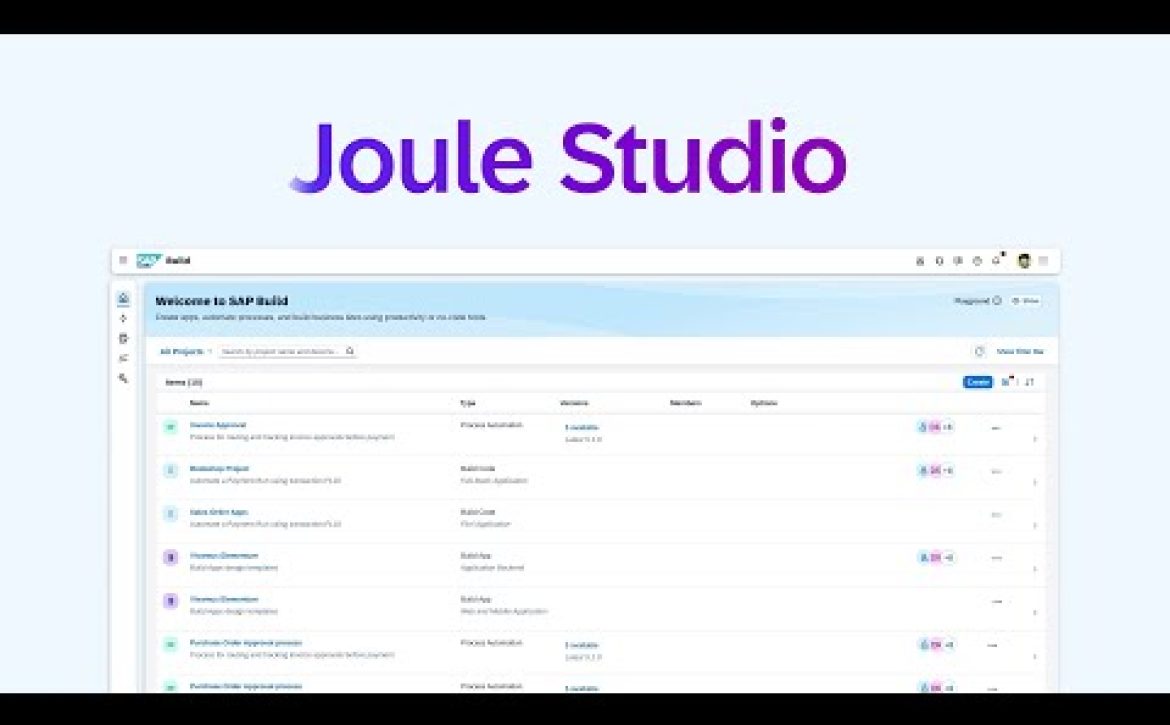
Joule Studio, a new capability within SAP Build, enables users to build AI agents and Joule skills that are scalable, secure, and grounded in business context to enhance business specific outcomes. While Joule skills execute rule-based tasks, AI agents plan and execute complex business scenarios. Deeply grounded in business data, these agents drive accurate outcomes in line with goals. The open and extensible framework of Joule Studio enables users to connect with not only SAP, but also non-SAP applications for seamless execution.

Joule Studio, generally available in June 2025, allows customers to design, deploy, and manage custom Joule skills and AI agents with low-code, no-code simplicity. Read our announcement blog here to learn more and register for the upcoming webinar to see Joule Studio in action.

With Joule Studio, we expand our extensibility portfolio SAP Build to the next level for building Joule skills and agents. This way, customers can implement innovations intuitively and efficiently.

Previous Next
Close
Test Caption
Test Description goes like this