In many B2B organizations, creating a customer quote still involves a familiar sequence of emails, approvals, contract reviews, and manual handoffs. The process can take days or even weeks, creating delays for customers and additional work for employees.
Generate traffic from AI search and use AI to execute
As a global leader in telecommunications technology operating in more than 190 countries, Ericsson manages highly complex commercial relationships involving products, services, customer-specific contracts, pricing agreements, and global fulfillment operations. Behind every quote is a web of business rules, approvals, and dependencies that must be coordinated accurately and efficiently.
For years, that complexity created friction in the quoting process. In some cases, generating a quote could take more than two weeks. Today, many of those same requests can be completed in minutes or even seconds.
The hidden complexity behind every quote
At Ericsson, many customer transactions are tied to multi-year framework agreements that include negotiated pricing, contract-specific products, and customer entitlements. Sometimes customers return months or even years after an agreement is signed and need to understand what products, configurations, and pricing are available to them before placing an order.
Historically, that process often required customers to contact their account representative, who would manually gather information, validate contract terms, and prepare a quote. Depending on the complexity of the request, responses could take days or even weeks.
Ericsson’s objective was straightforward: make it easier for customers to do business with the company.
“We want to be easier to work with as a partner to our customers,” said Aaron Thomas, global product owner at Ericsson.
Using SAP Commerce Cloud, Ericsson introduced digital commerce capabilities that allow customers to access contract-specific products, generate quotes, and place orders through self-service channels. Customers can now access dedicated storefronts built around their agreements, browse available products, generate quotes, and complete transactions without relying on manual intervention from account teams.
What once took days or weeks can now be completed in minutes or even seconds, helping improve accuracy and reduce rework across commercial operations.
Beyond automation: Exploring the role of AI agents
Once the quoting process became digitized and streamlined, Ericsson began exploring how AI could take commercial execution to the next level.
“We’ve moved from manual processes to digitized and automated processes,” Thomas explained. “Now we’re asking: can an agent perform those tasks?”
Rather than using AI solely as a productivity tool, the company started evaluating how AI agents could actively participate in commercial processes.
One area Ericsson is exploring is quote creation. The company is evaluating how AI agents could analyze customer requests, identify relevant contract information, assemble recommendations, and prepare proposed quotes for human review.
Employees remain responsible for oversight and decision-making, while AI helps reduce administrative work and allows sales and account teams to spend more time advising customers, solving business challenges, and strengthening relationships.
The company is also exploring other AI-driven capabilities, including agents that can improve product descriptions and search experiences across its internal product portfolio, helping employees find information more quickly across a large and complex catalog.
Defining the next chapter of B2B commerce
For Ericsson, AI is becoming more than a productivity tool. It is creating new possibilities for how commercial work gets done.
Reducing quote creation from weeks to seconds delivered immediate value for customers and employees alike. But the company’s exploration of AI agents points to a broader shift, one where intelligent systems help businesses execute complex processes faster, more consistently, and at greater scale.
For Ericsson, the journey from weeks-long quoting cycles to AI-assisted execution is about more than efficiency. It is about creating a simpler experience for customers and helping employees focus on the work that matters most. As the company continues exploring how agents can support commercial operations, it is helping redefine how complex B2B processes can be executed in the age of AI.
To learn more about Ericsson’s approach to AI and the future of agentic commerce, watch the webinar: Agentic B2B Commerce: Finding the fast track to profitable growth. You can also explore SAP’s vision for unified commerce at sap.com/unified-commerce and learn how organizations are connecting commerce, customer experiences, and operational execution to drive better business outcomes.
Subscribe to our newsletter to receive weekly news, highlights, and updates from the SAP News Center
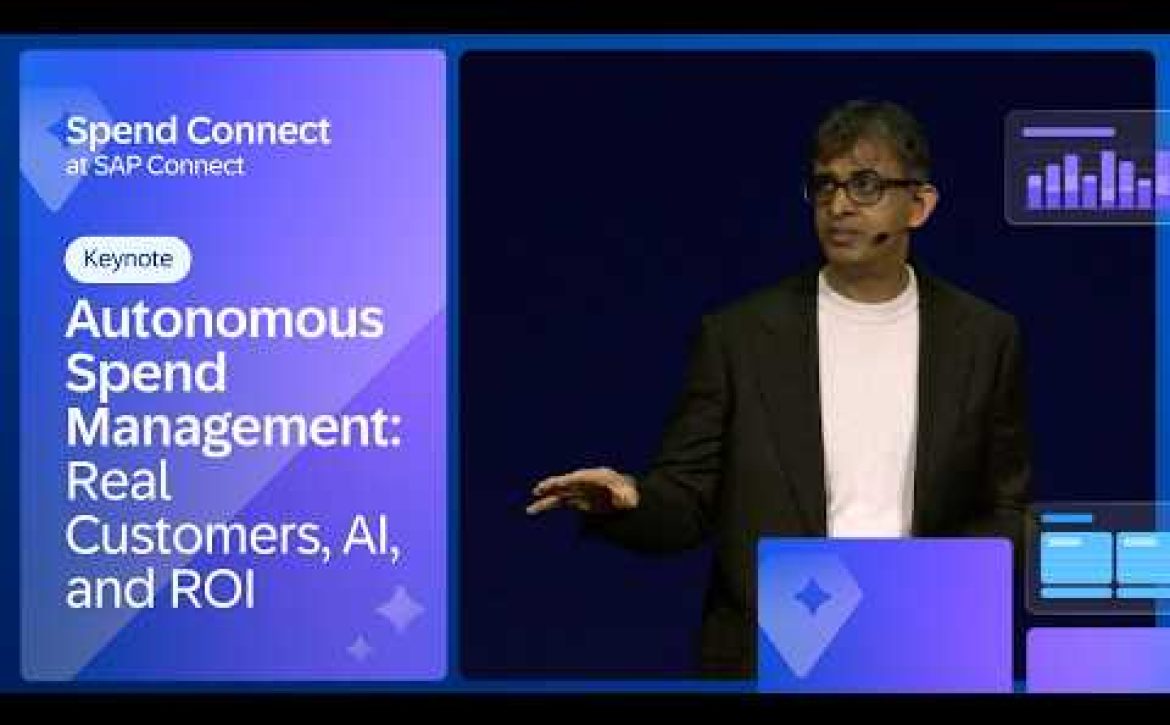
Watch the full Spend Connect 2026 keynote, live from Las Vegas. SAP leaders, customers, and partners show how Autonomous Spend Management is moving from vision to reality, with next-gen SAP Ariba, live AI demos, customer proof points, and a new procurement orchestration partnership.
What you’ll see:
➡️ Autonomous Spend Management — how SAP is helping procurement move from reactive management to continuous intelligence with AI, trusted data, integrated workflows, and governed automation
➡️ Next-gen SAP Ariba — now generally available, with customers already live and using an AI-native foundation built for source-to-pay transformation
➡️ Spend Intelligence and SAP Business Data Cloud — how procurement teams can identify opportunities, monitor spend signals, and act before costs escalate
➡️ Joule and AI agents — live demos of opportunity analysis, bid evaluation, obligation management, services procurement, and change orders across SAP Ariba and SAP Fieldglass
➡️ Customer proof points — IBM, KPMG Germany, and ElringKlinger share how they are modernizing procurement with SAP
➡️ Procurement orchestration — a new SAP solution extension partnership with ORO Labs to support heterogeneous procurement landscapes
Customers featured: IBM, KPMG Germany, ElringKlinger AG
Partners featured: apsolut GmbH, ORO Labs
Speakers: Baber Farooq, CMO, Spend Management, SAP; Peter Graulich, Chief Revenue Officer, SAP Finance & Spend Management; Fang Chang, GM and Chief Product Officer, SAP; Aabhas Bhardwaj, Chief Revenue Officer, Procurement, SAP Ariba & SAP Fieldglass; Lorie Meola, CPO, IBM; Michael Muennich, Head of Procurement / CPO, KPMG AG Germany; Johanna Noack, Purchasing Process Manager, ElringKlinger AG; Kevin Drescher, Associate Partner, apsolut GmbH; Sudhir Bhojwani, Co-founder and CEO, ORO Labs
Chapters:
0:00 — Opening: Procurement in the age of AI
1:29 — Welcome to Spend Connect 2026
3:23 — Certainty, uncertainty, and the future of procurement
6:59 — Economist research and changing expectations for procurement
7:35 — Four signs of real Autonomous Spend Management
10:37 — The state of next-gen SAP Ariba
11:29 — IBM: Trust, transformation, and next-gen SAP Ariba
21:13 — Live demo: Spend Intelligence with SAP Business Data Cloud
24:18 — Spend opportunity agent and sourcing event creation
26:35 — Live demo: Bid analysis and award recommendations with Joule
28:12 — Contract creation, Cloud ERP integration, and obligation management
29:53 — Live demo: Services procurement with Joule, SAP Ariba, and SAP Fieldglass
34:18 — SAP User Research Panel and product feedback
34:57 — KPMG Germany: Procurement transformation and source-to-pay maturity
42:45 — KPMG: Invoice management, sourcing, and AI-enabled procurement
46:53 — ElringKlinger and apsolut: Next-gen sourcing implementation
55:44 — New SAP solution extension partnership with ORO Labs
57:20 — Procurement orchestration and evolving user expectations
1:02:09 — Roadmap for SAP and ORO Labs integration
Explore next-gen SAP Ariba solutions: https://sap.to/6059BG2MCz
Follow us on social:
LinkedIn: https://sap.to/6050BG0v3M
Instagram: https://sap.to/6052BG0v3O
Facebook: https://sap.to/6053BG0v3P
Threads: https://sap.to/6054BG0v3u
About SAP:
As a global leader in enterprise applications and business AI, SAP stands at the nexus of business and technology. For over 50 years, organizations have trusted SAP to bring out their best by uniting business-critical operations spanning finance, procurement, HR, supply chain, and customer experience. For more information, visit: https://sap.to/6055BG0v3R
Every executive I talk to is navigating the same fundamental challenge: how to execute faster and make smarter decisions while operating in an unpredictable market. Shifted demand, supply chain constraints, and margin pressure are no longer temporary disruptions—they are standard operating conditions.
To adapt, businesses are increasingly moving toward the vision of an Autonomous Enterprise. Achieving this requires connected, intelligent cloud systems that provide immediate operational clarity and give their teams the confidence to act.
For 13 years, SAP Innovation Awards have celebrated organizations turning transformation into reality
When organizations get this right, the results go far beyond internal efficiency. They set new standards for their entire industry, deliver exceptional value to customers, and solve critical economic, environmental, and social challenges.
That is the driving force behind the 2027 SAP Innovation Awards. Every year, the awards recognize organizations that take on tough business challenges, leverage modern SAP technology, and deliver measurable outcomes that push their organizations—and our global community—forward.
Why participate?
Recognizing your team’s hard work is just the beginning. SAP Innovation Awards are designed to elevate your success story on a global stage and provide tangible benefits for your organization:
Global visibility and marketing: Winners gain high-profile exposure, including a dedicated feature on the SAP News Center, cross-channel promotional campaigns, and potential placement on the SAP.com homepage.
Event access and speaking opportunities: Winners receive a complimentary pass to SAP Sapphire (or a $1,000 charity donation voucher) and an invitation to celebrate at the SAP Sapphire reception. Top innovators may potentially secure coveted speaking slots at the event to share their journey directly with industry peers.
Official recognition: To properly celebrate your team’s achievements, winners receive official, physical trophies and finalists and winners receive kits to showcase their success internally and externally.
A streamlined experience: focus on your story
Operational agility should apply to recognition, too. We have updated the submission process for 2027 to make sharing your story straightforward and fast.
You no longer need to figure out which category fits your project.
Instead of asking you to navigate a complex list of options, we want you to focus entirely on what matters most: telling your story. Simply submit your entry detailing the business problem you set out to solve, the SAP technologies you deployed, and the tangible business results you achieved.
Once submitted, our review committee will evaluate your entry and automatically assign it to the most relevant category. Because transformative work rarely stays in a single silo, your entry will also be considered across multiple applicable categories to maximize your team’s recognition.
Recognizing excellence across the enterprise
The 2027 awards framework recognizes breakthrough achievements across 14 core solution areas:
AI Excellence
Autonomous Enterprise Orchestrator
Business Network Luminary
Cloud ERP Champion
Emerging Growth Leader
Supply Chain Catalyst
Financial Futurist
Procurement Visionary
People Experience Pioneer
Customer Experience Innovator
Technology Pathfinder
Transformation Impact
Services Superstar
Sustainability Hero
Additionally, every entry is automatically evaluated for our Industry Leader awards, recognizing organizations that are building new business models across five key sectors:
Consumer Industries
Discrete Industries
Energy & Natural Resources
Public Services
Financial Services
Showcase your progress
Real innovation rarely happens in one massive leap. It happens when focused, pragmatic teams use technology to solve everyday problems, make better decisions, and build momentum day by day.
If your team is using SAP solutions to drive real value, we want to celebrate your work and share your success with our global ecosystem.
Think you know how fast SAP GROW works? We put real customer numbers to the test — game show style.
✅ 15 weeks to go live
✅ $25B supply chain managed with zero custom code
✅ Fully productive employees in just 3 days
✅ Enterprise ERP run by a team of 28
SAP GROW is AI cloud ERP built for companies of any size. See how it works for our customers: https://sap.to/6055BG5qA1
Three-time W Series Champion and Indy NXT race winner Jamie Chadwick built her career by learning when to block out the noise, when to ask for help, and when to trust herself under pressure.
In the fourth episode of Significant Figures, Jamie sits down with Ariana Bravo and Jason Bell to revisit the moments behind the numbers that have shaped her life so far. There is 1.329, the margin behind her breakthrough W Series win at Hockenheim. The 20 laps she led at Road America to make history in Indy NXT. The 2019 season that changed the course of her career. The 55 that followed her from karting into racing. And then her “Bring It” Number: the number Jamie brings to the table herself, and the one that looks toward the future of women in Formula One.
Jamie opens up about growing up unaware of gender barriers in karting, the pressure of being seen as a trailblazer, the physical and mental demands of stepping up to Indy NXT, and why she wishes she had asked Williams for more support earlier in her career.
Significant Figures is a new series about the people behind the public achievements – the pressure, relationships, turning points and beliefs that shape their lives and careers.
🔔 Subscribe to follow the series as more Significant Figures reveal the stories behind their numbers.
CHAPTERS
00:00 – What’s To Come
01:05 – 1.329 – W Series Debut
08:40 – 20 – History in America
15:45 – 2019 – Trailblazer
28:55 – 55 – Jamie’s Number
37:06 – 60 – The Future
43:25 – The Debrief
Follow us on social:
LinkedIn: https://sap.to/6059BG6Fbt
Instagram: https://sap.to/6050BG6FbQ
Facebook: https://sap.to/6051BG6Fbv
Threads: https://sap.to/6052BG6Fba
About SAP:
As a global leader in enterprise applications and business AI, SAP stands at the nexus of business and technology. For over 50 years, organizations have trusted SAP to bring out their best by uniting business-critical operations spanning finance, procurement, HR, supply chain, and customer experience. For more information, visit: https://sap.to/6053BG6Fbx
The Danish wholesaler Lemvigh‑Müller has deployed artificial intelligence to automate one of the most time‑consuming tasks in procurement: processing supplier order confirmations. The solution consists of multiple AI agents, each responsible for a clearly defined task, orchestrated into a single automated workflow built on SAP Business AI. The outcomes are faster processing, improved data quality, and more accurate delivery information for customers.
When suppliers send order confirmations as PDF files, even minor discrepancies in price, quantity, or delivery dates can trigger significant manual effort within procurement. For Lemvigh‑Müller, one of Denmark’s largest wholesalers within steel, plumbing, heating and electrical products, this has long been a familiar challenge, consuming substantial time and resources.
The company has now tackled the very point where earlier automation initiatives often stalled. With a new solution based on several specialized AI agents, developed on SAP technology and implemented in close collaboration with NTT DATA Business Solutions, supplier PDF order confirmations can now be read, interpreted, compared, and processed automatically—directly against SAP systems.
Capture business-wide AI value with speed and confidence
“We have previously tried both RPA and traditional automation approaches without really achieving the desired effect. The key difference this time is that we broke the task down into multiple independent AI agents, each responsible for a specific part of the process. Together, they now handle what previously required manual review,” says Frederik Aakerlund, IT director at Lemvigh‑Müller.
10 weeks from idea to AI agents in production
The project originated with an e-mail from Jess Frederiksen, an AI‑savvy project manager in Lemvigh‑Müller’s Market and Procurement organization. After successfully matching an order confirmation with a purchase order using ChatGPT as an experiment, he approached the IT director to explore whether this could be turned into a fully integrated system solution.
From the initial tests to production deployment, the entire project took just 10 weeks. According to Lemvigh‑Müller, this short implementation timeline was critical in allowing the solution to demonstrate tangible business value quickly and build internal support.
“This was not a long-running project. In 10 weeks, we moved from idea to AI agents in production, already delivering measurable value to our procurement officers,” Aakerlund says.
Over time, Lemvigh‑Müller expects the solution to free up resources equivalent to three to four full-time employees. These resources will instead be redeployed to higher-value activities, including handling the most complex and exception‑driven orders.
“The objective is not to reduce headcount, but to use our expertise more effectively. The AI agents take care of routine tasks, enabling procurement officers to focus on cases where their experience genuinely matters,” Aakerlund adds.
More than 100,000 order confirmations automated
Each year, Lemvigh‑Müller sends approximately 175,000 purchase orders to more than 2,000 suppliers. While part of this volume is handled in a structured manner via EDI, around 60% of supplier order confirmations are still received as unstructured documents.
With the coordinated AI agents in place, the company can now automatically identify delays, quantity changes, and price discrepancies—and respond significantly faster.
“Previously, when order confirmations were handled manually, it could take hours or even days before changes were reflected across the organization. Today, the AI agents update the data almost immediately, allowing customers to receive a much more accurate picture of deliveries far sooner,” says Klaus Heinemann, head of SAP ERP at Lemvigh‑Müller, who led the development together with the project team. “In addition, we now identify price discrepancies before the final invoice is issued, saving time both for us and for our suppliers.”
Multiple AI agents orchestrated in a single workflow
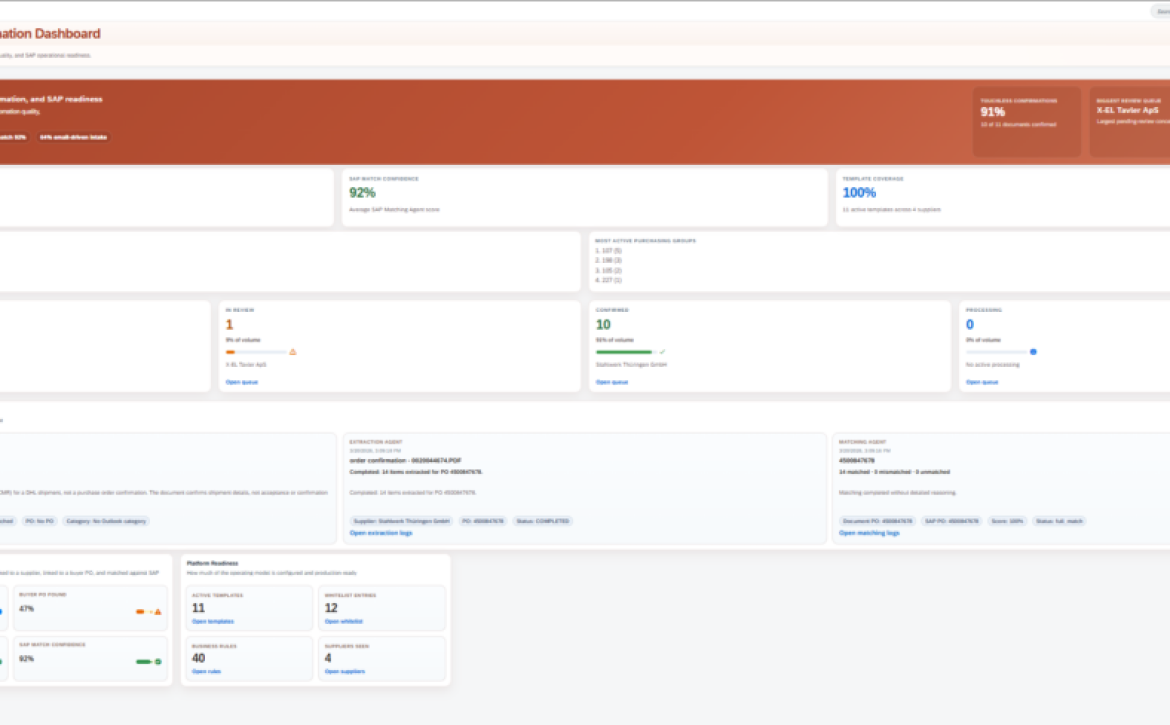
The solution is built around three cooperating AI agents, each with a clearly defined role in the process. One agent handles incoming e-mails and attachments, a second extracts and structures data from PDF documents, and a third compares the extracted information against purchase orders in SAP to determine whether there is a match or a deviation.
As a result, complex and unstructured supplier data can be processed in a unified, automated workflow without requiring procurement officers to open and manually review lengthy PDF files.
“What makes this solution robust is the interaction between the agents. Each agent is highly specialized, but they are orchestrated in a way that ensures the process flows seamlessly from start to finish,” Heinemann explains.
Three AI agents working together at Lemvigh‑Müller
Lemvigh‑Müller’s solution is built around three specialized AI agents, each responsible for a clearly defined task within the procurement process. Together, they form a single, end‑to‑end, automated workflow:
1. The e-mail agent receives and sorts incoming e-mails from suppliers. The agent identifies relevant order confirmations and attached documents and routes them to the next step in the process.
2. The data extraction agent extracts key information such as prices, quantities, and delivery dates from PDF documents and structures the data so it can be compared directly with purchase orders in SAP.
3. The matching agent compares the extracted data with existing purchase orders in SAP and determines whether there is a match or a deviation. In case of a match, the process continues automatically, while deviations are flagged for further handling.
During the project, the importance of master data quality also became increasingly clear.
“In areas such as Incoterms and other master data, we identified improvements that need to be addressed. This has been an important learning not just for this initiative, but for our broader work with AI,” he says.
While it is still too early to measure the full impact on customer experience, error rates, or claims, expectations are that faster and more precise handling of supplier confirmations will, over time, lead to fewer surprises and significantly improved delivery transparency. Internally, the solution has been met with strong interest and curiosity among employees.
“Procurement officers clearly recognize the value of being relieved from the most tedious routine work. This has sparked a constructive dialogue about how technology can best support their day‑to‑day responsibilities,” Heinemann says.
The interaction between the three AI agents makes it possible to automate a task that previously required manual review of unstructured documents.
Business AI with a clear business outcome
According to Lemvigh‑Müller, the investment is expected to deliver a return within a relatively short timeframe.
“We are talking about quarters rather than years when it comes to ROI. That is why it was essential for us to get the solution into production quickly and focus on processes with a clear and measurable impact,” Aakerlund says.
For SAP, the project serves as a concrete example of how artificial intelligence can be embedded directly into core business processes rather than remaining a disconnected experiment.
“Many companies talk about AI agents primarily in terms of automation. Lemvigh‑Müller demonstrates that the real challenge—and the real opportunity—lies in coordination,” says David Pontoppidan, head of AI at SAP for the Nordics and Baltics. “It is the orchestration of three specialized agents directly within the core process that makes this solution robust. This is also where many multi‑agent initiatives fail, not due to limitations of individual agents but because of insufficient coordination. Lemvigh‑Müller has succeeded by anchoring the solution in its SAP landscape, where data, business rules, and governance frameworks are already firmly established.”
He continues: “Innovation is not about company size. Lemvigh‑Müller shows that a Danish organization with short decision paths and a pragmatic approach to technology can move faster than many large global enterprises that are still in the planning stage. Ten weeks from idea to production is far from the norm, but perhaps it should be.”
Designed for operations and scalability
The solution was implemented in close collaboration with NTT DATA Business Solutions, which was responsible for making the solution production‑ready and fully integrated into Lemvigh‑Müller’s SAP landscape.
“By distributing responsibilities across multiple AI agents, Lemvigh‑Müller has been able to automate a complex process without losing transparency or control. This has enabled a fast and secure transition from pilot to production and ensures a more robust solution that can easily be expanded as new requirements emerge,” says Kristian Dahl, SAP UX manager at NTT DATA Business Solutions.
According to Dahl, the modular, agent‑based architecture was a key enabler in moving efficiently from proof of concept to live operation.
First step in a broader AI agent strategy
Initially, the AI agents have been deployed for selected supplier inboxes and business areas. However, Lemvigh‑Müller already sees significant potential in applying the same agent‑based approach across additional administrative processes.
“This is the first AI agent solution we have put into production. The experience has given us the confidence to consider similar approaches across other areas, including invoice processing and order management,” Aakerlund concludes.
Ellen Vig Nelausen is a Nordic Integrated Communications Expert at SAP.
Subscribe to the SAP News Center for the latest SAP news each week
See how SAP Business AI Platform connects data, rules, processes, and models to help enterprises unlock agentic value.
The race is on to unlock the value of agentic AI across the business. But building an autonomous enterprise is not just about adding tools. It starts with connection—bringing together your data, rules, processes, and best-in-class models so AI can work with the context of how your business actually runs.
In this overview, learn how SAP Business AI Platform helps connect the enterprise from end to end. By combining AI, business data, process context, and governance, the platform helps organizations build solutions that deliver real outcomes across the business from day one.
With SAP Business AI Platform, governance can help accelerate innovation, agents can act with purpose, and AI guidance can be grounded in your business data. Powered by 50 years of SAP business expertise, the platform provides a trusted foundation for organizations ready to scale AI with confidence.
Chapters:
00:00 – The race to unlock agentic value
00:08 – Building an autonomous enterprise starts with connection
00:21 – Bringing the enterprise together
00:33 – Governance, agents, and grounded guidance
00:44 – Connect to your AI potential
Learn more about SAP Business AI Platform: https://sap.to/6055BBAb8L
Follow us on social:
LinkedIn: https://sap.to/6056BBAb80
Instagram: https://sap.to/6057BBAb8F
Facebook: https://sap.to/6050BBAb84
Threads: https://sap.to/6051BBAb8f
About SAP:
As a global leader in enterprise applications and business AI, SAP stands at the nexus of business and technology. For over 50 years, organizations have trusted SAP to bring out their best by uniting business-critical operations spanning finance, procurement, HR, supply chain, and customer experience. For more information, visit: https://sap.to/6053BBAb87