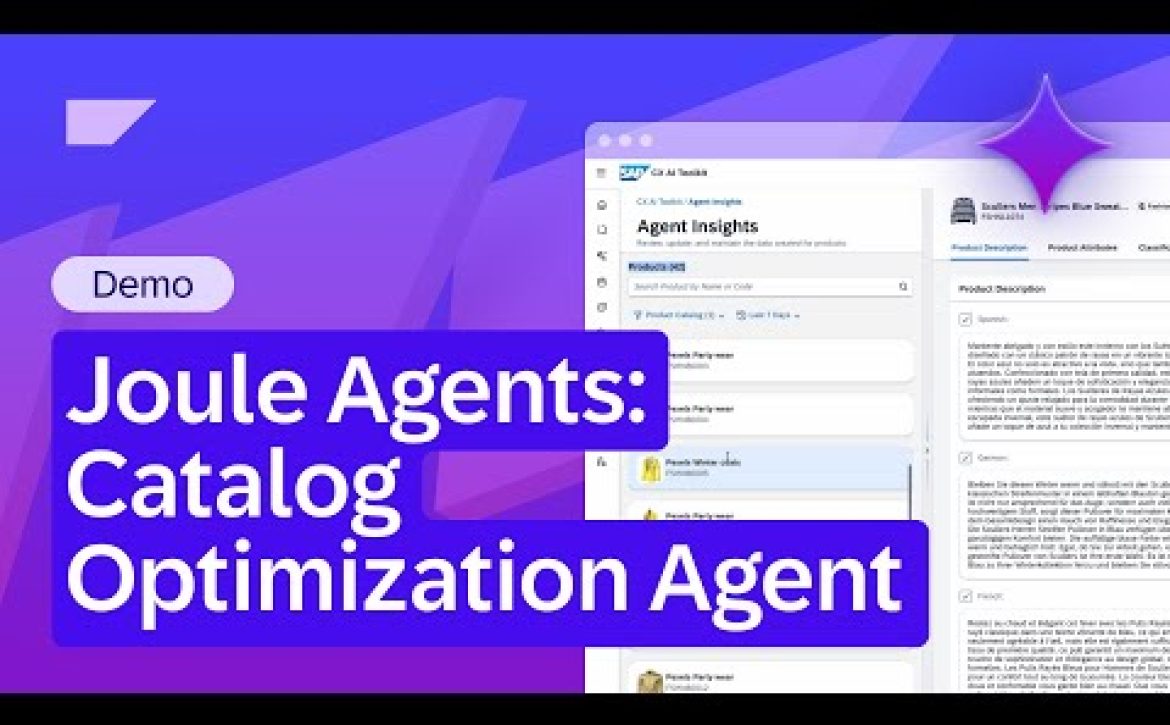
Joule Agents: Catalog Optimization Agent | Demo

Discover how category managers can eliminate manual catalog work, launch products faster, and deliver better customer experiences – creating measurable impact for the business.

With the Catalog Optimization Agent, merchandisers can cut time on descriptions, reduce catalog translation time, and lower the cost of maintaining high data quality.

Discover Joule Agents: https://sap.to/6053hbRCX

#Joule #AIAgents #BusinessAI

Approval Tasks in Planner Workspaces in SAP IBP | 2602 Release Highlight & Demo

See how SAP IBP 2602 makes planning approvals smarter and simpler by bringing approval tasks directly into the Planner Workspaces app, so you can manage S&OP sign-offs without switching applications.

In this highlight tour, you’ll see how approval workflows can be handled end-to-end inside SAP IBP: business process owners configure the right workbook as the approval context, managers review aggregated KPIs and charts, and approvals move the process forward, all within the planning environment. This helps teams implement dual control more easily and keep monthly S&OP cycles running smoothly.

✅ Approvals inside Planner Workspaces — Approve or reject SAP IBP workflows directly in the planning environment—no need to switch to SAP Build Process Automation.

📊 Right context for the right approver — Configure workbooks to show aggregated data at the level managers need, so decisions are informed and fast.

🔁 Seamless workflow progression — Approval tasks arrive in Planner Workspaces with full business context, completed tasks are tracked, and the process automatically continues to the next step after sign-off.

Chapters:
00:00 – What’s new in IBP 2602 approvals
00:07 – Approval tasks inside Planner Workspaces
00:31 – Full business context shown in workbooks
00:56 – Configure approval context via workbook selection
01:20 – Process step moves to “In Approval”
01:36 – Manager reviews & approves in Planner Workspaces
01:49 – Completed tasks + process continues
02:14 – Wrap-up: dual control made simple

• What’s new (Help Portal): https://sap.to/6058hBRjC

• Learn more about SAP Integrated Business Planning: https://sap.to/6053cGTA3

End-to-End SAP Landscape Refresh Automation: A Service Delivery Perspective

In the evolving world of enterprise IT, SAP landscapes are foundational to business process continuity, agility, and innovation.

SAP Datasphere: Top New Features | Highlights from 2025

See the top capabilities from SAP Datasphere’s 2025 updates, explained clearly by Klaus-Peter Sauer, in minutes.

From SAP Business Data Cloud to object store (GA), object versioning, and a broad set of efficiency enhancements across modeling, flows, task chains, and catalog, this video breaks down what shipped in 2025 and why it matters. Klaus-Peter also covers SAP Cloud ALM integration for centralized tenant monitoring and a small but powerful update: data access controls based on IdP user attributes, helping teams scale permissions with more consistency and control.

Chapters:
00:19 – SAP Business Data Cloud
01:56 – Object Store (GA)
02:47 – Object Versioning Support
03:41 – Efficiency Features Across SAP Datasphere
05:53 – SAP Cloud ALM Integration
07:05 – Data Access Controls (IdP User Attributes)

Explore SAP Datasphere. 👉 https://sap.to/6054CmSMO

Why Inventory Is Central to Supply Chain Planning in SAP S/4HANA

Inventory is the foundation of supply chain planning in SAP S/4HANA because every logistics and planning process depends on how stock quantities and values are classified, managed, and moved.

What’s new in SAP Mobile Start Version 2.5

See what’s new in SAP Mobile Start 2.5, from Apple’s Liquid Glass design refresh to smarter ways to stay on top of work on the go.

In this “What’s New” walkthrough, we highlight how Liquid Glass changes the look and feel of SAP Mobile Start (including a more dynamic, translucent navigation experience in iOS 26) and what that means for custom theming.

We also cover key productivity updates to To-Dos, including new filtering aligned to semantic groups from SAP Task Center, plus a refreshed list view that makes it easier to scan and manage a busy workload. Finally, we show how empty pages are now hidden so users can stay focused on mobile-relevant content.

00:00 – Welcome + what’s new in 2.5
00:12 – Release overview
00:25 – Liquid Glass design updates (iOS 26)
01:53 – Theming changes (UI Theme Designer)
02:34 – To-Dos improvements (Group filter + list view)
03:12 – Empty pages removed (mobile-only content)
03:34 – Learn more + roadmap
03:47 – Closing

Explore SAP Mobile Start and SAP’s mobile apps here: https://www.sap.com/products/mobile/applications.html

Storytelling: Where Art Meets Technology – Jussi Ängeslevä, ART+COM | SAP Design Talks

SAP Design Talks: The multidisciplinary teams at ART+COM push the boundaries of art and technology in spectacular installations that communicate complex information. Jussi Ängeslevä, creative director, explains how they do it.

Watch design leaders from some of the most iconic brands share their stories and insights: https://sap.to/605977Lhl

Originally published on August 3, 2018

How Collaborative Maintenance with SAP Improves Asset Management and Partnership | Expert Talk

Join host Fernanda Rodrigues and SAP experts Rajarshi Ghosh, Steven Wolter, and Fabian Sommer in a deep dive into collaborative maintenance with SAP Business Network Asset Collaboration. Discover why network-enabled capabilities are crucial for outsourcing maintenance and how integration strengthens asset-heavy industries. Explore real-world demos and learn about planned enhancements for seamless integration with SAP Cloud ERP Private applications. Gain valuable insights from DSAG’s customer perspective on intelligent asset management. Enhance your understanding of the collaborative processes driving efficiency and transparency in asset management.

⏱️ Chapters:
00:00 – Introduction & why collaborative maintenance matters
01:13 – Market challenges & outsourced maintenance trends
03:03 – SAP’s vision: Business Network Asset Collaboration
05:02 – Customer perspective & key benefits
08:48 – Live demos & integration with SAP Cloud ERP Private

🔗 Learn more about SAP Business Network Asset Collaboration: https://sap.to/60547smU
🔗 Why Collaborative Maintenance? https://sap.to/60557smUZ
🔗 What’s new with Collaborative Maintenance? https://sap.to/60567smUw

👍 If you found this video helpful, give it a thumbs up.
💬 We value your feedback; drop your questions and thoughts in the comments!
🔗 Share this episode to spread the knowledge about SAP Logistics innovations.
📺 Subscribe to our channel for more Expert Talks from SAP!

#SAPCloudERP #Maintenance #SAPBusinessNetwork

The Roadmap to SAP S/4HANA and Its Innovations

Deciding on an SAP S/4HANA adoption is often a combined exercise between the business and IT.

Processes, Software, and Catena X: How Automakers Should Prepare for CBAM

Time is running out for Europe’s automakers to prepare for the new carbon emissions rule. The EU automotive industry, which is responsible for 6% of total EU employment and 7% of EU gross domestic product (GDP), will be heavily impacted by the EU’s Carbon Border Adjustment Mechanism (CBAM).

The new regulation will require companies to account for carbon emissions on select imported products. For the auto industry, the steel and aluminum categories are especially critical.

Complete automobiles are not currently covered by CBAM, but the automotive sector is among the most exposed because of its dependence on emissions-intensive materials. Components such as body panels, chassis, frames, and battery enclosures rely heavily on imported steel and aluminum.

CBAM is currently in its transition phase and will enter the definitive phase on January 1, 2026, meaning that companies need to track their imported emissions on covered products throughout 2026 and begin purchasing certificates for those imported, tracked emissions in February 2027, with the first report due August 2027.

CBAM costs will add up quickly

The modern passenger vehicle contains around 1 tonne of steel and 200 kilograms of aluminum. Global averages hover around 1.9 tonnes of CO2 emitted per tonne of manufactured steel, and each tonne of primary aluminum produces around 15 tonnes of CO2.

With analysts projecting carbon ETS prices could reach €150 per tonne of CO₂ by 2030, a newly manufactured vehicle could soon be subject to €300 in CBAM certificate costs, assuming manufacturers import 20% of the necessary steel and 54% of the required aluminum, consistent with EU import data. Given that Germany produced 4 million cars in 2024, German automakers and component manufacturers could be on the hook for about €1.2 billion in CBAM certificate purchases in 2027.*

Looking past 2027, the European Commission plans to add categories like chemicals and plastics to the regulation, bringing more auto parts under the CBAM umbrella and making it even more important for European automakers and component manufacturers to solidify their CBAM strategies today.

Build a more compliant, sustainable, and resilient business with SAP Sustainability

CBAM preparations for automakers and component manufacturers

Across the EU automotive industry, companies seem insufficiently prepared for the new phase of CBAM.

This is not completely due to inaction by companies—EU regulators have not yet finalized details of the emissions value calculations methodology or how to verify data. That said, regulators already clarified the scope of companies that must report and the timelines to purchase certificates.

With this information, it’s now crunch time for European automakers and component manufacturers to get ready for the rules taking effect in January 2026. Here’s what they should prioritize.

1. Get familiar with CBAM and evaluate your process

The core elements of CBAM have been defined and companies must act now. If you haven’t done so yet, start by understanding the overall process and requirements.

If you are in scope—meaning you meet the de minimis threshold of either importing more than 50 tonnes of CBAM affected goods per year or 100 tonnes of embedded CO₂ annually—determine which parts of your supply chain are most affected. Identify your top suppliers and imported goods, develop a focused approach for obtaining actual emissions data from those suppliers, and assess the potential financial impact. As more materials come under the scope of CBAM, and as the carbon ETS prices rise, the financial impact will increase in the years ahead. Companies must prepare to meet these new obligations and manage this financial impact.

2. Collaborate with your suppliers

Identify and focus on your most critical suppliers—typically the top 50 to 100—and build a targeted engagement plan while defining an informed approach for the broader supplier base. Consider updating procurement terms to require future data sharing and provide support to suppliers in educating and calculating emissions where needed. Close collaboration will be essential to obtain actual emissions data to avoid the more expensive default values and identify decarbonization potentials. 

Accessing trusted supplier data is one of the biggest challenges facing companies today.

While the EU provides mechanisms for data exchange between suppliers and importers, Catena-X, an industry network for the European automotive sector, in combination with third-party data exchange software, offers an alternative to collecting trusted, standardized emissions data. Catena-X enables companies to collaborate and share data in a trusted environment. It brings together manufacturers, technology providers, and suppliers to standardize data sharing processes across the value chain. Beyond data exchange, these networks foster knowledge sharing, allowing members to learn best practices, align on standards, and accelerate compliance readiness collectively.

To participate, companies typically register with the network, adopt certified software that supports standardized data exchange, and begin collaborating with other members. This approach ensures interoperability and automates trusted emissions data collection. Catena-X is actively refining its scope and standards to support CBAM.

3. Find the right technology for your business

Most importantly, you want to find the right technology partner that will streamline CBAM reporting and support the integration of carbon into core financial accounting processes.

The EU CBAM report requires a lot of data, all of which can be requested, filled, and reported automatically using actual emissions values with tailored, ERP-based systems. The SAP Green Token solution can support CBAM declarant reporting by enabling standardized, auditable reporting workflows. The SAP Green Ledger solution will manage the certificate repository and help ensure financial and carbon accounting of CBAM emissions and certificates in alignment with accounting standards like US GAAP and IFRS (planned for H1 2026).

Manual processes, like e-mails and Excel files, are prone to error, do not scale, and will make CBAM compliance time-consuming and resource intensive.

Prepare your systems for CBAM compliance

CBAM is set to reshape material sourcing in the automotive industry by introducing carbon as a cost factor and driving transparency across global supply chains.

The ideal scenario for automakers and component manufacturers is to take decisive actions to decarbonize—such as sourcing low-emissions steel and aluminum, increasing circularity efforts, and optimizing product design to use less CBAM materials—while fully automating CBAM compliance.

Access to accurate data on supply chain emissions—and their financial implications—provides the insights that business leaders need to decarbonize and reduce risk in the years ahead.

The right combination of software tools and industry network collaboration can enable cost-optimized and automated CBAM compliance and deliver valuable supply chain intelligence. SAP Sustainability solutions can deliver measurable ROI by automating data collection and workflows and enabling finance teams to move beyond manual processes toward strategic analysis and action. This helps create a scalable foundation for ongoing carbon cost management while supporting standardized data exchange and collaboration across the value chain.

Start preparing now to ensure your business thrives as the 2026 CBAM definitive phase approaches.

Read the CBAM playbook and watch the CBAM webinar to learn more.


Thomas Janzen is an industry expert at SAP SE.

*This is a back of the napkin calculation to illustrate the potential impact. This is based on data that shows the EU imported 27.4 million tonnes of finished steel products in 2024. The EU consumed about 129 million tonnes. Therefore, we assume  imports account for roughly 20% of EU steel use. In 2023, 54% of the aluminum used in the EU came from imports. Using these averages means about 2 tonnes of imported CO2 per vehicle, or €300, assigning 20% of 1 tonne of steel emissions and 53% of 200kg of aluminum emissions.

Get the latest SAP news delivered to your inbox once a week

Previous Next
Close
Test Caption
Test Description goes like this