How SAP Customer Checkout and Viva.com Are Advancing Payment Processes at the POS Along Checkout Experience

The way payments are made is changing rapidly, shaping the future of modern point-of-sale systems. The traditional payment process is becoming a key part of the customer experience, as customers expect speed, flexibility, and smooth integration.

Digitalize your business with intelligent POS software

While cash is losing importance, contactless payments and mobile wallets are becoming dominant, with many providers enabling customers to make payments directly from their smartphones. These shifts put constant pressure on retailers to update their systems. The demand for mobile, contactless, and secure payment solutions keeps growing.

Market trends determine success

As a globally operating company, SAP keeps a close eye on the latest trends, looking not just to adapt its solutions but to rethink them. SAP Customer Checkout, the intelligent integrated point of sale (POS) solution for retail, merchandising, and catering, relies on strong partnerships to stay ahead and keep pace with those trends. Speed and the right collaborations make the difference.

“The POS market is in constant flux. Competitors are alert and customers arrive every day with new demands and ideas,” said Harald Tebbe, development lead for SAP Customer Checkout, speaking to the scale of change in the market. “Ultimately, market trends decide who stays successful and who doesn’t. Even though payment processes aren’t our direct business, our focus is on offering customers a wide range of payment options to make the end customer’s shopping experience as simple and convenient as possible. Payment infrastructure is a critical component of that experience. Our trusted technology partnerships are what make it possible, which is why we’re continuously looking for new collaborations.”

End-to-end solution through SAP Customer Checkout and Viva.com

As the first tech bank in Europe for businesses and being active in 29 countries, Viva.com offers customers an integrated omnichannel payments, banking, and financing platform.

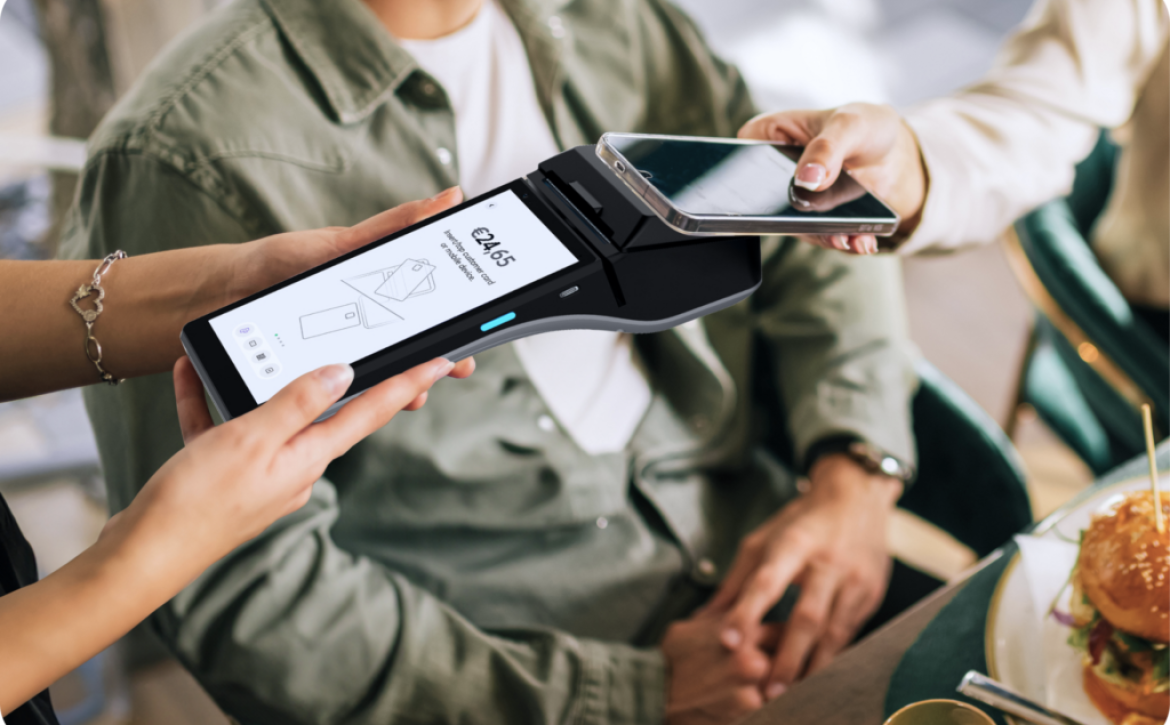
Viva.com’s leading Tap on Any Device payment technology takes centre stage. It turns any Android device—from fixed and mobile payment terminals to self-checkout tills and handheld devices—or iPhone into a secure card terminal, optimizing the customer experience and helping customers pay wherever they are. Tap on Any Device by Viva.com supports over 40 payment methods, DCC, surcharge, offline payments, while the tech bank delivers real-time settlement 365 days a year and a cashback scheme reducing transaction fees to zero percent.

Since SAP Customer Checkout was built to be hardware-independent, works across a variety of devices, and integrates with different payment terminals, the partnership creates an ideal end-to-end solution for customers in retail, consumer goods, food service, and other sectors. Open API interfaces in SAP Customer Checkout and Viva.com’s Terminal Integration Hub made the integration straightforward and quick to implement.

“With Viva.com, SAP Customer Checkout customers in 29 European countries get integrated payments and banking in one platform: From omnichannel payments and our leading Tap on Any Device technology to fast, seamless access to tailored financing options -no need to switch providers,” Harry Xenophontos, Chief Business Officer at Viva.com, said. “That’s the unique proposition we’ve built with SAP.”

Secure data communication for customers

Integrating SAP Customer Checkout with Viva.com requires a dedicated plug-in, which simplifies the connection between the POS system and the payment terminal by ensuring data is transferred via the HTTPS protocol, keeping communication secure. This matters in a period where both innovation and the protection of sensitive data are front of mind.

Customers also benefit from a particularly fast setup process and the freedom to choose from a wide range of devices to use as payment terminals. With three possible integration options, the system offers flexibility so merchants can find the right fit for their specific needs.

The joint project supports the development and delivery of forward-looking POS solutions that work well for both merchants and end customers.


Elena Vavitsa is a senior solution specialist for SAP Customer Checkout.

Subscribe to the SAP News Center newsletter to receive weekly stories, highlights, and news

Top image courtesy of Viva.com

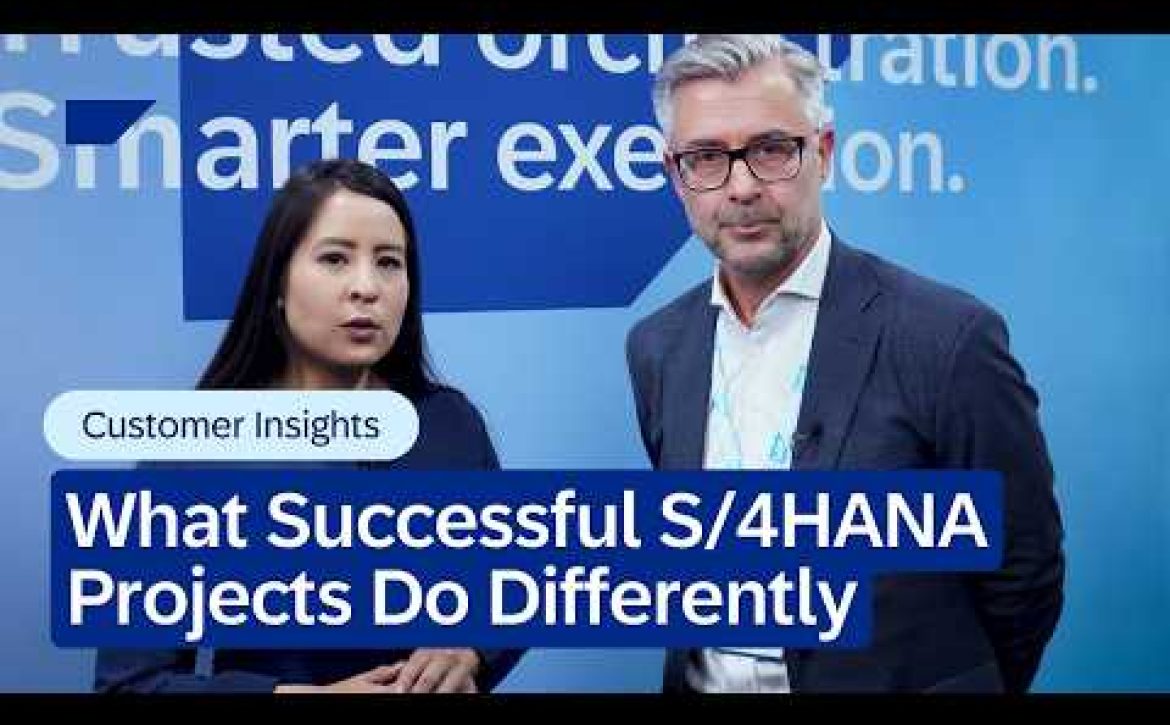
What Successful S/4HANA Projects Do Differently | Customer Insights with CIDEON

What makes an SAP S/4HANA project truly successful? It’s rarely just the technology.

In this interview, Sarah Mei Niesel from Global Product Marketing for PLM Solutions at SAP speaks with Peter Vandrey from CIDEON Software & Services, an SAP partner, about what sets successful SAP S/4HANA transformations apart. Drawing on their experience with Elementaranalyse Systeme GmbH, they discuss why strategic clarity, aligned processes, and structured product data are essential to long-term project success.

You’ll learn why SAP projects often run into challenges when requirements are unclear or product data is inconsistent, and how a strong foundation from day one can help reduce complexity, rework, cost, and time to market. The conversation also explores the role of SAP Engineering Control Center in creating a stable foundation for product data and enabling smoother collaboration between engineering and downstream processes.

Watch to gain practical insights into how companies can build a scalable, future-ready engineering and documentation landscape as part of their SAP S/4HANA transformation.

Listen to the full discussion in the “Inside SAP S/4HANA Cloud” podcast:
🎧 Spotify: https://open.spotify.com/episode/1ZuR0irCBBU6QO7enpP2et
🎧 Apple Podcasts: https://podcasts.apple.com/us/podcast/de-episode-02-sap-engineering-control-center/id1483791349?i=1000764241186

Chapters:
00:00 – What makes an SAP S/4HANA project successful?
00:33 – Why SAP projects rarely fail because of technology
01:08 – Lessons from Elementaranalyse Systeme GmbH
01:53 – The role of SAP Engineering Control Center
02:46 – Why clean product data matters from day one
03:01 – Listen to the full podcast discussion

Follow us on social:
LinkedIn: https://www.linkedin.com/company/sap/
Instagram: https://www.instagram.com/sap
Facebook: https://www.facebook.com/SAP/
Threads: https://www.threads.com/@sap

About SAP:
As a global leader in enterprise applications and business AI, SAP stands at the nexus of business and technology. For over 50 years, organizations have trusted SAP to bring out their best by uniting business-critical operations spanning finance, procurement, HR, supply chain, and customer experience. For more information, visit: https://www.sap.com/index.html

#SAP #S4HANA #DigitalTransformation

How AI Powers Customer Experience in Travel and Transportation

When talking about travel and transportation, there is only one thing a business should focus on: the end-to-end customer journey. Excellence in experience is what to strive for from the very first point of interaction to the destination.

Travelers nowadays have very strict requirements. From booking a ticket to arriving at a destination, they expect fast, convenient, and prompt assistance when they face issues along the way. No matter how perfectly a system is designed to meet needs, there will always be situations that can’t be avoided. Delays, confusing booking systems, long customer service wait times, and much more create frustration for travelers.

AI is reshaping how the travel and transportation industry is doing business. It delivers more avenues to provide customer care aside from the typical communication channels such as e-mail, short messaging services, and social media. AI provides smarter, faster, and more personalized customer experiences, leading to happier customers and therefore growth in revenue for the business. AI is no longer optional, it is now becoming a necessity.

Get an analyst’s perspective on the business impact of success plans from SAP Services and Support

Beyond tickets and timetables: how AI orchestrates the customer journey

Previously, travelers preferred travel agents over booking apps, relied on printed tickets, and valued personal service and human interaction. However, mobile apps for bookings, check-ins, and payments are now widely used. Travelers also expect real-time updates and personalized recommendations that provide seamless, end-to-end experiences.

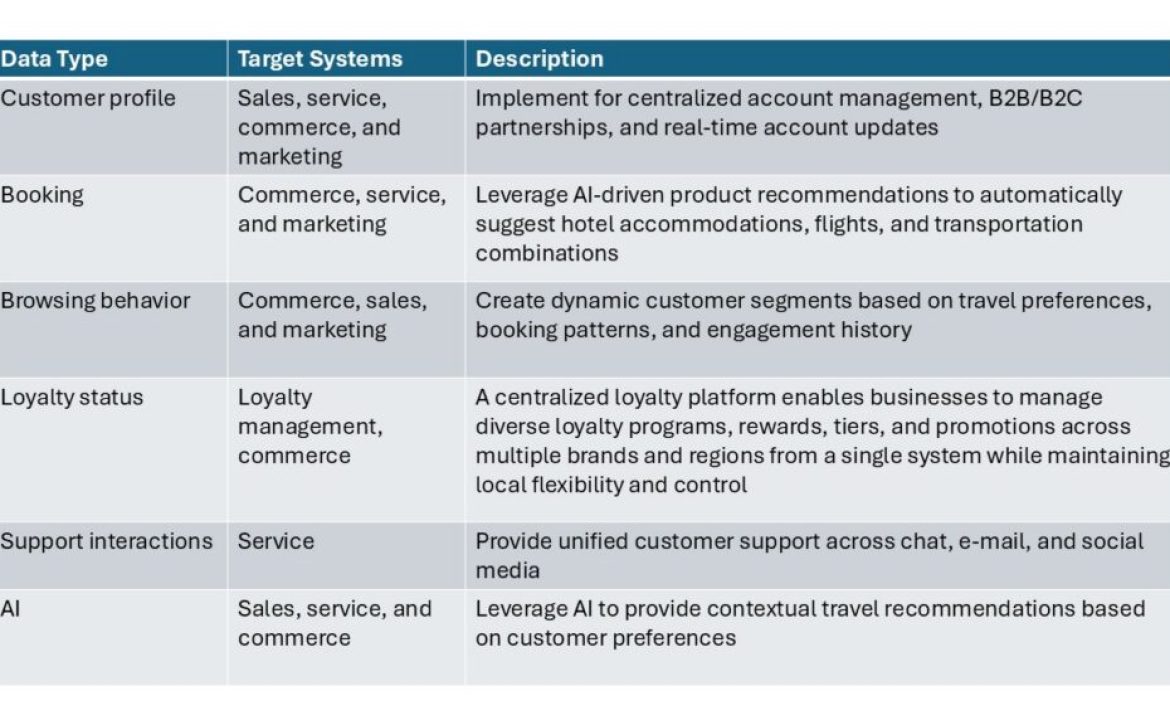
SAP delivers an ecosystem that can provide the tools needed to meet these expectations. Using SAP Service Cloud, organizations can manage cases, complaints, and information requests efficiently. AI can respond within seconds, unlike traditional customer service processes that rely on manual handling of support tickets. AI-powered chatbots can also manage a high volume of customer conversations simultaneously. Here is an example integration strategy:

Intelligent selling services for SAP Commerce Cloud

Intelligent selling services for SAP Commerce Cloud are AI-powered services that leverage machine learning and artificial intelligence to help deliver personalized customer experiences and optimize booking strategies. These services help analyze customer booking patterns, provide contextual data across customer touchpoints, and offer recommendations that can lead to increases in revenue.

Travel accelerator

The travel accelerator for the SAP Commerce solution is an industry-specific solution designed to enable travel companies to deliver omnichannel digital traveler engagement through SAP Commerce Cloud. For customers that already have an existing SAP Commerce Cloud solution, they can use the travel accelerator to help tailor it for travel business demand. It can provide real-time information to offer personalized customer experiences and reinforce customer loyalty.

Loyalty management program through integration

Organizations may need a system to reward customers for coming back, like earning points, perks, or special treatment when you repeatedly book with the same travel company. For this, an integration to a loyalty management program, either SAP Customer Loyalty Management or a third-party solution, can be used.

The way forward

The Advanced Success Plan version for SAP Customer Experience solutions can help you achieve your business goals. As a starting point, we can create a service engagement plan that provides a tailored approach to meeting your KPIs. During this phase, we also deliver sessions to help you set up SAP Sales Cloud, SAP Service Cloud, and SAP Commerce Cloud while working to ensure that travel and transportation industry best practices are followed.

With AI capabilities available across every solution, you can now categorize your customer base based on travel behaviors and patterns, as well as perform sentiment analysis on customer reviews and support tickets. The Advanced Success Plan can serve as a strategic partner in helping achieve AI objectives. Our experts, backed by deep industry knowledge, can provide guidance on the most effective path forward.

To deliver services that are aligned with each customer’s specific goals, we have organized our offerings into four phases: implementation, pre-go-live, post-go-live, and continuous improvement.

Implementation

During the implementation phase, our focus is on providing adoption guidance to help set up the solutions, from front-end applications to back-end systems. We work alongside the team to establish core capabilities needed for a successful implementation and to help ensure the solution is aligned with business requirements.

This includes, but is not limited to, application user management, key user extensibility, the SAP CX AI Toolkit, integrations, security considerations, and other essential platform capabilities. Our goal is to help build a solid foundation that supports scalability, maintainability, and future growth while enabling teams to get the most value from the platform.

Pre-go-live

In the pre-go-live phase, our focus is to validate and safeguard the solutions that have been built throughout the implementation. The goal is to make sure systems are configured correctly, performing as expected, and ready at go-live.

This includes conducting detailed reviews of business configuration settings, evaluating system performance, validating integrations, reviewing security and user access setups, and assessing analytics and reporting capabilities. We also help identify potential risks, gaps, or areas for optimization before launch, working to ensure issues are addressed proactively.

In addition, we work with teams to confirm readiness across key functional and technical areas, helping ensure that testing has been completed successfully, critical business scenarios have been validated, and the solution is aligned with operational requirements. Performing an adoption checkpoint during this phase helps reduce risk, improve system stability, and support a smoother go-live experience.

Post-go-live

During the post-go-live phase, we work closely with the team to help ensure that recommendations and best practices identified throughout the implementation have been properly configured and are delivering the intended results.

As users begin working in the production environment, new questions, opportunities for optimization, and minor challenges often emerge. During this stage, we provide continued guidance and support to help address those items, whether they are related to business processes, system configuration, integrations, extensibility, analytics, or overall solution adoption.

Our functional and technical experts remain available to review issues, provide recommendations, and help navigate any areas that require additional attention. We also help identify opportunities for further improvements and knowledge transfer, working to ensure the organization is well-positioned to maintain, enhance, and scale the solution over time.

Continuous improvement

Finally, as part of the continuous improvement phase, we help stakeholders remain informed about new innovations and enhancements introduced through SAP release cycles. By staying up-to-date with the latest capabilities, the team can continue to maximize the value of the solutions and drive ongoing business success.


Tara Tracey is global product owner of the Advanced Success Plan at SAP.
Geoffrey Arado is product manager for SAP Customer Experience.

Sign up to receive weekly news highlights from the SAP News Center

Reimagining the Supply Chain: Turning Strategic Vision into Operational Reality

Supply chain leaders are facing a defining moment. The conversation has largely moved from disruption and resilience to operational orchestration that transforms isolated functions into a unified, agile system capable of responding to real-time challenges and delivering measurable business impact. This shift is reflected in new research from IDC based on a global study of 300 C-level executives, published in the whitepaper Orchestrating the End-to-End Supply Chain: Strategic Priority, Practical Reality. End-to-end orchestration is no longer a distant ambition. For many organizations, it is becoming critical.

At the same time, the research also makes clear that ambition and vision are not enough.

The orchestration gap

Explore the benefits of an orchestrated supply chain and the challenges and obstacles to achieving end-to-end orchestration

Nearly half of the executives surveyed by IDC recognize the substantial benefits of end-to-end orchestration—but many have yet to take decisive action. The true challenge lies not in understanding its value, but in bridging the gap between strategic intent and effective execution.

IDC surveyed C-level leaders across industries and regions. The message was consistent. Leaders understand the destination, but they want clearer guidance on the blueprint to execution. As one executive told IDC, the value of supply chain orchestration is evident, but the challenge is defining and executing the path to get there.

That tension is familiar. Many organizations have made progress in operational silos, but far fewer have connected design, planning, procurement, manufacturing, logistics, and service into a truly coordinated operating model.

What orchestration really means

An orchestrated supply chain connects people, processes, and technology to provide agility and deliver continuous improvement, despite persistent disruption. Agentic AI is fundamentally reshaping orchestration, enabling systems to analyze, decide, and coordinate across functions in real time. From sourcing and procurement to planning, manufacturing, logistics, and delivery, the focus shifts from optimizing individual functions to achieving enterprise-wide alignment.

Traditional linear supply chain models were built for a more predictable world. Today’s reality is different. Geopolitical uncertainty, AI-driven disruption, climate pressures, regulatory complexity, and rising customer expectations are constant. Decisions made in one area now ripple quickly across the rest of the supply chain.

Orchestration addresses this reality by establishing a shared foundation of contextually relevant information, designing processes to operate together, and enabling systems that support end-to-end decision-making and execution. Technology plays a critical role, but orchestration ultimately depends on organizational alignment: clear roles, shared metrics, and coordinated processes. Instead of optimizing planning or execution in isolation, orchestration evaluates trade-offs based on their impact on the entire supply chain and the broader business.

Different leaders, shared outcomes

IDC’s research also highlights how perspectives on orchestration vary by role. COOs focus on enterprise performance, CSCOs balance transformation with operational demands, and CPOs emphasize cost and risk exposure in direct materials, including mitigation strategies. Orchestration must deliver value across these perspectives while maintaining a unified, end-to-end view.

This diversity of perspective reinforces why orchestration matters. Success comes from respecting functional priorities without allowing silos to drive disconnected decisions, enabling coordinated decision-making that optimizes the whole, not just the parts.

Efficiency and agility, not trade-offs

Many executives perceive a trade-off between efficiency and preparedness, but orchestration changes the equation. With integrated data, shared context, and agile tools, companies can respond faster, reduce disruption response times, and make informed trade-offs—demonstrating that agility and efficiency can reinforce each other rather than compete.

As one procurement leader told IDC, organizations need to be both resilient and efficient, or at least able to make informed trade-offs quickly. Without integrated supply chains and shared context, that balance is difficult to achieve. When companies can identify issues earlier and respond faster, recovery times shrink, translating into lower costs, less expediting, and more reliable customer service.

The role of agentic AI

Agentic AI is emerging as a practical, transformational path to supply chain orchestration. AI-driven agents can monitor signals, evaluate scenarios, and recommend or initiate actions within defined guardrails. Across SAP customer environments, AI delivers value in supplier onboarding, predictive maintenance, and rapid rebalancing of inventory or capacity. Leaders generally prefer AI as an advisor rather than a fully autonomous decision-maker, reflecting the continued importance of human judgment, accountability, and experience. Orchestration works best when AI strengthens decision-making while keeping people firmly in the loop.

Data, platforms, and the role of SAP Supply Chain Management

Effective orchestration requires more than connectivity, it depends on harmonized data, coordinated processes, and contextual intelligence embedded where work happens. As supply chains extend across multi-tier supplier networks, logistics partners, and service providers, the challenge is no longer access to data, but making data usable, contextual, and actionable at scale.

IDC’s research underscores that true end-to-end orchestration must span both internal operations and external ecosystems. Much of the most critical information—risk signals, capacity constraints, execution status—lives outside the enterprise. Without a common data foundation, organizations struggle to move from insight to action.

This is where SAP Supply Chain Management plays a distinct role. SAP brings together an end-to-end portfolio of supply chain applications, deeply integrated with ERP and line-of-business systems, and connected externally through SAP Business Network. Planning, sourcing and procurement, manufacturing, logistics, and service operate as a coordinated system rather than isolated domains.

At the data layer, SAP Business Data Cloud provides a normalized foundation that can harmonize operational, transactional, and network data. This shared context provides visibility, analytics, and AI. On top of it, embedded and extensible AI—including agentic AI and Joule—supports orchestrated decision-making, helping to accelerate time to decision and time to recovery while keeping people engaged and in control.

Turning priority into practice

The move toward orchestrated supply chains is well underway, but progress remains uneven. Only a minority of organizations consider themselves close to full, end-to-end orchestration. Technology alone is not the constraint. Data readiness, clarity of outcomes, organizational alignment, and change management matter just as much.

Leading organizations start with clear objectives, invest in people alongside platforms, and build pragmatic road maps that prioritize time to value. Orchestration is not a single project. It is a progression that evolves as capabilities mature.

At SAP, our focus is on making orchestration practical and accessible. Through SAP Supply Chain Management solutions and SAP Business Network, we help organizations align teams, connect processes, integrate partners, and embed AI into core supply chain activities—enabling better decisions, faster execution, and sustained enterprise impact in a constantly changing world.


Hagen Heubach is chief marketing officer for Supply Chain Management at SAP.

Subscribe to the SAP News Center for the latest SAP news each week

SAP Joule for Consultants | AI Assistant for SAP Projects | Overview

SAP Joule for Consultants is a conversational AI copilot built specifically for SAP implementation and cloud transformation work. In this video, we walk through what it does, how it works, and what it means for consultants on the ground.

Whether you’re a functional consultant, technical consultant, or practice lead evaluating AI tools for your delivery teams, this video gives you a clear picture of what Joule for Consultants does and where it fits.

Learn more about SAP Joule for Consultants: https://sap.to/6050BDzMgp

Follow us on social:
LinkedIn: https://sap.to/6051BDzMgV
Instagram: https://sap.to/6052BDzMgn
Facebook: https://sap.to/6053BDzMgX
Threads: https://sap.to/6056BDzMgw

About SAP:
As a global leader in enterprise applications and business AI, SAP stands at the nexus of business and technology. For over 50 years, organizations have trusted SAP to bring out their best by uniting business-critical operations spanning finance, procurement, HR, supply chain, and customer experience. For more information, visit: https://sap.to/6058BDzMgj

#SAPJouleforConsultants #DigitalTransformation #SAPImplementation

Shot of a young woman using a laptop while working in a server room

SAP Receives VS-NfD Authorization to Use for SAP Cloud Infrastructure

WALLDORFSAP SE (NYSE: SAP) today announced authorization to use from the German Federal Office for Information Security (BSI) to process information classified as “VS-NfD” (“Restricted – For Official Use Only”) on SAP Cloud Infrastructure in Walldorf/St. Leon-Rot. This strengthens SAP’s sovereign cloud portfolio for public sector organizations and regulated industries and enables security-critical SAP and customer applications to run in the cloud.

SAP is therefore one of only a few providers in Germany that will be offering a cloud environment whose key security components have received corresponding authorization to use from the BSI – and currently the only provider whose platform will be able to support both SAP applications and customer-specific applications in a high-performance, VS-NfD-compliant environment in the near future.

The authorization to use applies to workloads running on SAP Cloud Infrastructure in SAP’s own data centers in the Walldorf/St. Leon-Rot region, which are operated exclusively by security-cleared personnel. The authorization to use represents an important milestone and forms the basis for the subsequent full BSI approval SAP is working toward, including the recertification of SAP Cloud Infrastructure according to ISO 27001 based on the German IT-Grundschutz framework.

The evaluation process was completed in approximately 12 months and was characterized by close and constructive cooperation between the BSI and SAP — a sign of the growing collaboration between public authorities and industry in the field of IT security.

SAP Cloud Infrastructure: A Fully Sovereign Cloud Infrastructure from Germany

SAP Cloud Infrastructure is an Infrastructure-as-a-Service (IaaS) platform fully developed and operated by SAP, based on open-source technologies.

It is designed to provide customers with digital sovereignty across four dimensions: data sovereignty, operational sovereignty, technical sovereignty and legal sovereignty.

The foundation is a fully sovereign cloud region of SAP Cloud Infrastructure, comprising three independent availability zones in physically separated data centers in Walldorf/St. Leon-Rot. This sovereign cloud platform is further reinforced by a robust security and compliance foundation, demonstrated through certifications including ISO/IEC 27001 based on IT-Grundschutz for the data centers, EN 50600/ISO/IEC 22237, TSI Level 3+ and C5 Type II. Additionally, SAP Cloud Infrastructure has conducted a self-assessment against the BSI’s C3A (Criteria enabling Cloud Computing Autonomy) catalog, confirming compliance with all digital sovereignty requirements.

The VS-NfD authorization to use adds an important building block for security-critical use cases with the highest requirements.

As a deployment option within SAP Sovereign Cloud, SAP Cloud Infrastructure is an integral part of SAP’s portfolio for digital sovereignty. Together with the SAP Sovereign Cloud On-Site offering and Delos Cloud, SAP provides customers with demanding regulatory requirements the freedom of choice, control, and robust security they need.

Visit the SAP News Center. Get SAP news via LinkedIn and Bluesky.

Subscribe to the SAP News Center for the latest SAP news each week

Media Contact:
Dana Roesiger, dana.roesiger@sap.com, +49 16090820259, CET
SAP Press Room; press@sap.com

This document contains forward-looking statements, which are predictions, projections, or other statements about future events. These statements are based on current expectations, forecasts, and assumptions that are subject to risks and uncertainties that could cause actual results and outcomes to materially differ. Additional information regarding these risks and uncertainties may be found in our filings with the Securities and Exchange Commission, including but not limited to the risk factors section of SAP’s 2025 Annual Report on Form 20-F.
© 2026 SAP SE. All rights reserved.
SAP and other SAP products and services mentioned herein as well as their respective logos are trademarks or registered trademarks of SAP SE in Germany and other countries. Please see https://www.sap.com/copyright for additional trademark information and notices.

Introducing SAP Business AI Platform | #SAPSapphire

At SAP Sapphire, SAP unveiled major updates to its Business AI platform – bringing together SAP Business Data Cloud, SAP Business Technology Platform, and new integrations including AWS.

But the expert advice that matters most? Start with your data foundation before anything else.

Irfan Khan, President & Chief Product Officer, SAP Data & Analytics, covers:
→ What’s new with SAP Business Data Cloud at Sapphire
→ The one thing to get right before AI delivers real value
→ Why culture – not technology – is the actual game-changer

Learn more about SAP Business AI Platform: https://sap.to/6058B8UyNO

#SAPSapphire #SAPBusinessAIPlatform #AI

SAP, Dremio, and the Future of Data AI | SAP Sapphire Orlando 2026

SAP is expanding the data foundation enterprises need to help AI agents reason across SAP and non-SAP data.

In this SAP Sapphire Orlando 2026 segment, SAP shares its intent to acquire Dremio, a high-performance data and agentic lakehouse with data federation across clouds and traditional legacy databases. Once closed, the acquisition is expected to support Apache Iceberg in SAP Business Data Cloud, helping enable interoperability with any data store.

The video also highlights SAP’s intent to acquire Prior Labs, a frontier AI lab focused on tabular foundation models. Together with SAP Business Data Cloud, these capabilities are designed to help agents reason across data from any cloud or environment without data movement, while supporting industry-specific use cases with SAP and non-SAP data.

These announcements strengthen the foundation for SAP Business AI by bringing together open data access, business context, and advanced AI models for the Autonomous Enterprise.

Watch the full Global Keynote: https://sap.to/6052BBLzdi
Watch all SAP Sapphire replays on demand: https://sap.to/6053BBLzdc

Follow us on social:
LinkedIn: https://sap.to/6056BBLzdm
Instagram: https://sap.to/6058BBLzdo
Facebook: https://sap.to/6059BBLzdU
Threads: https://sap.to/6050BBLzdq

About SAP:
As a global leader in enterprise applications and business AI, SAP stands at the nexus of business and technology. For over 50 years, organizations have trusted SAP to bring out their best by uniting business-critical operations spanning finance, procurement, HR, supply chain, and customer experience. For more information, visit: https://sap.to/6051BBLzdS

#SAP #BusinessAI #SAPSapphire

Announcing New Joule Studio for Enterprise Scale Agentic Development

SAP has held a long-standing mission to help organizations turn ideas into innovation faster, continually evolving our technology to give developers and business users the tools they need to build what’s next.

SAP Sapphire in 2026: Advancing the Autonomous Enterprise

From application development to automation, integration, and now agentic AI, we have pushed forward so organizations can move faster, solve bigger challenges, and create with confidence.

At SAP Sapphire, we’re taking a giant step forward in making that mission a reality.

I’m thrilled to announce Joule Studio, a bold new, fully managed offering that empowers enterprises to build and manage the full life cycle of AI agents, applications, and workflows. Joule Studio brings SAP Business AI Platform to life, empowering organizations to build agents that are natively grounded in live business data, end-to-end processes, and rich business semantics that already exist across your SAP landscape.

Let’s look at what users can accomplish with Joule Studio.

SAP Unveils the Autonomous Enterprise


The company introduces a unified SAP Business AI Platform, deepening partnerships with Anthropic, Amazon Web Services, Google Cloud, Microsoft, NVIDIA and Palantir


ORLANDO — At SAP Sapphire in 2026, SAP SE (NYSE: SAP) introduced the Autonomous Enterprise to help enhance the world’s most critical business workflows, so that humans and AI work together to meet the accelerating demands of global business profitably, strategically and safely.

SAP Sapphire in 2026: Advancing the Autonomous Enterprise

“For the mission-critical processes of our customers, ‘almost right’ just isn’t good enough,” said Christian Klein, CEO of SAP SE. “By uniting SAP Business AI Platform with SAP Autonomous Suite, we anchor AI agents in the business processes, data and governance so they can deliver accurate, compliant and secure outcomes, unlocking new sources of revenue and meaningful cost savings.”

The Autonomous Enterprise includes a unified AI platform for building, contextualizing and governing agents, an autonomous suite that executes core business operations and a new user experience that redefines how people work with enterprise software.

Introducing SAP Business AI Platform

SAP Business AI Platform is a new foundation for building and deploying enterprise AI grounded in real business context. SAP Business AI Platform now unifies SAP Business Technology Platform, SAP Business Data Cloud and SAP Business AI into a single, governed environment.

At its core is the SAP Knowledge Graph solution, which gives AI agents a structured map of business entities, processes and relationships across a customer’s SAP landscape. Joule Studio is SAP’s AI-first solution for building enterprise agents, applications and agentic workflows. Developers can build using the no-code, pro-code and AI frameworks of their choice on SAP-managed infrastructure that is secure, scalable and optimized for enterprise AI.

Deploying SAP Autonomous Suite Across Every Business Function and Industry

Building on this foundation, SAP also introduced SAP Autonomous Suite, which enables SAP’s existing business applications with AI agents capable of running processes from start-to-finish.

The suite will deploy more than 50 domain-specific Joule Assistants across finance, supply chain, procurement, human capital management and customer experience. These assistants will automate end-to-end processes by orchestrating a subset of over 200 specialized agents to execute precise tasks. For example, the new Autonomous Close Assistant can compress the financial close process from weeks to days by automating journal entries, reconciliation and error resolution across the entire process.

SAP also launched Industry AI, expanding its deep industry portfolio through seven autonomous solutions that will enable start-to-finish industry processes and embed sector-specific process logic, data models and regulatory requirements. At SAP Sapphire, SAP showcased its work with European energy giant RWE to leverage Industry AI, helping reduce unplanned downtime across its offshore wind turbines. With SAP’s Autonomous Asset Management scenario, AI agents are designed to analyze data from thousands of past incidents, identify the likely root cause and generate pre-filled work orders with the right tools and proven fixes from other sites.

Designing the Autonomous User Experience

The company also revealed Joule Work, redefining how users engage with SAP software. Instead of navigating individual applications and entering data across several screens, users will now interact primarily with Joule. By describing a desired business outcome, Joule will orchestrate the right combination of workflows, data and agents to get it done.

Joule Work goes beyond conversation, proactively surfacing relevant insights and automating routine tasks behind the scenes so work moves forward even when humans aren’t actively steering it. It will be available on desktop, mobile and voice across SAP and non-SAP systems.

Accelerating the Customer Journey Toward Autonomy with €100 Million Infusion

SAP evolved its customer and partner programs to help accelerate the organization’s journey to the Autonomous Enterprise. To catalyze adoption, the company has launched a €100 million fund for SAP partners to help customers deploy SAP-built AI assistants and agents. The fund is also available to partners that extend or build new partner agents on the new SAP Business AI Platform using Joule Studio.

SAP has enhanced its RISE with SAP and SAP GROW offerings to accelerate AI adoption. Both include access to the Joule Assistants portfolio; RISE with SAP customers will have three assistants activated within their first year, while SAP GROW customers receive full portfolio access at onboarding. SAP S/4HANA on-premises and SAP ERP Central Component (SAP ECC) customers are not excluded: those that commit to transitioning the majority of their current landscape to SAP Cloud ERP gain access to select AI scenarios, bridging the gap between their current landscape and their cloud destination

SAP also introduced new agent-led transformation tooling that can reduce ERP migration efforts by more than 35 percent, driving faster and more predictable projects by automating system analysis, code remediation, configuration and testing at scale.

Lastly, SAP announced a full slate of strategic partnerships across each category:

  • Platform and suite partnerships include Anthropic, with Claude among the foundation models SAP’s AI platform will leverage to power Joule agents across HR, procurement and supply chain; Amazon Web Services, bringing zero-copy data integration between SAP Business Data Cloud and Amazon Athena; Google Cloud and Microsoft, enabling bidirectional agent-to-agent interoperability between Joule and external agent frameworks; Mistral AI and Cohere, delivering sovereign model options on SAP’s cloud infrastructure; n8n, providing visual AI workflow orchestration inside Joule Studio; NVIDIA, whose OpenShell provides the trusted secure runtime for Joule Studio; and Parloa, bringing AI agents into SAP Service Cloud to handle customer interactions with full access to business data and service processes.
  • Implementation partnerships include Palantir and Accenture, partnering on complex data migration scenarios, and Conduct for AI-powered cloud ERP migrations.

Learn more in the SAP Sapphire 2026 Innovation News Guide.

Visit the SAP News Center. Get SAP news via LinkedIn and Bluesky.

About SAP

As a global leader in enterprise applications and business AI, SAP (NYSE: SAP) stands at the nexus of business and technology. For over 50 years, organizations have trusted SAP to bring out their best by uniting business-critical operations spanning finance, procurement, HR, supply chain, and customer experience. For more information, visit www.sap.com.

SAP Sapphire in 2026: Discover our bold new vision for how businesses will run from now on

Note to editors:
To preview and download broadcast-standard stock footage and press photos digitally, please visit www.sap.com/photos. On this platform, you can find high resolution material for your media channels.

For customers interested in learning more about SAP products:
Global Customer Center: +49 180 534-34-24
United States Only: 1 (800) 872-1SAP (1-800-872-1727)

For more information, press only:
Aimée Leabon, +1 646-799-3277, aimee.leabon@sap.com, EST
Marcus Winkler, +49 622 776-74-97, marcus.winkler@sap.com, CET
SAP Press Roompress@sap.com

This document contains forward-looking statements, which are predictions, projections, or other statements about future events. These statements are based on current expectations, forecasts, and assumptions that are subject to risks and uncertainties that could cause actual results and outcomes to materially differ. Additional information regarding these risks and uncertainties may be found in our filings with the Securities and Exchange Commission, including but not limited to the risk factors section of SAP’s 2025 Annual Report on Form 20-F.
© 2026 SAP SE. All rights reserved.
SAP and other SAP products and services mentioned herein as well as their respective logos are trademarks or registered trademarks of SAP SE in Germany and other countries. Please see https://www.sap.com/copyright for additional trademark information and notices.
Please consider our privacy policy. If you received this press release in your e-mail and you wish to unsubscribe to our mailing list please contact press@sap.com and write Unsubscribe in the subject line.

Previous Next
Close
Test Caption
Test Description goes like this