Agentic AI Is Reshaping Commerce: The Next Frontier of Discovery, Payments, and Trust

At NRF 2026, agentic AI was everywhere. At SAP, we’re moving beyond the hype and turning AI into real, scalable outcomes. Agentic AI represents a fundamental change in how commerce works, reshaping discovery, payments, fulfillment, and long-term customer loyalty.

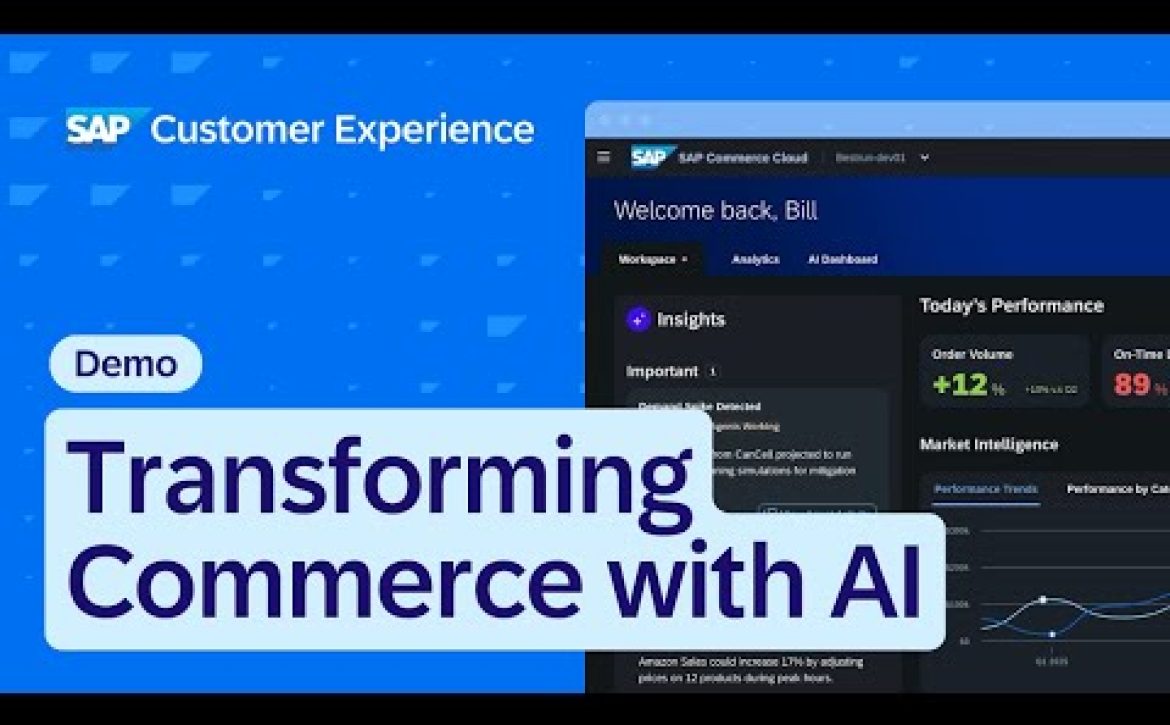
Our vision for agentic commerce is bold. In our latest video, we showcase a future where humans and AI agents collaborate to drive intelligent recommendations, proactive operations, efficient business processes, and deeper customer relationships. While this vision points forward, SAP’s focus is firmly grounded in helping retailers take practical steps today. This isn’t about flashy demos of a distant future—it’s about building the foundation now for how consumers will buy and retailers will sell in the years ahead.

Unlike traditional AI systems that respond to prompts, agentic systems act on intent. They learn from preferences, make proactive recommendations, and can complete transactions on a shopper’s behalf. These agents are increasingly becoming the starting point of the buying journey, reshaping how brands compete for visibility, trust, and loyalty.

This evolution introduces both opportunity and risk. As AI agents mediate more interactions between brands and consumers, retailers must rethink how they capture intent, transact with agents, and deliver post-purchase experiences that reinforce trust.

How Embodied AI Powers Cognitive Robots and Streamlines Warehouse Operations

BITZER, a global leader in heat and cooling technologies, partnered with NEURA Robotics and SAP to showcase the potential of cognitive robots powered by embodied AI from SAP to transform and streamline warehouse operation.

Learn more: https://sap.to/6054CDoWq

00:00 – Winning Insights from BITZER
00:19 – Robotics
00:31 – Embodied AI x Cognitive Robots
00:35 – SAP Extended Warehouse Management
01:11 – SAP S/4HANA and SAP BTP
01:33 – What’s Next for BITZER?

SAP Business Data Cloud: Rebrand or Game-Changer? | Dimitri Zarganakis

Is SAP Business Data Cloud just a new name — or something bigger?

Dimitri Zarganakis breaks down what it is and why it matters for Business AI.

What is SAP Business Data Cloud and why should I care? https://sap.to/6055CrD6x
What to know about SAP Business Data Cloud Data Products: https://sap.to/6056CrD6I

🎧 More episodes of the Trending Chats podcast:
Watch on YouTube: https://sap.to/6057CrD6L
Listen on Spotify: https://sap.to/6058CrD60
Listen on Apple Podcasts: https://sap.to/6059CrD6F

#TrendingChats #SAPBusinessDataCloud #SAPDatasphere

B2B eCommerce Is Getting a B2C Makeover | Peter Cridland

Your buyers expect “B2C simple” — even in B2B.

Peter Cridland shares how B2B organisations can stay competitive and win in a digital-first market.

Unlock your e-commerce potential: https://sap.to/6058CrBIp

🎧 More episodes of the Trending Chats podcast:
Watch on YouTube: https://sap.to/6050CrBIn
Listen on Spotify: https://sap.to/6052CrBIk
Listen on Apple Podcasts: https://sap.to/6053CrBIZ

#TrendingChats #CX #eCommerce

Redefining CX: The B2C Effect on B2B eCommerce with Peter Cridland | Trending Chats

In this episode of Trending Chats, we sit down with Peter Cridland, Senior Account Executive at SAP, to discuss how B2B businesses can stay competitive in an era of digital disruption.

From enhancing customer convenience to unlocking new revenue opportunities and leveraging data-driven insights, Peter shares key strategies to thrive in the evolving e-commerce landscape.

Tune in to learn how B2B businesses can protect and grow their market share in a digital-first world.

00:05 – Welcome + the Amazon effect on B2B ecommerce
00:21 – Why marketplaces are winning: revenue + CX control at risk
00:48 – Rising expectations: digital natives want seamless B2B buying
01:32 – Competing with marketplaces: make your experience more convenient
02:04 – 3 actions: customer convenience, new revenue, use data for AI

Unlock your e-commerce potential: https://sap.to/6058CrBIp

🎧 More episodes of the Trending Chats podcast:
Watch on YouTube: https://sap.to/6050CrBIn
Listen on Spotify: https://sap.to/6052CrBIk
Listen on Apple Podcasts: https://sap.to/6053CrBIZ

#TrendingChats #CX #eCommerce

Top New Features in SAP HANA Cloud | Q4 2025 Release Highlights

See what’s new in SAP HANA Cloud Q4 2025 in under 6 minutes.

Join Thomas Hammer, Lead Product Manager, for a quick walkthrough of key release highlights: semantic search enhancements for text embeddings and re-ranking, high availability improvements that enable active use of replicas for read-intensive analytics, and zero-copy consumption of data products from SAP Business Data Cloud.

You’ll also learn about selective, incremental migration from SAP HANA 2.0 to reduce downtime, plus column lineage insights for graphically modeled calculation views to strengthen transparency and trust.

Chapters:
0:00 – Intro
0:37 – Advanced Semantic Search
1:30 – High availability with active use of replicas
2:22 – Consume Data Products from SAP Business Data Cloud
3:06 – Selective, incremental migration
4:00 – Column lineage insights
4:35 – Further innovations

👉 Learn more about SAP HANA Cloud: https://sap.to/6059AwvoP
👉 Join the SAP HANA community to stay in the know: https://sap.to/6050Awvou

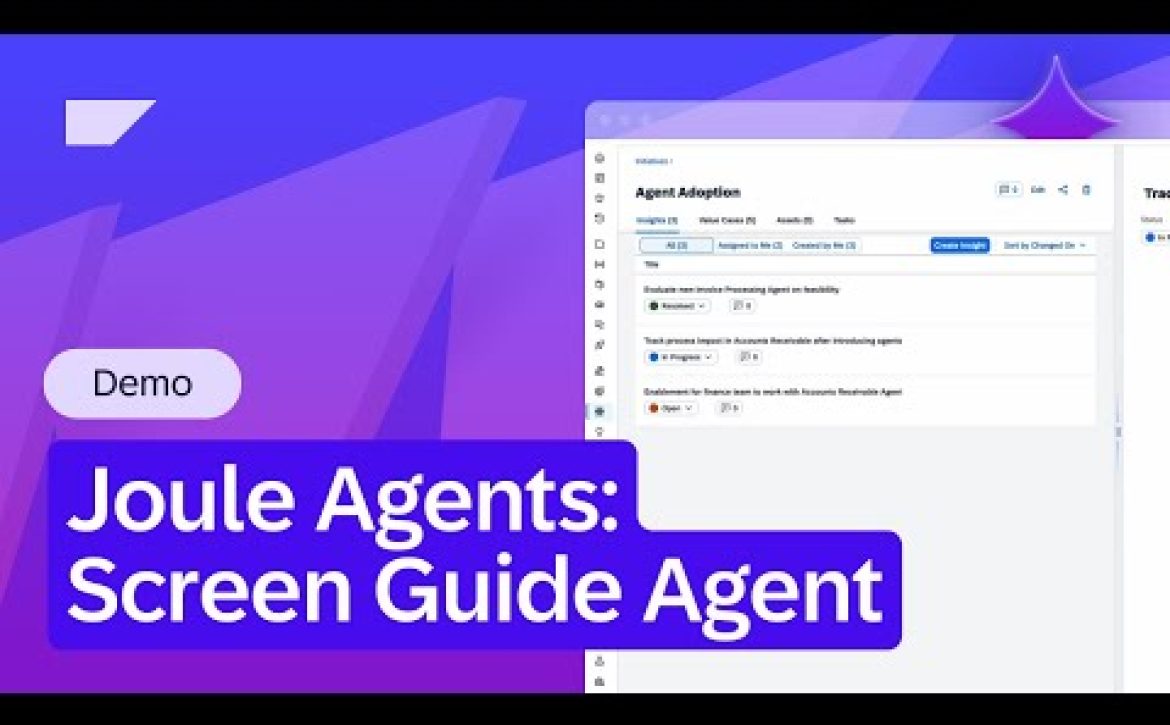
How to Build, Test and Deploy AI Agents with Agent Builder in Joule Studio | Overview & Demo

Discover how to design, test, and deploy intelligent Joule Agents—powered by SAP AI—in minutes.

Accelerate agentic AI development with Joule Studio, SAP’s intuitive environment for building, testing, and deploying Joule Agents across your enterprise. This overview and demo video shows how developers and business leaders can turn ideas into intelligent, production-ready agents—no complex coding required.

Using natural language prompts, Joule Studio automatically creates an agent plan, defines structure and goals, and connects to the right large language models (LLMs) to power advanced reasoning and planning. The platform generates Joule Skills for rule-based tasks and seamlessly configures the MCP server, enabling secure connections to third-party tools and SAP applications.

You’ll also see how Joule Studio enables grounding with domain documents—allowing agents to respond contextually with organization-specific knowledge—and provides full testing and validation before deployment. A detailed execution trace reveals how each agent plans and acts, providing developers with complete visibility into performance and reliability.

Finally, watch how easily you can version, govern, and deploy your agents to production. Whether you’re automating workflows, optimizing decision-making, or exploring new AI-driven business models, Joule Studio gives you the foundation to innovate faster and scale safely.

Ready to get started?
Explore how Joule Studio brings the power of AI agents to your enterprise:
👉 https://sap.to/60527KA2a

00:00 – Introduction – Simplify agentic development
00:18 – Creating a Joule Agent from natural language
00:47 – Structuring goals, reasoning, and LLM selection
01:06 – Connecting tools and applications via MCP server
01:15 – Grounding with domain documents
01:19 – Testing and validation in Joule Studio
01:41 – Deploying agents with governance
01:49 – Transforming workflows with agentic AI

#SAP #JouleStudio #BusinessAI

Businessman in an modern sky office by night with beautiful city skyline view .

Cloud ERP Insights from an Industry Expert at Westernacher

Moving to cloud ERP is not just investing in new software. It is committing to changing how your business operates.

Run your core operations with confidence using a ready-to-run cloud ERP

That is the reality. Behind all the talk of faster deployments and streamlined processes lies a deeper shift. It requires rethinking your data, core processes, and how teams work together. And this shift does not begin at go-live. It begins months earlier, with the questions asked and the foundations put in place.

Many companies still approach cloud ERP as an IT upgrade. But the success of these programs rarely comes down to just technology. It comes down to how well you prepare, how you approach process standardization, data readiness, governance, and change leadership.

Even with the best intentions, challenges still show up. Teams struggle to balance global templates with local needs. Subject matter experts do not always have the time to fully participate. Expectations around timelines and automation can be misaligned from the start.

In a recent episode of the Future of ERP podcast, Abhishek Vasudevan, head of SAP S/4HANA at Westernacher, shared his perspective on what separates successful ERP transformations from the rest — from the most critical prerequisites to the common mistakes and what ERP looks like when it truly enables the business.

Breaking down business challenges and expectations

“Disconnected systems cause poor integration, data delays, and isolated teams,” Vasudevan explained. “The fragmentation creates barriers to real-time data visibility and integration, forcing reliance on manual work to piece together information from disparate sources. This slows decision-making and enforces artificial walls between business functions.”

Switching to an integrated, modern cloud ERP platform helps businesses break down barriers and provides real-time, cross-functional data flow.

Vasudevan also highlighted a critical hurdle: “There is a clear disconnect between how legacy users operate and the demands of moving to an integrated ERP system. The key question is whether the workforce can adapt to these changes and take on the challenges of adopting a new system and new ways of working.”

But one misconception is expecting a fully integrated ERP to be operational quickly by simply activating system functions. Faster implementations — which can sometimes take weeks or months instead of years — depend heavily on an organization’s ability to standardize processes across sites while retaining competitive differentiators.

“Success requires a phased “crawl, walk, run” approach focusing on processes, people, and standardization,” further explained Vasudevan.

Before a company ever starts configuring a system or training users, there is foundational work that must be done to set the stage for success. These are the conversations and actions that happen behind the scenes — months before go-live — that ultimately determine whether the implementation will deliver value.

Essential prerequisites for a successful ERP implementation

An effective cloud ERP adoption starts long before go-live. Based on extensive experience across industries, Vasudevan outlines six critical areas organizations must focus on early:

  1. Start with your data: Data is often the Achilles’ heel of ERP projects. Companies must start by understanding where their data lives, how clean it is, and whether it covers all critical business processes. That means assessing your sources early, ensuring completeness, and working with ERP experts to understand what fields matter and how your data should be structured.
  2. Understand the technical preparation, especially for upgrades: Even if you are doing what feels like a technical upgrade — like moving from SAP ECC to SAP S/4HANA — there is still deep preparation involved. Organizations must think through customer-vendor integration, system sizing, platform readiness, and historical data decisions. These technical topics are not just backend items; they directly affect the ability to execute a project smoothly.
  3. Rethink and standardize your processes: ERP implementations are a golden opportunity to simplify operations and remove legacy complexity. The more standardized processes are across regions, business units, and functions, the easier it becomes to scale and automate.
  4. Set up strong governance from the start: You need the right structure in place to guide the program, enable fast decisions, and stay aligned. That includes a clear steering committee, empowered business leads, and a process for how deviations will be evaluated and approved.
  5. Identify your internal change agent: Your system integrator will support change management, but someone from within your organization must to champion the change. This person should understand how things work today and be able to work across teams to bring clarity and alignment.
  6. Start identifying key and end users and prepare a plan for them early: Do not wait until testing or training to engage end users: start early. Understand their day-to-day, shape the design through day-in-the-life scenarios, and roll out MVPs that invite feedback.

Listen to the full podcast episode here: How Can Cloud ERP Serve as a Strategic Catalyst for Digital Transformation

Coming up, we will explore the most common challenges businesses face during and after ERP implementation. From data readiness gaps to change resistance, we will unpack the patterns that often derail projects — and how to stay ahead of them.

Sign up for the SAP News Center newsletter to get stories and highlights delivered straight to your inbox each week

The 5 Dimensions of Clean Core Success, Explained | Unlocking SAP BTP

A successful Clean Core strategy covers five dimensions. Here’s what they are—and why they matter.

Explore the full Clean Core episode: https://sap.to/6056AzruG

#SAP #CleanCore #DigitalTransformation

SAP and SmartRecruiters: Shaping the Future of Talent Acquisition

People are the pulse of every organization. Their skills and agility determine whether a company is able to innovate, grow, and adapt to meet the constant changes in technology and customer demands.

Equip every employee to meet their potential and foster success across your organization with SAP

Attracting and hiring the best talent is more important and more competitive than ever before. According to the World Economic Forum, 70% of organizations plan to hire new staff with emerging in-demand skills by 2030. Yet, more than three-quarters of board members and C-suite executives regard skills and talent availability as a major source of risk for their organizations.

The message is clear: hiring isn’t just an HR challenge. It’s a business imperative. 

With SAP’s recent acquisition of SmartRecruiters, we are thrilled about the opportunity to help our customers face this challenge head-on. As entrepreneurs and business leaders, we’ve been at the forefront of innovation in the HCM market, and we recognize that we are at a pivotal moment that demands more than incremental improvements. Together, we’re excited to deliver bold innovation and flexibility to help our customers not only attract and hire top talent, but to continuously nurture that talent to learn, grow, and push the boundaries of what is possible. 

Uniting talent acquisition and HCM leadership

SAP SuccessFactors HCM is an AI-enabled global suite of HR solutions, expanding across core HR and payroll, talent management, employee experience, analytics, and more. SmartRecruiters is a leading recruiting AI company with the mission of making hiring easy and deep expertise in high-volume recruiting, recruitment automation, and AI-enabled candidate sourcing, experience, and engagement.

Individually, we have led the way in building robust talent acquisition software to empower thousands of organizations to attract, engage, and hire the best talent. United, we are amplifying our impact.

Combining the scale of SAP SuccessFactors, the depth of SAP Business AI, and the expertise of SmartRecruiters will result in robust benefits for our customers.

  • User-friendly interfaces and seamless workflows will provide improved decision-making, reduced time-to hire, and better experiences for candidates, hiring managers, and recruiters.
  • Enhanced AI-enabled recruiting and hiring capabilities will deliver faster, smarter, and more equitable recruiting experiences — all with the relevant, reliable, and responsible approach of SAP Business AI. We will be able to enhance our ability to deliver intelligent candidate recommendations, predictive hiring insights, and personalized candidate experiences.
  • The benefits of bringing our products together extend beyond the hiring process. A single system of record and harmonized data across SmartRecruiters and SAP SuccessFactors will provide rich insights into talent pools, hiring bottlenecks, and workforce planning — because talent acquisition is only the start of an employee’s journey with an organization. 

Talent acquisition is no longer just about filling roles. Together, SAP and SmartRecruiters will help organizations build smarter, more resilient workforces that are agile, skills-driven, and ready to meet the future head-on.

Join us virtually for Success Connect at SAP Connect to learn more about the future of SAP SuccessFactors and SmartRecruiter

Dan Beck is general manager and chief product officer for SAP SuccessFactors.
Rebecca Carr is CEO of SmartRecruiters, an SAP company.

Previous Next
Close
Test Caption
Test Description goes like this