SAP S/4HANA Transition Net: The 5 Big Questions Prior to a Project

The transition net is a simple yet powerful method to choose the right transition strategy for SAP S/4HANA transition.



The transition net is a simple yet powerful method to choose the right transition strategy for SAP S/4HANA transition.
At a time when many boardrooms are still asking whether AI will disrupt software revenue, go-to-market (GTM) leaders are asking a more practical question: how can AI help us find and keep more customers?
The honest answer is that most GTM teams don’t have an AI problem. They have a decision-flow problem.
I’m seeing this across some of the world’s largest enterprises. And my clearest takeaway is that the organizations pulling ahead are not doing the same GTM motion but faster. They’re doing a fundamentally different one.
Here are five moments in the customer journey where that shift is already showing up in results.
Most GTM organizations still segment the way they always have based on characteristics like industry, company size, geography, and more. AI changes the input. Rather than asking who a prospect is, it asks what they’re signaling right now. This includes more nuanced signals like operational pressure points, purchasing patterns, and growth indicators embedded in their business data. Reps aren’t chasing more leads; they’re chasing the right ones, and that shows up in how many of those signals turn into real opportunities.
Cold outreach reply rates have dropped to near-historic lows across enterprise sales. The answer can’t be to send more outreach. It must be to do smarter outreach. When AI has access to full business context such as what’s happening inside an account operationally, financially, and commercially, it can help teams generate outreach grounded in what matters to a buyer at that moment. That’s not personalization at the persona level. It’s relevance at the account level. What shifts is the quality of first contact. Response rates can rise while the time it takes for the first qualified meeting shrinks because the outreach reflects what a buyer is dealing with in the moment.
This is the one that most organizations underestimate. In most enterprise deals, the seller isn’t the bottleneck. The system around the seller is. Approvals, pricing sign offs, quote generation, and contract routing are where time is lost and deals slip. This isn’t because the buyer hesitates, but too often because of internal complexity. AI agents can help eliminate this friction.
For example, Amadeus, working with SAP, deployed an autonomous agent that reconciles unstructured payment data, clearing around 40,000 incorrect transactions that previously required manual intervention. That kind of autonomous resolution doesn’t just reduce cost, it changes what the buying experience feels like from the customer’s side. Deals that stalled for weeks waiting on internal processes don’t have to anymore.
The handoff from sales to post-sale is historically where value gets lost. Expectations set during the sale don’t always match what a customer experiences in the first 90 days. AI makes that gap visible and actionable in real time through an “account brain.” This can be thought of as a growing repository of context and knowledge around an account, which makes handovers much easier and, most importantly, independent of any single individual. This can shift time-to-first value and 90-day adoption rate: how quickly a new customer reaches their first meaningful milestone, and whether they’re using what they bought.
Net revenue retention is the most durable commercial metric and it’s the one most dependent on what happens after the sale. The historical challenge is scale. AI can have a big impact here. Continuous scoring of expansion-readiness and churn risk, triggered by behavioral and operational signals, means teams act on the right accounts at the right moment not after a customer has already made up their mind.
Expansion of net revenue retention is where the largest commercial upside in most enterprise businesses lives. Both are chronically underserved when customer success is working reactively, account by account, rather than across the full base at once. The organizations getting this right haven’t simply deployed more AI tools. They’ve been deliberate about where in the customer journey AI can add real value for customers.
At SAP, we’re applying these same principles to our own GTM organization. We’re investing in a model where a single AI-powered entry point connects our sales teams to a network of specialized agents spanning planning, outreach, quoting, content, customer engagement, and more. The goal is a shared intelligence layer built around each account to give our teams more context and consistency so they can drive even more value and better outcomes for our customers at every stage of the customer journey.
So to me, the right question isn’t “Where can we implement AI?”; it’s “Where does customer value stall because information, authority, and action are separated?”
That kind of clarity is what a more intelligent go-to-market organization can already bring. And it’s only a first glance of what else will soon be possible.
Jan Gilg is global president of Customer Success & Americas and a member of the Extended Board of SAP SE.
In an environment shaped by constant change, workforce planning is no longer defined by predictable hiring cycles or seasonal demand. Shifting market conditions, evolving customer expectations, and persistent skills shortages mean that the line between permanent and temporary labor has all but broken down.
External talent, including contractors, consultants, and project-based specialists, is becoming a core component of how work gets done rather than a stopgap solution.
Leading organizations are responding by treating external talent less as a short-term fix and more as a standing part of workforce strategy. With 74% of employers worldwide reporting difficulty finding the skilled talent they need in 2025, workforce planning has become less about filling roles in sequence and more about maintaining access to critical capabilities. This shift moves organizations to a workforce model that can respond quickly, scale efficiently, and align with long-term business priorities.
External workers have historically been brought in to meet short-term needs, helping fill gaps during peak periods or support one-off projects. While that approach still exists, ongoing volatility has proven that this is no longer sufficient.
Demand signals change quickly, transformation is continuous, and new skill requirements emerge faster than internal teams can adapt.
In this context, external talent provides a clear advantage. It gives companies access to specialized expertise on demand, helps accelerate innovation, and supports operations without overextending internal resources. It also allows leaders to rethink workforce composition to better balance stability with adaptability.
This shift mirrors the recent shifts seen in procurement and supply chain functions, where visibility and cross-functional integration have become drivers of long-term success. Workforce strategy is moving in a similar direction.
As organizations expand their use of external talent, visibility remains essential. Many companies still manage contingent labor in disconnected ways, which makes it harder to understand where talent is deployed, what it costs, and how effectively it is being used. Without that visibility, workforce decisions remain reactive.
When organizations can see how external talent is deployed across business units, geographies, and projects, they can plan with greater confidence. This level of insight also supports stronger governance by improving compliance, supplier performance, and consistency from sourcing to offboarding.
In practice, organizations that invest in visibility often see measurable improvements in efficiency, productivity, and decision-making speed. More importantly, they begin to treat external labor as a strategic lever rather than a cost center.
Visibility is essential, but the real opportunity lies in turning workforce data into actionable insight.
AI is playing an increasingly important role in this transformation. By analyzing hiring patterns, project pipelines, and market signals, AI can help organizations anticipate future talent needs instead of reacting to them. This is especially valuable in environments where workforce decisions need to balance cost, speed, and quality. For example, organizations can use AI to:
As organizations look to make external talent a more strategic part of workforce planning, technology becomes increasingly important. SAP Fieldglass helps organizations gain greater visibility into their external workforce, connect talent data across the enterprise, and use AI-driven insights to make more informed staffing decisions.
By bringing together workforce planning, services procurement, and external talent management, organizations can better anticipate skill needs, improve agility, and align workforce investments with business priorities.
One of the most important shifts underway is how organizations think about workforce composition. Rather than treating external and internal talent as separate categories, forward-looking companies are managing both as part of a single ecosystem.
This integrated approach offers several advantages. First, it more closely aligns with business goals. Leaders can allocate resources based on outcomes rather than employment type, ensuring the right skills are applied where they create the most value. Second, it improves agility. When workforce models are designed to flex continuously, organizations can quickly respond to changing conditions without disrupting operations. Third, it enhances the employee experience for both internal teams and external contributors by streamlining processes and making them more efficient.
Technology plays a key role in enabling this shift and provides organizations with the tools to manage external talent alongside internal workforce data, improving visibility and supporting more data-driven decision-making. Solutions such as SAP Fieldglass help organizations bring greater transparency, consistency, and insight to how external talent is sourced, managed, and aligned to business needs. While no single solution defines success, the ability to connect data, processes, and insights is increasingly important.
Business no longer moves in predictable cycles. Demand shifts quickly, priorities evolve in real time, and skills gaps can emerge faster than traditional hiring models can address. In that environment, resilience depends on staying adaptable while keeping work moving.
That is why external talent is becoming a more strategic part of workforce planning. With finding skilled talent becoming increasing more difficult, many organizations are looking for ways to maintain access to specialized capabilities as business needs shift. External talent can help teams move faster, bring in targeted expertise, and sustain progress on critical initiatives without overextending the core workforce.
For many organizations, this reflects a broader change in mindset. External talent has moved closer to the center of workforce strategy, especially in areas where speed, specialization, and adaptability matter most. How well organizations plan for and manage that talent will shape their ability to execute, compete, and grow.
Amber Roth is vice president of GTM for SAP Fieldglass.
We know AI is changing the technology stack. But how is it fundamentally changing the workforce?
We are moving past theWe know AI is changing the technology stack. But how is it fundamentally changing the workforce? We are moving past the buzzwords to focus on the human element of transformation, exploring how organizations can empower their teams and lead through uncertainty.
In Episode 3 of AI Voices, host Jesper Schleimann, SAP’s EMEA AI Officer, sits down with Muizz Bolanji, Director of HR at @danfoss, for a conversation on the future of talent and leadership in the AI era.
Together, they tackle the human reality of the AI transition. They explore the idea that “everybody needs a minor in AI”, and discuss what it takes to build a baseline of AI literacy across an entire organization. Hear a first-hand account of HR’s evolution from a reactive support function to a predictive, strategic enabler, and discover why automating our operational processes actually makes leadership more human.
Follow us on social:
LinkedIn: https://www.linkedin.com/company/sap/
Instagram: https://www.instagram.com/sap
Facebook: https://www.facebook.com/SAP/
Threads: https://www.threads.com/@sap
About SAP:
As a global leader in enterprise applications and business AI, SAP stands at the nexus of business and technology. For over 50 years, organizations have trusted SAP to bring out their best by uniting business-critical operations spanning finance, procurement, HR, supply chain, and customer experience. For more information, visit: https://www.sap.com/index.html
#SAP #BusinessAI #FutureOfWork

Join us for Success Connect, Spend Connect, Finance Connect, Supply Chain Connect, and Customer Experience Connect at #SAPConnect. 🎉
Experience innovation and connection as you explore the latest SAP solutions. Discover how AI, data, and applications work together to achieve greater business outcomes. ✨ https://www.sap.com/events/connect.html

SAP has been named a Strategic Leader in the 2026 Fosway 9-Grid™ for Talent Acquisition, recognizing our ability to help organizations navigate a labor market defined by rapid change, evolving skills requirements, and the growing role of AI in workforce decisions.
This recognition reflects SAP’s broader vision for AI-driven, skills-based workforce orchestration, where hiring is no longer a standalone process but part of a continuous, intelligent system connecting people, skills, and business outcomes. With innovations across SAP SuccessFactors solutions and the addition of SmartRecruiters to the portfolio in September 2025, SAP is enabling organizations to move beyond transactional recruiting toward agentic, autonomous talent strategies that continuously adapt to change.

SmartRecruiters for SAP SuccessFactors combines a modern, AI‑native recruiting platform with SAP’s core HCM to help create a more connected and intelligent hiring experience at global scale. Hiring becomes part of an integrated flow of workforce decisions—linked directly to skills, planning, mobility, and long-term business strategy.
With embedded AI across the hiring lifecycle, organizations can:
SmartRecruiters’ AI hiring companion, Winston, works alongside Joule to help automate repetitive tasks, surface top candidates, and explain recommendations transparently, which allows recruiters to focus on higher‑value decision‑making while moving faster and with greater confidence.
New capabilities, including agentic interviewing and real‑time candidate engagement, are helping organizations accelerate hiring while improving candidate experience at scale. For example, early adopters of AI‑driven screening have seen up to a 75% reduction in time‑to‑decision, demonstrating how AI can streamline evaluation without sacrificing quality.
At the same time, innovations like agentic CRM are helping organizations activate existing talent pools—surfacing, ranking, and re‑engaging candidates automatically—turning recruiting from a reactive process into a continuous, dynamic pipeline.
SmartRecruiters plays a key role in SAP’s broader shift toward Autonomous HCM—where AI-driven agents can continuously orchestrate workforce decisions across hiring, planning, development, and mobility.
Rather than treating hiring as an isolated function, SAP is embedding AI across SAP SuccessFactors solutions to create a unified, skills-based system of action. Workforce planning, learning, and talent acquisition are directly connected, enabling organizations to align skills with business and financial priorities in real time.
At SAP Sapphire, this vision came to life through innovations that increase agility and responsiveness. Intelligent agents can identify skill gaps, recommend hiring or redeployment strategies, and take action—turning talent management into a dynamic, continuously optimized system.
Within this model, hiring becomes one of several coordinated levers in an adaptive workforce strategy, ensuring every decision is guided by real-time data, skills intelligence, and evolving business needs.
Organizations across industries are already seeing the impact of AI‑driven, connected hiring.
Retailer JYSK selected SmartRecruiters to improve the candidate experience and reduce drop-off in a high-volume hiring environment. Today, the company processes 50,000 applications each month, reducing the application processing time from 28 days to just four and cutting time-to-fill from 56 days to just 20—demonstrating how speed and experience directly improve hiring outcomes.
Global real estate services firm Colliers implemented SmartRecruiters to increase visibility into recruitment activity and create a more consistent experience across its EMEA business. As a result, Colliers achieved a direct hiring rate above 80%, reduced agency reliance to roughly 7% of hires, and improved first‑year retention by 25%, showing how connected hiring can lower costs while strengthening long‑term talent outcomes.
Learn more about SmartRecruiters for SAP SuccessFactors and discover how AI‑driven, connected hiring can help turn talent acquisition into a true strategic advantage.
About the Fosway 9-Grid™
Fosway Group is Europe’s #1 HR industry analyst. The Fosway 9-Grid™ provides a unique assessment of the principal talent supply options available to organizations in EMEA. The analysis is based on extensive independent research and insights from Fosway’s Corporate Research Network of over 250 organizations, including BP, HSBC, PwC, Sanofi, Shell, and Vodafone. Visit the Fosway website at www.fosway.com for more information on Fosway Group’s research and services.


Learn how to set up a pMRP simulation from scratch, including how to configure job templates, selection criteria, and scheduling options to get your planning environment ready to run.



In today’s hyperconnected digital enterprise, the ability to respond to business changes instantly has become a competitive necessity.



Python is currently one of the most popular programming languages due to its ease of use, flexibility, and many useful libraries.

The world of logistics is undergoing a profound transformation, driven by volatility, global fragmentation, ongoing supply chain disruptions, and rapid technological change.
Workforce scarcity impacting global logistics operations, logistics corridors becoming tools in geopolitical conflicts, and continuously rising transportation costs all point to the same reality: Future-proofing logistics is no longer a strategic choice, but the critical tipping point that separates those who will rise from those who will fall in an increasingly unforgiving global economy.
Traditional logistics systems were designed primarily for efficiency. Today’s supply chains, however, are more complex and exposed to even more risk, requiring resilience, agility, and smarter decision‑making across warehousing and transportation operations.
Pressure is constant and from multiple directions, including geopolitical tensions, economic volatility, stringent government regulations, and rising customer expectations. The core challenge is no longer reacting to individual disruptions but overcoming constant firefighting. Leaders are seeking a clear path toward a more agile and future‑ready logistics strategy. Two questions sit at the center of this challenge: How fast do logistics operations have to change? And how complex are the operations that must be supported?
Answering these questions starts with examining the technological foundations that power your current logistics operations. Long-standing solutions—such as SAP ERP Central Component modules for logistics execution – warehouse management (LE-WM) and logistics execution – transportation (LE-TRA) as well as SAP Extended Warehouse Management and SAP Transportation Management—have served reliably for decades, yet SAP continues to evolve to serve today’s demands for real-time adaptability and scale.
SAP’s logistics portfolio has supported customers across three decades and continues to evolve with adaptive, cloud-native, AI-driven platforms capable of learning, predicting, and orchestrating logistics processes autonomously, because that is what companies need to compete now and in the future.
Future‑proofing logistics ultimately comes down to choosing the right modernization path. Every organization has a unique starting point, depending on how existing solutions have been implemented across the business. To choose the right next step, leaders need to understand the available options, determine what fits with the organization’s appetite for innovation, and assess the transformational impact on the team.
Gartner’s logistics complexity model, breaking down process complexity across five levels, can help when setting a transformation strategy.

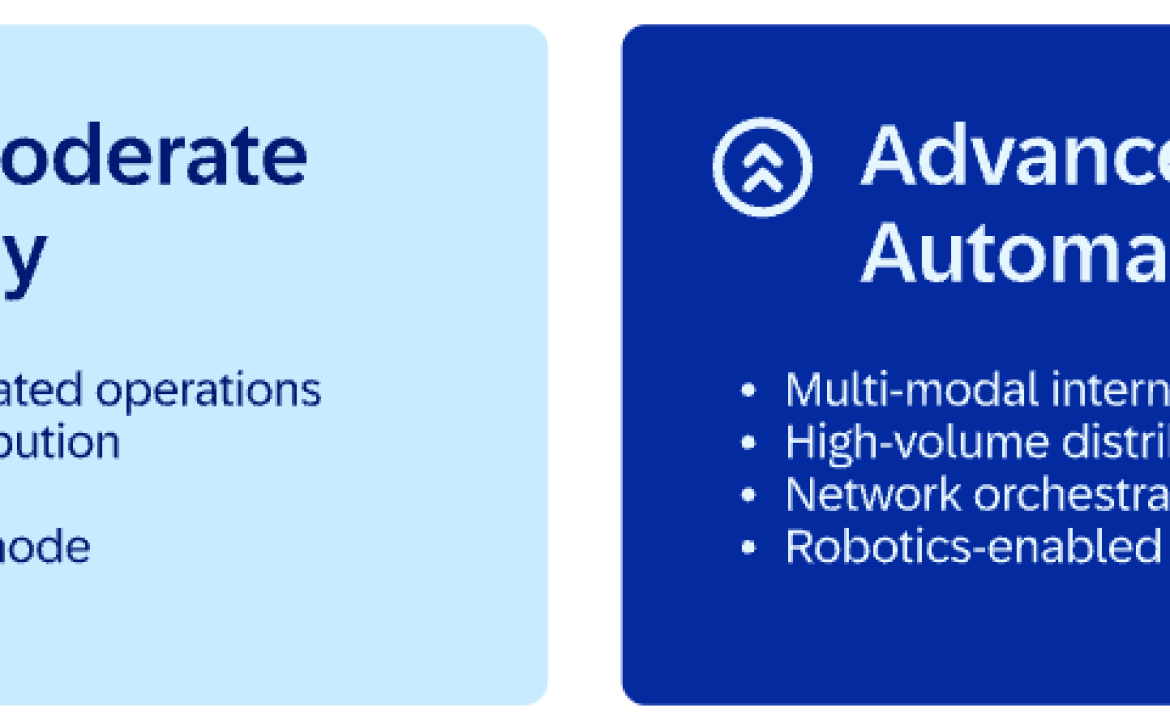
Companies operating at levels one to three of Gartner’s model are typically characterized by manual or semi-automated processes, regional distribution, and lower complexity. These companies are best-suited for SaaS-native warehouse and/or transportation solutions that offer the implementation speed of standardized workflows, cloud qualities such as flexible, mobile interface, and advantages from improved scalability and lower TCO.
Organizations at levels four and five require warehouse automation for high volume distribution, multi-modal transportation, and orchestration across multiple ERP systems. These companies seek the benefit of dedicated cloud environments that offer a higher level of adaptation for more control over their operations and their solution landscape.
SAP offers different pathways to help businesses run and modernize across the span of operational complexity. Below are three journeys to guide strategic planning for modernization. Each journey can be aligned to high-level business ambitions, accounting for process complexity, innovation speed, and risk tolerance.

Moving legacy SAP ERP Central Component modules LE-WM and LE-TRA to SAP S/4HANA for stockroom management keeps operations supported until 2040, offering more time to manage your transformation. This journey is about sustaining what works until you need to evolve. It is designed for organizations that need more time to move their decades-old warehousing solution into the future. This approach, rooted in stockroom management, extends the life of a proven system without prematurely forcing change. It is a temporary but intentional holding pattern for conservative logistics strategies based on a firm foundation. Throughout this journey, SAP Logistics Management can be the go-to solution when you are ready to move from stockroom management.
For organizations that know modernization is essential but need to be mindful of organizational change management, this journey offers a stable path. It begins with moving on-premise SAP ERP Central Component modules LE-WM and LE-TRA to SAP S/4HANA Cloud, private edition, with basic warehouse management and transportation management capabilities, creating a modern foundation for future readiness. From there, companies can evolve their processes toward more advanced options as their needs grow (see journey 2b). This journey is best suited to businesses that want flexibility and control in their operations as well as in their change management. This journey also supports deeply integrated logistics that align with the RISE with SAP journey.
Along this journey, if you find that your business complexity is manageable, SAP Logistics Management can even be incorporated as the most modern, AI-native SAP solution for logistics to complement your ongoing operations.
This journey supports organizations that need to manage highly specific processes, high-automation, and mission-critical logistics execution with one or multiple ERP systems. You can migrate from SAP Extended Warehouse Management and SAP Transportation Management to the cloud with SAP S/4HANA Cloud for advanced extended warehouse and transportation management without losing depth or control. This path can also serve as a second step for advancing operations from basic to advanced SAP S/4HANA Cloud in order to support growing business needs.
For innovation leaders ready to sprint ahead of the competition, this journey represents the direct path to the most modern logistics operating model. Companies move from on-premise SAP ERP Central Component modules LE-WM and LE-TRA to AI-native SAP Logistics Management, bringing together cloud delivery, embedded intelligence, and network connectivity in a single solution for warehousing and transportation.
This is the right path for businesses that want to standardize faster, simplify their landscape, and take advantage of continuous innovation. You gain a more connected and adaptive logistics model with built-in AI and a carrier network. Along this journey, you are setting the pace for modern supply chains.
Logistics is accelerating into a new era, one defined by both efficiency and intelligent adaptability and autonomous orchestration. Embodied in its evolving logistics portfolio, SAP’s strategy offers a clear, flexible, and future-ready path for companies at every level of complexity.
Whether maintaining existing operations, maturing gradually as complexity increases, or leapfrogging to leading-edge capabilities, you can now compose and run your entire logistics operations on SAP. Basic to moderate complexity processes are supported with SAP Logistics Management, and advanced and highly automated business with S/4HANA Cloud EWM and TM. By combining the two, you can design and achieve logistics networks to improve speed, agility, and resilience.
To explore which logistics journey fits your business best, don’t miss our “Future of Supply Chain” conversation with SAP executive Till Dengel: Logistics in the 21st Century: Journey to the Cloud.