Early Talent Hiring and Development: Now’s the Moment for a Major Reset

How will organizations attract and develop the AI-native workforce they’ll need tomorrow when entry-level roles are shrinking today? Here’s the future-ready, early talent strategy you need.

Fewer opportunities for early talent 

The job marketplace has contracted significantly for those with less than five years of professional experience. Research published by SAP shows that openings in the 10 most common entry-level job titles declined by 35% in just one year, from 2024 to 2025.*

Budget constraints, hiring freezes, and uncertainty around the ROI of early talent as AI increasingly takes on routine and manual tasks are among the reasons cited by HR leaders today.  

Applications skyrocket  

AI is also having a major impact on the recruitment process. With such limited opportunities available, more than half of early talent candidates use AI to help them land a job—a process that now takes eight months on average and involves more than 300 job applications.*

HR is feeling the pressure managing the candidate pipeline, with the number of applicants per early talent job opening doubling since 2021. A high volume of candidates are submitting AI-generated résumés and applications, and it’s becoming much harder to detect high-fidelity signals around skills, fit, and potential. 

HR can strategically select and develop the workforce of tomorrow

It’s a painful scenario for everyone involved. Fragile and unsustainable. And the implications will be profound for enterprises that don’t act quickly.  

HR leaders voice concerns  

Playing out the current trajectory to its natural conclusion, what happens when all the fresh talent eventually dries up? Already, HR leaders are alarmed by this risk. “Ultimately, if we stop investing in early talent, we will wind up eliminating our talent pipeline,” one global head of early talent programs at a high-tech organization told researchers.*

A senior HR director at a high-tech organization commented: “If we continue down this path and don’t provide a way for early talent to get started, it’s going to lead to massive skill shortages in the future.” 

Widespread reductions in early talent hiring will lead to skills gaps that will prove expensive to remedy. Organizations will struggle to build company capabilities, retain knowledge, and develop future leaders.  

But by far the most common concern from leaders was around not seeing early talent as AI-native. If the AI capabilities of this cohort are overlooked, companies may miss out on a key opportunity to scale AI innovation and adoption across the business.  

What’s the answer?  

Today, there’s an opportunity for HR leaders to be more intentional and strategic, to reimagine their approach to early talent from the ground up. With the right early talent strategy, organizations can gain a competitive advantage.

Here are three steps to consider. 

Step 1: Rethink entry-level roles 

Traditionally, junior employees have mainly been given routine, repetitive tasks. Combined with frustratingly slow career progression, the result is eroding morale and commitment.  

This approach must evolve. The nature of work is changing rapidly, and early talent no longer need to take on those routine tasks. These employees need the opportunity to develop at speed and to be supported in performing work that meaningfully addresses business challenges.  

HR has the chance to reshape entry-level positions, to provide support, guidance, and tools to enable junior staff to contribute in more impactful ways. This may involve them working with proper guidance to support more critical projects, interacting with customers, and even owning some tasks end to end. 

This approach not only enables early talent to contribute more positively to the business at an earlier stage, but when combined with clear goals, regular feedback loops, and occasional coaching, it also fosters greater engagement and commitment. 

Step 2: Support your strategy with technology 

Hiring and developing early talent have become more complex—from deciphering AI-generated applications, to redesigning roles and meeting their aspirations in a fast-changing business context. And with the nature of early talent work shifting, leaders need tools to help understand the new capabilities that will predict long-term success and demonstrate the value of early talent initiatives.  

Here’s where technology can help. During the hiring process, technology can help employers see beyond the noise of AI applications and rediscover the meaningful signals they need to create candidate shortlists and strengthen hiring decisions. Meanwhile, technology can also help to maintain engagement with other high-potential candidates who applied—for when the next opportunities arise.  

Once early talent begin work, today’s technology can help you track their participation in early talent programs and progression towards their goals. It also helps facilitate individualized learning opportunities and demonstrate the ROI of your early talent investments. For research-based recommendations on the role of technology in early talent selection and development, check out this quick guide

Step 3: Reframe the business case for early talent 

As the nature of early talent work is changing alongside the technology used to support them, HR leaders agree that the old business case for early talent investments needs to be reimagined. Many organizations are focused on mitigating critical skill gaps and engaging in large-scale AI transformations. While early talent lack experience, they are eager to engage in continuous learning and understand how to work effectively alongside AI. 

Research also reveals that—as they work alongside modern tools and technologies—early talent can contribute to high-value, meaningful work much faster than in the past.  

A modern early talent business case is one that involves focusing on faster time to meaningful work, reducing critical skill gaps, and leveraging the AI-native capabilities of today’s entry-level workers.  

Build your early talent strategy 

Will HR leaders watch on as a generation of AI-savvy talent remains underused, or act now and build the skills pipelines necessary for a future-ready workforce? 

Get further insights on this topic by reading our report, “Early talent in peril: How HR can strategically select and develop the workforce of tomorrow.” Visit our research library to stay tuned for when phase two of this research gets published later this year. 


Dr. Autumn D. Krauss is chief scientist at SAP SuccessFactors.

Get the latest SAP news delivered to your inbox once a week

*Early talent in peril: How HR can strategically select and develop the workforce of tomorrow, SAP, 2026. 
Salt River Project’s 5 Benefits of WalkMe for SAP Business Suite

Salt River Project (SRP) is a community-based, non-for-profit public power utility in Arizona. As the largest electricity provider in the Phoenix metropolitan area, it serves roughly 1.2 million electric customers, covering 2,800 square miles of electric service territory, and manages a 13,000 square-mile watershed that supports central Arizona’s water supply.

“We operate primarily to serve the needs of our customers and communities, so reliability is critical to SRP,” Drake Winfrey, ERP solution architect at Salt River Project, said. “We must ensure that anything we implement within our technology ecosystem doesn’t impact that reliability in any way—and, ultimately, enables our team members to deliver the best possible service.”

WalkMe’s superpower to work seamlessly on top of SAP and non-SAP systems helps ensure technology enables reliability without disruption. SRP’s first encounter with WalkMe was part of its SAP SuccessFactors implementation. At the time, Winfrey was the IT administrator for SAP Concur solutions at SRP and, based on the success of the SAP SuccessFactors implementation, saw an opportunity to add WalkMe in its travel and expense processes.

“Our employees only travel maybe once or twice a year, so no matter how user-friendly the system may be, there’s always going to be some pain points and friction,” Winfrey said. And, for those who travel frequently, the SRP team knew they could benefit from in-app guidance to ensure processes were completed quickly and accurately.

It was a perfect use case for WalkMe’s digital adoption solutions. At SAP Sapphire Orlando, Winfrey shared five wins that Salt River Project experienced by applying WalkMe to its processes.

1 Greater process efficiency

At SRP, there are several standard expense reports that employees can submit in Concur Expense, such as personal mileage, safety gear, and telework.

Accelerate SAP adoption and AI transformation using learning, guidance, and AI assistance in the flow of work

To improve process efficiency, Winfrey built WalkMe “Smart Walk-Thrus”—step-by-step solutions that guide users through a series of actions to help complete a task—that direct SRP employees through the report completion and submission process. “With WalkMe, we automate some of the fields and fill in critical information for the user, taking away some of those hidden dependencies,” he said.

This proactive, in-flow guidance not only creates a simplified user experience for SRP employees when submitting expenses, but it has domino effects on IT support overhead. Since employees get the in-app guidance they need as they’re completing key steps, they submit reports accurately the first time, reducing support tickets or time spent correcting inaccurate submissions. “We’ve eliminated a lot of the support tickets and hand-holding we saw previously,” Winfrey said.

2 Risk mitigation and improved compliance

Winfrey applied WalkMe solutions in SRP’s payroll system to help with policy reinforcement. By adding in-app reminders, especially during important times of the year like holidays, SRP ensures employees are following procedures, boosting data and process accuracy.

When users log in to the system, they see in-app pop-up messages to remind them about key dates, such as time card due dates and approval timelines, and can opt to take action immediately or receive a reminder. If the user opts to act, they’re automatically redirected to the company’s time and attendance system via another WalkMe solution. “WalkMe solutions are very simple to build and deploy—and very effective compared to e-mails or chasing down people at the end of the pay period,” Winfrey said. He knows this for a fact because he can use WalkMe analytics to see how many users have viewed the in-app reminder and how many have clicked through to the time card. “It’s all reportable,” he said. “There are a lot of metrics behind the scenes that you can use to understand trends and find ways to improve the experience.”

3 Faster cycle times

Making changes to enterprise-wide systems can take time, as organizations are often constrained to the development cycles set by the IT department. “At SRP, we have monthly releases, so unless it’s a critical update or fix, getting a change is usually going to take a few weeks,” Winfrey said. “But with WalkMe, I can build and deploy content in 15 to 30 minutes.”

This agility is especially powerful for real-time communication and keeping the employee experience seamless. For example, Winfrey explained how SRP can instantly support users during routine system updates or maintenance windows. When a specific tile requires temporary maintenance, Winfrey’s team can immediately place a real-time message directly over the feature. This keeps employees informed and guides them to alternative workflows, ensuring business continuity and a smooth user experience while IT completes its work behind the scenes.

4 Boosted cost efficiency

Empowering employees with self-service support “frees up their time for more value-added activities. By achieving this impact, my team can deliver enterprise-wide value without increasing headcount,” Winfrey said.

“We use WalkMe and the analytics it provides to look at different pages and see where the friction is and what processes are causing issues,” he explained. “Then we look at the support tickets and say ‘Okay, these are the same questions we get on this screen every time, so we’ll build a self-support solution.’” A user can then see those top support questions in the flow of work and get guided assistance. As a result, they’re able to complete the task themselves. No help ticket required.

5 Enhanced digital user experience

Optimizing the digital employee experience means empowering employees with the digital tools and support needed to perform at their best. SRP uses WalkMe to anticipate user needs and ensure seamless change during major UI transitions. Using highly visual, contextual callouts like targeted Launchers that connect users to resources, eye-catching ShoutOuts for feature adoption, and Banner Reminders for critical updates, the team delivers personalized support that provides a unified, consistent user experience across multiple enterprise applications. “There’s just a lot of flexibility and, honestly, a lot of creativity” about the solutions they can deploy, Winfrey said.

What’s more, WalkMe solutions exist on top of current system landscapes. “As we continue to see everything moving to the cloud, it’s all about clean core,” he added. “I think we’re going to be limited on what we can customize going forward.”

What’s next for WalkMe at SRP

Salt River Project is building on its success with WalkMe solutions and establishing a center of excellence to better balance central governance and cross-departmental collaboration. “In order to scale it, we really have to start building department-level WalkMe experts who know how to develop impactful content,” Winfrey said.

It’s clear: with WalkMe, Salt River Project can improve process efficiency, strengthen compliance, accelerate change, reduce support burden, and create a better digital experience for employees. As SRP expands its internal WalkMe expertise, it is positioning itself to scale those gains across the business while maintaining the high operational standards the organization is known for.


Get the latest SAP news delivered to your inbox once a week

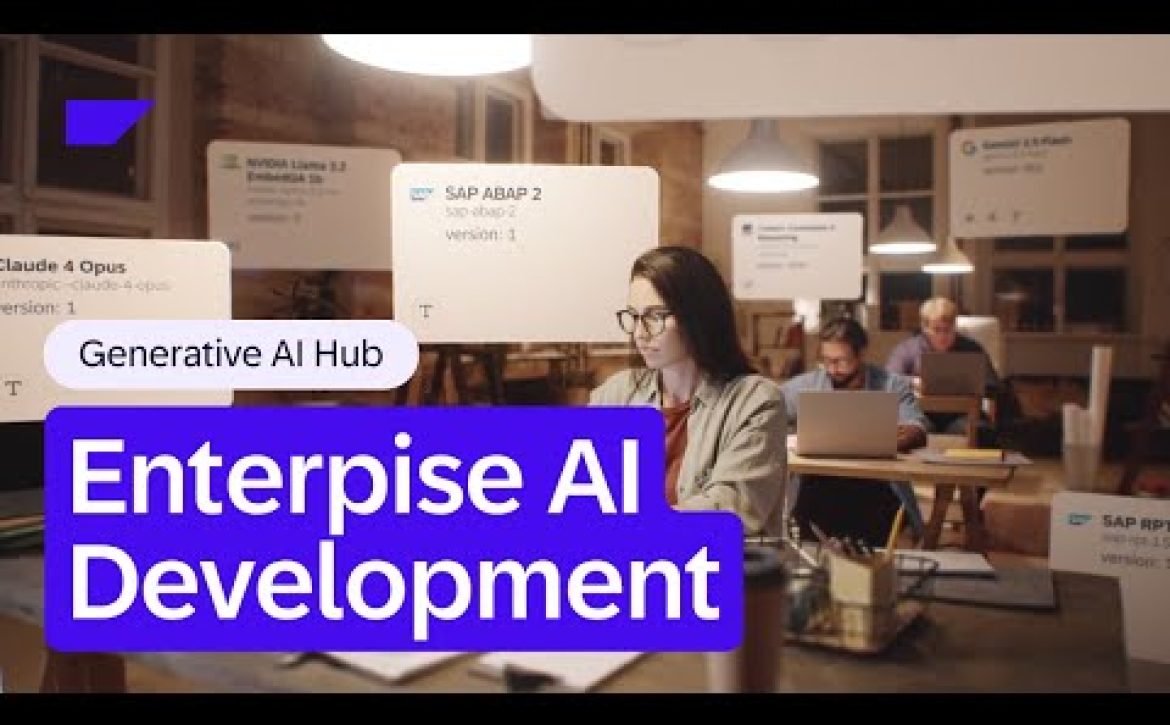
Generative AI Hub for Enterprise AI Development

See how Generative AI Hub helps organizations move from AI experimentation to real business impact.

Generative AI can create powerful opportunities, but scaling it across the enterprise requires the right foundation. Teams need centralized model access, built-in governance, secure development tools, and a clear path from experimentation to production.

Generative AI Hub brings AI development into one enterprise-ready platform, with centralized access to SAP and partner foundation models, orchestration, governance, and administration. It provides a single entry point to explore ready-to-use multimodal AI models, agents, and predictive insight capabilities, pre-integrated, fully managed, and connected to SAP business context.

With a low-code playground, developers and teams can compare models, optimize prompts, and test use cases faster. Using one API, they can ground model outputs in enterprise data, orchestrate complex scenarios across applications, and maintain control over AI access, monitoring, security, and costs.

The result is a faster, more governed way to productize AI use cases and scale generative AI across the business.

Learn more about Generative AI Hub:
https://www.sap.com/products/artificial-intelligence/generative-ai-hub.html

Follow us on social:
LinkedIn: https://www.linkedin.com/company/sap/
Instagram: https://www.instagram.com/sap
Facebook: https://www.facebook.com/SAP/
Threads: https://www.threads.com/@sap

About SAP:
As a global leader in enterprise applications and business AI, SAP stands at the nexus of business and technology. For over 50 years, organizations have trusted SAP to bring out their best by uniting business-critical operations spanning finance, procurement, HR, supply chain, and customer experience. For more information, visit: https://www.sap.com/index.html

#SAP #BusinessAI #GenerativeAI

Would today’s AI have changed Formula 1 history? 💨 Hear from Mika Häkkinen and David Coulthard.

F1 legends Mika Häkkinen and David Coulthard shared their perspective on how data, AI, and real-time decision-making have transformed racing, and what that evolution says about the future of performance.

What Is SAP Business Data Cloud?

Most organizations running SAP have spent years accumulating data.

Previous Next
Close
Test Caption
Test Description goes like this