Dr. Benjamin Blau was recently appointed chief process and information officer and head of Corporate Processes and Information Technology at SAP. Here, he shares how he defines his new role as well as the future of his organization and the impact of artificial intelligence (AI).
SAP Business AI: Revolutionary technology, real-world results
Blau joined SAP in 2010 and has held various executive leadership positions with a strong track record in process management and business transformation. As chief process and information officer (CPIO), he represents the Corporate Processes & Information Technology (CPIT) organization with the main objective to enable SAP to scale and increase productivity through process transformation and optimization powered by AI. At the same time, the unit functions as the company’s own best reference customer showcasing how SAP runs SAP.
In this interview, Blau discusses his role and the transformation of the IT industry in general.
Q: For those not familiar with the Corporate Processes & Information Technology organization, what is its role within SAP?
A: It is widely recognized and acknowledged that the traditional concept of IT Services has undergone a significant shift in recent years, thanks to advancements in cloud computing, AI, and Big Data. Companies need to double down on their core strength and USP while demonstrating their ability to scale. To do so, IT has become a strategic instrument to enable every business to be more adaptable, scalable, and intelligent.
At SAP, we have invested a considerable amount of time and resources in this transformation, turning IT into a strategic enabler for business growth and a trusted technology partner. However, companies need to rethink their strategies to outperform their competitors by demonstrating operational efficiency and accelerated scalability. We see a substantial requirement to focus on process excellence and automation powered by AI. This means unleashing productivity through simplification and standardization of processes, powered by business AI and SAP’s own technology.
With that in mind, our strategic focus has evolved beyond information technology to support end-to-end process excellence with clear accountabilities that drive autonomy and quick decision-making. And that is the leading aspect of the CPIT organization.
Q: How would you describe the difference between the CIO and CPIO?
A: For me, the key difference lies within the approach to problem-solving. Rather than focusing solely on products or tools, the CPIO tends to tackle issues at the process level, where the root causes are often found. Especially as a SaaS company, we tend to solve every issue with another tool or a customization and/or a worst-case modification of a system, while in many cases the problem can be solved by standardizing and simplifying the way we work.
Hence, in addition to our information technology strategy, it is crucial for our organization to fulfill our mandate as SAP’s business process design authority, emphasizing our responsibility to oversee and optimize business processes. This means the business defines the strategy and clear objectives — aka the “why” and “what” — while we define “how” to get there in the most end-user friendly and productive way.
Q: What are you most looking forward to in your new role?
A: Coming from my former role leading Industry Engineering for SAP, I love working close to products and customers. To this extent, I have the perfect job as we are SAP’s customer and first adopter of new technology, all while I am in the luxury position of being able to authentically talk to SAP’s customers about our challenges and solutions, being their trusted “peer” in the industry. This also means demonstrating how we boost productivity for SAP mainly through our fast-growing AI portfolio.
Q: The past five years have seen a tremendous amount of innovation, especially with the rise of generative AI. How will this influence the role of CIOs or that of an IT organization in the next two to five years?
A: In the coming two to five years, the influx of generative AI promises to revolutionize the landscape of IT organizations and the role of CIOs. Let me give you three examples.
First, it will significantly boost IT productivity by automating repetitive tasks and streamlining processes, which will free up valuable resources to either “do more with the same” or elevate those roles to even higher value-adding ones. Second, as CIOs in SaaS companies are customer zero, it is our task to showcase how AI can unlock value in highly differentiating parts of our value chain as innovation leaders of the industry. Third, with data even further emerging as a crucial competitive advantage, CIOs will increasingly focus on harnessing and maximizing the value of data assets. This entails not only owning and controlling data, but also developing new data products and mastering provisioning, management, and analysis, thereby cementing data management as a core responsibility of the IT organization.
For SAP, this clearly is the competitive edge in the AI game, as we have access to the probably largest amount of business data to feed high-value AI scenarios.
Q: Considering the fast-tracked development of AI and its potential impact, what is your approach for CPIT and SAP at large?
A: The strategic role of my organization in that context is twofold. First, we are the early adopter of every AI case ideated and developed at SAP, with an obligation to challenge the level of quality, maturity, and value on behalf of our customers. Second, I expect my team to also come up with new ideas and potential AI use cases, try them out, and be equally strict in their assessment regarding desirably, feasibility, and especially viability.
At the end of the day, business AI is about quality not quantity. To accelerate AI innovation, we have started an internal initiative to identify use cases with the highest value. This includes a process that also ensures we focus on the most effective solutions. By implementing quality gates in each step of the process, we also prioritize quality over quantity. This enables us to implement use cases that clearly demonstrate business value.
Marcus Kabat is head of CPIT Business Operations at SAP.
Sign up to receive weekly highlights on news, stories, and coverage from the SAP News Center
The recent SAP PRESS E-Bite Introducing SAP PLM in the Cloud delves into the evolution of SAP Product Lifecycle Management (SAP PLM) and has reminded us of the importance of key changes within PLM solutions.
MANNHEIM —SAP SE (NYSE: SAP) today announced that at the company’s Annual General Meeting of Shareholders (AGM), Pekka Ala-Pietilä (67) was elected as a new member of the company’s Supervisory Board. Ala-Pietilä’s election was supported by 95.50% of shareholders. Subsequently, Ala-Pietilä was also elected the new Chairman of the SAP Supervisory Board, completing the handover from former Chairman of the Board, Prof. Dr. h. c. mult. Hasso Plattner.
“I am happy to pass the baton to Pekka Ala Pietilä to accompany SAP’s ongoing successful transformation,” said Plattner. “Pekka profoundly understands SAP and the technology industry and will strongly support the company in expanding its leadership in cloud ERP and business AI.”
Ala-Pietilä added, “I am grateful to the SAP shareholders and Supervisory Board for the opportunity to rejoin Europe’s most important software company and I’m looking forward to help SAP broaden this strong position.”
As announced in 2023, SAP Co-Founder and former Chairman of the Board Hasso Plattner left the SAP Supervisory Board after the 2024 AGM.
During Plattner’s tenure as Chairman of the Supervisory Board (May 2003 to May 2024), SAP’s market capitalization increased from c. €30 billion to c. €200 billion, making SAP Germany’s most valuable listed company. Plattner’s innovative and competitive spirit has been a foundation of SAP’s success for more than 50 years, from the company’s first pioneering innovations in ERP to its strategic shift as an enterprise cloud and business AI leader. He will continue to serve as an advisor to SAP, ensuring his knowledge and experience remain available to the company.
Aicha Evans (55), Gerhard Oswald (70) and Dr. Friederik Rotsch (51) were re-elected as members of the Supervisory Board with 93.39%, 89.82% and 92.45% of the vote respectively. Prof. Dr. Ralf Herbrich (50) was elected with 99.29% of the vote as successor to Punit Renjen, who left the SAP Supervisory Board at the end of the 2024 AGM.
The AGM also supported all other proposals of the Executive Board and Supervisory Board. That included approving the actions of the Executive Board and Supervisory Board for fiscal 2023, 99.51% and 99.44% support respectively, and approving the adaptation of the compensation of the Chairman of the Supervisory Board. An overview of the resolutions of the Annual General Meetings 2024 and of previous years can be found here.
For 2023, SAP shareholders will receive a dividend of €2.20 per share. This is an increase of €0.15, or seven percent compared to the dividend paid for 2022. The total payout to shareholders will thus amount to around €2.6 billion. The dividend is expected to be paid out from May 21, 2024.
As a global leader in enterprise applications and business AI, SAP (NYSE: SAP) stands at the nexus of business and technology. For over 50 years, organizations have trusted SAP to bring out their best by uniting business-critical operations spanning finance, procurement, HR, supply chain, and customer experience. For more information, visit www.sap.com.
Note to editors: To preview and download broadcast-standard stock footage and press photos digitally, please visit www.sap.com/photos. On this platform, you can find high resolution material for your media channels. To view video stories on diverse topics, visit www.sap-tv.com. From this site, you can embed videos into your own Web pages, share video via email links, and subscribe to RSS feeds from SAP TV.
For customers interested in learning more about SAP products: Global Customer Center: +49 180 534-34-24 United States Only: 1 (800) 872-1SAP (1-800-872-1727)
For more information, financial community only: Anthony Coletta, +49 6227-7-60437, investor@sap.com, CET
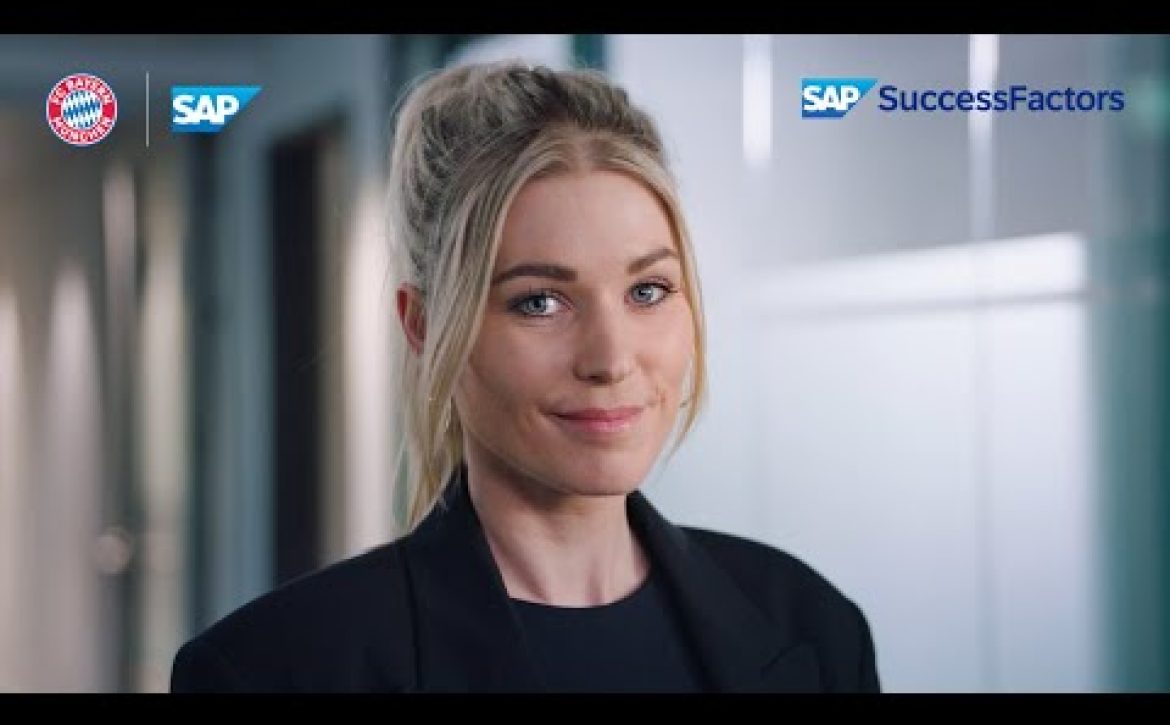
FC Bayern are optimizing the employee experience and accelerating their digital transformation with SAP SuccessFactors.
Discover more about SAP and FC Bayern’s innovative partnership :https://sap.to/6059bPRm3
FC Bayern is building a future ready workforce with SAP SuccessFactors. Using the latest HCM capabilities, the globally renowned club is driving innovation in its HR processes to maintain a winning culture and motivated workforce.
Discover more about SAP and FC Bayern’s innovative partnership: https://sap.to/6052bPbJE
SAP co-founder Dietmar Hopp once said about co-founder Hasso Plattner: “It’s hard to quantify his legacy. All I can say is that without him, SAP would never have been so successful.” At the 2024 Annual General Meeting of Shareholders on May 15, Plattner will step down from the SAP Supervisory Board after 21 years as its chairman.
One need only look at the key milestones in Plattner’s 52-year career at SAP to gain a vivid picture of his legacy. Together with Dietmar Hopp and his fellow co-founders, Plattner created the market for real-time business software, helped steer SAP through more than five decades of fast-moving IT history, and drove SAP’s global expansion – transforming it from a single-product company to the world’s No. 1 provider of enterprise applications.
Over the years, he worked tirelessly to open new horizons for the company and its employees, identifying technological trends and channeling his pioneering spirit into revolutionizing far more than just data management.
1972-1973: The Early Days
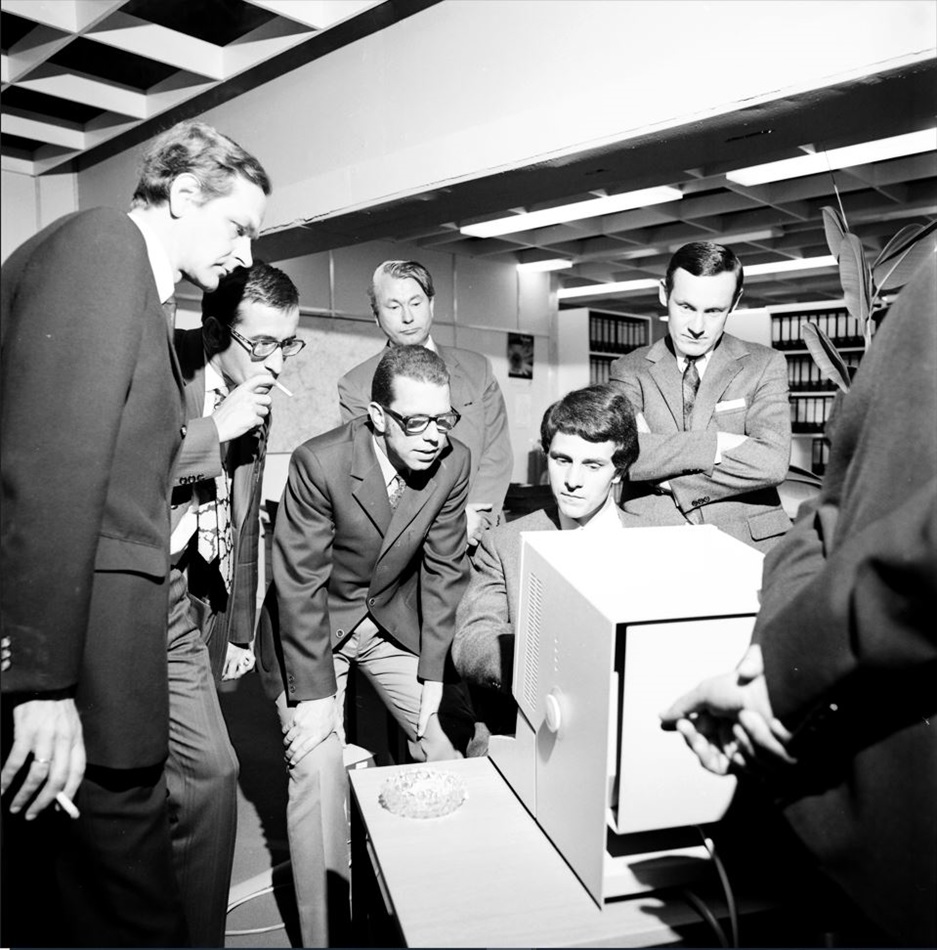
Hasso Plattner (sitting) explains the real-time screen application to colleagues from IBM and ICI
Having created Germany’s first real-time software application with a user interface, Hasso Plattner and Dietmar Hopp founded a company they named Systemanalyse Programmentwicklung (“System Analysis Program Development”) on April 1, 1972, together with their IBM colleagues Claus Wellenreuther, Klaus Tschira, and Hans-Werner Hector.
In 1973, the entrepreneurs launched RF, their first financial accounting system. The “R” in the name stood for “real time.” Developed under Plattner’s leadership, RF laid the foundation for a series of software modules in a system that would later be known as SAP R/1.
“Before I worked on RF,” Plattner once said, “I knew nothing about financial accounting; afterwards, I could hold seminars about it for CFOs. And not because I’d read stacks of books or was very smart, but because I’d learned from customers how to build this kind of system. I worked side by side with our customers at their offices every day.”
1976: The Formative Years
Systemanalyse Programmentwicklung was renamed “SAP.” Each of the founders and their employees – numbering about 30 at this point – was a developer, salesperson, and consultant all rolled into one.
Hasso Plattner and Dietmar Hopp were constantly competing to be the best at programming and selling their products. Plattner recalls that it made him really mad once when Hopp sold more than he did. Wherever their tasks and skills converged, they would engage in a private, “take-no-prisoners” contest to outdo each other.
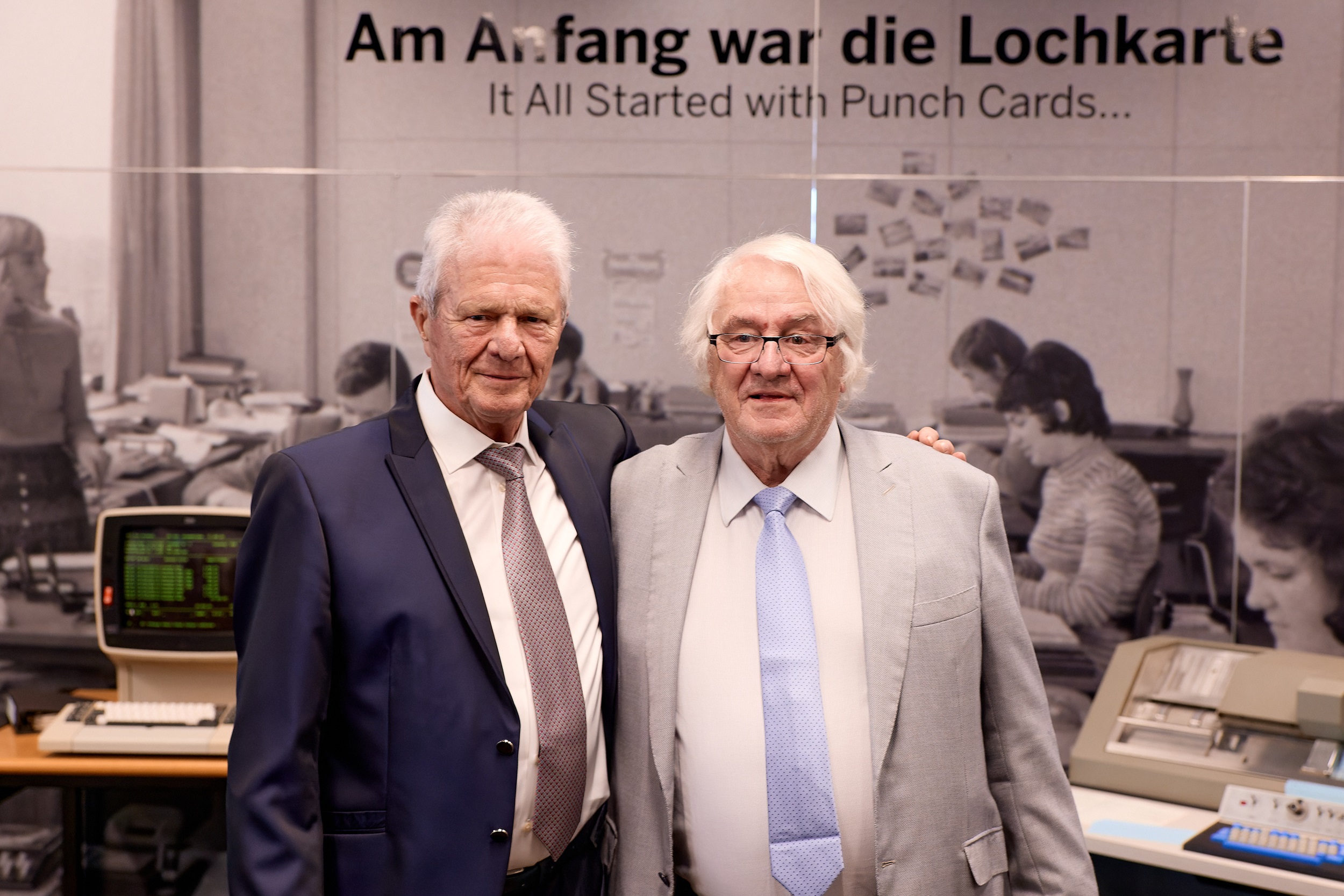
Dietmar Hopp (left) and Hasso Plattner: ambitious and always encouraging each other to achieve top performance (in the anniversary year 2022)
Nevertheless, both men also knew how to harness their ambition and fondness for friendly competition to the benefit of their fledgling business.
1988: Conversion and IPO
SAP GmbH was converted to a stock corporation, SAP AG, and in October 1988 it listed on the stock exchanges in Frankfurt and Stuttgart, providing the company with the funding it needed to expand into even more markets.
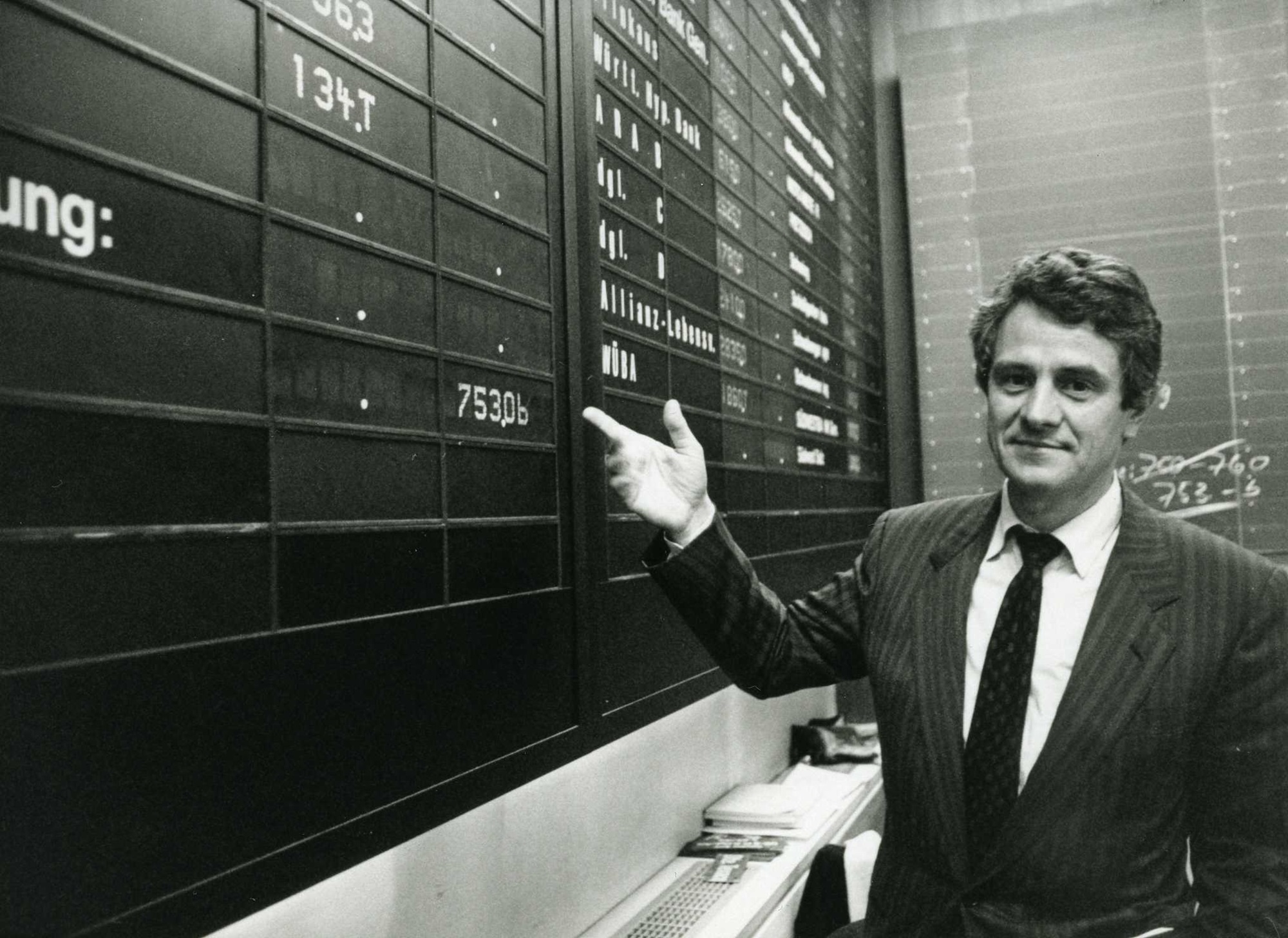
The initial public stock offering (IPO) was the beginning of a steep stock rise
1991: SAP R/3
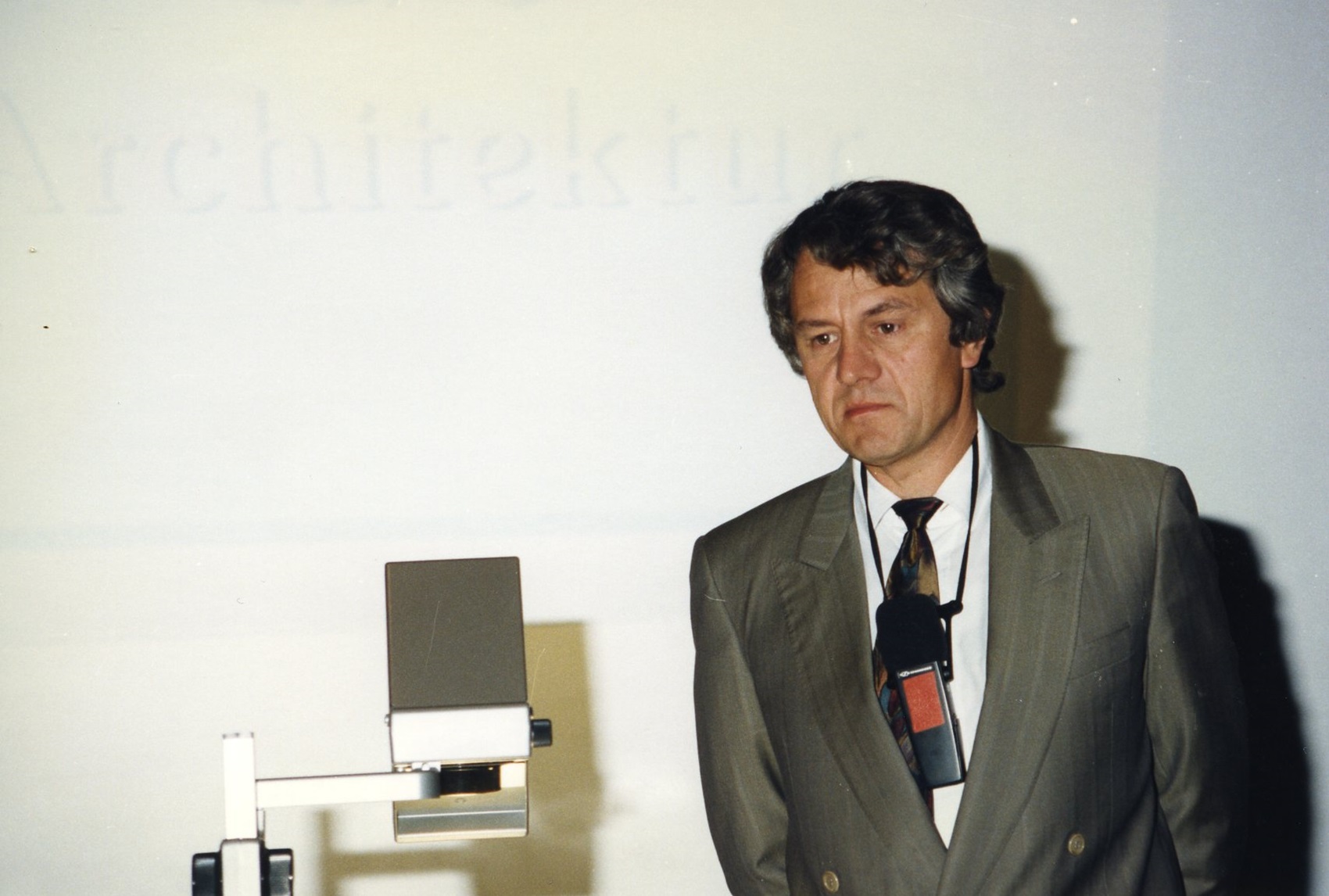
SAP R/3 made the company a global player. Plattner in 1991 at a Hewlett Packard (HP) event.
At SAP’s 25th anniversary celebrations in 1997, Plattner recounted an incident in late January 1991, which he described as “probably the most dramatic situation” in the company’s history: “A year before the final delivery date for R/3, we realized during testing that its performance on our mainframe was completely unsatisfactory and that the test conditions were unacceptable. Six weeks before we had planned to present R/3 at the CeBIT trade fair in Hanover, we had all but given up on the project.
We called an emergency meeting at which everyone remained standing, such was the urgency of the matter at hand. We decided to halt work on the mainframe systems and, in a last-ditch attempt, to switch to the new, more powerful Unix workstations, which we’d previously only used in development.
The presentation of R/3 on Unix was a huge hit. A year and a half later, we began shipping our new client-server software to customers. That was the start of R/3, a business application for network-based computers.”
1992: Heading Stateside
In the early 1990s, when everyone else’s attention was focused on getting SAP R/3 to market quickly, sales of SAP R/2 in Germany were a cause of concern for Dietmar Hopp. As Plattner recalls: “Dietmar and I were standing in his office, and he said to me, ‘It’s not looking good. The only option I can see is for you to pack the system up and take it to America.’” They agreed to continue promoting the SAP R/2 mainframe software in Germany while going all-in on SAP R/3 in the U.S.
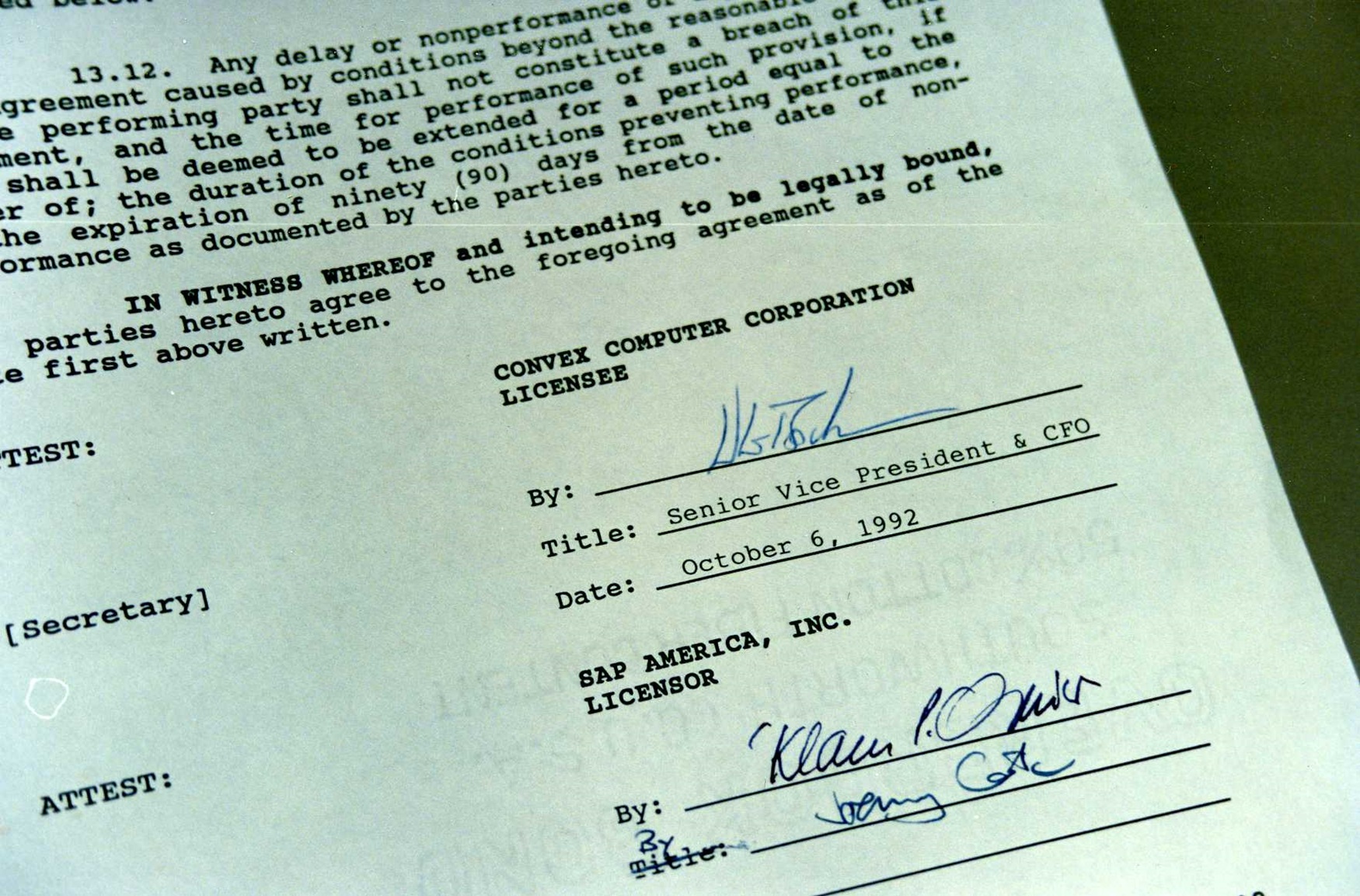
At the Sapphire customer conference held in Orlando in September 1992, Plattner announced that SAP would deliver the SAP R/3 system within six weeks to anyone who ordered it there and then. By October, computer manufacturer Convex had signed a contract for the new product, giving SAP its first SAP R/3 customer in the United States. And when, not long after that, oil giant Chevron – one of the country’s largest companies – also opted for R/3, SAP’s new software, originally built with the midmarket in mind, was well on track to becoming a global success story.
The computer manufacturer Convex was the first SAP R/3 customer in the U.S.
1993: A Very Special Partnership
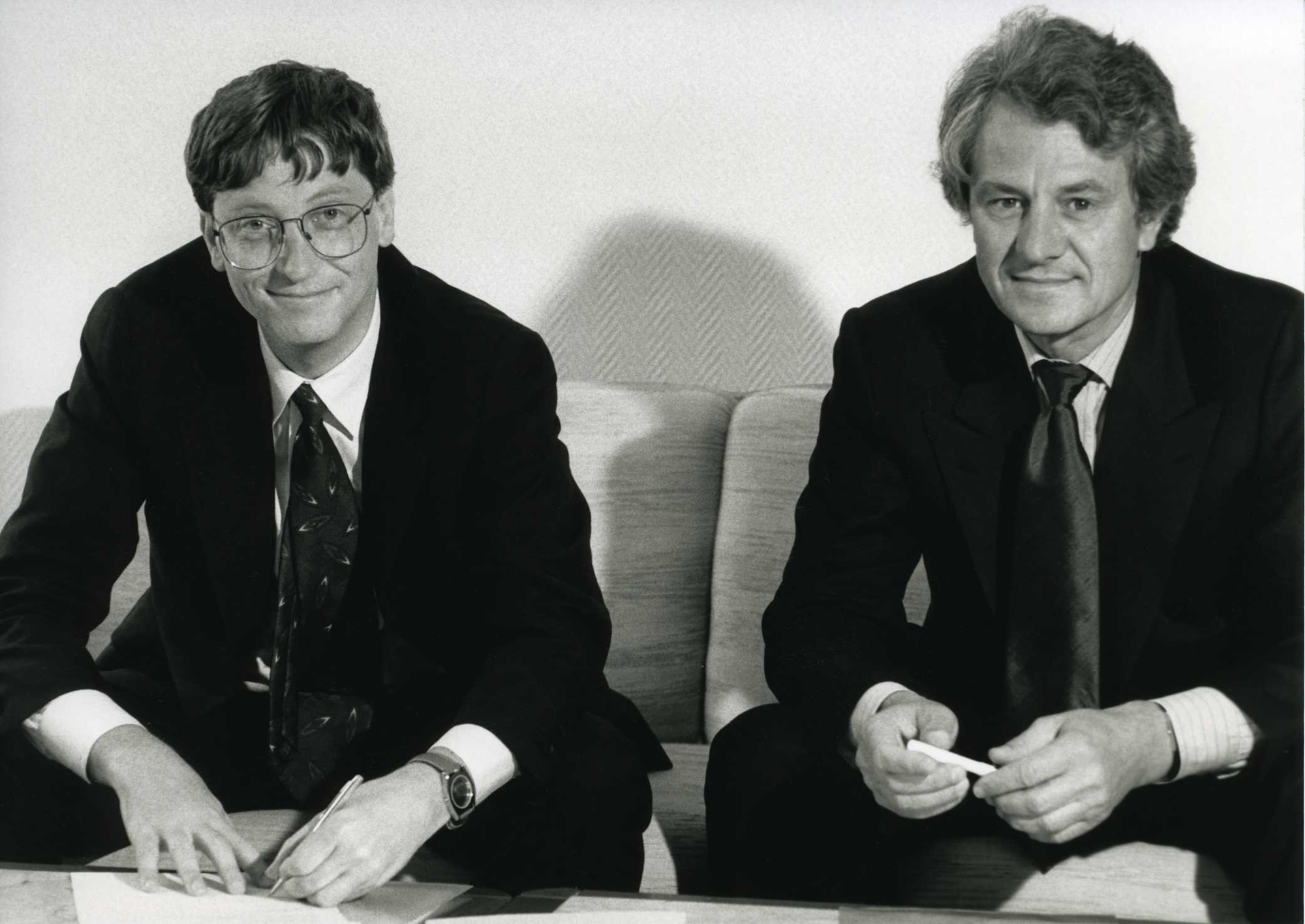
SAP entered into an alliance with the world’s largest software company: Microsoft. Bill Gates, who had flown into Munich to sign the contract in person, told the audience at the press conference announcing the partnership: “We are delighted that SAP, one of the leading providers of standard software, supports Microsoft’s client-server operating system. We believe that many businesses will see this move by SAP as a compelling reason to opt for Windows NT.”
The beginning of a long and fruitful partnership: Microsoft founder Bill Gates and Hasso Plattner
And when, in 2010, Plattner received the Transatlantic Partnership Award, Gates had this to say about his friend and colleague: “I’ve known Hasso for more than three decades. His knowledge, energy, and vision never cease to impress me.”
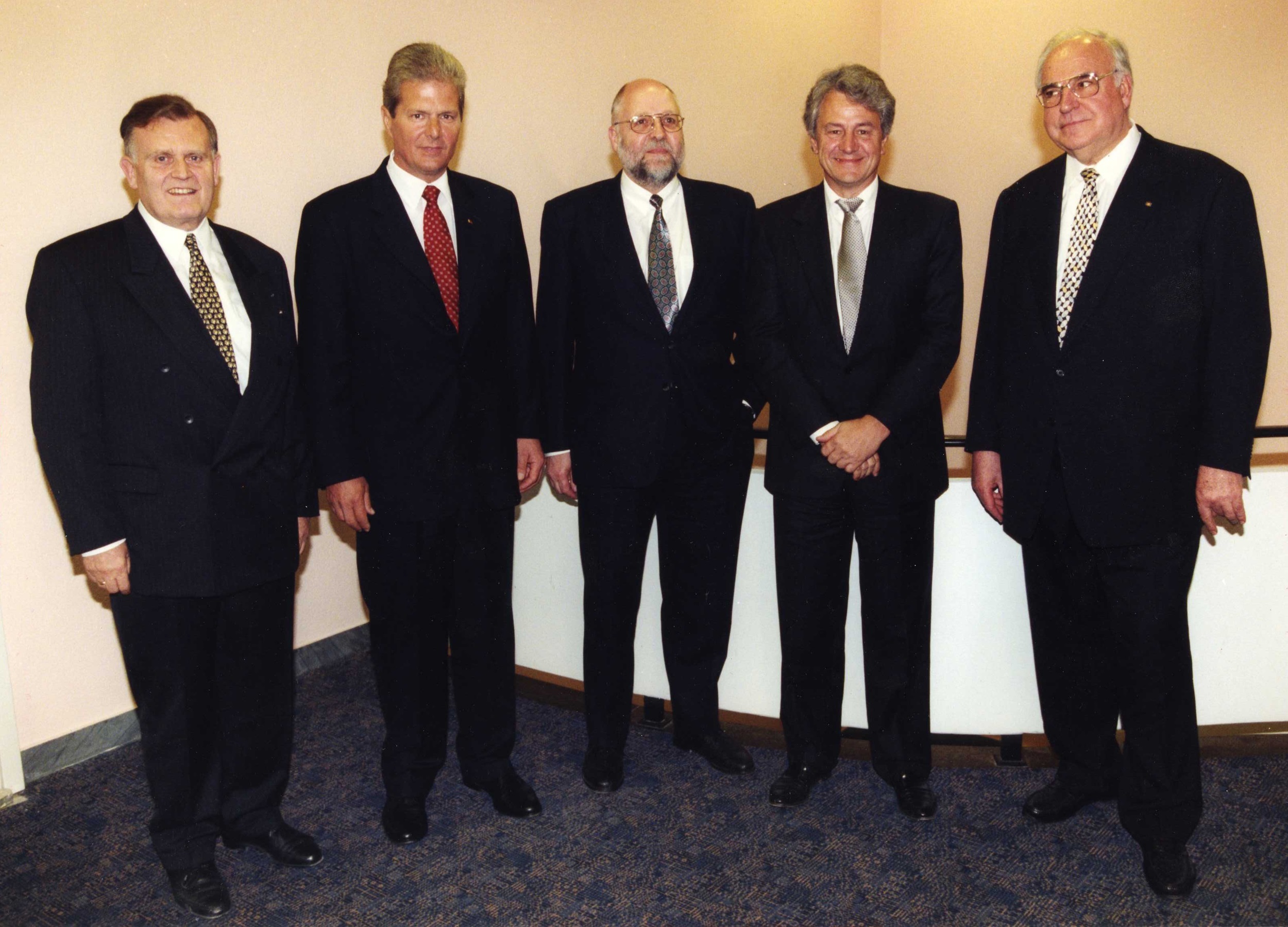
1997: SAP Celebrates Its 25th Anniversary
SAP turns 25 and celebrates with the Prime Minister of Baden-Württemberg, Erwin Teufel (left) and Federal Chancellor Helmut Kohl (right) in between Hopp, Tschira, and Plattner
Plattner was appointed co-CEO, alongside Dietmar Hopp. In his speech at SAP’s 25th anniversary celebrations, he spoke about what had helped the company prosper: “Product focus is one pillar of SAP’s success. When a product sells well, the employees share in that sense of achievement. That feeling is just as important to them as the pay they take home each month. Our employees identify with the product – that’s why they have always gone the extra mile. No matter how different our views at times were, we always managed to regroup and we never lost sight of the product. For the past 25 years, the founders and employees of SAP remained true to the original product vision and never veered off course.”
1998: SAP Conquers New York
On August 3, 1998, the company debuted on the New York Stock Exchange (NYSE), the world’s largest exchange. CEO Hasso Plattner described SAP’s Wall Street listing as “a strategic necessity and logical milestone in the history of SAP.”
By having its shares listed on the New York Stock Exchange “Big Board,” SAP gained new prominence in its most important market
That same year, Plattner founded the Hasso Plattner Institute (HPI) for Software System Engineering in Potsdam, near Berlin. “The institute here in Potsdam is my contribution to training internationally competitive junior managers who help shape and advance the digital world,” he said.
Dietmar Hopp and Klaus Tschira transitioned from the Executive Board to the Supervisory Board, and Plattner became co-CEO alongside Henning Kagermann.
1999: The mySAP.com Revolution
In May, Plattner announced the mySAP.com strategy, which set the company and its product portfolio on an entirely new path. Using the latest Web technology, mySAP.com connected e-commerce solutions with the company’s existing ERP applications.
To be successful in the increasingly important Internet business, Plattner relied on the mySAP.com strategy
According to Plattner, success on the Internet was key to the company’s survival. At the Sapphire conference in Philadelphia in September 1999, a live demo of mySAP.com — with a prelude by Plattner playing Queen’s “I Want to Break Free” live on electric guitar — was enough to convince customers to adopt SAP’s Web strategy.
And, true to form, Plattner was already thinking about where the technology would go next, predicting that e-commerce and the hosting of applications on SAP servers would be “the future of software sales.”
2003: From Executive Board to Supervisory Board
Plattner stepped down from the Executive Board and was elected chairman of the Supervisory Board.
Speaking at the Annual General Meeting of Shareholders in May, he said: “This rising star of the 90s is now playing in the same league as IBM, Microsoft, and Oracle.”
With Plattner’s withdrawal from the Executive Board, Kagermann (left) becomes the sole CEO
Though no longer its CEO, Plattner continued to channel his passion and his eye for technological trends into driving SAP forward, but now in his new role as chief software advisor on the Supervisory Board. That same year, he helped found the Hasso Plattner Institute of Design (“d.school”) at Stanford University, providing funds to support its work on design thinking, a new approach to finding creative solutions to complex problems.
2006: The In-Memory Database
It was in 2006 that Plattner and students at HPI began work on a revolutionary technology. The result was SAP HANA (High-Performance ANalytic Appliance), an entirely new, column-oriented, in-memory database management system.
“It’s not so easy for a big company to break out and do something radically different,” said Plattner. “The university context gives you the freedom to do it.”
Plattner loves to pass on his knowledge to young people
2011-2013: SAP HANA Drives Growth
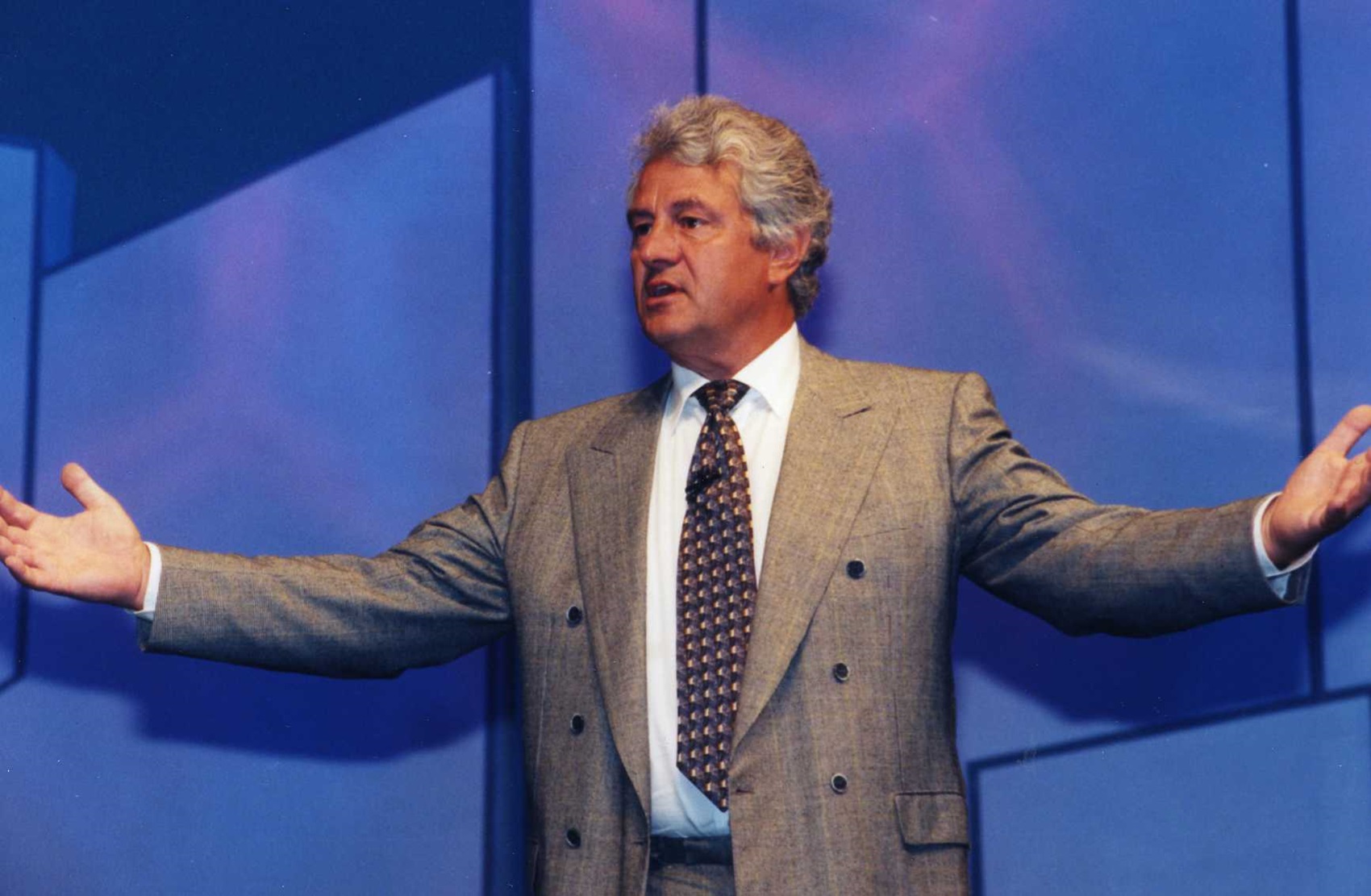
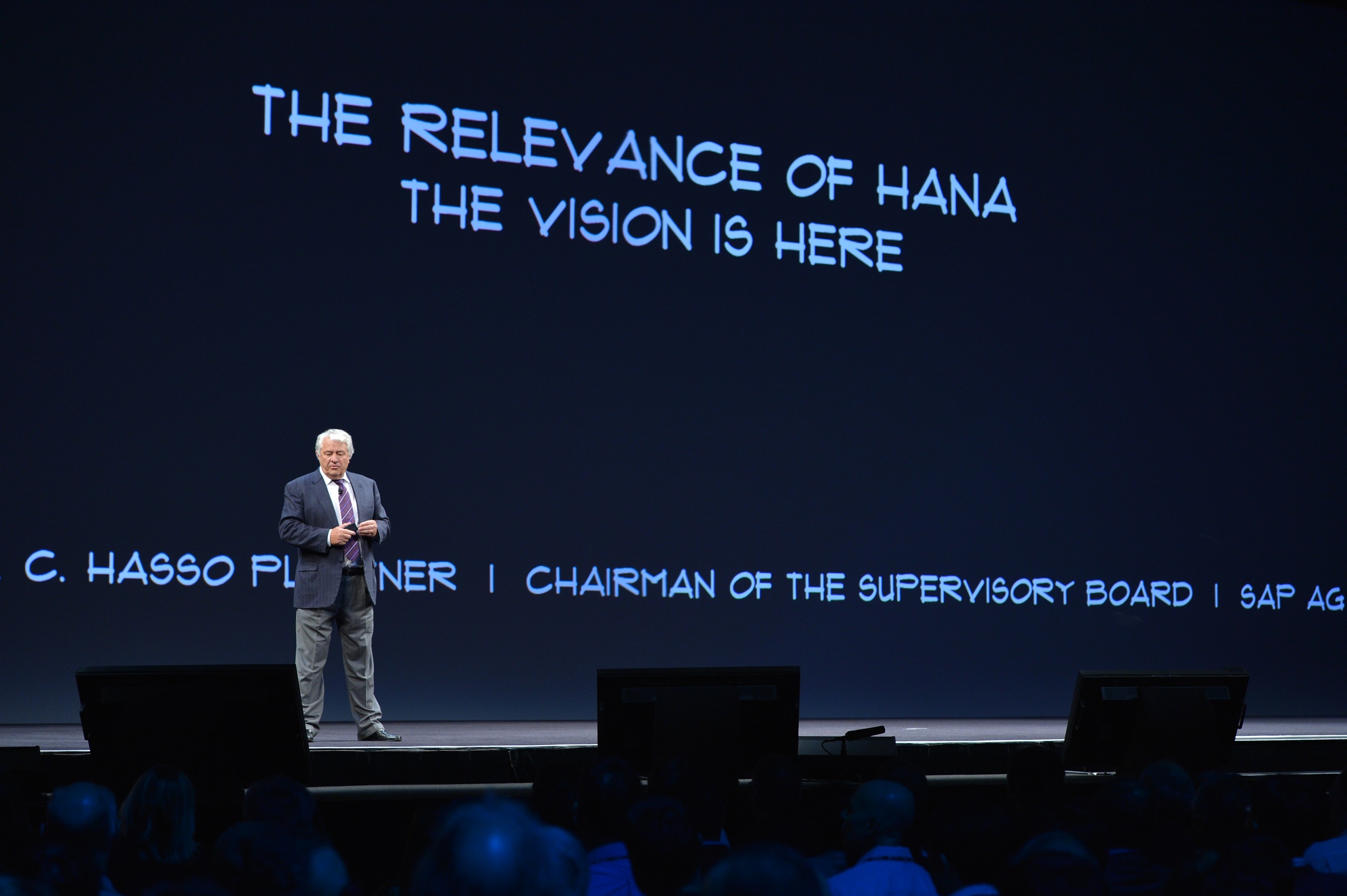
Plattner talks about the importance of SAP HANA at the SAPPHIRE NOW conference in Orlando in 2012
Five years later, the first SAP HANA customers began implementing the new database, which generated the kind of demand not seen since the market launch of SAP R/3.
By the end of 2013, the entire SAP Business Suite had moved to SAP HANA. In the three years since its launch, SAP HANA had garnered nearly €1.2 billion in revenues, making it one of the fastest-growing products in the history of enterprise software.
In an interview with German daily Handelsblatt in 2020, Plattner said: “SAP HANA is so superior in practice that there is no alternative. And quite honestly, it saved SAP’s life, because it let us massively accelerate our ERP system without a lot of changes, while physically downsizing it at the same time. That meant a huge cost saving for our customers.”
2015: The Foundation
Plattner reinforced his commitment to promoting education and culture by setting up the Hasso Plattner Foundation.
Among the many causes the foundation has supported over the years are programs to promote healthcare and health education in South Africa. The German city of Potsdam also has much to thank Plattner for: The Hasso Plattner Institute is the largest investment in Potsdam and the one that bears his signature most strongly. The Barberini Museum that he rebuilt completes the inner cityscape of Potsdam and provides a home for his impressive Impressionist collection — the largest outside of France. With the Kunsthaus MINSK, he saved one of the few architectural icons of the GDR era and created a home for his GDR art collection.
Celebrities at the opening of the Barberini Museum in Potsdam in 2017
On being asked why he chooses to get involved with causes and projects of this kind, Plattner explained: “I owe the resources and skills for life to my parents and, above all, to my studies at the public technical university in Karlsruhe. That’s why I want to give something back in the area of education, so that others can also benefit from it.”
2022: Learn from Our Customers
In an interview to mark SAP’s 50th anniversary, Plattner shared some advice: “I recommend a return to the approach we used in the early days of SAP – of sending SAP teams out to the customer. Instead of implementing our standard systems, they should find out how people actually use the tools they get from SAP and other vendors. That will give us our starting point. There are so many interesting companies out there. We can learn from them and with them. We have to step outside SAP and do something with the customers.”
And in a comment directed to SAP employees, he said: “Treat the customers well – once we have them, we have to keep them. That’s one of SAP’s strengths. And never think it’s done. You have to carry on. The job is never done!”
“Treat the customers well” – Plattner’s wish to employees on SAP’s 50th birthday
2024
Plattner will step down from the Supervisory Board on May 15, the last of the SAP co-founders to leave the company.
Explore more of SAP’s more than 50-year history of success that began with five entrepreneurial programmers
In a significant development for the defense sector, SAP National Security Services, Inc. (SAP NS2) has obtained the Defense Information Systems Agency (DISA) provisional authorization (PA) for SAP S/4HANA Cloud, Private Edition. This authorization enables SAP NS2 to deploy SAP S/4HANA and other cloud applications within their secure U.S. Department of Defense (DoD) cloud environment, […]
In-app enhancements in SAP S/4HANA are striking because of their simplicity. These enhancements are implemented in the same system, connections to other systems aren’t necessary, and latency is reduced.
In a significant move towards digital transformation, Swedish dairy and farming machinery giant DeLaval has embarked on a SAP S/4HANA Cloud implementation to overhaul its enterprise resource planning (ERP) system. As part of the Tetra Laval Group, DeLaval aims to leverage the cloud-based solution to standardize its processes, harmonize data, and develop innovative solutions for […]
Today we’re introducing a new customer onboarding experience and quality check enhancements in RISE with SAP Methodology. After April 1, 2024, all customers subscribing to RISE with SAP for the first time will go through this improved experience at no additional cost.
RISE with SAP is a managed cloud offering that can enable customers to unlock continued innovation and transformation by modernizing their business-critical systems and processes in a highly collaborative and measurable way. This offering includes the newly announced RISE with SAP Migration and Modernization program that helps bring renewed focus on the cloud transformation journey by enabling smooth, secure migration of on-premise SAP ERP Central Component (SAP ECC) and SAP S/4HANA customers to the cloud. The key pillars of the program are the RISE with SAP Methodology, transformation incentives, and the innovation road map. The program features offerings tailored to each customer’s unique starting point. Its components are differentiated for SAP ECC and SAP S/4HANA customers and can run with a clean core approach, taking advantage of the latest innovations in RISE with SAP.
Cloud solutions, infrastructure, and services combined to deliver a clear cloud migration path
The cornerstone of the program is the RISE with SAP Methodology. The methodology captures the best practices of successful implementations from thousands of RISE with SAP customers over three years and is designed to provide a consistent approach – from planning to go-live to ongoing operations and evolution – that can meet customers’ business transformation goals. Whether through SAP or partner-led engagements, customers can get a clear path with specific implementation stages and success KPIs to be able to take advantage of speed, agility, and all the benefits of the cloud.
Today we’re adding enhancements to the RISE with SAP Methodology, including a new onboarding experience and quality checks throughout the project implementation phases. All new RISE with SAP customers will go through this onboarding experience at no additional cost. The new experience provides guided enablement by SAP-assigned onboarding advisors and related tools and services to help customers implement their cloud ERP solutions with clarity and confidence. The onboarding advisors can guide customers through the overall process aligned with the RISE with SAP Methodology and prepare them to get started with their implementation. The new experience also helps simplify best practice implementation of the clean core, helping to make it a more central, actionable, and measurable standard of all implementations. This helps ensure all RISE with SAP customers can benefit from business agility, faster innovation cycles, and improved value realization.
The new improvements to the RISE with SAP Methodology include:
Expert onboarding guidance through embedded launch activities: A dedicated SAP advisor can deliver 1:1 enablement sessions to help educate customers on the RISE with SAP Methodology, clean core strategy, and related tools for implementation. Also, there are role-based, recorded enablement sessions covering business process best practices, solution architectures, and other strategic topics leading up to the go-live milestone. Check out this blog on embedded launch activities to get a full view on what enablement resources are delivered through this new onboarding experience with RISE with SAP.
Clean core-focused success plan, runbook, and quality checks: We’ve developed a clean core success plan with clear milestones and KPIs. The clean core success plan is now added to the SAP Activate road map viewer, where customers – with the support of SAP advisors and partners – can review the recommended actions in uniquely created road maps, aligning their needs with best practices to help continually unlock business value faster. We’re also adding new quality gate checks to validate that the actual implementation is in line with recommended clean core best practices before customers proceed to the next project phase. The outcome of the quality gate is the SAP clean core report with feedback and recommendations on how to implement the clean core strategy. These recommendations are recorded and tracked via the updated runbook in the SAP Cloud ALM solution. To learn more, read a blog post on this topic.
We’ll continue to deliver more tools, templates, training, and oversight to help make it easier for customers to execute an optimal migration or transition to the cloud and achieve their business objectives. Coming later this year is the RISE with SAP system transition workbench. This tool will help the technical implementation of migrating to cloud ERP by providing digital access to SAP-approved best practices and guidance for migrations, automation of tasks, health, and system checks. Stay tuned as we get ready to share more on this in the coming weeks.
To learn more, join us for our upcoming webinar on May 23, where we will go deeper into this new onboarding experience in the RISE with SAP Methodology. Register here.
Panda Priyadarsana is SVP and GM of Customer Services & Delivery and head of Cloud ERP at SAP.
Photo courtesy of SAP employee Juelma Guerreiro.
Receive weekly news highlights from the SAP News Center