What does it take for businesses and industries to be ready for tomorrow’s challenges, growth opportunities and beyond? Tune in as #SAP’s Gina Vargiu, SAP’s Thomas Saueressig, Siddhi Pal, Anahita Thoms and Chris Leong who attended the World Economic Forum event in Davos share their insights and why people remain the driving force behind innovation and growth. #wef25
Learn more about SAP in Davos: https://sap.to/6052xEeHq
00:00 Siddhi Pal
00:17 Anahita Thoms
00:38 Chris Leong
01:00 Thomas Saueressig
01:19 Gina Vargiu-Breuer
01:37 Siddhi Pal
Markus Oertelt, Cloud ERP Product Success Enablement, unveils the game-changing innovations in SAP S/4HANA Cloud Public Edition 2502 for Manufacturing, including Demand-Driven Material Requirements Planning (DDMRP) enhancements, mass editing capabilities for production versions, and a new quality management feature for manual certificate receipt creation. These updates promise to boost customer service, reduce lead times, cut inventory, and streamline manufacturing processes, transforming your business operations.
The key highlights shared in this video are:
00:42 Buffer Level Zone Update
01:35 Mass Edit in Process Production Versions
02:16 Background Mass Edit
02:52 Manual Certificate Receipt Creation in Quality Management
✔️ Find Markus’ blog post further discussing the innovations mentioned above: https://sap.to/6052ahSSj
✔️ Check out the SAP S/4HANA Cloud Public Edition Community: https://sap.to/6056ahSSg
✔️ Hear more from Markus at https://sap.to/6058ahSSi
Unleash the future of Finance with SAP S/4HANA Cloud Public Edition 2502! Katrin Deissner, Cloud ERP Product Success Enablement, showcases game-changing innovations like the SAP Green Ledger for integrated carbon accounting, Financing with Taulia for streamlined cash flow management, and AI-Assisted Financial Business Insights for Group Financial Statement Review Booklet. Dive in to transform your financial operations!
The key highlights shared in this video are:
00:29 SAP Green Ledger
01:09 Financing with SAP Taulia
01:56 Introduction of New Review Booklets
02:13 AI-Assisted Financial Business Insights for Group Financial Statement Review Booklet
✔️ Find Katrin’s blog post further discussing the innovations mentioned above: https://sap.to/6053a2Bwl
✔️ Check out the SAP S/4HANA Cloud Public Edition Community: https://sap.to/6056a2Bwo
✔️Hear more from Katrin on X at @DeissnerKatrin and at https://sap.to/6057a2BwU
In August 2024, SAP AppHaus Network partner AGILITA launched the AGIL AI.Sales solution on the SAP Store site, built with SAP Business Technology Platform (SAP BTP). AGILITA developed this new solution along SAP’s human-centered approach to innovation and the new SAP Business AI workshop format.
As one of the first customers, petZEBA AG implemented the new solution as a sales recording app to support its daily sales operations and capture orders by voice command, find retailers and customers via GPS, process orders automatically, and get real-time CRM updates. Since its implementation, this new intelligent solution saved the petZEBA sales teams significant time and enabled a 55% increase in customer visits.
Pet Food Expert petZEBA Is Shaping the Future
Founded in 2006, petZEBA AG is a family-run company with headquarters in Alberswil, Switzerland. The company sells high-quality food and nutritional supplements for dogs, cats, and horses throughout Switzerland. The company also supports and supplies numerous pet shops, animal shelters, veterinarians, breeders, depots, and end users. In 2017, petZEBA established its first subsidiary, petZEBA International GmbH, in Germany.
SAP AppHaus Network consists of SAP and partner locations around the globe
With its passion to drive change and lead the way in shaping the future, petZEBA AG showcases its commitment through adopting and unlocking new potential. The introduction of the AGIL AI.Sales app is just another step on its innovation path, helping optimize sales processes.
About the New AGIL AI.Sales App
With the rise of new intelligent solutions powered by AI and generative AI, SAP AppHaus Network partner AGILITA created its first AI solution known as the AGIL AI.Sales app, which aims to make sales processes seamless and intelligent. To make it a fully user-centric product, the AGILITA team developed and created it along the proven SAP AppHaus human-centered approach to innovation, using the SAP Business AI Explore workshop as the guiding process.
Designed to simplify and accelerate sales processes, the AGIL AI.Sales app not only helps save time but it can also maximize revenue by preparing data-driven decisions. The app supports businesses with intelligent customer visit briefings and sales opportunities, utilizing advanced algorithms to make accurate predictions and help optimize the sales process. What’s more, by reducing manual effort, it offers businesses automated sales processes and increased efficiency. Lastly, the app provides centralized data management so that all relevant information is in one place, easily accessible, and clearly presented. Watch this video to learn more.
How AGIL AI.Sales Transformed petZEBA’s Sales Processes
The AGIL AI.Sales solution was successfully implemented for petZEBA AG sales teams to optimize their processes. Sales representatives can now easily record meeting sessions with customers, enter orders by voice command, and track customer orders from the past and estimate them for the future. Additionally, there’s geolocation embedded in the app that helps find customers in the area based on location, availability, and how close or far they are located for easy and sustainable commuting.
Additional benefits included:
Time savings leading to a 55% increase in customer visits done by sales teams
Orders captured by voice command and automatically processed
Support for recording customer meetings and proposing next steps
Full integration providing real-time customer relationship management updates
Accurate, timely, and contextually relevant information.
Seamless Integration of AGIL AI.Sales
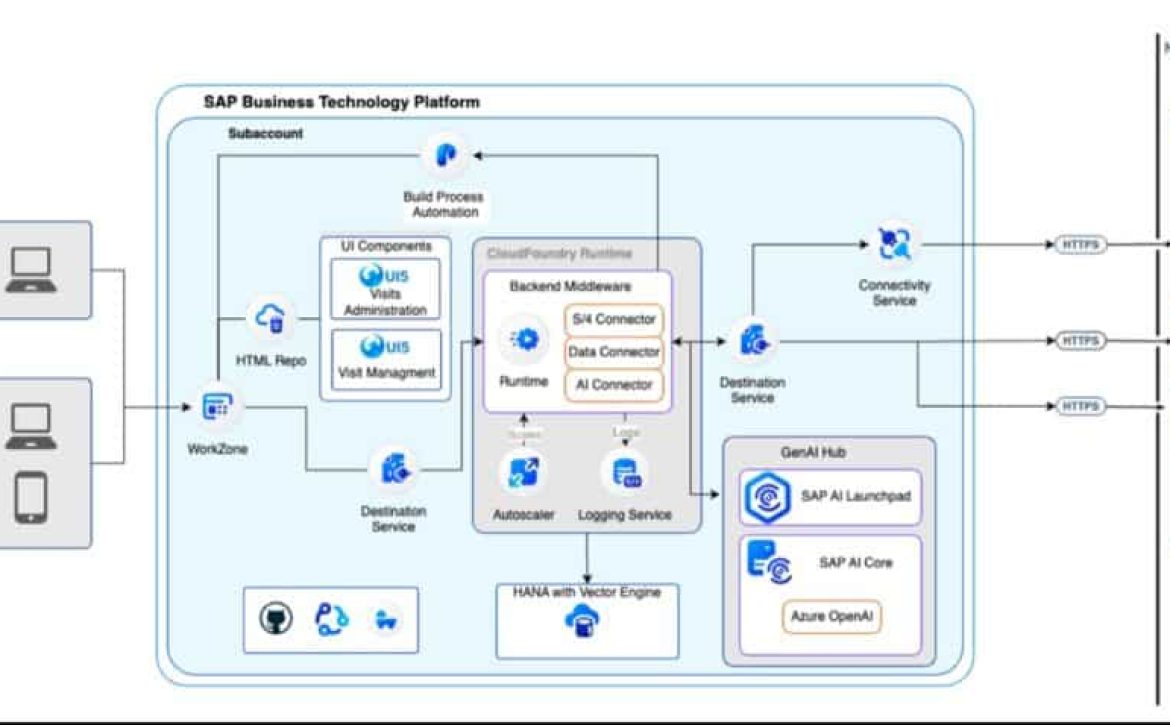
Building on SAP BTP, the AGIL AI.Sales app seamlessly leverages different SAP AI solutions such as SAP AI Core, generative AI hub, and SAP HANA Cloud vector engine, which provides a powerful synergy that helps enhance performance and functionality. This integrated solution enables the AGIL AI.Sales app to deliver superior performance, enabling users to receive accurate, timely, and contextually relevant information.
Thomas Neuhaus, head of Digital Experience at AGILITA AG, says: “Our AGILITA team is very happy to see the benefits brought about by AGIL AI.Sales in the case of our customer petZEBA. Their sales team uses the app successfully and could already experience measurable improvements and benefits. It helped them simplify and accelerate sales processes. Our team is especially proud of the measured 55% increase in customer visits since its implementation. This was made possible by significant time savings and intelligent sales planning. Thanks a lot to the petZEBA team for the great collaboration! We look forward to seeing them progressing further on their future-oriented journey.”
Priscilla Darfour is a working student at SAP AppHaus Network.
Subscribe to receive weekly news highlights from the SAP News Center
That’s a wrap on #wef25! Collaborating for the Intelligent Age was the theme of this year’s World Economic Forum and it aligns perfectly with SAP’s mission of providing solutions that benefit the world. SAP was present on the promenade, right across from the congress center, hosting multiple panels and roundtables around AI, creating agility and more. This week was all about bringing together business leaders from industries around the globe and push the conversation forward during these critical and fast-moving times.
Tune in as SAP’s Christian Klein, Dominik Asam, Gina Vargiu, Thomas Saueressig and Pekka Ala-Pietilä who attended the World Economic Forum event in Davos share their highlights.
Learn more about SAP in Davos: https://sap.to/6052xEeHq
SAP AI solutions are transforming industries by integrating advanced AI capabilities across cloud applications to enhance efficiency and decision-making. SAP continues to lead in artificial intelligence by embedding innovative solutions into its business applications, aiming to streamline operations and empower users with smarter tools. Philipp Herzig, Chief AI Officer at SAP, shared that in 2024, […]
Syntax Systems, a global provider of technology solutions for cloud application implementation and management, has announced Steve Hatcher as its new Chief Customer Officer for SAP Americas. Steve Hatcher brings over 30 years of SAP expertise to his new role, where he will focus on driving Syntax’s expansion in the Consumer Industry across North America. […]
According to the latest research from SAP and Oxford Economics, only 57% of business transformations end up being worth the time, money, and effort they require — but this can change.
Business Transformation Management: Realize holistic, data-driven business transformation for faster time to insight and adaption
Today’s business transformations are diverse, ranging from creating new products or services and entering new markets to adopting cybersecurity frameworks and transitioning to net-neutral carbon emissions. However, these transformations are neither swift nor inexpensive, and sometimes the costs can be hidden.
That is why SAP has partnered with Oxford Economics on a new and comprehensive survey of large organizations, providing an exclusive look at the current global state of business transformation.
Spanning a range of industries and focusing on companies with a minimum revenue of $500 million, the report provides insights from a balanced audience of 800 respondents, including IT professionals and leaders from corporate strategy, R&D, finance, manufacturing, HR, and operations.
The paper further reveals that:
Barely half of transformations go according to plan (51 percent)
Fifty-eight percent of transformations end up going over budget
The average cost of transformation efforts is €9.5 million
Sixty-three percent of respondents face resistance from leadership regarding the value of transformation efforts
Nearly half of the initiatives highlighted by respondents remain incomplete, and budgetary constraints pose a significant challenge
From Strategy to Execution
In broad terms, this disconnect between the confidence level of respondents and what the report data reveals about the true cost and organizational impact of transformation can be understood in the equivalent disconnect between strategy and execution.
For example, while three in five say their major transformation plan was well communicated across their organization, only 53 percent say it was clearly defined in the first place.
While most companies are employing strategic practices such as crafting mission statements, appointing dedicated leaders, and forming cross-functional teams, they can lack the final piece of the puzzle when it comes to converting strategy into action. That is where SAP comes in.
“Transformation challenges will always exist, particularly in aligning execution with strategic road maps,” Dee Houchen, head of Marketing for SAP Signavio and SAP LeanIX, shared. “As companies navigate these complexities, the path to successful transformation remains a critical focus for global businesses, which is why this research is so relevant.”
“SAP Signavio and SAP LeanIX solutions offer clarity and transparency in business transformation, helping organizations leverage enterprise analytics and process data to really turn transformation plans into action through supporting decision-making, setting timelines, and tracking progress effectively,” Houchen said. “This report is an invaluable resource for anyone wondering why their transformation efforts have slowed, what they can do differently, and how others have identified and overcome similar hurdles to their own.”
Lucas de Boer is Global Marketing program lead for SAP Signavio at SAP.
The Estimation Game: What Do Business Transformations Really Cost?
In today’s fast-paced and competitive business environment, delivering exceptional sales experiences is crucial for driving growth and staying ahead of the competition. However, many businesses still struggle with fragmented processes that make it difficult to take a personalized, timely approach to customers.
With disconnected enterprise resource planning (ERP) and customer relationship management (CRM) solutions, sales teams face challenges such as siloed data, delayed responses, and inconsistent messaging — all of which prevents sales teams from engaging customers effectively and scaling operations.
When businesses connect SAP Customer Experience solutions, such as SAP Sales Cloud, with SAP ERP, the results are impressive. According to research by Enterprise Strategy Group, organizations see:
Approximately 90% improvement in productivity in Sales team
Approximately 40% improvement in productivity in Business Operations team
Approximately 100% improvement in sales conversion rates
SAP Sales Cloud: Improve sales engagements and build lasting relationships by truly understanding customers
A unified lead-to-cash process is at the heart of every successful business. It enables organizations to manage leads from the moment they enter the pipeline — through qualification, proposal, negotiation, and, ultimately, to closed deals. However, for many, the journey from lead to cash is complicated by fragmented processes that prevent a holistic view of data.
When sales teams struggle to connect the dots between lead generation, order fulfillment, and invoicing, they encounter inefficiencies that prevent them from acting on real-time insights, providing consistent messaging, and delivering personalized experiences to customers. The result is missed opportunities and lost revenue.
This is where SAP Sales Cloud, together with SAP S/4HANA Cloud Public Edition, comes in. These powerful solutions provide a unified process that connects all critical sales and operational functions into a seamless workflow. By integrating SAP Sales Cloud with SAP S/4HANA Cloud Public Edition, businesses can break down data silos and transform their sales processes to be more agile, responsive, and customer-centric.
Key Benefits of SAP Sales Cloud and SAP S/4HANA Cloud Public Edition
Real-Time Insights for Informed Decision-Making: With SAP Sales Cloud and SAP S/4HANA Cloud, sales teams gain access to real-time data, so they can make informed decisions on the spot. No more waiting for updates or dealing with outdated information. This integration helps teams respond to customer inquiries more quickly and tailor solutions to each customer’s unique needs.
Streamlined Lead-to-Cash Process: One of the most significant advantages of using SAP Sales Cloud in combination with SAP S/4HANA Cloud is the ability to streamline the entire lead-to-cash process. From capturing leads to managing opportunities and enabling AI-infused sales processes, these solutions provide a seamless experience for both sales reps and customers.
Improved Collaboration Across Teams: Integration between SAP Sales Cloud and SAP S/4HANA Cloud aligns different departments — from sales to finance — for seamless collaboration and unified access to critical data. This integration fosters better collaboration, so that everyone has access to the same data, improving alignment and accelerating deal closures.
Accelerated Sales Operations Through Automation: SAP Sales Cloud automates routine tasks like lead assignment, follow-ups, and quote generation, which accelerates sales cycles. This automation reduces manual workloads, empowers sales teams to focus on strategic activities, and helps close deals faster, all while supporting accuracy and consistency across the process.
Exclusive Access for GROW with SAP Premium Subscribers
For businesses using a suite of SAP solutions, the value is clear: SAP Sales Cloud is included as an entitlement for premium subscribers of GROW with SAP. This allows them to take full advantage of these powerful tools without additional cost, empowering them to unlock their sales potential and accelerate growth.
The benefits of GROW with SAP go beyond just access to SAP Sales Cloud. Premium subscribers of GROW with SAP also gain access to a suite of resources designed to optimize their SAP environment and empower teams with the skills and tools needed to drive success.