WALLDORF —SAP SE (NYSE: SAP) announced today its financial results for the third quarter ended September 30, 2024.
Current cloud backlog of €15.4 billion, up 25% and up 29% at constant currencies
Cloud revenue up 25% and up 27% at constant currencies
Cloud ERP Suite revenue up 34% and up 36% at constant currencies
Total revenue up 9% and up 10% at constant currencies
IFRS cloud gross profit up 26%, non-IFRS cloud gross profit up 27% and up 28% at constant currencies
IFRS operating profit up 29%, non-IFRS operating profit up 27% and up 28% at constant currencies
SAP raises its 2024 outlook for cloud and software revenue, operating profit and free cash flow
“Q3 was another strong quarter for SAP, and we are confidently raising our 2024 financial outlook. Cloud revenue growth developed remarkably well in the quarter, especially for our Cloud ERP Suite. Even more importantly, we are making strong progress on Business AI with groundbreaking innovations such as SAP Knowledge Graph. A significant part of our cloud deals in Q3 included AI use cases.”
Christian Klein, CEO
“We are very pleased with our third quarter performance. The 2024 transformation program has already started to yield efficiency improvements. This allowed us to deliver a strong operating profit and free cash flow, while retaining our topline momentum. We’re now focused on carrying that momentum into Q4 to safeguard the achievement of our 2025 ambition amidst a highly volatile environment.”
With a commitment to sustainability, Weir Minerals, a part of The Weir Group plc, has more than 11,000 employees across 60 countries. The mining equipment manufacturer helps customers work to their fullest, most sustainable potential.
The company develops engineering solutions for mineral and mining technology markets. Servicing a regionally distributed clientele across geographies, Weir Minerals depends on a synchronized web of data processing and analysis systems that give it the right balance of foresight and agility to sustainably manage customer data. Operating through an integrated system of tech hubs, manufacturing operations, and local service centers, the company creates sustainability solutions that help track the lifecycle of mining equipment, predict part deterioration, and minimize detrimental environmental impacts.
However, Weir Minerals had been using isolated, offline sources, like spreadsheets, to store records and data. “Our paper-based methods and siloed process put us at a disadvantage,” said Karun Naidoo, global process owner service at Weir Minerals.
The reliance on siloed data sources left the company – and ultimately its customers – vulnerable to risks. This inefficient approach to collecting and processing data and inventory planning was time-consuming, error-prone, and difficult to adapt to changing circumstances. Often, technicians had to travel from location to location to collect necessary customer audit data. By the time that data was properly categorized, it was largely outdated, preventing the company from making agile supply chain decisions, like having the foresight to order specific spare parts for aging machines. Additionally, employees had to focus on completing paperwork and other low-value tasks, which was time-consuming and prevented them from focusing on giving customers the desired service level. This inefficiency and a lack of central digitalization left customers wanting more.
“To remediate our relationships with customers and continue our sustainability mission, we needed to digitalize our core infrastructure to match modern technology and data analysis standards,” Naidoo remarked.
Revitalizing Data Processing Environments to Enhance Agility
As a long-standing SAP customer, Weir Minerals, conducted an internal evaluation to find a solution within SAP’s portfolio that could meet its unique inventory planning and data processing needs. The team found that SAP Field Service Management was ideal for the widespread remote workforce due to its centralized and digitalized hubs, which could help prevent manual errors, reduce silos, and improve transparency.
Empower your field service team with SAP Field Service Management
“Besides SAP Field Service Management we also use the customer service functionality of the SAP ERP application,” Naidoo said. With that, customer recommendations can be included much faster and more precisely with an improved view of relevant service information.
The integration of SAP Field Service Management and SAP ERP helped Weir Minerals create digital customer service history reports and improve communication between the back office and field technicians, facilitating the collection and analysis of real-time, centralized data. The company also established a change management framework for internal project ownership.
With both solutions, the company enhanced its internal data collection infrastructure with a digitalized channel that provides real-time insights without excess, time-consuming, manual processes. The solutions allow technicians to make vital service notes in a digital environment instead of on paper, which improves data availability for both personnel and customers. Through a greater level of communication in terms of audits, supply, and demand, the company saw that SAP Field Service Management could meet the needs of its widespread remote workforce.
Weir Minerals can better forecast demand by monitoring machine lifespan and inventory data, allowing it to swiftly provide customers with solutions instead of relying on outdated information. Once the company could establish real-time visibility in multiple environments, including on mobile devices in the field, it could improve efficiency and satisfy its customers more effectively.
Creating Agile Analysis Environments to Forecast Supply and Demand
Weir Minerals has seen significant business improvements since implementing SAP Field Service Management integrated with SAP ERP.
Data veracity and visibility are critical; the solutions let the business digitally collect and analyze customer data, helping to create predictive models to outline product demand, maintenance, and quality and generate service history reports. SAP Field Service Management also enables the company to use a built-in digital data integration that facilitates smoother analysis on the backend.
Technicians can upload daily digital reports from both mobile and site-based devices, leading to increased data richness. These reports make data analysis and collection much faster, improve communication between technicians and the backend, and eliminate time-consuming, error-prone paper processes.
The readily available reports and digitalized channels of data recording help both field employees and customers better understand how customers use equipment. This informs sustainability measures and allows personnel to better predict trends in customer spare part demand. Through sophisticated, digitalized data insights, the company can determine that proper part inventory is available at the right warehouse, allowing it to quickly meet customer needs.
The solution setup and mobile integration capabilities further empower Weir Minerals employees to drive change and digital adoption in the field. This improves customer satisfaction with enhanced data analytics and digitalized ability to implement smoother and more relevant sustainability measures into customers’ operations.
Overall, data availability and agility are appealing to customers that demand transparency and clear service history reports. This led to:
40% greater satisfaction with better-quality data and service
70% time saved when generating customer service reports
50% more timely reports with real-time timesheets and parts records
Broadening SAP Portfolio to Further Optimize Planning Processes
After the successful implementation of SAP Field Service Management integrated with SAP ERP, Weir Minerals now plans to utilize more data management, available-to-promise, and inventory planning solutions from SAP to help increase digitalization, product availability, and data accuracy.
It’s also looking at SAP Transportation Management for enhanced logistics planning and transportation processes across its global enterprise. No matter how its technological framework evolves in a modern industry, Weir Minerals is dedicated to its sustainability efforts and aims to use the improved infrastructure for eco-friendly mining operations.
“Through the adoption of SAP Field Service Management along with SAP ERP, we successfully digitalized manual processes and improved availability of real-time data as well as enterprise-wide communication,” Naidoo concluded. “Our technicians can now focus on value-adding activities and raising service levels, ultimately leading to greater customer satisfaction and operational efficiency.”
Karin Fent is senior director for Global Customer Success Digital Supply Chain at SAP.
Photo courtesy of Weir Minerals
Receive weekly news highlights from the SAP News Center
Recently, we asked you for your SAP Signavio questions so that Johannes Strasser, Michael Sokollek, and Manuel Sänger, authors of SAP Signavio: Business Process Transformation, could answer them. Here’s what they had to say.
Over the last months, the drumbeat of urgency for climate action has been growing ever louder. Fittingly, this year’s New York Climate Week theme was “It’s time” — a clarion call for immediate and focused action as the climate crisis intensifies.
Two weeks ago, SAP joined global business leaders, political changemakers, decision-makers, and representatives from civil society for a week of focused discussions on the transition to a low-carbon, circular economy. Across dozens of in-person and virtual sessions, SAP reaffirmed its commitment to enabling a more sustainable world through an ERP-centric, cloud-based, AI-enabled approach.
At Climate Week, SAP’s focus on AI, precise carbon accounting, and expanded commitments to nature conservation highlighted its proactive approach to addressing the climate crisis.
AI’s Role in Advancing Sustainability
A major topic during New York Climate Week was the role of artificial intelligence in advancing sustainability. Key discussions highlighted how AI can assist chief sustainability officers (CSOs) and their teams in managing the complex data necessary for effective sustainability initiatives. By processing disjointed and multimodal data, AI empowers companies to monitor, predict, and optimize their systems, leading to improved sustainability outcomes across supply chains and energy grids.
AI serves not only as a tool for automation but also as a strategic ally, embedding sustainability into core business processes. Last month, SAP shared two innovative AI-driven use cases: SAP Sustainability Control Tower, AI-assisted ESG report generation and emission factor mapping capabilities. These capabilities help companies enhance carbon footprint calculations and streamline sustainability reporting. With real-time data, companies can make decisions faster and align with their sustainability goals.
SAP Sustainability solutions: ERP-centric, cloud-based, AI-enabled
However, the discussions also acknowledged the challenges associated with AI deployment, including high energy consumption, potential biases, and data privacy concerns. Addressing these challenges is crucial for ensuring AI’s sustainable application.
Sector-specific applications of AI were also explored. In the energy sector, AI can optimize consumption patterns, while in construction and consumer goods it can aid in waste reduction and resource efficiency. By integrating AI with SAP solutions, companies can enhance supply chain optimization, route planning, and demand forecasting.
Toward More Precise Carbon Accounting
Another critical topic at Climate Week was the need for companies to accurately track, report, and manage their carbon emissions while aligning their environmental impacts with financial operations. To thrive in today’s regulatory landscape, organizations must adopt robust sustainability management systems. With regulations like the Corporate Sustainability Reporting Directive (CSRD) on the horizon, businesses are transitioning from voluntary to mandatory reporting, navigating over 600 global regulations and frameworks.
To address these challenges, SAP will make the SAP Green Ledger solution generally available in December 2024. This innovative solution can integrate carbon and financial data, helping provide the real-time visibility essential for precise carbon accounting. This integration not only helps enhance compliance, but can also allow companies to gain a competitive edge by speeding up action towards sustainability.
Expanding Commitments to Nature Conservation
Starting in 2024, SAP is enhancing its net-zero strategy by committingto nature conservation and financing global climate projects for carbon removal and carbon reduction. It aims to plant and protect 25 million trees by 2030 and invest in wetland conservation. These initiatives align with SAP’s goal of achieving net-zero emissions by 2030, 20 years ahead of the original timeline.
SAP believes that financing climate projects beyond its value chain is essential to restoring ecosystems and fostering resilient, low-carbon economies. This comprehensive approach supports broader climate action and shifts corporate perceptions, demonstrating that sustainability is integral to long-term business success, not merely an operational add-on.
Through an ERP-centric, cloud-based, AI-enabled approach, SAP is well-positioned to lead the charge toward a more sustainable future while enabling customers to navigate the complexities of climate action. As always, collaboration and commitment from all sectors will be vital in driving truly meaningful change, and COP29 in Baku, Azerbaijan, will be an opportunity for the sustainability community to unite in accelerating global action, fostering new partnerships, and advancing innovative solutions.
By integrating technological innovation with strategic sustainability initiatives, SAP is not just adapting to the evolving landscape of sustainability, but is actively shaping it and charting the course for a resilient, low-carbon economy where businesses can thrive while safeguarding the planet for future generations.
Hear from SAP Sustainability executives and customer Ambipar at Climate Week 2024 and listen to our post-Climate Week podcast on how data and tech drive corporate sustainability.
The transformative power of generative AI has already started to reshape productivity. From generating detailed reports to automating customer service tasks, AI helps streamline day-to-day activities.
Joule: Reimagine productivity with collaborative agents
However, the promise of AI-driven transformation has yet to be fully realized. This is largely because true business transformation doesn’t hinge only on improving individual productivity; it’s about unlocking the power of collaborative capabilities that enable cross-functional teams to solve ever-evolving business challenges. This shift paves the way for a new era of automation, driving the next industrial revolution.
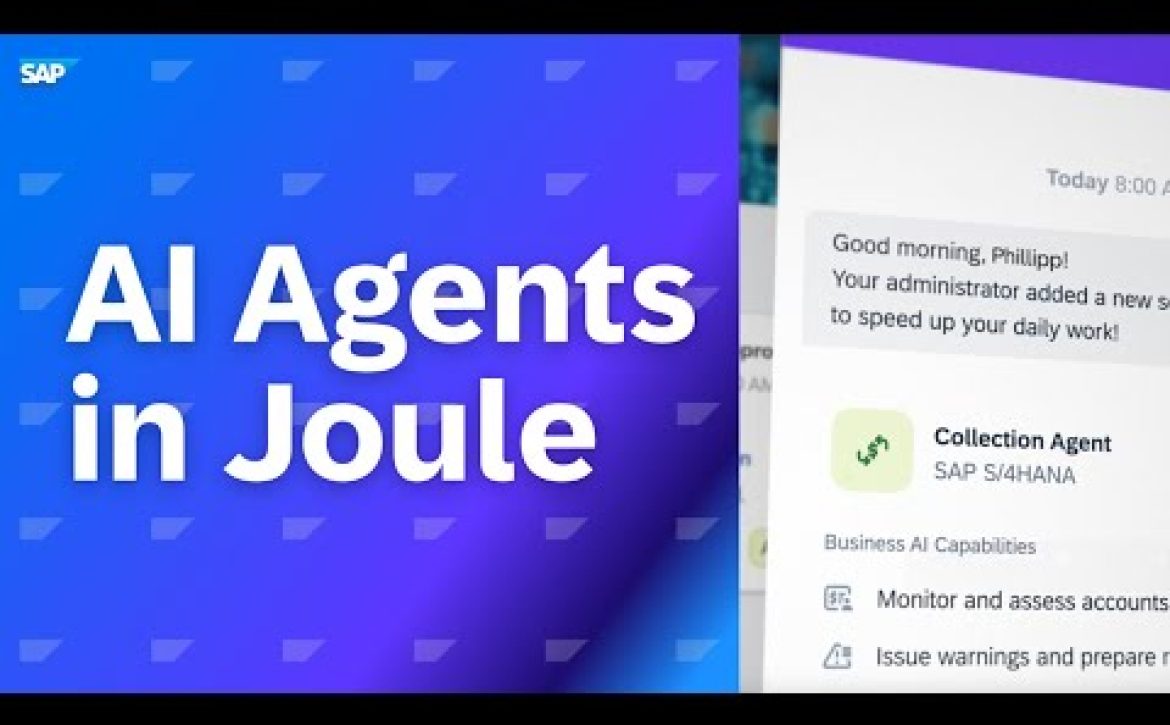
This year at SAP TechEd, we extended our business AI strategy with a greater focus on transforming how businesses operate through autonomous, collaborative AI agents. Seamlessly infused into our AI copilot Joule, these agents span across business processes, breaking down silos and enhancing cross-functional collaboration.
At SAP, we believe that AI’s next frontier goes beyond isolated efficiencies and is about seamlessly unifying people, data, and processes to create business value and amplify the impact of outcomes.
As a world leader in understanding of how businesses and organizations run around the globe, SAP is continuing to rapidly deliver traditional and generative AI use cases that help people get work done faster and smarter.
Get all the latest news and coverage from SAP TechEd in 2024
Today, one quarter ahead of our road map, we offer more than 100 high-value generative AI capabilities that are ready to use out-of-the-box across SAP cloud applications.
From navigating regulatory challenges to addressing complex HR policy questions to generating comprehensive sustainability reports, SAP Business AI capabilities are driving real business value for our customers.
For example, a company with 2,000 employees can expect to improve its top line by up to 3.5%* and gain efficiencies for the company’s bottom line of up to 1.4%* by adopting available SAP Business AI features. These productivity gains are relevant for developers and business users alike, as well as for the entire C-suite and all lines of businesses — from the CFO to the chief human resources officer, chief procurement officer, and more.
And this only accounts for AI features that we released in the last 12 months.
AI innovations delivered in Q3 2024 include:
SAP S/4HANA Cloud Public Edition has a flurry of AI-assisted improvements, from smart summaries and filters to natural language explanations of asset depreciation as well as accelerating your financial close. In addition, Joule can now proactively detect and generate proposals for missing compliance configurations around U.S. internal tax. Joule is now also generally available in SAP S/4HANA Cloud Private Edition.
In supply chain, conversational search features in SAP Product Lifecycle Management, SAP Integrated Business Planning for supply chain, and SAP Asset Performance Management allow users to perform informal searches more efficiently and access information more easily. In SAP Field Service Management, the AI-assisted activity summary is now generally available. The AI-enabled visual inspection feature has been expanded to SAP Asset Performance Management.
In SAP Business Technology Platform (SAP BTP), a new AI capability in SAP Integration Suite lets developers automatically generate integration flows by simply describing the scenario, meaning designing time is three times faster*. SAP Build Code provides generative AI to help developers build applications up to 30%* quicker and reduce application development costs by up to 30%*.
Sustainability experts can now automate AI-enabled environmental, societal, and governance (ESG) reports, reducing the time needed to collect relevant ESG metrics manually from 30 minutes* to 30 seconds*, building on ESG or own report templates and using the data available in SAP Sustainability Control Tower.
SAP Signavio offers AI-assisted process recommender and AI-assisted performance indicator recommender features, which can provide preconfigured process models and quick recommendations on performance indicators. The new AI-assisted process analyzer capability allows users to ask questions in natural language and receive immediate insights, democratizing process mining and empowering non-technical users to conduct deep analysis.
While we’re incredibly excited about what we can offer customers today, there is so much more to come still this year and beyond. That said, we will increase our target of delivering more than 100 generative AI use cases by the end of 2024. We’re only accelerating the pace of innovation, so that across our entire range of solutions, customers can find SAP Business AI capabilities that offer businesses large-scale ROI benefits and, on an individual level, improve employees’ day-to-day work.
Today at this year’s SAP TechEd, we are announcing multiple innovations that will revolutionize how we work and make businesses more agile and productive. With cutting-edge innovations to come, including collaborative agents and knowledge graphs, these benefits will become even more impactful and relevant for business users across industries and geographies. Of course, we’re doing all of this while ensuring that our SAP Business AI features are relevant, reliable, and responsible.
Read on for a detailed accounting of the new AI innovations we have released to customers in Q3 2024, and join us at SAP TechEd to learn more about what’s ahead.
SAP S/4HANA Cloud Private Edition: Joule General availability
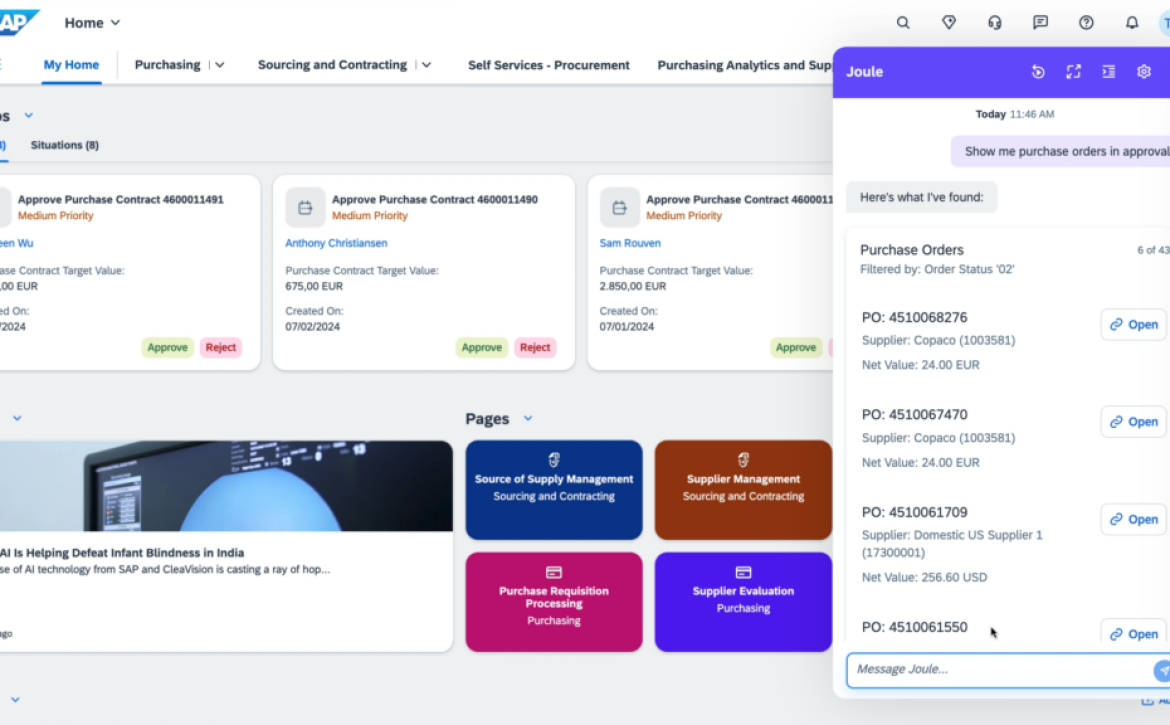
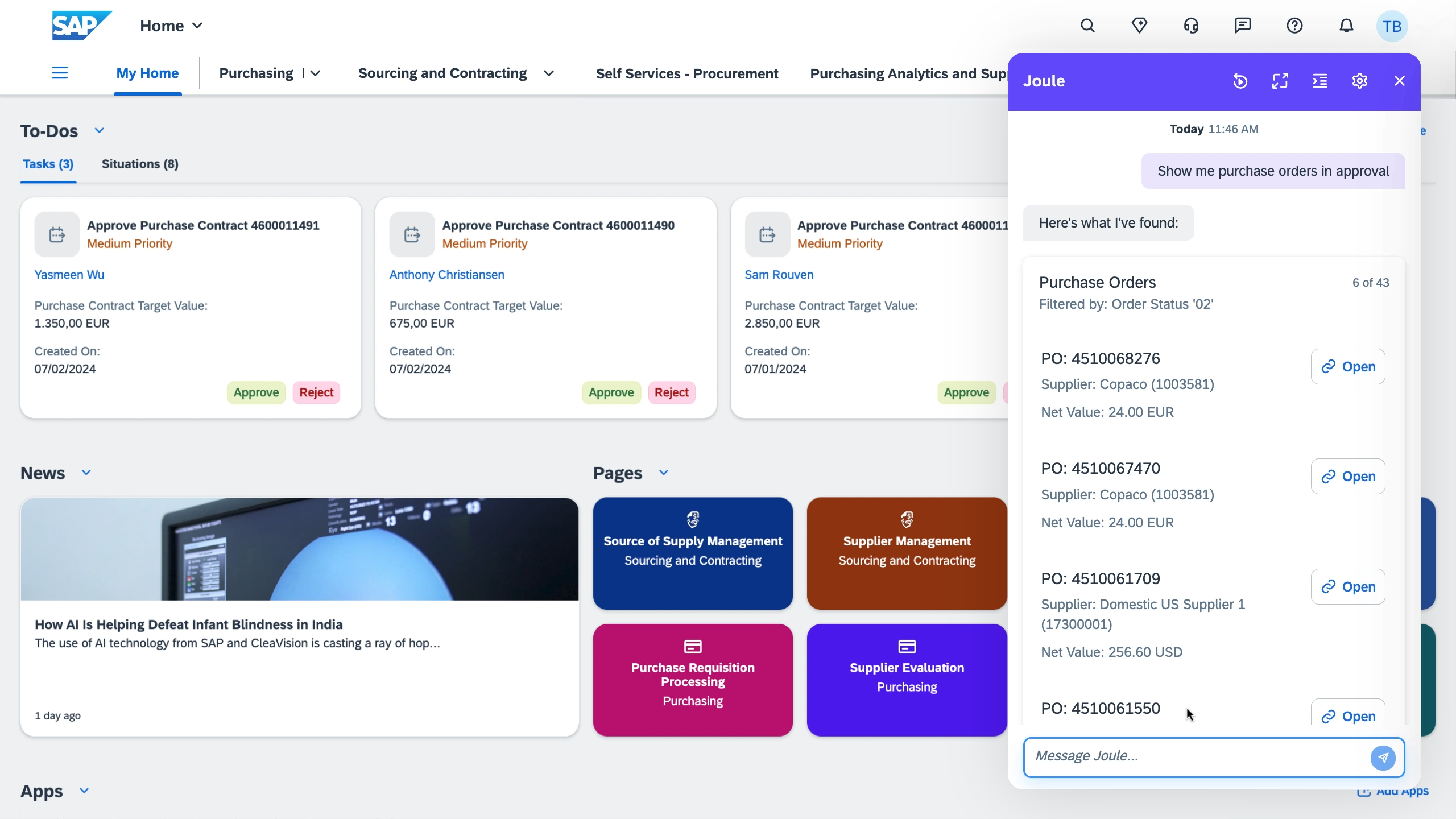
Available since Q2, users have been able to directly navigate to business applications. Now, the integration of SAP’s AI copilot Joule in SAP S/4HANA Cloud Private Edition allows for:
Conversational search, allowing users to perform informational searches up to 95%* faster with quick and seamless access to the relevant content from SAP Help Portal by asking Joule in natural language for the information they need.
Up to 95%* faster insights into relevant business objects for purchasing experts and shipping, without the need to navigate to the application that provides the insights. This includes, for example, purchase requisitions, sales orders, and more.
SAP S/4HANA Cloud Public Edition: AI-assisted smart summarization Beta release
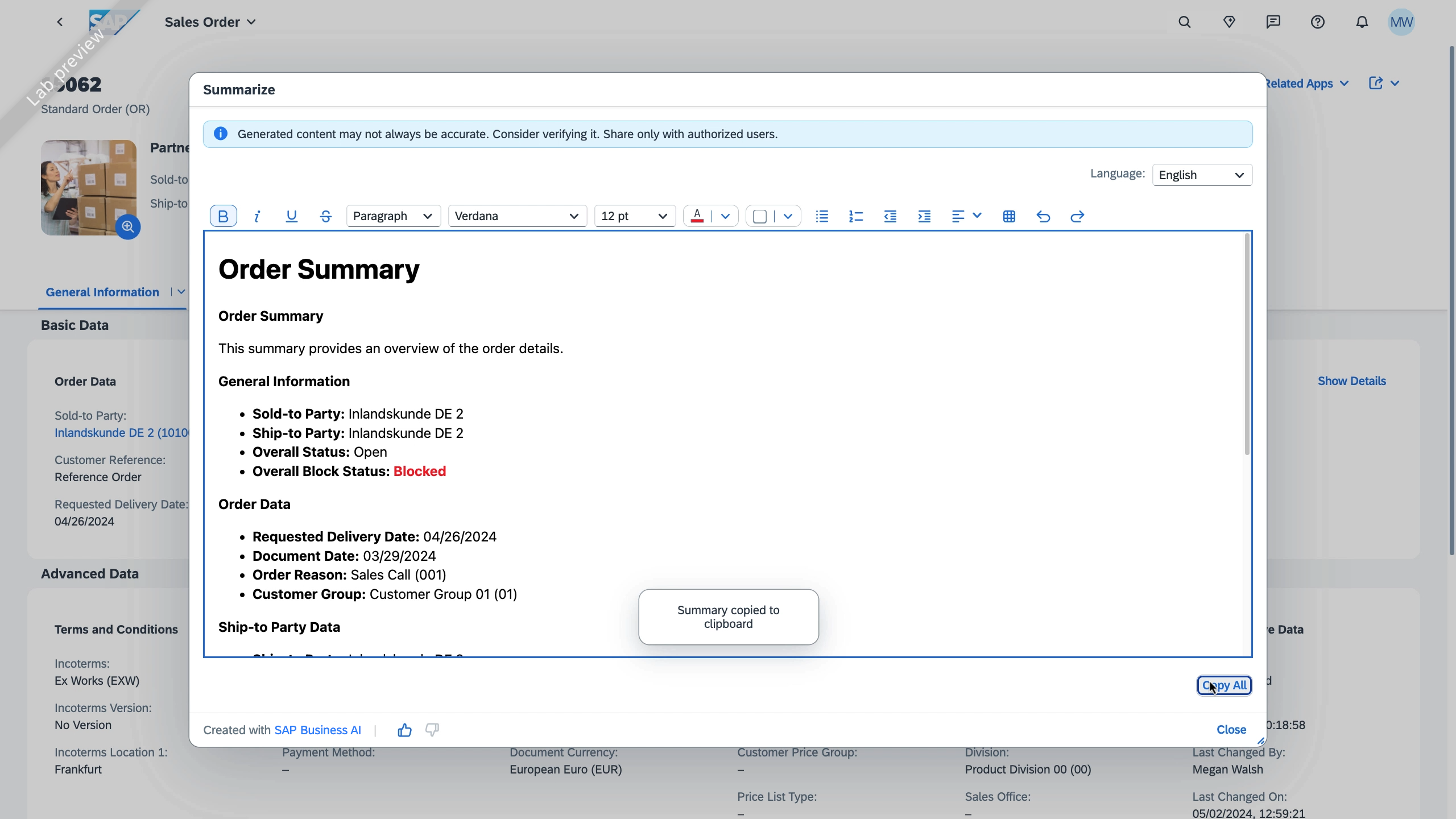
SAP S/4HANA Cloud Public Edition customers can now benefit from a much smoother SAP Fiori experience by using AI-assisted smart summarization jump-starts. This feature allows users to collaborate or follow up by extracting the essential information from the object pages of the SAP Fiori Elements application that they use. Users can expect more than five minutes* saved per summarization.
AI-assisted smart summarization in SAP S/4HANA Cloud Public Edition
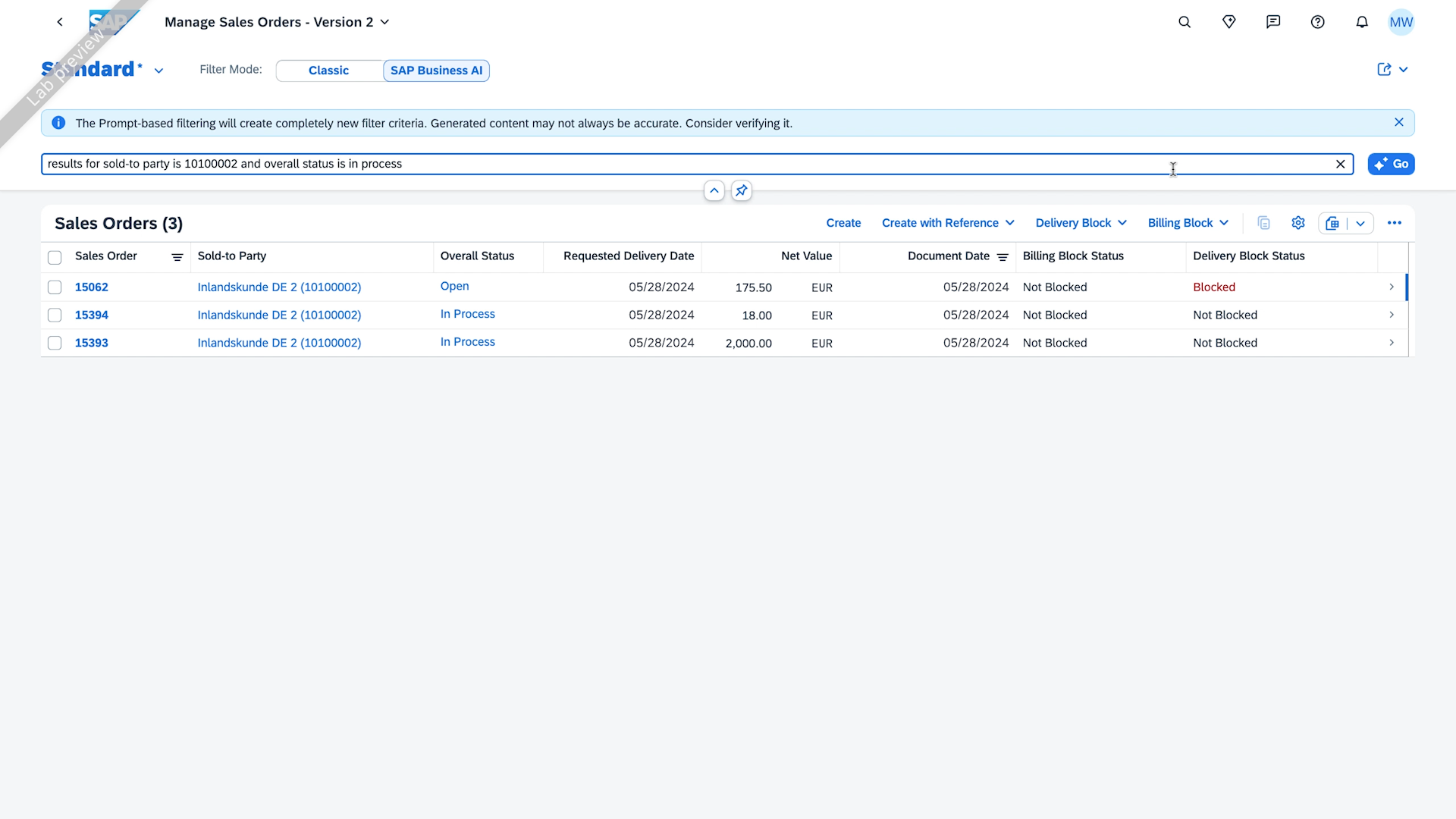
SAP S/4HANA Cloud Public Edition: AI-assisted easy filter Beta release
The AI-assisted easy filter capability helps sales representatives select data of list report-based SAP Fiori applications in natural language instead of defining filter values manually. This streamlines the filtering experience to quickly get the required information.
AI-assisted easy filter in SAP S/4HANA Cloud Public Edition
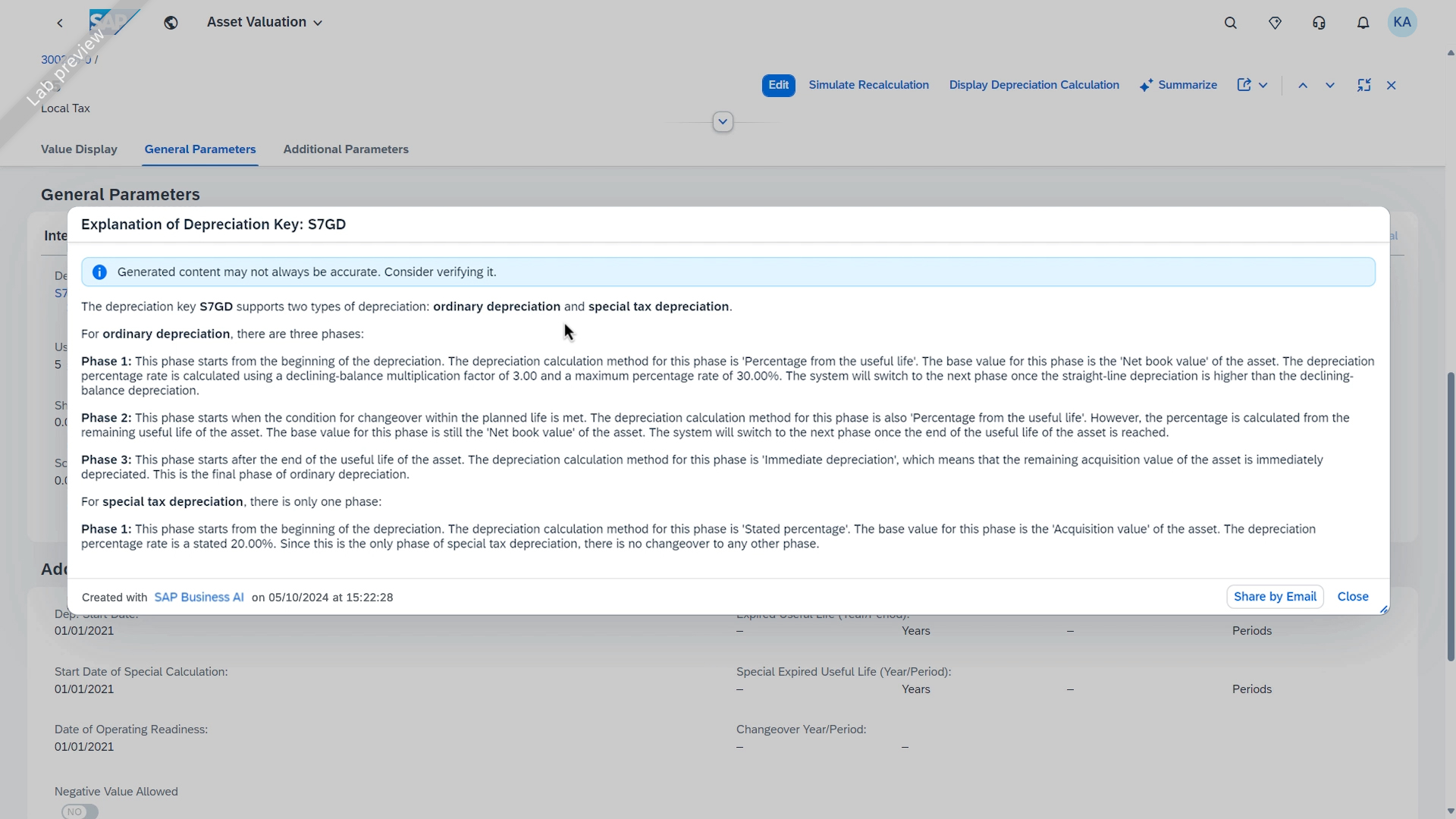
SAP S/4HANA Cloud Public Edition: AI-assisted explanation of fixed asset deprecation keys Beta release
Asset accountants can use AI-assisted explanation of fixed asset deprecation keys to analyze asset values per deprecation area. The feature explains depreciation types and calculation procedures in natural language, increasing the accuracy of financial and tax statements. Users can save up to 60 hours* of onboarding efforts per country version and 0.5 days* for analyzing asset values during period closing times.
AI-assisted explanation of fixed asset deprecation keys in SAP S/4HANA Cloud Public Edition
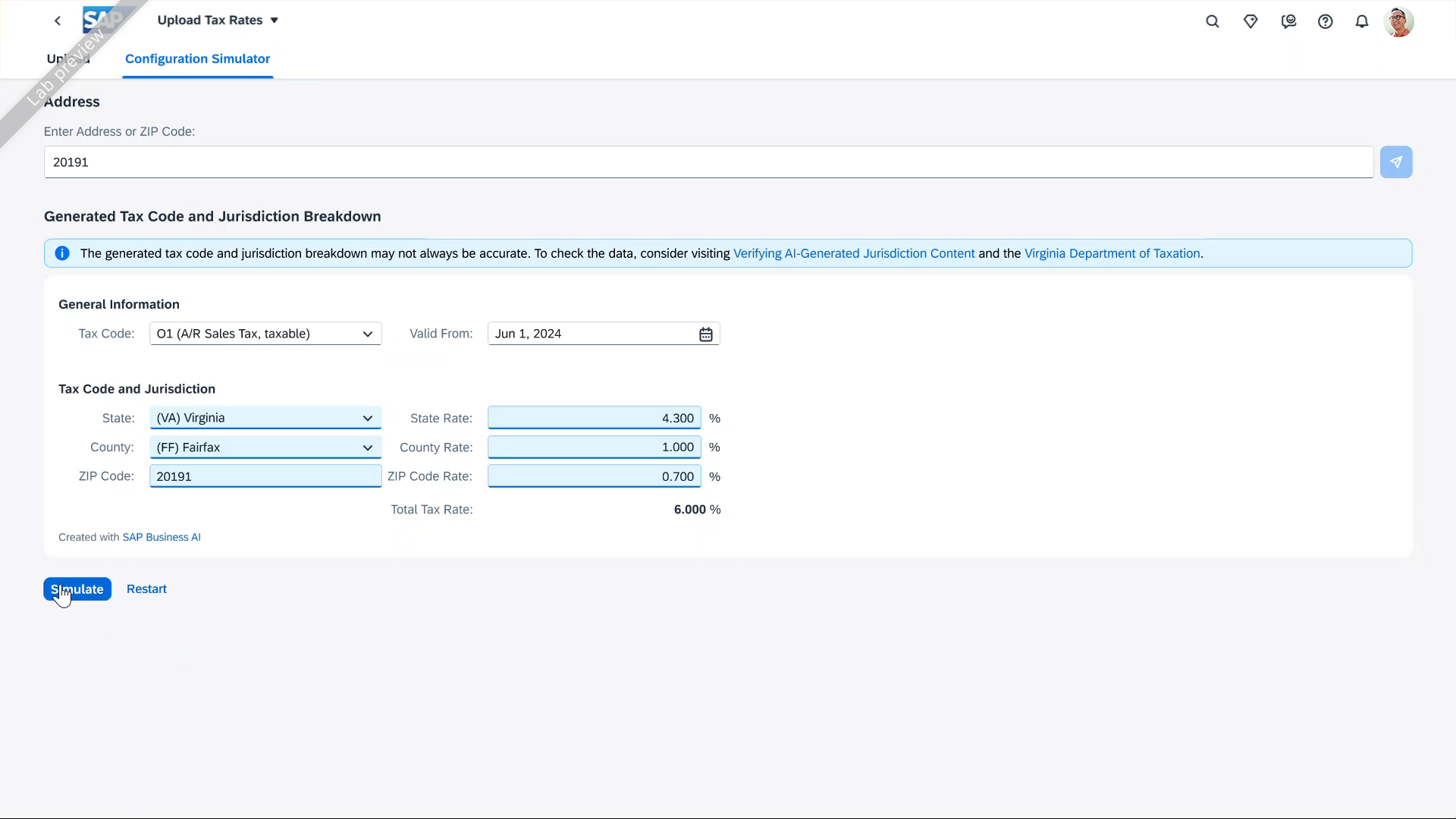
SAP S/4HANA Cloud Public Edition: AI-assisted configuration for U.S. tax jurisdictions Beta release
Tax accountants can now simplify the process of maintaining U.S.-internal tax configuration with the help of Joule. The AI copilot proactively detects and generates proposals for missing compliance configurations. This ensures faster onboarding for businesses in the United States with less complexity and greater accuracy and reliability compliance with the Tax Authority website integration. Companies can expect a reduction of 50-90%* in effort to set up U.S. sales and use tax configuration.
AI-assisted configuration for U.S. tax jurisdictions in SAP S/4HANA Cloud Public Edition
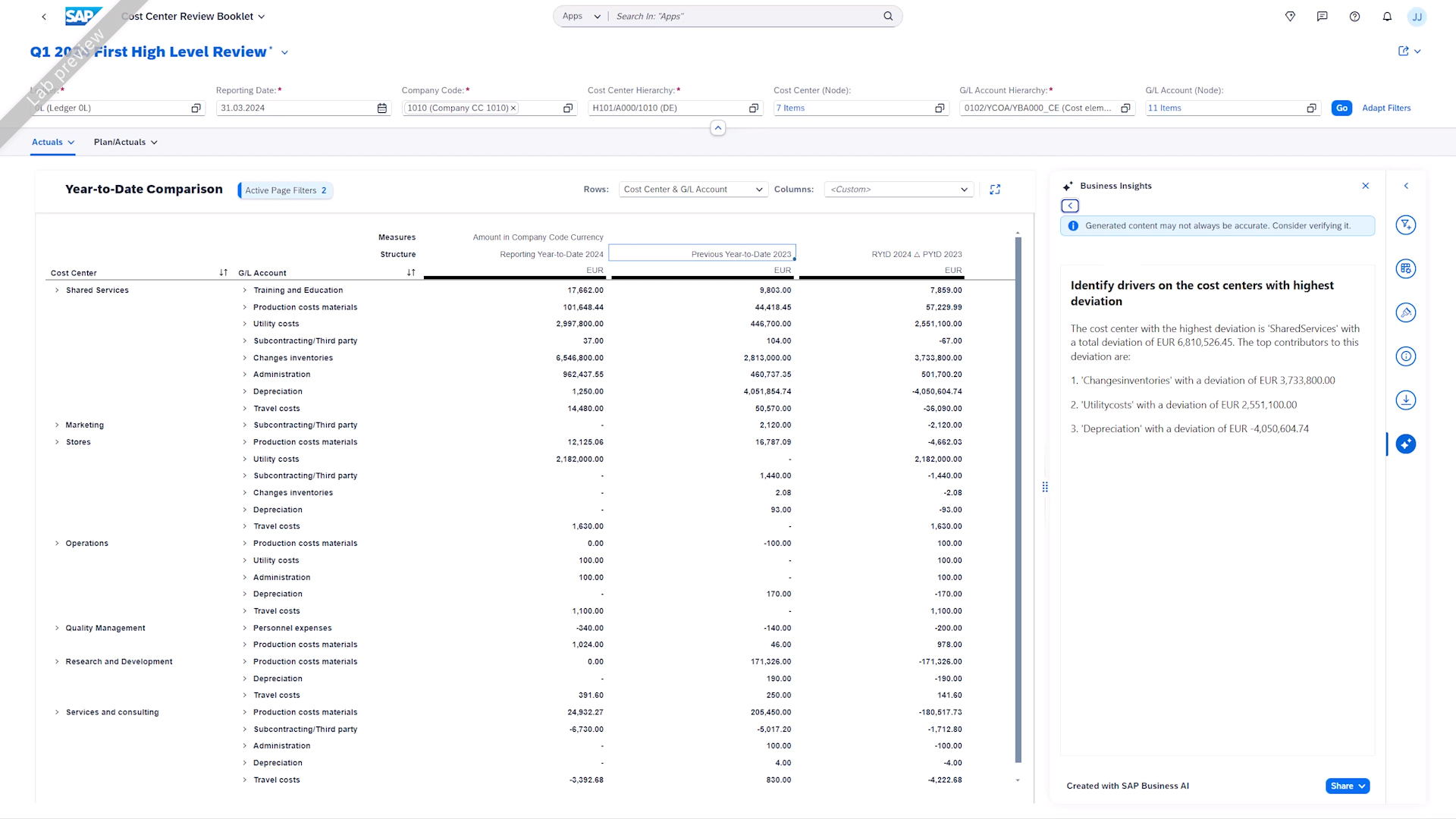
SAP S/4HANA Cloud Public Edition: AI-assisted financial business insights Beta release
With the help of generative AI, employees in finance departments can analyze and summarize data from their cost center review booklet into actionable financial business insights. This empowers them with a complete picture, including root cause analyses, suggested rectifications, and written reports. It also increases efficiency by prioritizing workload, automating repetitive tasks, and recommending actions. Finance costs also get reduced via immediate visibility into critical KPIs, AI-generated reports, and instant sharing. With this feature, business users can expect to save up to 50% of their time per summarization of financial data in a review booklet and 2x accelerated decision-making.
AI-assisted financial business insights in SAP S/4HANA Cloud Public Edition
SAP S/4HANA Cloud Public Edition: AI-assisted localized form template management, AI-assisted merging for payment formats Beta release
We introduced two generative AI-assisted localization apps as part of the localization-as a-self-service for SAP S/4HANA Cloud Public Edition:
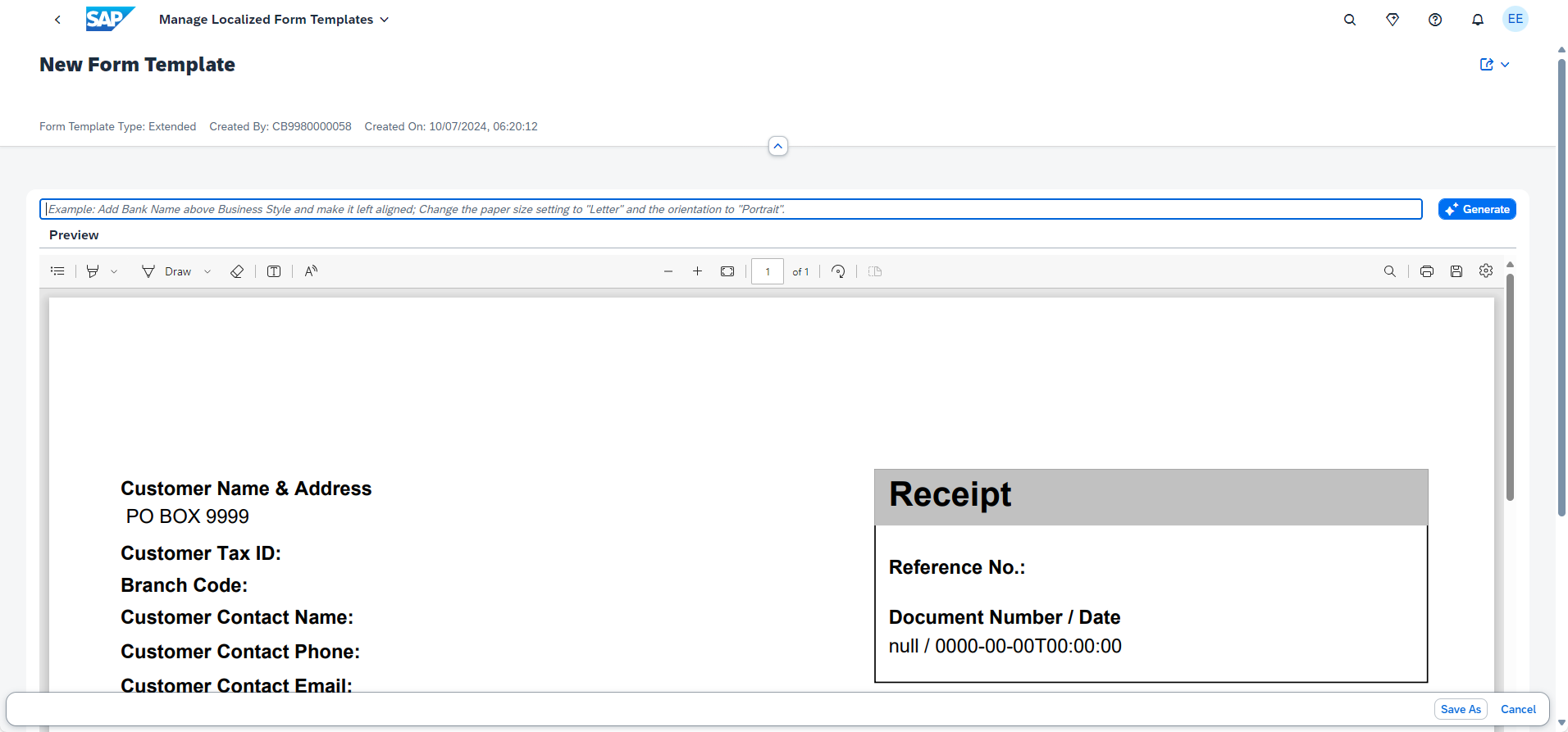
The Manage Localized Form Templates app allows application owners to extend localized forms, such as payment receipts, to meet their specific requirements. The feature reduces the time and cost for localized form template creation by up to 95%* compared to a manual mapping in a third-party tool.
Manage localized form templates in SAP S/4HANA Cloud Public Edition
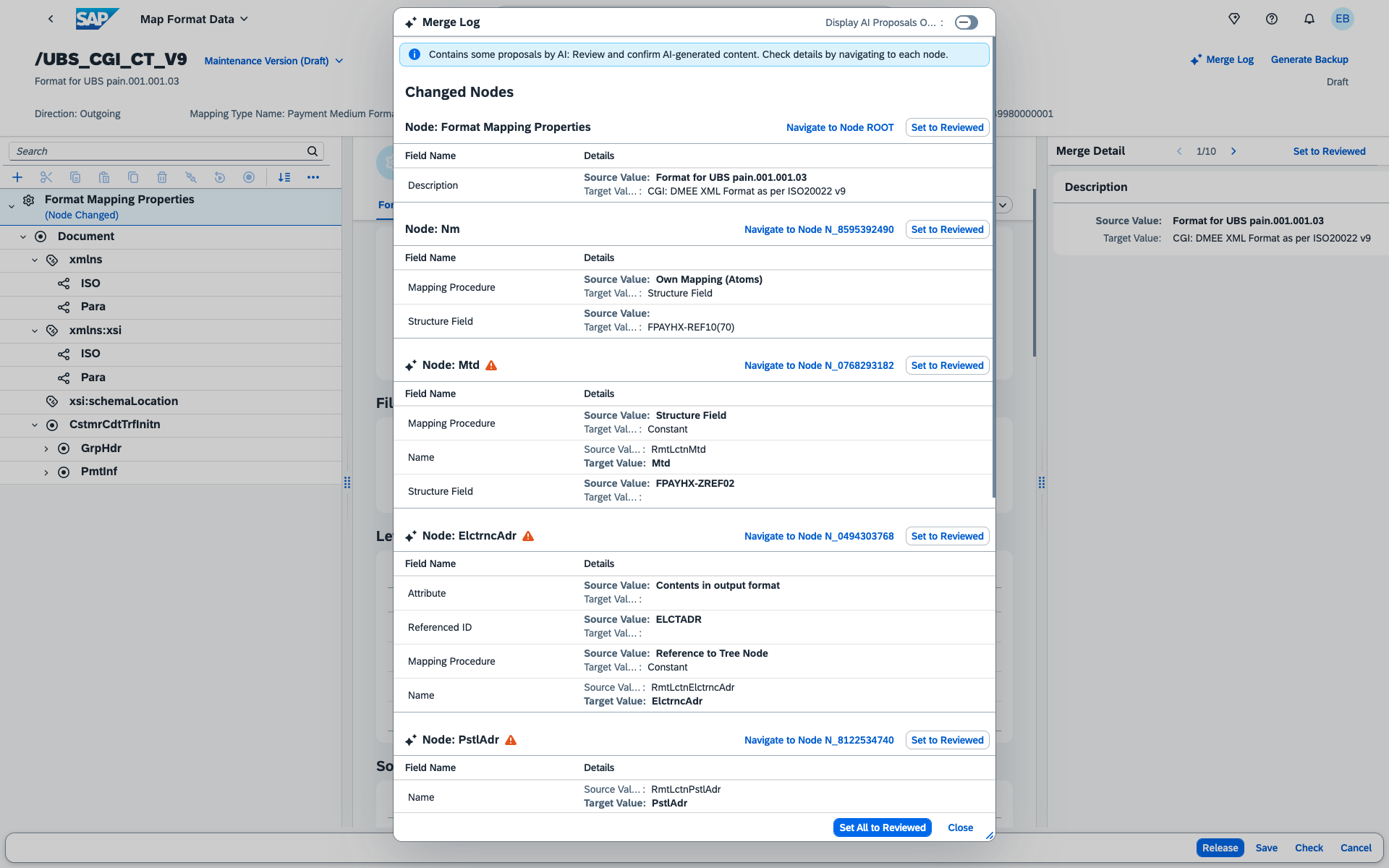
With the Generative AI Merge for Payment Formats feature in the Payments app, business users can create customized payment formats using generative AI-generated mappings. This simplifies adapting payment formats to local standards, increasing accuracy and reducing by up to 60%* the time and cost to update payment formats compared to a manual review of the changes.
Create customized payment formats in SAP S/4HANA Cloud Public Edition
SAP Advanced Financial Closing: AI-assisted error resolution Beta release
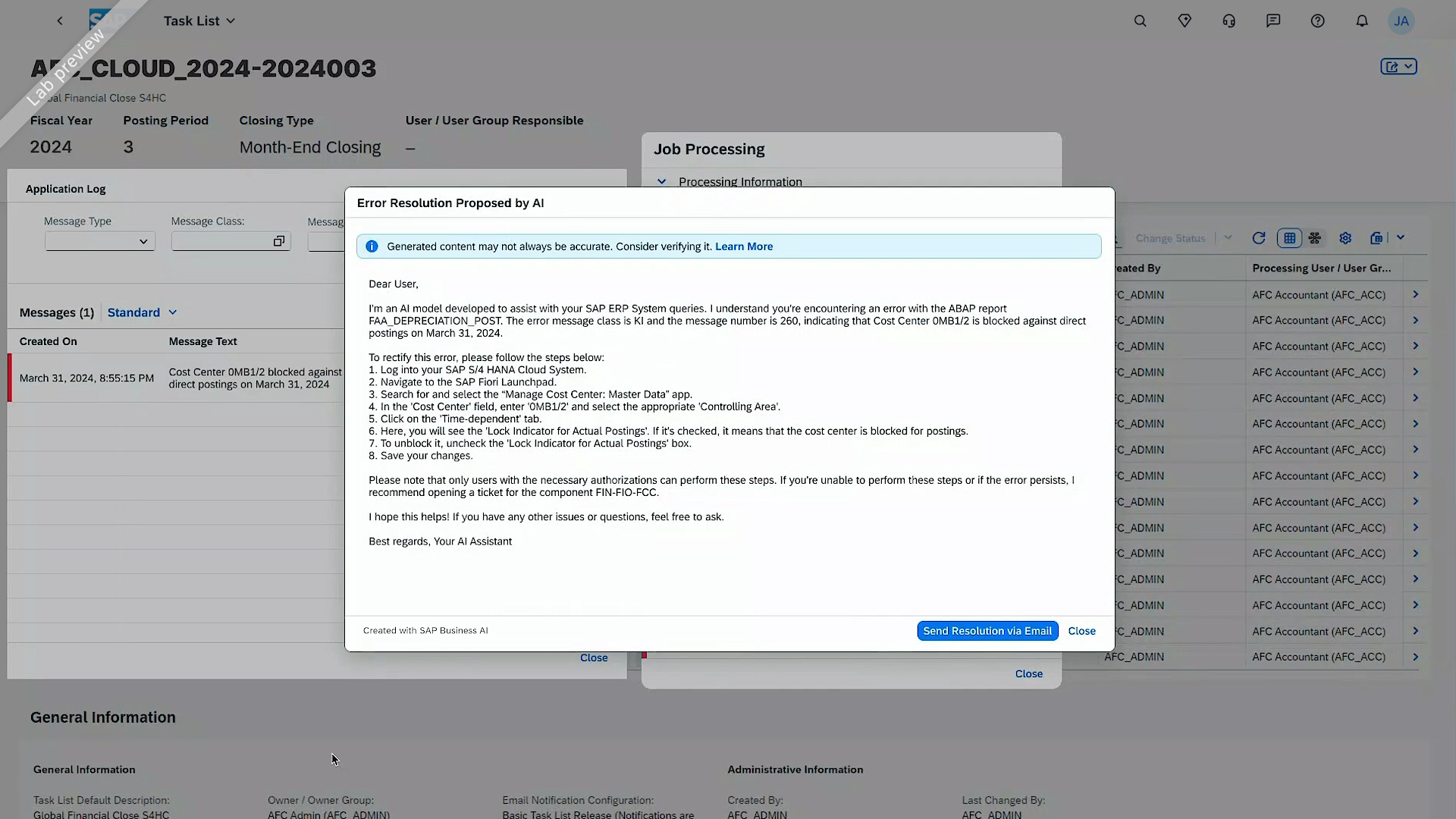
The AI-assisted error resolution feature helps controllers and accountants to understand the root causes of issues that arise during financial closing. It provides step-by-step guidance for fixing the error and the option to manually email the resolution to the expert in charge. By identifying errors and analyzing root causes faster, users can reduce efforts to investigate and remediate errors in automated closing tasks by up to 90%* (approximately two hours saved* per financial close), ensuring faster financial closing and lower support and compliance costs.
AI-assisted error resolution in SAP Advanced Financial Closing
SAP Signavio: AI-assisted process recommender and AI-assisted performance indicator recommender General availability
Business process consultants can now benefit from new generative AI-powered capabilities in SAP Signavio.

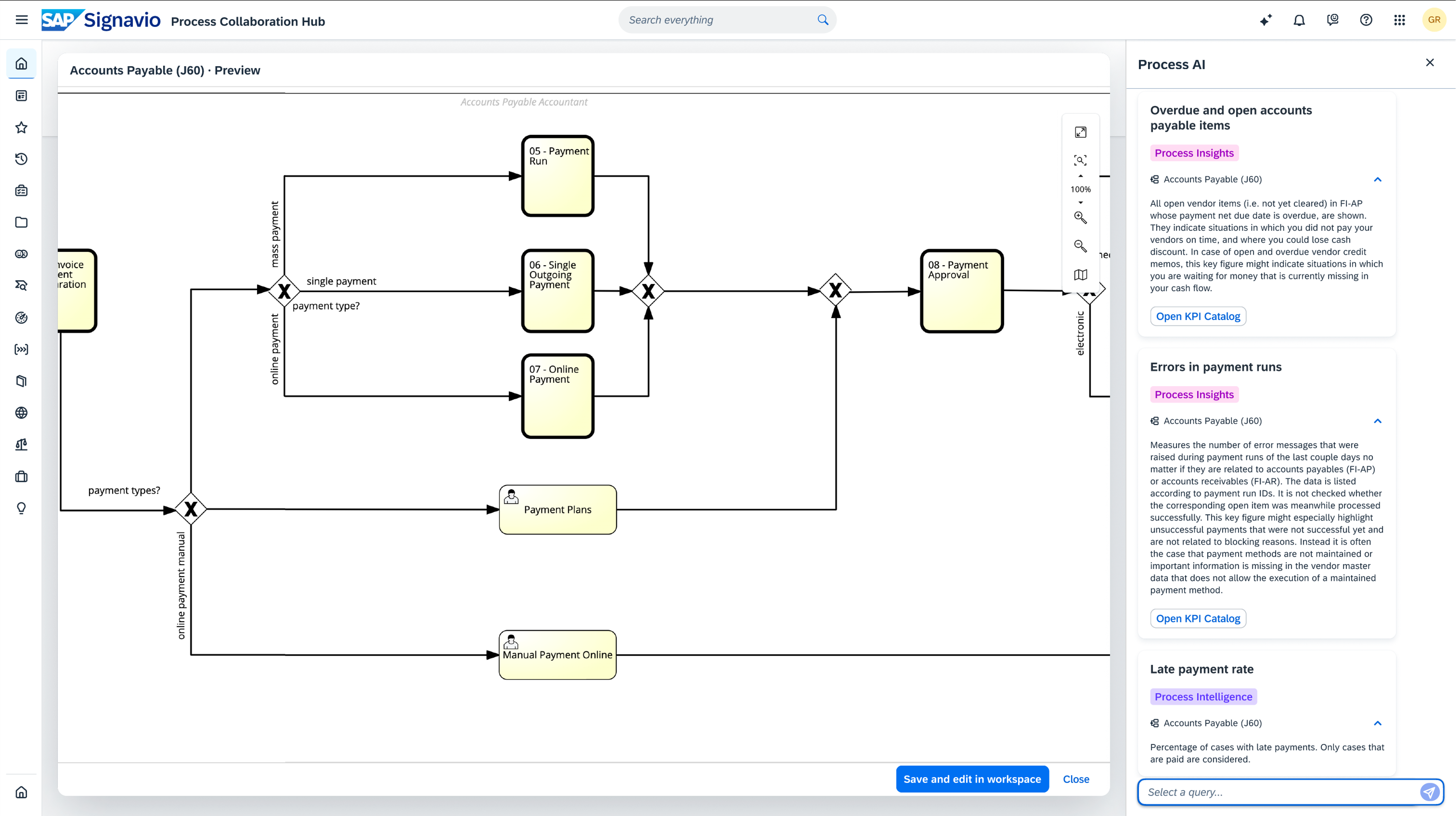
The AI-assisted process recommender capability helps to obtain preconfigured process models based on a database of more than 5,000 best practices from SAP, allowing process experts to move fast from initial exploration to process design and reducing the effort needed for a first process draft to start the process modeling. This reduces the time invested from business process consultants by up to 30%*, and the costs of designing a new process or redesigning an existing one can be reduced by 30%*.
AI-assisted process recommender in SAP Signavio
The AI-assisted performance indicator recommender feature helps users obtain quick recommendations on process performance indicators (PPIs) relevant to their business processes and problems. This allows users to solve problems through a measurement approach based on a repository of thousands of KPIs and PPIs. The time and cost of refining process performance indicators can be reduced by up to 20%*.
AI-assisted performance indicator recommender in SAP Signavio
SAP Signavio: AI-assisted process analyzer (text-to-insights) Beta release
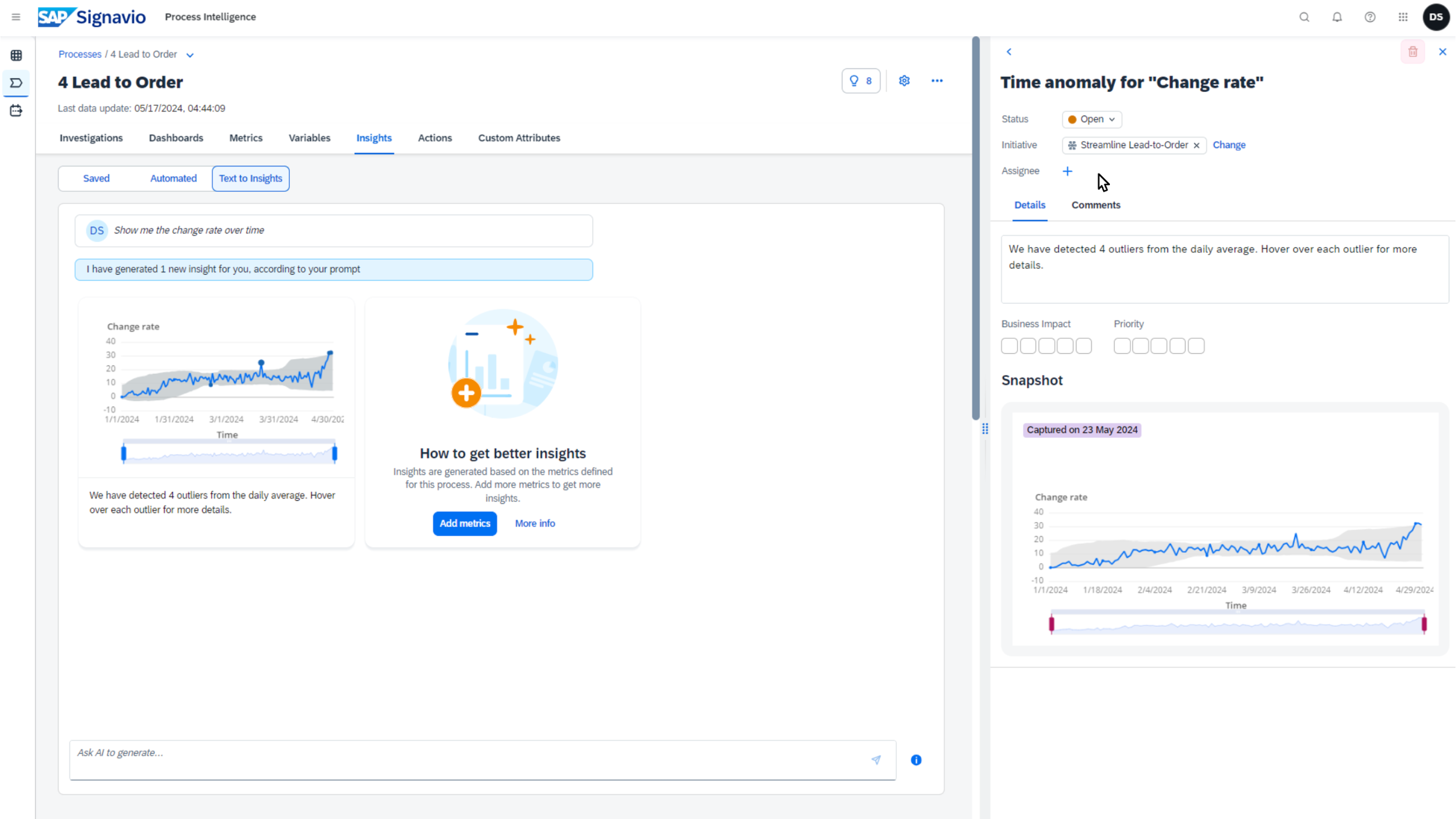
With the new AI-assisted process analyzer capability, users can ask questions in natural language and receive immediate insights that can accelerate business decisions by up to 50%*. It democratizes process mining and empowers non-technical users to conduct a deep analysis and obtain valuable knowledge.
AI-assisted process analyzer (text-to-insights) in SAP Signavio
SAP Integration Suite: Generation of integrations General availability
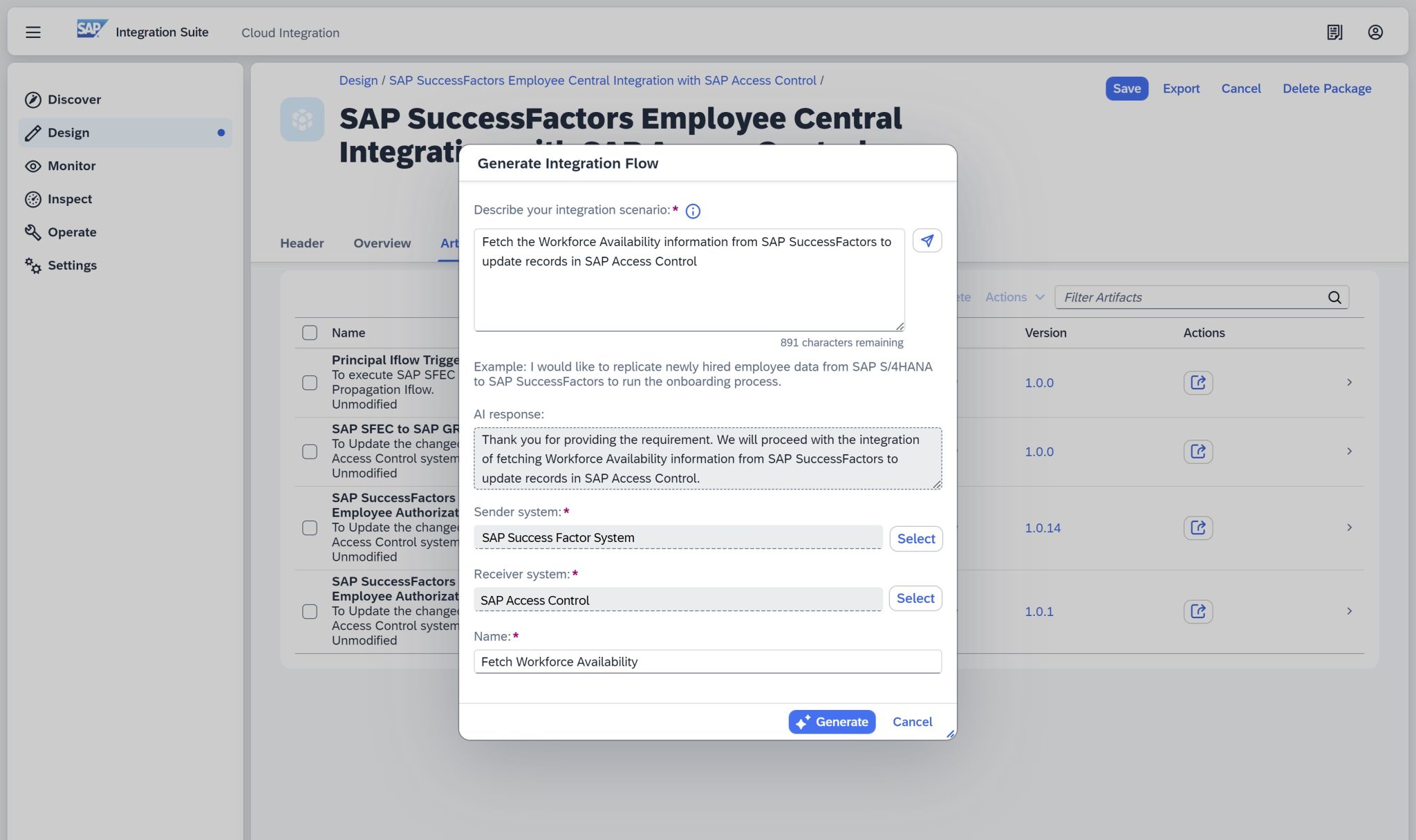
Developers can now automatically generate integration flows in SAP Integration Suite. Users only need to describe the integration scenario and the tool will then create an integration flow with pre-configured connectors based on their description and inputs. This helps to quickly integrate processes, services, applications, events, and data across heterogeneous system landscapes and enhance productivity.
With over 3,600 prebuilt integration flows, users can reduce the time needed for designing the integration by a factor of three*, resulting in cost savings with improved quality, as well as reduced implementation effort.
Generate integration flows in SAP Integration Suite
SAP Build Code: Support SAP S/4HANA Cloud service integration for data model and app logic General availability
SAP Build Code, SAP’s generative AI-based code development solution, allows developers to build applications up to 30% faster. This can reduce application development costs by up to 30%*. The integration of Joule, optimized for Java and JavaScript application development, provides a turnkey environment for coding, testing, integrations, and application lifecycle management.
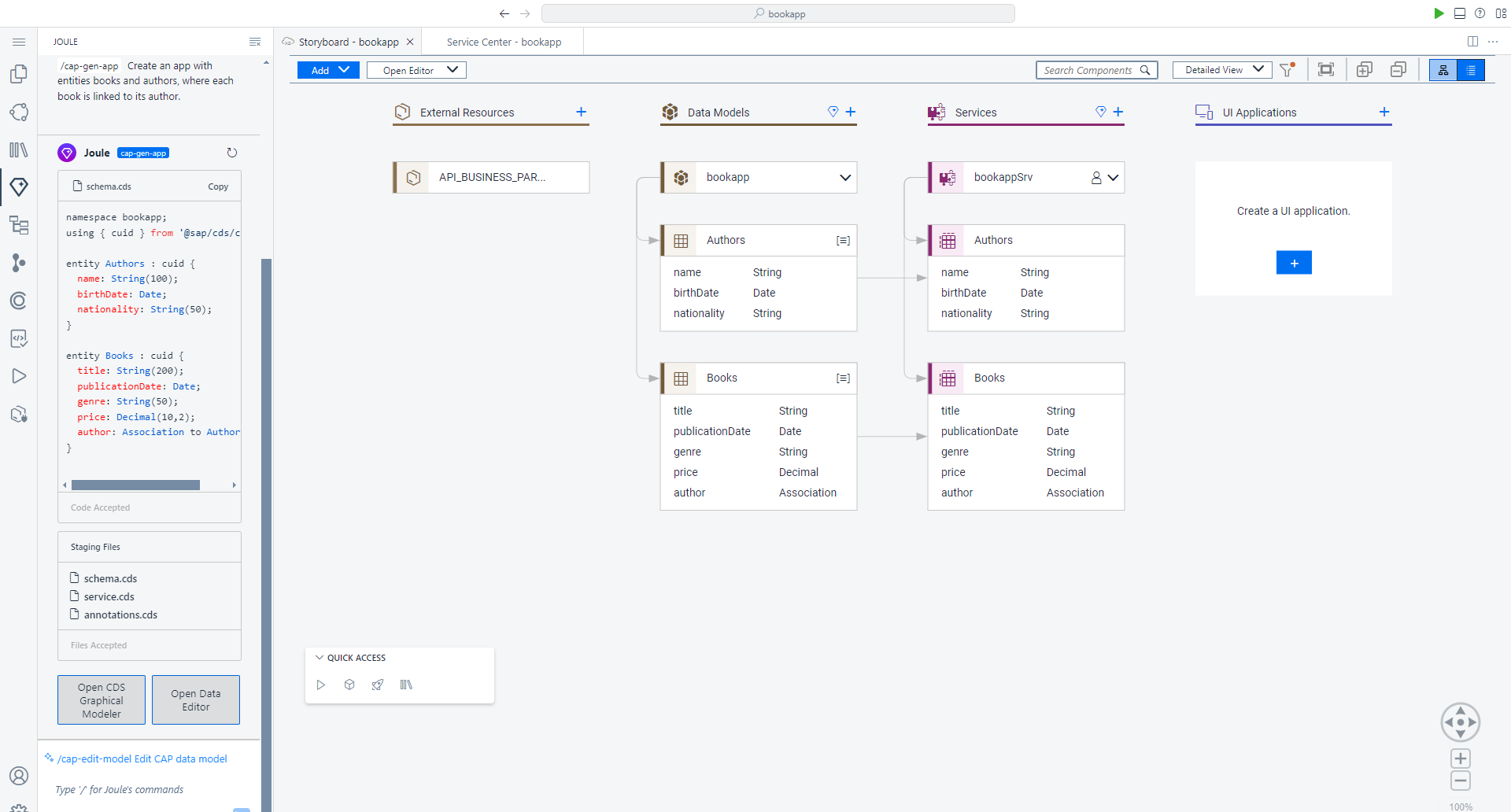
Starting in Q3, Joule will help developers to generate code for integrated SAP S/4HANA Cloud services. This is started by creating a full-stack application, importing an external SAP S/4HANA Cloud service, and defining the data model and services with Joule.
Create data model and services with Joule in SAP Build Code
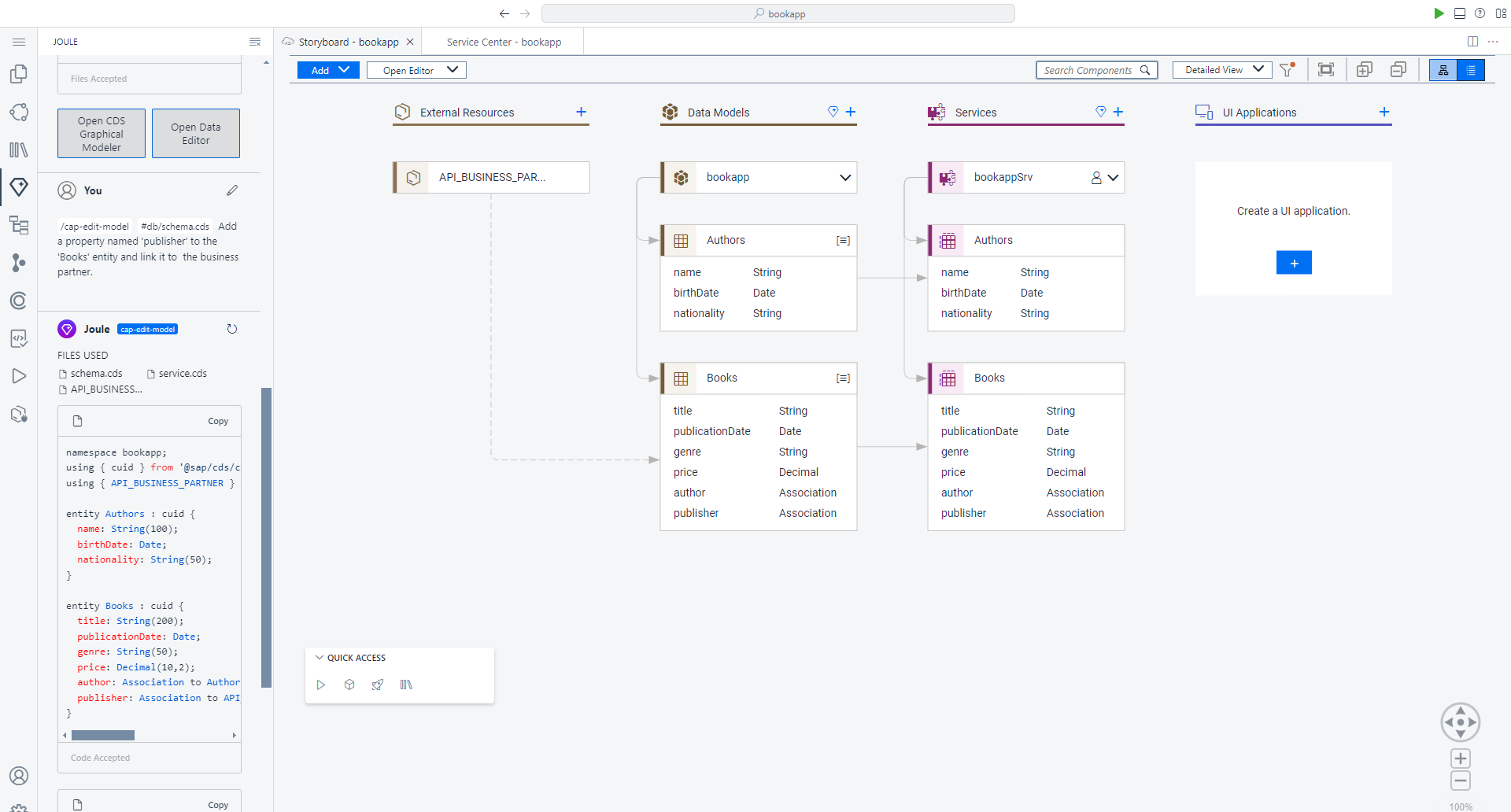
In addition, developers can use Joule to enhance the data model they created before by adding associations between the external SAP S/4HANA Cloud entity and local entities, and exposing the external entity to a local service via a projection afterward.
Use Joule in SAP Build Code to add an association between the entity Books and the external entity
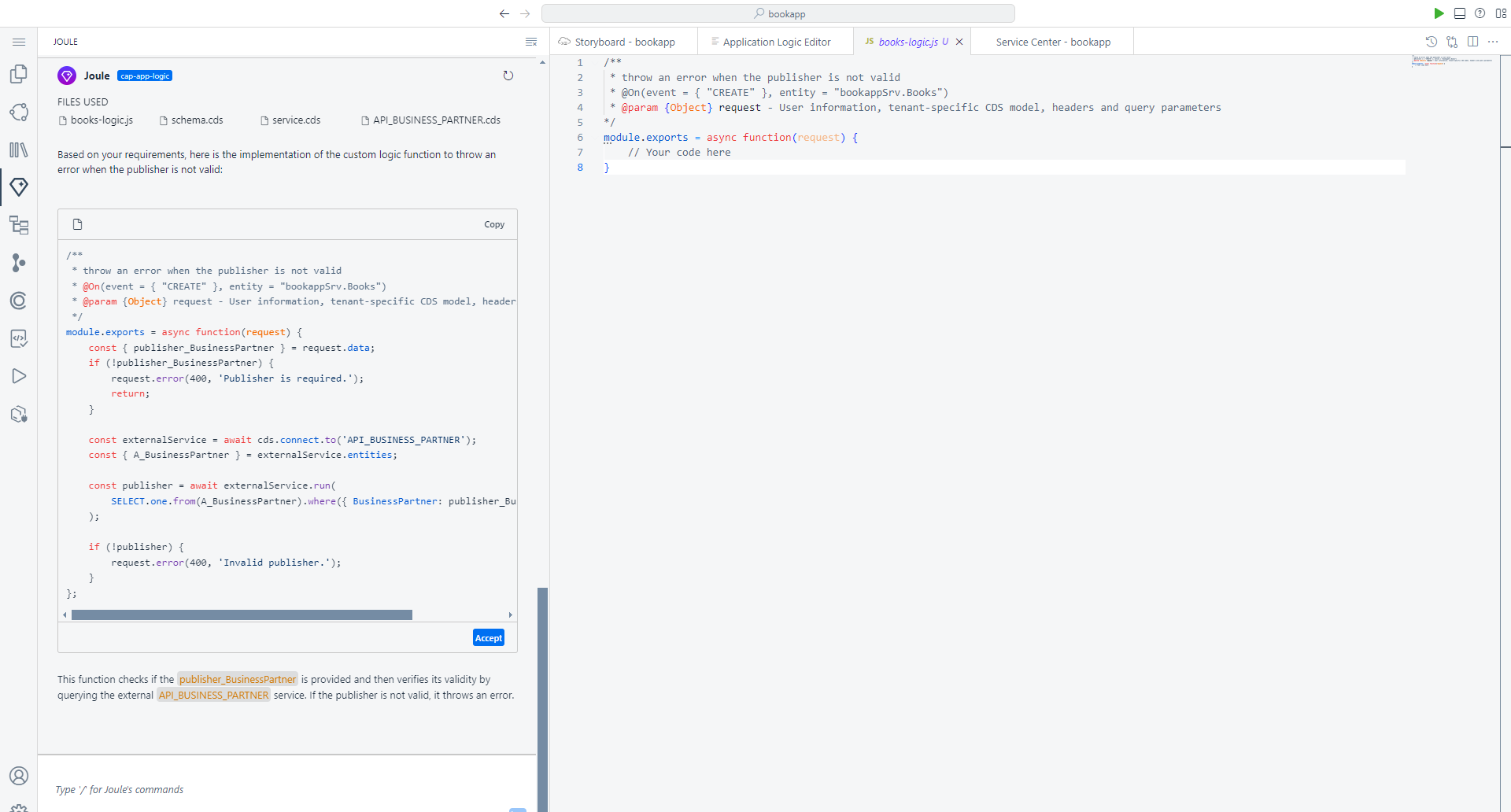
Joule also supports custom logic generation for reading the associated external entity and to perform further operations on the exposed external entity.
Use Joule in SAP Build Code to add a custom logic reading data from the external entity
SAP HANA Cloud: Generate SAP HANA SQL statements with the SQL console for SAP HANA General availability
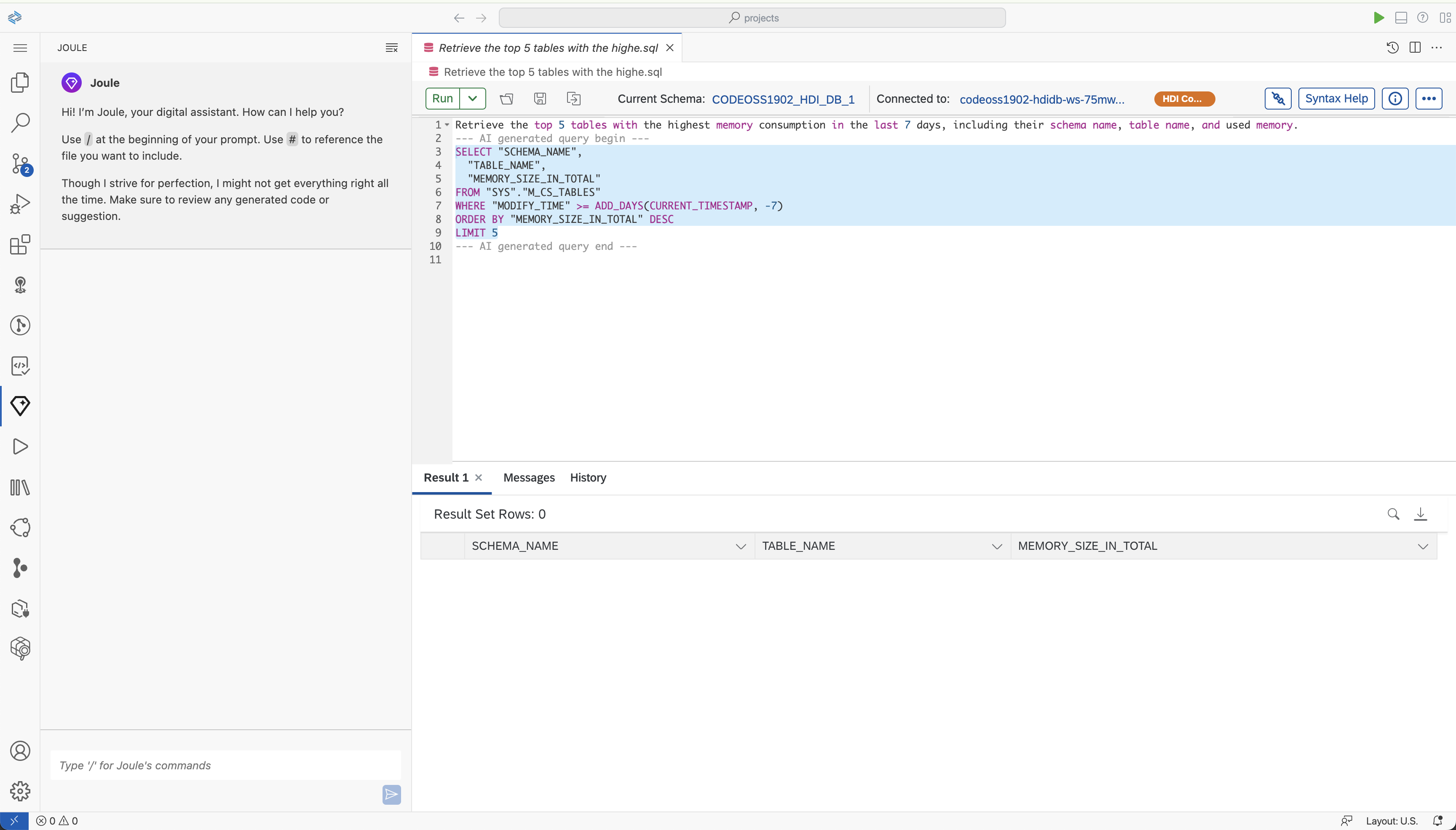
SAP HANA database application developers can use the new conversational SQL console in SAP Business Application Studio to generate SAP HANA SQL statements. The statements are based on the requirements specified in a special natural language prompt, which can be run directly in the SQL console. The resulting statement includes the correct SAP HANA syntax.
Note: To use the ‘Run Prompt’ option, you must have a subscription to SAP Build Code, the AI-powered cloud development environment based on SAP Business Application Studio.
The new console helps increase developer productivity by up to 20%*, reducing the SQL learning curve and enabling efficient data retrieval with natural language.
Generate SAP HANA SQL statements with the SQL Console for SAP HANA
Document Information Extraction service: Product enhancements General availability
Available on SAP BTP, the Document Information Extraction service helps businesses automate and scale their document processing use case end-to-end in more than 40 languages with easy extensions for any kind of document.
This upgrade includes three significant enhancements designed to streamline your document processing:
Instant learning: The premium edition of Document Information Extraction now features an instant learning capability. This allows for immediate improvements in accuracy as the service learns dynamically from user feedback. Just a few corrections from the user enable the system to adapt and enhance its performance, making document processing more precise than ever.
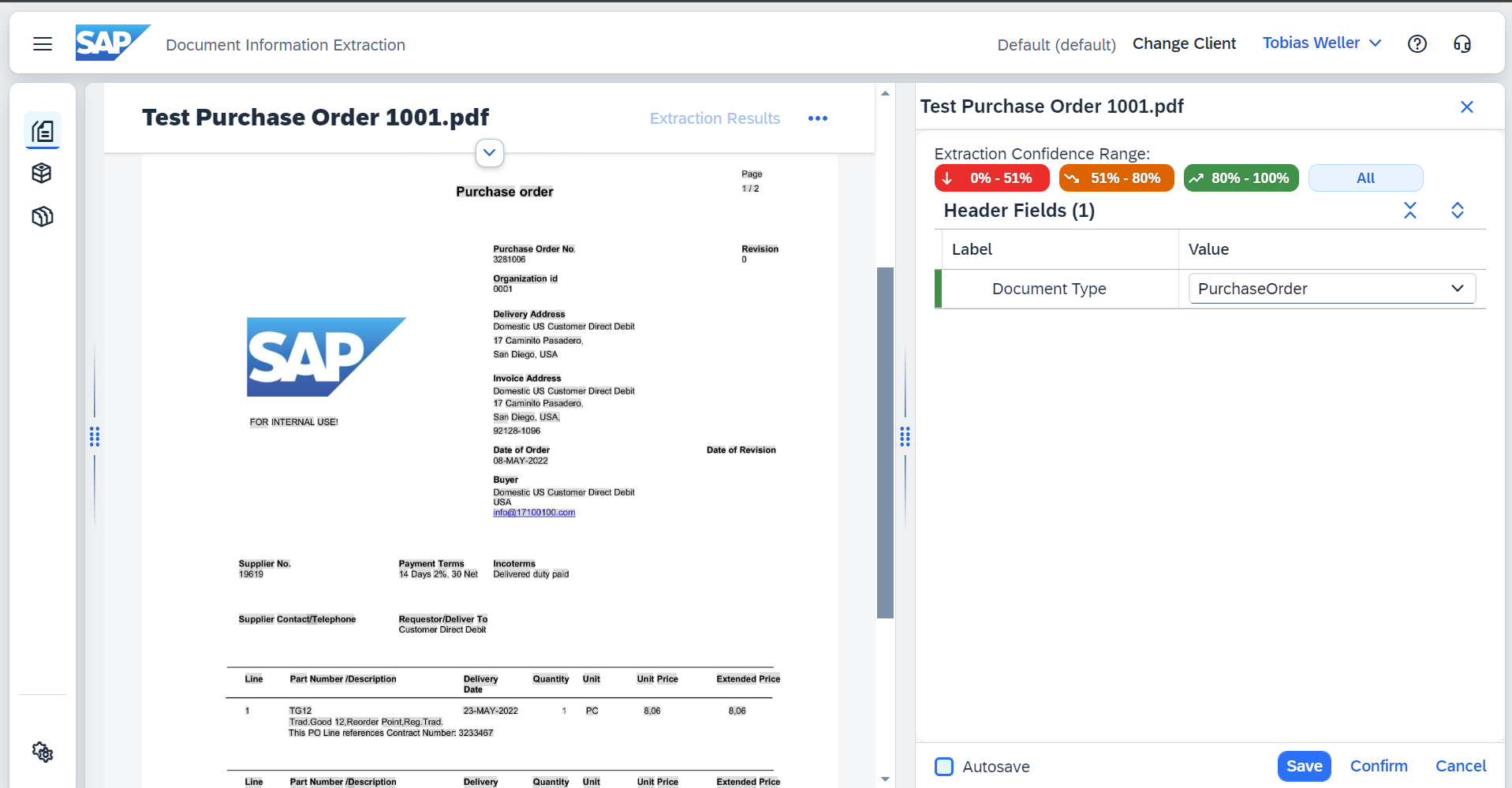
Enhanced document classification: With the new field type “list of value,” users can specify their own classification classes or categories; for example, to distinguish a supplier invoice from a payment advice. By providing a list of classification values when setting up a schema, they can tailor the service to automatically determine the type of incoming document according to their business processes. This results in more organized document handling, enabling faster and more accurate document processing.
Enhanced document classification capability in the Document Information Extraction service
Expanded availability on Microsoft Azure: To meet the growing global demand, the availability of the service has been extended to additional Microsoft Azure regions: Netherlands (Amsterdam) and U.S. East (Virginia). The service now incorporates:
Extended schema description, to get the most out of generative AI for document processing
New file types and improved performance, to get support for key Microsoft Office formats, including MS Excel and MS Word
Schema import and export to easily share schemas across different projects or environments, enhancing consistency and saving valuable setup time
Generative AI Hub in SAP AI Core and SAP AI Launchpad: Product enhancements General availability
The generative AI hub in SAP AI Core and SAP AI Launchpad enables developers to access market-leading large language models (LLMs) in a governed environment, run AI models securely and cost-effectively, and maximize value creation from generative AI use cases for SAP applications.
Developers can save up to 60%* of their time spent onboarding and running AI models securely and realize higher value for new generative AI use cases through better grounding for increased relevance of the outcomes, resulting in faster user adoption.
In the last quarter, we introduced two key enhancements:
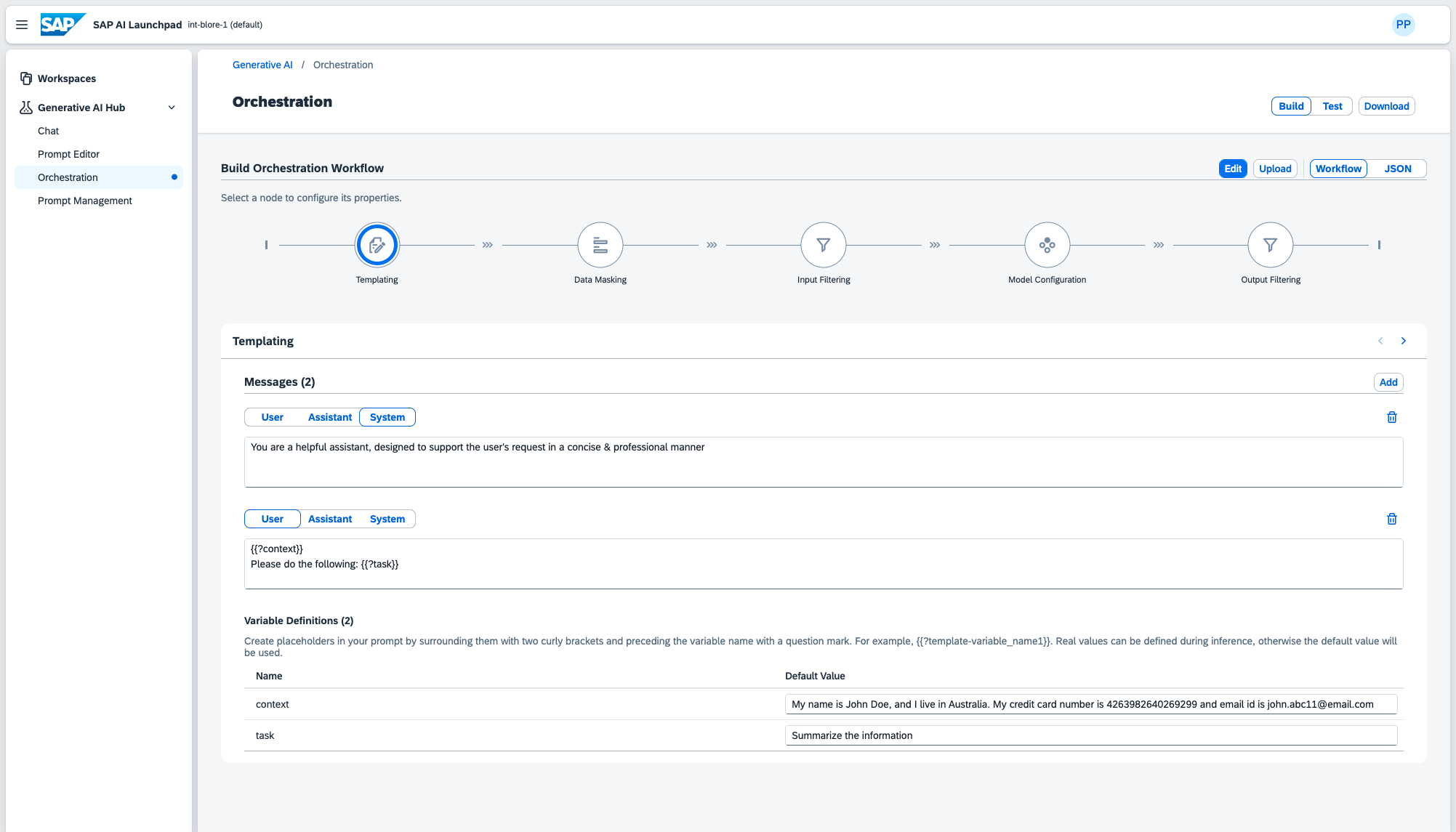
A new modular and intuitive orchestration builder helps create sophisticated, AI-driven applications by customizing pre-trained AI models for specific business use purposes through a guided process in the generative AI hub
A simplified integration and customization process lets developers deliver innovations faster and more precisely, enabling more relevant and effective AI-driven solutions for better business outcomes
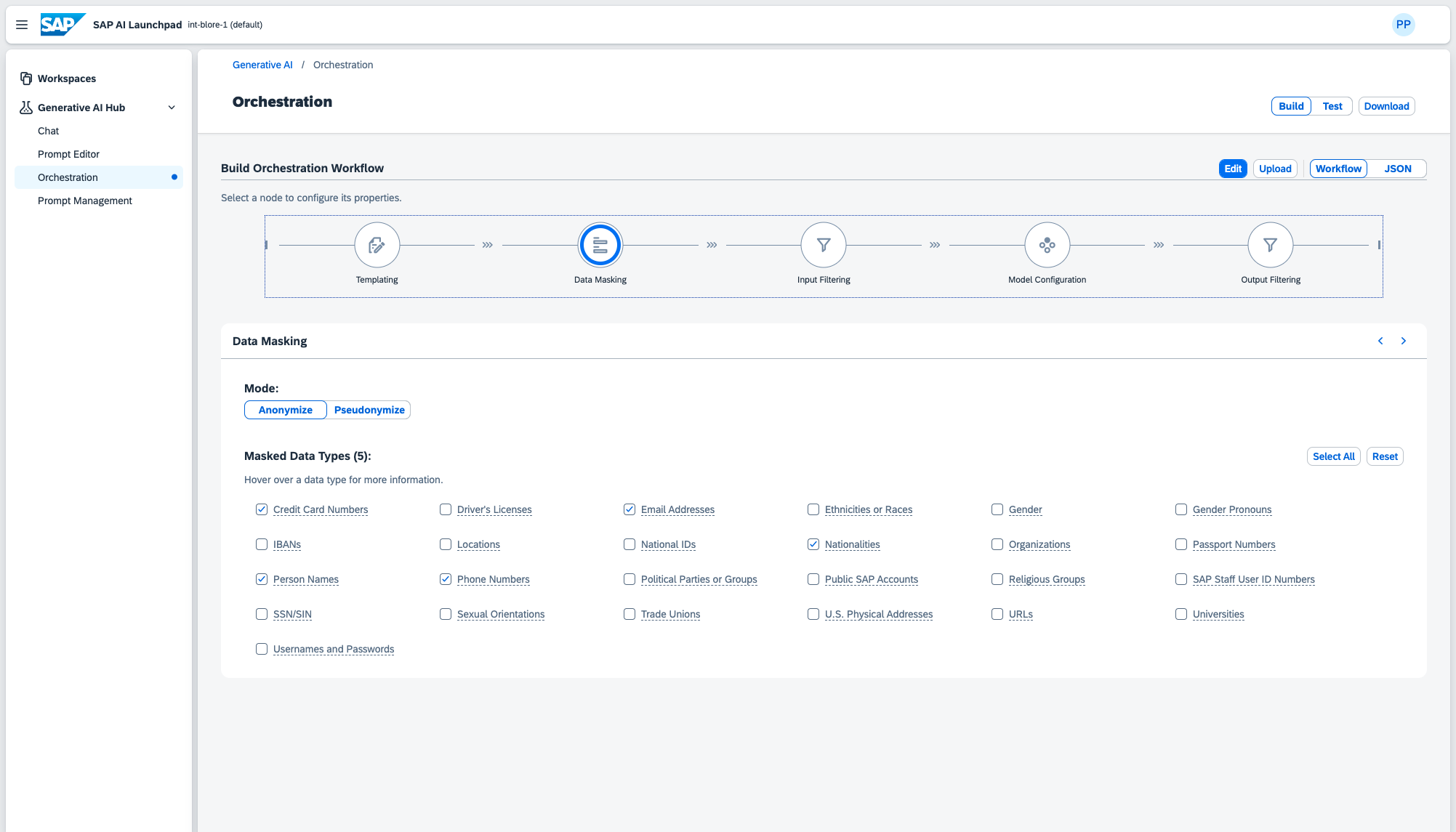
This feature also comes with a data masking and anonymization function for personal and sensitive data in prompts and LLM responses to enhance data privacy and compliance with data protection regulations.
Data masking and anonymization in the generative AI hub
A new JavaScript software development kit (SDK) helps integrate advanced AI capabilities into web applications. This user-friendly toolkit makes it easier to embed intelligent features such as chatbots and content generators, speeding up development and giving users more context-aware and relevant AI-generated content.
Finally, additional models from providers such as Google Cloud Platform, Meta, and OpenAI have been added to generative AI hub, and new data centers on Google Cloud Platform and Microsoft Azure are available in Europe and in the United States.
SAP Business AI in Sales, Services, Marketing and Commerce
SAP CX AI Toolkit: Product enhancements General availability
SAP CX AI Toolkit provides a comprehensive, configurable AI solution for e-commerce, marketing, sales, and service teams. It helps streamline content creation tasks and analyze data from across the enterprise. Many new AI-enabled tools are now integrated into the solution.
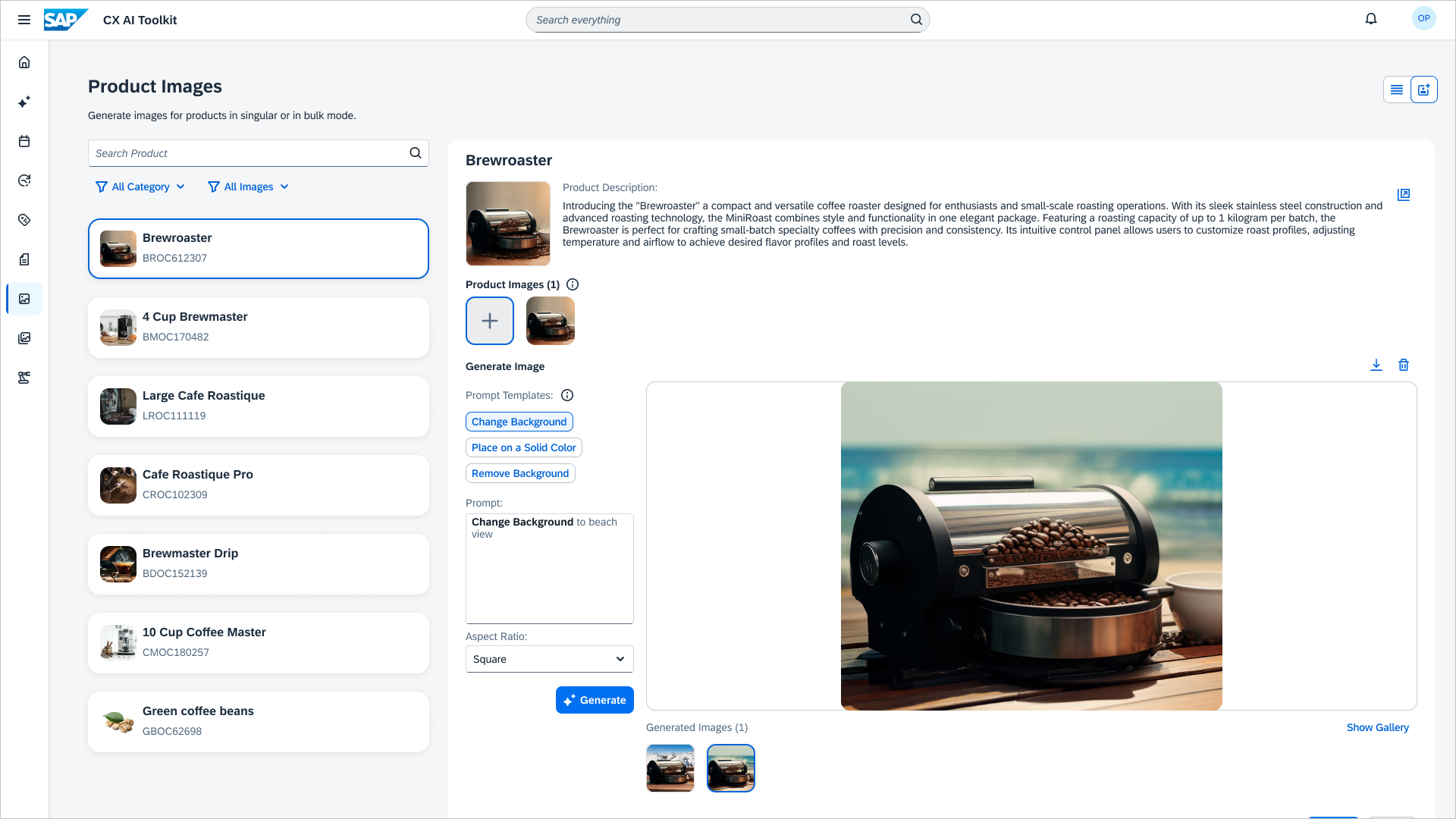
AI-supported image generation enables e-commerce teams to generate new product images or edit existing ones in the SAP Commerce Cloud catalog. It reduces the time spent on image customization by up to 50%* and increases the number of product-specific campaigns by up to 30%*. With this feature, e-commerce teams can also boost engagement with eye-catching, on-brand visuals tailored to commerce catalogs and effortlessly remove backgrounds or place products on solid-color backdrops.
Generate product images in SAP CX AI Toolkit
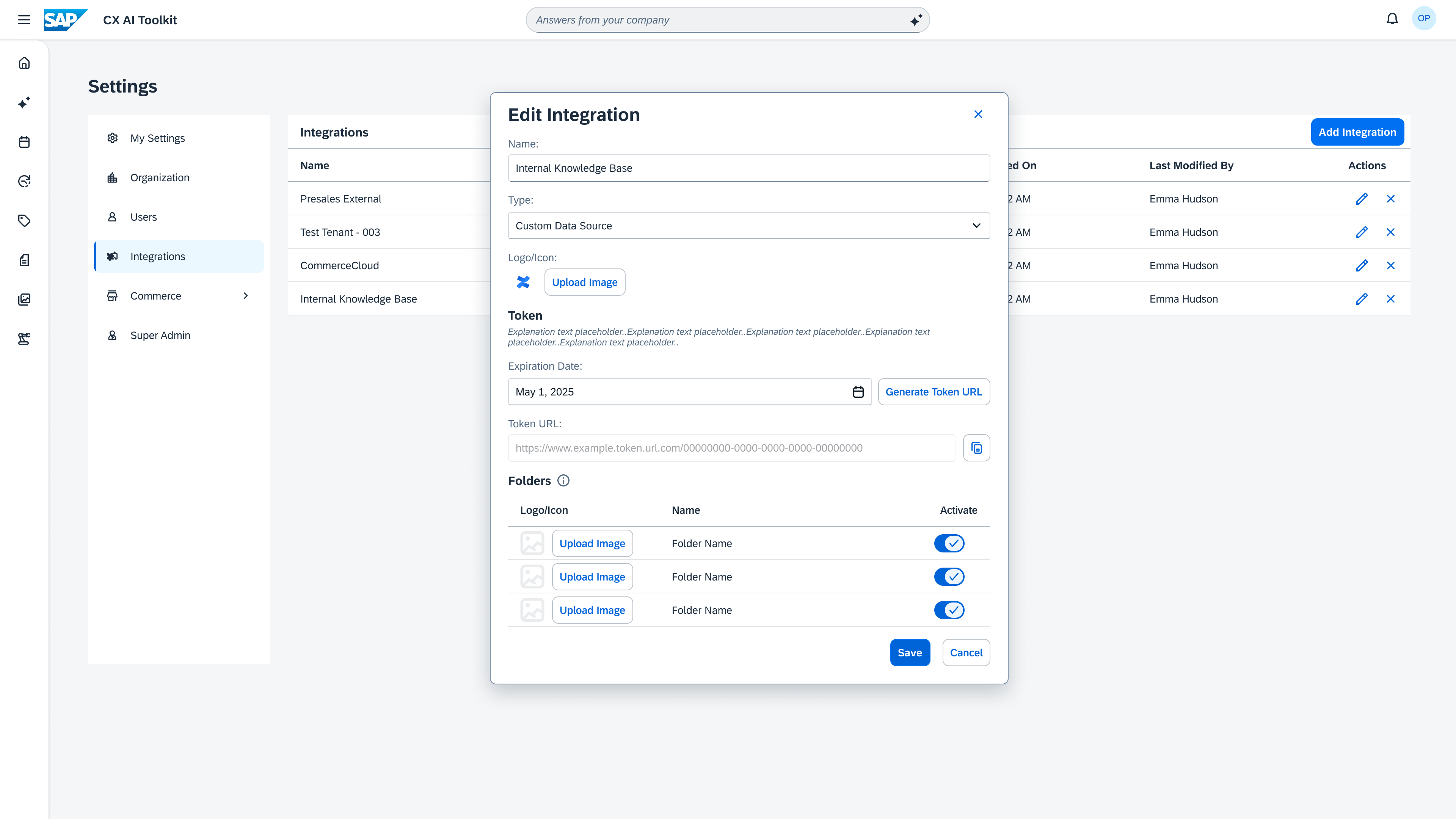
Intelligent Q&A support for service tickets and cases generates answers to business questions by finding and compiling the content of cases in SAP Service Cloud and tickets from SAP Cloud for Customers as sources for answers, saving time searching through thousands of records. Services teams can also integrate custom data sources and improve the answers provided by their unique company data.
Customize data sources for the intelligent Q&A feature in SAP CX AI Toolkit
SAP Intelligent Agriculture: Farming intelligence – create and process farming recommendations General availability
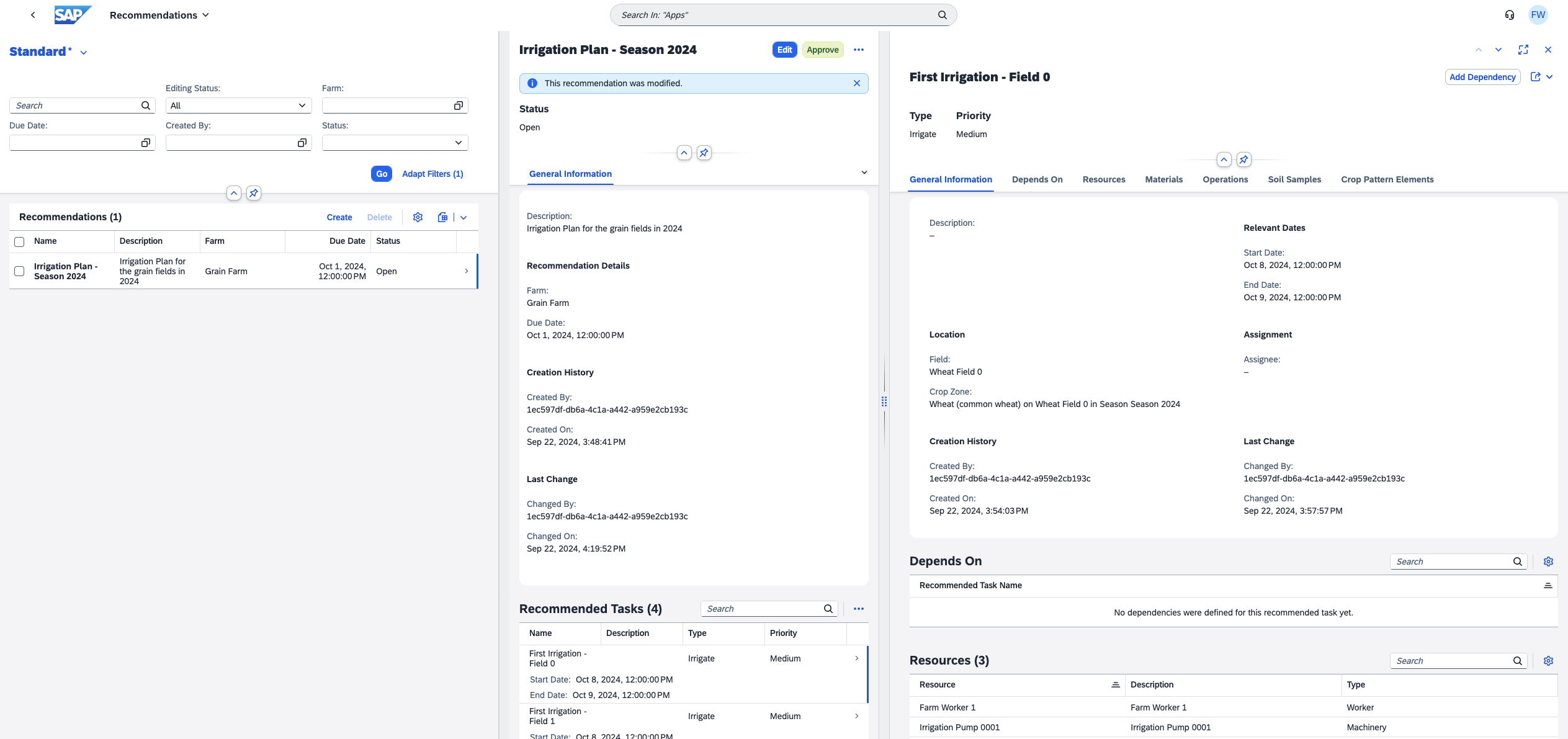
SAP Intelligent Agriculture now enables agribusinesses to create and process recommendations on when, where, and how to conduct farming activities, hence sustainably increasing farming efficiency and helping them thrive. These recommendations can either be created through an API for data science models or created in the solution UI directly.
Create and process executable farming recommendations in SAP Intelligent Agriculture
SAP Business Network: Intelligent invoice error classification SAP Early Adopter Care
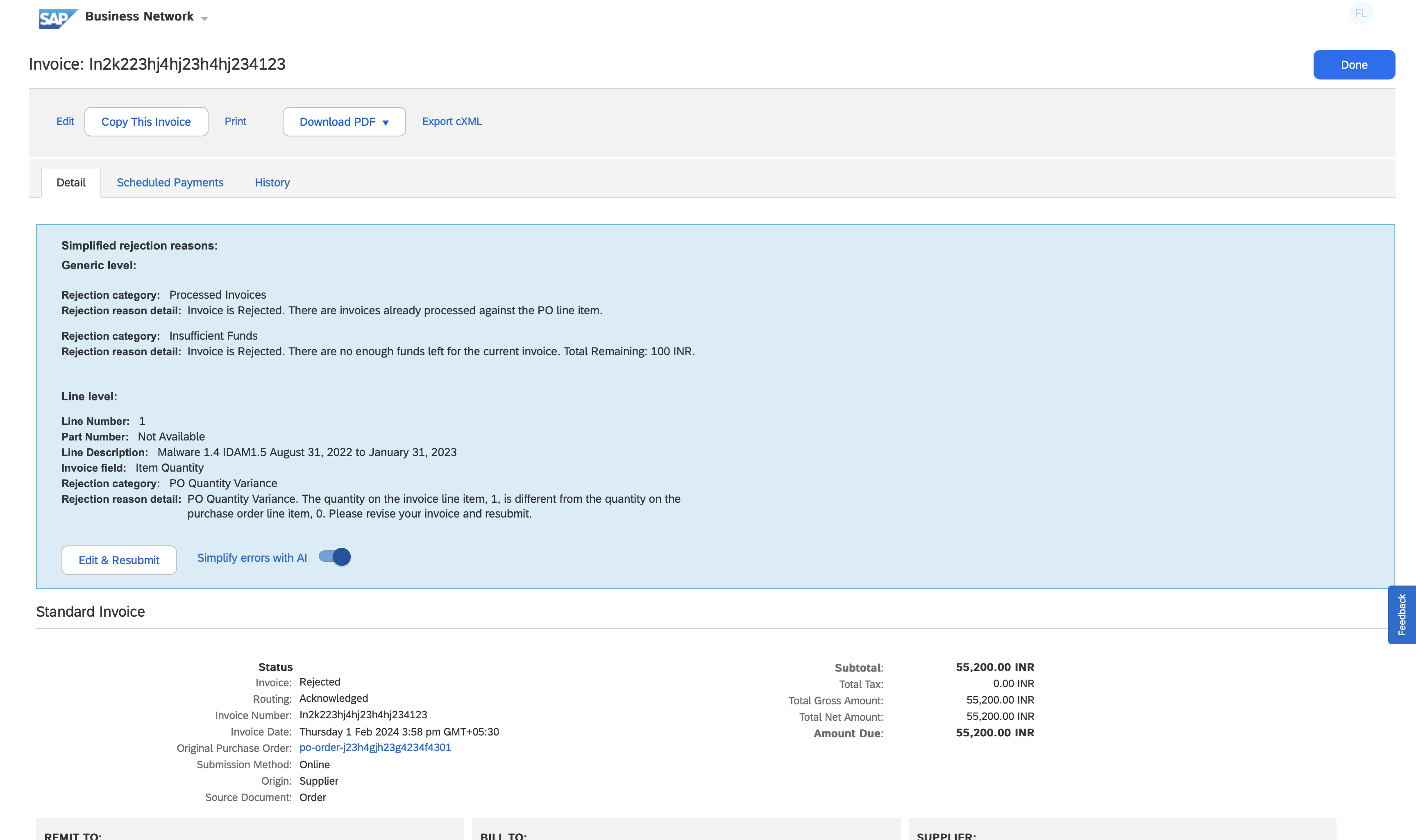
The invoice error classification feature helps suppliers process rejected invoices for payment in SAP Business Network and reprocess invoices accurately to address initial invoice submission errors after categorizing them into appropriate rejection categories. Suppliers can expect to reduce invoice re-processing time by up to 40%* and reduce days sales outstanding impacted by rejected invoices by up to 10%*.
Invoice error message categorization in SAP Business Network
SAP Concur: Chart of accounts mapping for product connectors General availability
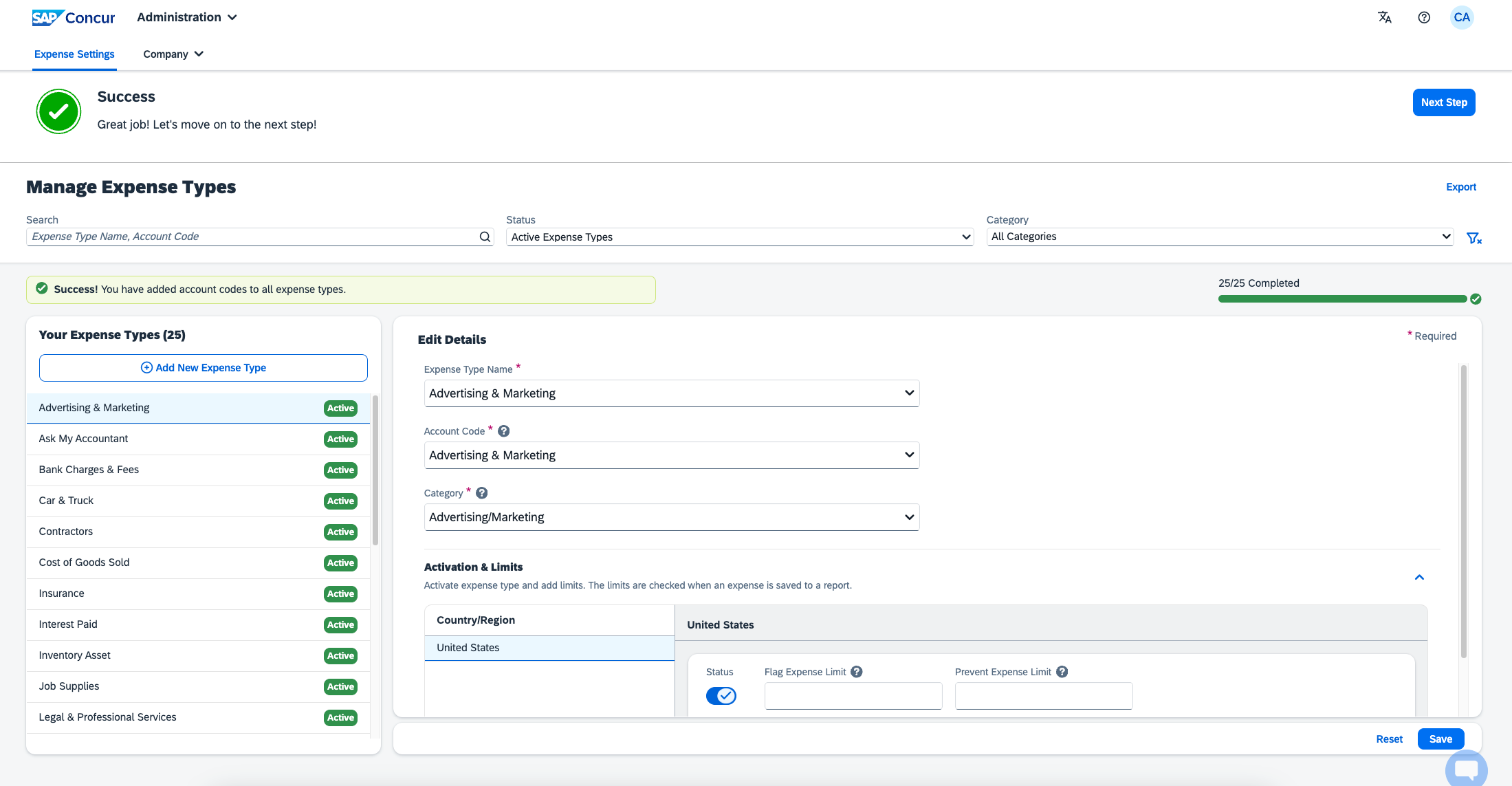
In Concur Expense, users can now access an AI-generated chart of accounts mapping for product connectors, such as QuickBooks or Xero, and decrease the setup time and effort of expense-type administration activities, including, for example, expense type creation and account code mapping.
AI-powered chart of accounts mapping for product connectors in SAP Concur
SAP Product Lifecycle Management: Joule General availability
SAP Integrated Business Planning for supply chain & SAP Asset Performance Management: Joule SAP Early Adopter Care
The conversational search feature within Joule is now supported in SAP digital supply chain solutions, providing smooth and contextual access to SAP Help Portal content and summarizing it in a clear answer to the question. Users can perform informal searches up to 95%* because they do not need to browse through a long search result list or read through several documents to find the correct information.
Watch this short demo of Joule in SAP Integrated Business Planning for supply chain:
Learn about the feature highlights in September 2024 with SAP Datasphere!
We delivered two nice releases this month, so let’s check out my top features:
1. Cloud object stores as sources in replication flows
2. Remove persisted data in task chains
3. Scheduling mass deletion of filtered records from local tables
4. Analytic Model: define order of variables
5. Changing space language for metadata translation
Key Moments:
00:16 Cloud object stores as sources in replication flows
00:57 Remove persisted data in task chains
01:17 Scheduling mass deletion of filtered records from local tables
01:48 Analytic Model: define order of variables
02:10 Changing space language for metadata translation
To learn more about SAP Datasphere, visit: https://sap.to/6050olsxe
Join our SAP Datasphere community to always stay up to date: https://sap.to/6052olsxg
Check out our product roadmap for SAP Datasphere: https://sap.to/6053olsx9
#sapdatasphare #cloud #sap
The latest version of the SAP AI Ethics Handbook is the one-stop shop for applying the SAP Global AI Ethics policy and creating ethical AI solutions that support our commitment to deliver relevant, reliable, and responsible AI.
The updated handbook now contains information about generative and other types of AI and how to apply SAP’s updated ethical AI guiding principles. Here is a brief introduction to the handbook and how you can use it to apply SAP’s AI ethics policy to your work.
SAP’s Guiding Principles on AI Ethics
Principles 1-7 are applicable for teams involved in creating AI systems; principles 8-10 are for governance requirements.
Proportionality and Do Not Harm
Safety and Security
Fairness and Non-Discrimination
Sustainability
Right to Privacy and Data Protection
Human Oversight and Determination
Transparency and Explainability
Responsibility and Accountability
Awareness and Literacy
Multistakeholder and Adaptive Governance and Collaboration
Who Is the Target Audience for This Handbook?
In a nutshell – everyone developing and implementing AI.
This handbook is for everyone who wants to give users confidence in the SAP AI ethics processes and confidence that humans are at the core of SAP’s AI processes. In short, it’s for everyone who wants help create a human-centered AI culture. Specifically, principles 1-7 apply to teams creating AI solutions, while principles 8-10 apply to governance teams.
The handbook explains how human-centered AI is achieved with tools like user research, design thinking, and user stories. These tools help create products that are closely aligned to the needs of SAP’s target groups, increasing benefits and mitigating the risk of unintended harm in SAP AI use cases.
What Is an AI Use Case at SAP?
An AI use case means that the AI system is built either on symbolic AI, traditional/narrow AI, or generative AI. This handbook is applicable to all three types of AI use cases.
How Do You Determine an AI Use Case?
In the handbook, there is an ideation checklist that guides you through the process to determine the type of use case – red line, high-risk, or standard. The handbook also has detailed checklists for validation, realization, productization, and operation.
What Is a Red Line Use Case?
Red line cases are AI use cases that are prohibited because they undermine personal freedom, undermine society, and/or cause intentional damage to the environment.
What Is High-Risk Use Case?
An AI use case that meets one of the high-risk criteria listed below is a high-risk use case:
Personal data is processed.
Sensitive personal data is processed.
It could negatively affect the well-being of individuals or groups, such as social, safety, financial, and/or physical harm.
It has automated decision-making.
It is a high-risk sector, like HR, healthcare, law enforcement, or democratic processes.
What Happens with High-Risk Use Cases?
The use case classification is checked by the SAP Global AI Ethics organization. If the organization agrees that the high-risk classification is correct, the SAP Global AI Ethics steering committee will review the case and recommend what, if any, further action needs to be taken.
Hear what guiding principles resonate the most with some of our in-house AI ethics experts:
“The guiding principle Safety and Security resonates with me because it covers everything that we need to take care of: AI security to ensure our systems are robust and work as designed and AI safety for protecting individuals, society, and the environment from harm done by AI systems. The guiding principle Transparency and Explainability resonates with me because it describes critical prerequisites to ensure human oversight – for humans on the loop like technical experts as well as humans in the loop such as business experts. Additionally, my cognitive scientist self is intrigued by the challenge to make AI output understandable for humans.”
– Bettina Laugwitz, Director, AI Ethics & Responsible AI
“The guiding principle Fairness and Non-Discrimination resonates with me because I believe this is currently the biggest gap in the development of AI and the reason why AI has the potential to harm human rights. Many AI scandals to date have been violations of this principle, including discrimination against women in finances and HR, to name but a few. AI cannot grow without the co-creation of, for example, minorities, the Global South, and women. The guiding principle Sustainability may be my biggest concern about AI, but it is also our biggest innovation possibility. Indigenous rights, co-creation, protection, and understanding how to protect fragile ecosystems parallel to the exploration and development of AI is crucial. SAP has the potential to explore how to become ‘green’ on this topic. This principle should be a priority for designing for future generations.”
– Camila Lombana Diaz, AI Ethics Expert and Researcher
“I am convinced the guiding principle Responsibility and Accountability gets to the heart of something very important: no matter how human AI appears to us, it cannot and should not be held morally accountable for its actions. AI is built and used by humans – and therefore responsibility and liability for all decisions and actions taken by AI must be assigned to human actors in order to ensure effective protection for those affected by AI. The guiding principle Fairness and Non-Discrimination in the development of AI makes a significant contribution to protecting human rights; it is difficult, however, to standardize processes to ensure fairness and many case-by-case decisions need to be made, which can be a challenge for those developing AI. Nevertheless, compliance with this principle is non-negotiable, which is why I am committed to supporting developers building fair AI.”
– Saskia Welsch, AI Ethics and Responsible AI Team Member
Alexa MacDonald is a senior editor for SAP News.
Follow SAP News on LinkedIn for the latest and greatest
#clouderp #sapcloud
💫Join Paul and Phil as they explore the latest innovations in ERP, with a focus on SAP’s role in driving the future of business technology.
🚀They’ll discuss the integration of AI, machine learning, and IoT into ERP systems and how these technologies can transform business operations, improve decision-making, and foster a culture of continuous improvement. You are invited to submit questions for a live Q&A with the speakers.