Clear Goals Are the Foundation for Success in SAP S/4HANA Cloud Migration

Björn Braemer, an expert in Transformation and Program Management at SAP, shares his insights as one of the co-authors of the “Mapping your journey to SAP S/4HANA Cloud Private Edition” guide. Here, he offers practical advice for companies starting – or already progressing through – their transition to cloud ERP.

Q: Your team recently made a comprehensive update to “Mapping your journey to SAP S/4HANA Cloud Private Edition.” Why?

A: Since the first edition of the guide was published in 2018, the technological landscape has changed significantly and, of course, we want to provide our customers with the most up-to-date information. That’s our ongoing goal: to offer comprehensive guidance to companies looking to transition to SAP S/4HANA Cloud Private Edition. There’s plenty of information on the subject online, coming from different perspectives and with various focal points. We wanted to create a central, reliable source of information that can serve as a planning tool. The entire transition process is covered, from initial considerations to go-live. At the same time, you can read the chapters independently if a specific topic feels more relevant. And it’s all written in a practical, hands-on way – no buzzwords, just real value for the reader.

“A successful SAP migration starts with the right mindset. The cloud mindset makes all the difference.”

Q: What sources did you use?

A: Our approach draws heavily on external sources and focuses on addressing real customer pain points. We gathered insights from various user groups and institutions, such as Koblenz University of Applied Sciences, to document the specific challenges customers face – or perceive they face. While our internal experts, such as the Regional Implementation Groups and the Customer Care Center, played a role, they primarily contributed SAP’s best practices and expertise to answer these customer-driven questions. Using the Pareto principle, we identified the challenges that account for 80% of project success. But we didn’t stop there. We are actively updating the guide based on ongoing customer feedback. For example, we were recently asked to add a chapter on our acquisition of WalkMe – and we’re on it!

Q: Were there any challenges that surprised you?

A: Surprised might not be the right word, but there are two main areas where I see easily avoidable issues.

First, there’s the lack of a cloud mindset. Some decision-makers still struggle to understand that a cloud environment has different requirements compared to an on-premise infrastructure. Throughout the guide, we address this need in several chapters, including the “Clean Core” chapter, which emphasizes standardizing processes and moving away from old customizations. A true cloud mindset requires attention to multiple components, all aimed at achieving greater flexibility, simplicity, and innovation. Everyone involved needs to understand this before the project starts or else you end up with misunderstandings and delays.

Second, there’s often room for improvement in project management. A project setup with clearly defined responsibilities and the right expertise is crucial. And those in charge need to be empowered to make decisions – otherwise, too much time gets wasted on unnecessary approvals or multiple iterations for validation and consensus discussions.

Q: Considering the entire guide, what are the most important recommendations?

A: Having a clear goal is the foundation. It serves as the central guiding element for all individual decisions. The goal must be clearly defined from the outset and, most importantly, pursued consistently. It may sound simple, but it’s so easy to lose sight of the bigger picture in the heat of the moment! For example, does a company primarily want to reduce existing dependencies or get prepared for digital business models? Depending on the objective, the processes will be shaped quite differently.

The Only Book You Need to Read About SAP S/4HANA

“Mapping your journey to SAP S/4HANA Cloud Private Edition” provides IT leaders with the perfect blend of theoretical insights and practical guidance to help keep their company digitally prepared beyond 2027.

Download it for free now.


Thomas Bamberger is president of SAP Customer Evolution.

Planning to migrate your ERP system to the cloud? The RISE with SAP Methodology can offer comprehensive support

SAP S/4HANA Cloud Public Edition Recognized in Gartner’s 2024 Magic Quadrants

SAP S/4HANA Cloud Public Edition has been recognized as a leader in the 2024 Gartner Magic Quadrants for both Cloud ERP for Service-Centric Enterprises and Cloud ERP for Product-Centric Enterprises, highlighting its influence in the evolving ERP landscape. According to Jan Gilg, President and Chief Product Officer for Cloud ERP at SAP, this recognition underscores […]

The post SAP S/4HANA Cloud Public Edition Recognized in Gartner’s 2024 Magic Quadrants appeared first on InsideSAP.

Expansion stages of financial accounting in SAP Business One

With this blog entry, we would like to introduce you to how Integrated Financial Accounting can be used in SAP Business One. In our everyday consulting work, we have encountered four expansion stages.

The post Expansion stages of financial accounting in SAP Business One appeared first on SAP Business One Cloud.

01/2023 Press Release – conesprit GmbH is now SAP-Gold-Partner

„Simply the best for our customers“ – conesprit GmbH is now SAP-Gold-Partner, with this status, conesprit GmbH has achieved the highest partner level that nationally operating companies can receive.

The post 01/2023 Press Release – conesprit GmbH is now SAP-Gold-Partner appeared first on SAP Business One Cloud.

Faster than the carrier pigeon – the SAP Business One Mailer

With conesprit’s SAP Business One Mailer, documents can be sent as email attachments.

The post Faster than the carrier pigeon – the SAP Business One Mailer appeared first on SAP Business One Cloud.

Accelerating Your Journey: AI’s Transformative Role in Sustainability

As the 29th UN Climate Change Conference (COP29) opens today in Baku, Azerbaijan, the global community continues to face an urgent call to action on climate change. Coordinated, innovative solutions are paramount to addressing this complex crisis, and advanced technology – especially AI – stands as a powerful enabler for transitioning to a net-zero economy. Recognizing AI’s potential to drive climate action, SAP has delivered two use cases that highlight how AI-driven sustainability software can streamline processes, eliminate manual work, and enhance precision.

With automated Emission Factor Mapping in SAP Sustainability Footprint Management and AI-assisted ESG Report Generation in SAP Sustainability Control Tower, SAP can support companies in setting meaningful environmental targets, ensuring compliance, and managing carbon footprints with heightened efficiency and accountability.

“Sustainability executives are on board with artificial intelligence. More than half say improving data analysis and consolidation using AI are top actions they will be taking over the next three years to enhance ESG capabilities.”

Addressing the Strategy Execution Gap in Sustainability Reporting, KPMG, February 2024

Emission Factor Mapping in SAP Sustainability Footprint Management

To calculate product carbon footprints accurately, companies must assign emission factors to thousands of purchased products. Ideally, emission factors are provided directly by suppliers, but often companies need to use industry averages based on product attributes like name, category, or location. Up until now, this mapping process has been a manual, time-consuming, and error-prone task that required expertise in lifecycle assessment (LCA), determining the environmental impacts associated with all the stages of the lifecycle of a product, process, or service.

Drive scalability, standardization, and trust in carbon data exchange across your supply chain

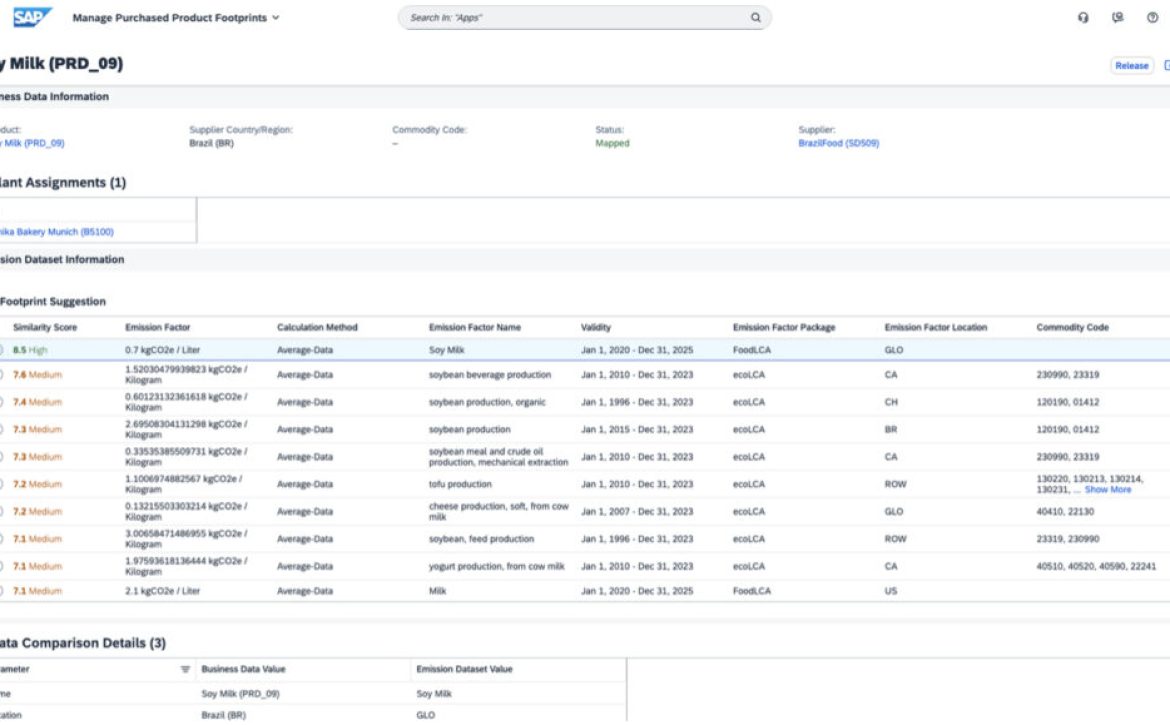
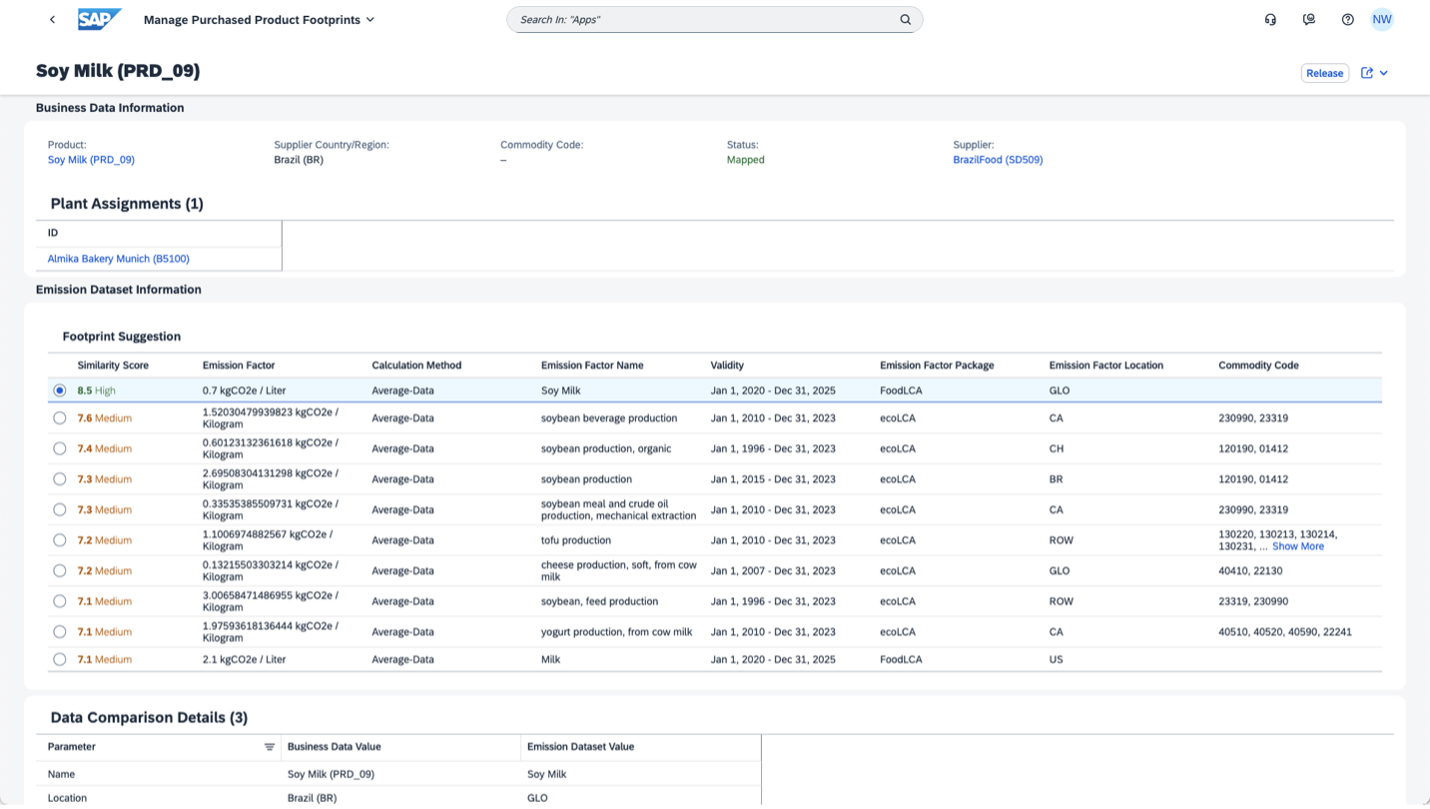
To help make this process easier and more efficient, SAP has introduced an AI-based capability within the SAP Sustainability Footprint Management solution. SAP’s AI engine can automatically suggest emission factor mappings for purchased products and services and can assign a similarity score to each recommendation.

For the mapping, SAP generates embeddings for both, emission factors from LCA databases and product data from the ERP system. Embeddings are vector representations – numerical representations of textual information to provide context and meaning of a text. Both sets of embeddings are saved in SAP HANA Cloud vector engine.

The system compares these embeddings to help identify the quality of the mapping and provide suggested results. This helps businesses reduce manual effort by up to 80% and calculate product and corporate carbon footprints quicker and with greater precision, even without LCA experts. It can also accelerate their sustainability reporting timelines and help them respond faster to regulatory demands.

AI-Assisted ESG Report Generation in SAP Sustainability Control Tower

In addition, SAP embedded a generative AI-powered reporting capability within SAP Sustainability Control Tower. Creating sustainability reports that align with internal strategies and meet external standards, such as the CSRD, is essential for staying compliant and transparent. However, gathering relevant environmental, social, and governance data and drafting these reports can be highly resource-intensive, involving multiple teams and complex data sources.

That’s why SAP’s AI capability helps generate comprehensive ESG report drafts based on best-practice templates and the company’s available ESG metrics. Once users select a template, AI can automatically collect the most relevant metrics from SAP Sustainability Control Tower, create graphs to visualize the data, and generate a polished report draft. That helps companies spend up to 98% less time collecting ESG metrics and up to 80% less time in creating a report.

Some key benefits of the feature include:

  • Efficient data utilization: The AI-powered solution leverages large language models and SQL grounding techniques, which help transform natural language inquiries into precise database queries that access real-time data from structured databases. That’s how it transforms raw data from customers’ systems into accurate, comprehensive reports tailored to specific timeframes.
  • Visualization: The AI generates insightful textual content through SQL-based data retrieval, helping to ensure data integrity and compliance. Additionally, it creates visually appealing charts and tables to help enhance report clarity and understanding.
  • Automated verification: Our robust system prioritizes data security by avoiding direct SQL query execution and employing a Retrieval Augmented Generation (RAG) process to help safeguard against informational discrepancies.

Watch a demo to learn more.

The Future of AI in Sustainability

The use cases above are just the beginning. AI’s potential to transform sustainability management is enormous, and at SAP we are accelerating the creation of use cases to be at the forefront of our customers’ sustainable transformation journeys. For example, users will be able to interact through natural language with SAP’s AI copilot Joule that can offer actionable recommendations and simulations to help improve environmental and social performance. And we will continue to apply AI to make the acquisition of sustainability data easier.

Using SAP’s ERP-centric, cloud-based, AI-enabled approach, we’re working to ensure AI’s massive potential turns into both real business transformation and sustainability outcomes. AI and technology can help us better understand and monitor the environment, improve energy efficiency, optimize resource management, and develop innovative solutions for reducing greenhouse gas emissions.

As COP29 convenes in Baku, it is essential for global leaders and decision-makers to fully explore AI’s transformative role in addressing climate change. The urgent demands of this crisis call for the kind of innovative, AI-driven solutions that can unlock greater precision, efficiency, and impact. By leveraging AI not only to streamline business operations but also to set and meet ambitious environmental goals, we are shaping a future where technology empowers businesses to thrive responsibly, contributing actively to a sustainable and resilient planet.


Gunther Rothermel is chief product officer and co-GM for SAP Sustainability.

Sign up to receive weekly news highlights from the SAP News Center

Navigating Compliance: AI Solutions for SAP Localized Business Processes

Join Eva as she showcases how SAP Localization, powered by SAP Business AI, helps businesses navigate the complexities of global compliance. Explore how SAP leverages AI to simplify compliance with local regulations. Discover the power of localized software solutions that adapt to changing regulations across various countries, enhancing efficiency and accuracy in e-document https://sap.to/6050qBaQw on Demand: https://sap.to/6051qBaQb

Video Chapters:
00:00 – Introduction to Global Compliance Challenges
Learn about the increasing need for compliance in a global business environment.
00:05 – The Rise of E-Invoicing Regulations
Discover the trend of mandatory e-invoicing in major economies.
00:13 – SAP’s Localized Solutions Explained
Understand how SAP provides localized versions to help businesses comply with regulations.
00:53 – Adapting to Changing Regulations
Explore how SAP’s regulatory-relief-as-a-service keeps you compliant.
01:26 – AI Enhancements in Localized Processes
See how AI transforms localized business processes for better compliance.
02:58 – Real-World Example: E-Document Processing with Joule
Witness how AI assists in understanding and resolving e-invoicing errors efficiently.

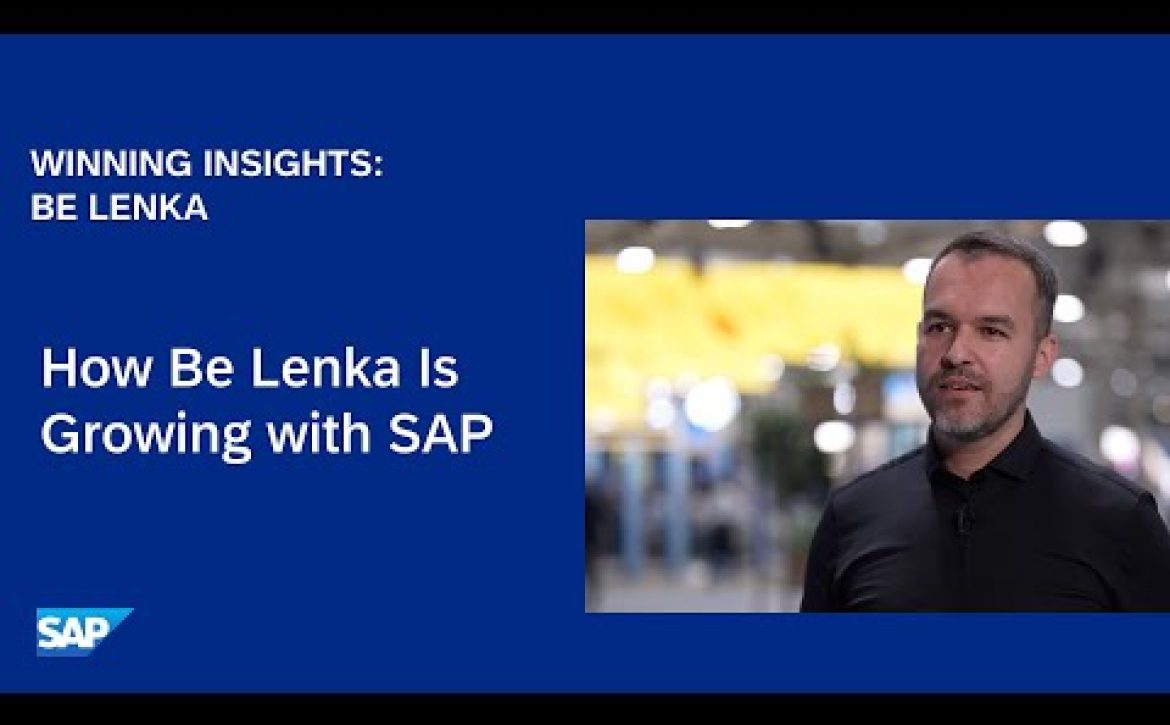
High-Growth Barefoot Footwear Pioneer Be Lenka Steps into the Future with SAP S/4HANA Cloud Public Edition

As demand for sustainable and innovative consumer goods continues to rise, Be Lenka, the Slovakian pioneer in barefoot footwear and ergonomic baby carriers, has chosen GROW with SAP S/4HANA Cloud Public Edition to help broaden its global footprint in the industry.

“We started six years ago in the basement,” explains Peter Brezani, Be Lenka’s chief operating officer, “with seven in the office and only two collections of shoes.” Dedicated to high-quality craftsmanship, innovation, and sustainability, Be Lenka now has more than 100 employees, offers 250 collections of shoes, and delivers products to over 70 countries.

Maintaining Security Material with SAP Cloud Integration

Cloud Integration provides the Security Material tile to enable users to manage security material on the tenant.

SAP Analytics Cloud: “Just Ask” – Data Analysis with Gen AI – New Feature

Explore the exciting new feature, ‘Just Ask,’ in SAP Analytics Cloud! Learn how this generative AI tool surpasses traditional Search to Insight by utilizing Large Language Models for intuitive, business-friendly queries. See how ‘Just Ask’ understands everyday language, and delivers insights with various chart types. Ideal for business users and administrators alike, this video showcases how ‘Just Ask’ simplifies complex data analysis and ensures consistent results across your organization. Don’t miss out on how we integrate Joule AI into SAP Analytics Cloud for an enhanced user experience. For more information, visit : https://www.sap.com/products/technology-platform/cloud-analytics/features/generative-ai.html

Previous Next
Close
Test Caption
Test Description goes like this