How Hamburg Prevents the Super Traffic Jam

­­­Streets, bridges, waterworks: The maintenance of Hamburg’s infrastructure is complex. How does the city manage to balance necessary construction sites and flowing traffic?

SAP HANA Cloud: Build and deploy intelligent data applications at scale

Hamburg has more bridges than any other city in Europe. For Germany’s second largest city it’s a complex task to maintain its 2,500 bridges and other structures like pedestrian tunnels, locks, flood barriers, and embankments.

The State Agency for Roads, Bridges and Waterways (LSBG) operates a large portion of the traffic infrastructure in Hamburg and is responsible for the entire lifespan of these public works.

“We’re an important player in flood protection and the prevention of water pollution as well as the maintenance of most roads and bridges in Hamburg,” Erdinc Karabugday, head of Planning and Controlling at LSBG, shares. “Together with our network, we build and protect everything that keeps Hamburg together.”

SAP technology is one building block to perform this duty safely and efficiently.

Free Flow of Traffic as Top Priority  

Mobility plays a key role in the lives of people in Hamburg and other major cities. Bridges bear a particularly heavy load, because they are critical junctions in the city’s transportation network. Tracking the condition of bridges and planning for their maintenance needs and upgrades is vitally important to keep people moving in urban areas.

Karabugday describes the problem in a nutshell: “Our objectives are long term, so basing operational decisions solely on the current situation isn’t enough. We need comprehensive data for the strategic context – not only economic aspects, but social and ecological impacts as well. Our SAP solution supports us with this.”

The manual entry of damage to structures like bridges used to be very expensive and time-consuming, a complex process made even more difficult by the fact that data entry and analysis are performed by both the agency’s own staff and external companies.

Digital Representation of Infrastructure

To reduce Hamburg’s renovation backlog and create a sustainable long-term solution, LSBG teamed with SAP to develop a standardized data platform. One central aspect involves merging data from a variety of sources on SAP HANA Cloud, making it possible to blend data such as the location and condition of each structure. The results feed into a digital model of streets and bridges and can be used to guide decisions and generate precise forecasts for maintenance and budget planning. 

Ulrike Brecht, architect advisor in Customer Advisory Public Sector at SAP Germany, explains: “The project was initially intended to handle bridge maintenance. Employees conduct the necessary maintenance work and inspections on site. They also document the condition of a structure, ensuring that necessary maintenance measures are carried out at the right time.”

All available data on the structures, including road and bridge data as well as geographic and monitoring data, is merged in SAP HANA Cloud. When combined with aging models for the structures, this information can be used for forecasting when specific road segments will require resurfacing, for instance.

These data-driven forecasts put infrastructure budget planning on a new, firmer foundation and make it possible to define the priorities for object renovation to minimize the impact on traffic flows and the lives of urban residents.

Future Urban Platforms

Cities around the world face enormous challenges in the coming years when it comes to protecting and maintaining their residents’ quality of life. Dr. Philipp Schulz was a research assistant at the University of Heidelberg and wrote his doctoral thesis on digital urban development. Today, he advises cities and communities on topics like revitalizing inner cities, redesigning public spaces, and civic participation.

One trend Schulz has observed in the cities and towns he works with is the development of urban dashboards that show all the data collected in a city as important parameters such as air quality, weather forecasts, and movements of people.

For Schulz, developing a long-term digital strategy is one of the pillars of modern urban planning.

“From my perspective the term ‘smart city’ is outdated,” he says. “Today I call it ‘platform urbanism,’ an approach in which different players and their information are brought together on one platform.” Platform urbanism describes how apps and websites are changing the way people in cities live, work, and interact with one another. It involves the digitalization of individual areas, which are then brought together incrementally.

The city of Hamburg is on the right track. “Hamburg’s goal is to handle the full maintenance management of its infrastructure through a standardized data platform,” says Brecht.

The city is in the process of expanding the accomplishments of this project to other areas, such as the maintenance of public parks and municipal buildings.

Revitalize public services and improve citizens’ lives with cloud-based and AI-driven SAP software

How a “Bold, Curious” Tech Approach Led RAUMEDIC to New Success

RAUMEDIC has big plans for its global network of production facilities, including a rollout of SAP Digital Manufacturing to all of its plants worldwide by 2028.

“Try out new innovative software and implement them quickly,” RAUMEDIC’s Christian Vogler told SAP’s Winning Insights. “So, if they fail, they should fail fast; and if they succeed, they can benefit from them for a longer time.”

For the German med-tech and pharma solutions provider, technology is a key factor in reducing daily workloads, according to Vogler. This frees time for more important tasks. Learn more: https://news.sap.com/?p=230577

00:00 Time for the Important Things
00:28 Global Plans for Cloud-Based Tech
00:50 Fail Quickly – or Succeed!

SAP Business AI Helps Syntax Revolutionize Timesheet Task Tracking

Canadian consulting firm Syntax leverages SAP Business AI and natural language processing to transform its timesheet project tracking. The new intelligent solution helped the company shorten the billing cycle significantly.

SAP AppHaus: Humanize business software and make innovation real

What has helped Syntax, formally Beyond Technologies, might soon be available for its clients too.

The tracking of revenue-generating activities and efficient billing routines are critical for professional services and consulting business to succeed. In exactly this operational area of its company, Syntax identified opportunities for improvement.

The company decided to explore use cases and existing solutions that leverage the power of SAP Business AI to transform and improve its timesheet task tracking.

Human-Centered Approach: Business AI Explore Workshop

Professional service firms that bill clients for their work need highly efficient time-tracking and billing systems. To address these challenges, Syntax, along with two other customers, began its journey with the SAP Business AI Explore Workshop, a human-centered process that helped evaluate operational issues. Following an additional SAP Business AI Design workshop, also offered by SAP AppHaus, Syntax entered the “Run and Scale” phase to implement an effective solution to meet its specific needs.

Navigating Billing Inefficiencies

For Syntax, the timesheet process is a necessary part of operations, serving as the backbone of task tracking and billing. The Timesheet app in SAP S/4HANA Cloud is widely utilized in the professional services industry. Considering the time constraints that most consultants have when entering their time reports, Syntax wanted to look for opportunities to enhance its usability and efficiency. Syntax recognized that complexities within the app could lead to delays in time entry. These delays often resulted in incomplete or inaccurate records that impacted billing and ultimately revenue generation.

Syntax looked to the SAP AppHaus team to optimize timesheet data entry and elevate the user experience for both employees and management through the use of SAP Business AI.

Harnessing the Power of Generative AI and SAP BTP

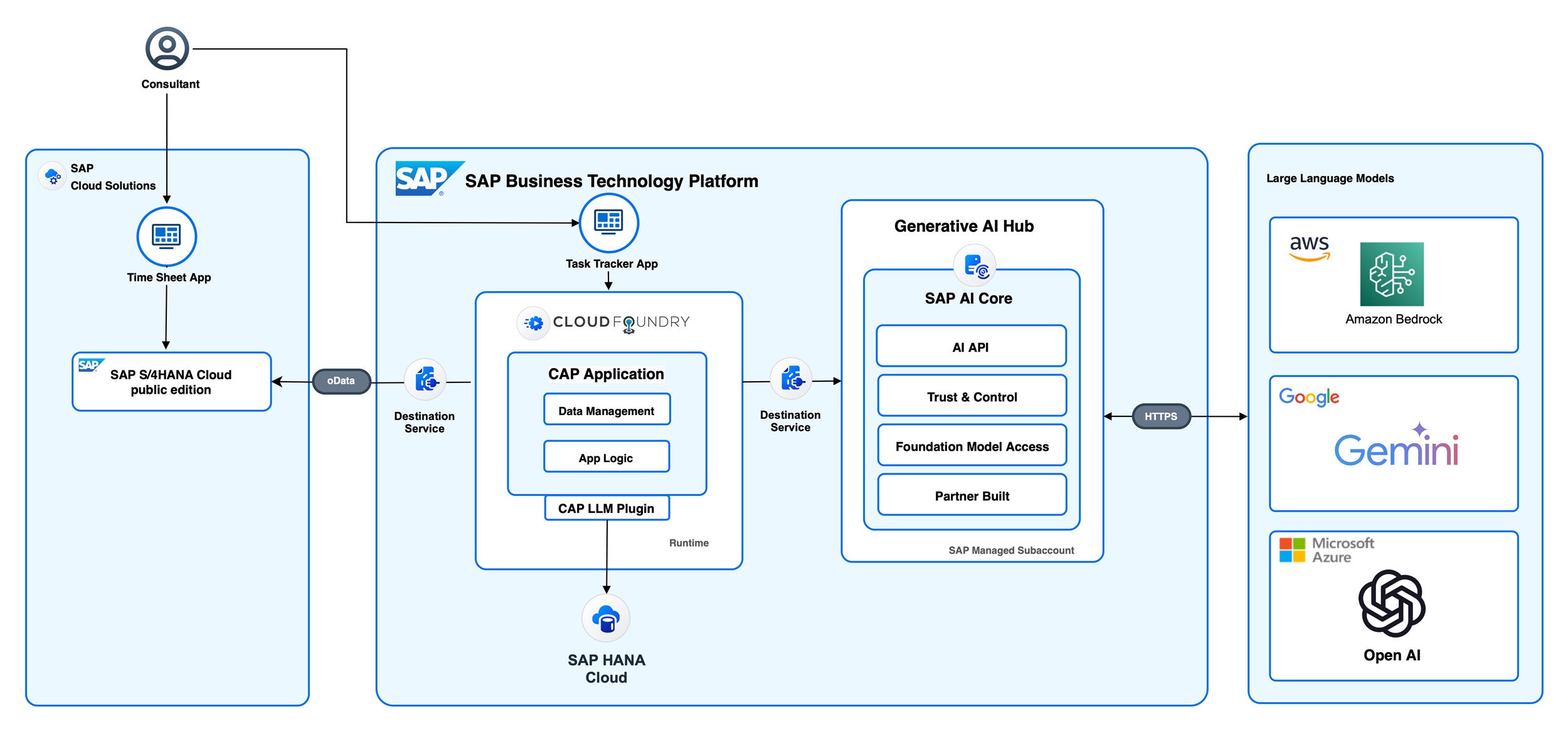
In a joint project with the SAP AppHaus team, Syntax and two other customers evaluated existing SAP solutions for the use case. To tackle billing inefficiencies, SAP developed an innovative application powered by generative AI and built with SAP Business Technology Platform (SAP BTP) and SAP S/4HANA Cloud (see diagram), based on feedback from users such as Syntax.

Syntax Solution Diagram

“With this Timesheet app task tracker, consultants can effortlessly record billable hours in real time using natural language, right after completing a task,” Ingo Feucht, senior director of Product Management for SAP S/4HANA at SAP, said about the success of this project. “Ultimately, we consider this a Joule use case, but the project is a great showcase of how SAP customers can leverage generative AI hub to quickly build their own custom business AI solutions.”

Easy Handling

The new solution enables real-time task logging and processing. It allows users to enter timesheet data with simple conversational prompts. The usual so-called “shadow systems” that people use to temporarily note down what they worked on — for example, in Notepad or Excel — can be eliminated as the information is directly sent to the Timesheet app in draft format.

Employees can easily and accurately track how much time they spent working on each client. First experiences with the application have shown that it can considerably reduce entry delays and help ensure that employees record their hours efficiently without the cumbersome steps traditionally associated with timesheet management.

Improved Billing Accuracy

Companies failing to accurately track billable hours can lose thousands of dollars in annual revenue per employee.  The new solution supports invoices in being processed more swiftly and accurately, leading to reduced days sales outstanding as well as less non-billable hours and less customer inquiries. This means that consultants can dedicate more time to high-value tasks rather than administrative duties, ultimately resulting in an even more productive workforce.

What’s more, the new task tracker replaces individual notes, be it in Excel, Notepad, or other places where employees used to track their own time. By empowering employees to accurately and easily log their time, thus reducing unbilled hours, the new solution helps organizations capture every billable hour, maximizing revenue potential.

Frank Densborn, enterprise architect at the SAP AppHaus, summarized his experience: “With this solution, we were able to eliminate the need for shadow systems that consultants put in place to temporarily track their work before entering it into the system. So, instead of building a new timesheet application, we collaborated and innovated using SAP BTP and the generative AI hub to solve the real business problem, leveraging SAP’s human-centered approach to innovation.”

Driving Future Growth and Efficiency

The implementation of this new SAP Business AI solution not only addressed immediate operational challenges, but also positions Syntax and its clients for future growth. By benefitting from the capabilities of SAP AI Core and SAP AI Launchpad, businesses can continuously evolve their processes, ensuring they remain competitive in an ever-changing market.

Leonardo De Araujo, partner for Global SAP Innovation at Syntax, reflected on the project success: “As early adopters of SAP S/4HANA Cloud and participants in the lighthouse program, we’ve used SAP Business AI to tackle industry challenges like inefficient timesheet processing. This innovation has significantly reduced our days sales outstanding. By saving up to $100,000 per day, we shorten the billing cycle.”

A New Era for Timesheet Management

Syntax’ journey illustrates the power of innovation and collaboration within the SAP ecosystem. By harnessing advanced technologies like generative AI built with SAP BTP, organizations are not only transforming their own processes but, in the case of Syntax, also driving significant improvements for clients.

Syntax is setting a new standard. The impact of its generative AI-driven solution will undoubtedly resonate throughout the industry, inspiring others to follow suit. The future of timesheet project tracking has arrived, and it’s powered by SAP Business AI.


Yasaman Jalaei is a working student in the SAP Business Technology Office.

Subscribe to the weekly SAP News Center newsletter and get highlights delivered to your inbox weekly

SAP Guides the Cloud Journey with Infinite Opportunities for Learning and Growth

The cloud era is an infinite loop of perpetual transformation. In this environment, businesses are on a journey of continuous innovation and change, advancing dynamically with each technological and industry shift.

This perspective reflects an essential truth for today’s companies: growth and adaptation aren’t one-time goals; they’re cyclical processes essential for staying competitive and relevant. To keep up in this new landscape, businesses need adaptable guidance and proactive support that evolve alongside them.

SAP services subscription offerings can deliver on that reality without adding risk and anxiety. Like the infinity symbol, our services can provide a continuous, adaptable loop of options for enhanced learning, smooth operations, iterative optimization, and peak performance.

Let’s walk through each pillar of our fundamental cloud success framework and its advantages.

Learning – Starting with the Foundation

Learning is essential and a cornerstone for cloud success. Workforce transformation is rapidly changing, and skills are in need of continuous evolution. To help customers understand the resources available and wield them with confidence, our cloud adoption portfolio pulls together clear options for:

  • Continuous training programs for end users with SAP Learning Hub
  • Access to ongoing expertise for solution administrators and IT personnel

This foundational phase goes well beyond onboarding new cloud software. It helps cultivate a culture of agility, continuous upskilling and certification, and readiness for ongoing innovation. For example, according to SAP’s commissioned Forrester Consulting Total Economic Impact™ study on SAP Learning Hub, a composite organization representative of interviewed customers achieved substantial benefits. They include up to 25% productivity gains from enhanced upskilling, 50% cost savings with digital delivery, and a 50% faster time to competence for end users.

Optimizing for Today in Preparation for Tomorrow

Optimizing the use of cloud software and maximizing its potential is an ongoing journey. With an ever-changing software landscape, staying up-to-date on the latest features and knowing how to leverage them for the greatest impact on the business is challenging for many of our customers across all industries.

That’s why we offer SAP Preferred Success, an offering of cloud adoption services that can enable our customers to build dynamic plans. Its service portfolio can provide the continuous expert guidance and insights necessary to refine business processes and help ensure technology investments support efficient, flexible, and resilient operations.

In SAP’s commissioned Forrester Consulting Total Economic Impact™ study on SAP Preferred Success, organizations have experienced significant ROI and improvements in operational efficiency. Such benefits include 30% higher business-process efficiency, 25% time savings in release management, and a 24% boost in productivity for a composite organization representative of interviewed customers. The proactive guidance and actionable insights provided by the offering empower our customers to stay ahead of the technology curve while driving measurable results.

Operating with Confidence

In the cloud, operations take on a new form. Traditionally, companies relied on on-premise services and external consultants to manage operations. Now, the shift to cloud services demands a more comprehensive, integrated approach.

Optimize your business and encourage innovation with help from SAP Cloud Application Services

SAP Cloud Application Services offerings are tailored to help support customers using SAP S/4HANA Cloud and SAP Business Technology Platform (SAP BTP) in their daily operations. Our customers can offset cloud operations and critical processes while focusing on more valuable sides of their business – all with the full confidence of a reliable and proven partnership.

Our customers can also opt for the expanded edition of SAP Preferred Success to help leverage services readily available as part of their plan for reinforced testing, configuration management, and application and business process checks. As a result, organizations can adapt without missing a moment of opportunity for improvement, enhancement, and growth.

The service portfolio can provide tremendous value to our customers, from helping accelerate time to first value to boosting operational efficiencies and productivity in impactful ways. The insights and expertise offered can give our customers the confidence that we understand their challenges and build trust as we partner together to deliver optimal solutions.

Performing at Peak Levels

For our customers, the ultimate goal of their cloud experience is to run their software at peak performance with minimal friction and maximum results. That’s where WalkMe solutions can step in, which are now part of the SAP solution portfolio.

The solutions help put people at the epicenter of this cloud journey. They can assist organizations in proactively navigating constant technology changes, enhancing business process adoption, resolving digital friction, guiding users within their workflows, and streamlining tasks across any application.

With this flexibility, our customers can adapt their technology landscape to meet unique needs and fuel future growth while significantly reducing costs and time spent on support, user training, and development.

By enabling consistent, effective, and efficient use of software across workflows, our digital adoption capabilities can detect points of friction and provide tailored support and automation to help streamline tasks within the flow of work, across any application. In return, organizations can adapt their technology landscape to their unique needs to minimize the change curve while maximizing their cloud investments, reducing risk, and fueling future growth.

Looking Forward to a Journey of Ongoing Evolution

Times change, and so do the ways businesses operate in the cloud.

In today’s technology-driven business landscape, having great systems isn’t enough. Dependable, proactive services are necessary to keep them running smoothly. SAP cloud service plans can deliver just that. With best-practice cloud services, we can harmonize the latest technologies and cloud services into a single, user-friendly experience that helps eliminate anxiety and guesswork.

As cloud technologies evolve, so will SAP’s cloud adoption service portfolio, bringing exciting new developments to help our customers learn, adapt, and excel. Here’s to a year filled with growth, opportunity, and the guidance you need to thrive!

Discover how SAP service offerings can deliver control and peace of mind.


Chad Crook is head of Enterprise Cross Solution Sales for the Customer Success Chief Business Office at SAP.

Want the latest SAP news delivered to your inbox once a week? Subscribe to the newsletter

SAP Datasphere Highlights in 2024

What a great ride it has been in 2024 with SAP Datasphere!
Let me share a few of my personal highlights.
184 innovations were delivered according to What’s New in SAP Datasphere on SAP Help.
11,967 attendees live at all SAP Datasphere sessions at SAP TechEd.
20k+ views of monthly top feature videos on YouTube about SAP Datasphere.

My top features in 2024
Picking my top features for all of 2024 was not easy and here is my top feature list in no particular order.
– Folder Support
– Nested and Global Task chains
– Confluent Kafka
– Column Level Lineage
– Elastic Compute Nodes
– Object store (Controlled availability)

Key Moments:
00:17 Innovations of 2024
00:39 SAP TechEd
01:04 Top feature videos on YouTube
01:18 My top features in 2024
01:23 Folder Support
01:39 Nested and Global Task Chains
02:03 Confluent Kafka
02:24 Column Level Lineage
02:50 Elastic Compute Nodes
03:12 Object store (Controlled availability)
04:12 Bonus Goodie

To learn more about SAP Datasphere, visit: https://sap.to/6058QS1fk
Join our SAP Datasphere community to always stay up to date: https://sap.to/6051QS1fb
Check out our product roadmap for SAP Datasphere: https://sap.to/6053QS1fd

SAP Learning Journey Offers AI Training Solutions

The new SAP Learning Journey focuses on equipping organizations to identify and define AI use cases, reflecting the growing integration of artificial intelligence into business processes. Launched in November 2024, the course is titled “Applying a Human-Centered Approach to Identify and Define Business AI Use Cases.” It was developed collaboratively by the SAP AppHaus and […]

The post SAP Learning Journey Offers AI Training Solutions appeared first on InsideSAP.

What Is Currency Translation in SAP S/4HANA?

Currency translation is a process in which an organization translates the financial data of its foreign subsidiaries from their transaction currency into the group currency of an organization.

SAP Preferred Success: Transforming Challenges into Opportunities for Companies Worldwide in 2024

Companies face increasing pressures to stay ahead of market shifts while enhancing operational efficiency to maintain their competitive edge. And many of them are turning to the SAP Preferred Success offering to help navigate these challenges and thrive in the cloud, demonstrating how the right partnership can bring tangible outcomes.

In 2024, our customers realized measurable success across various industries by leveraging the wide range of services. From proactive guidance and product expertise to prioritized support and tailored strategies for smooth feature adoption, SAP Preferred Success has enabled ongoing optimization and innovative technology enhancement to help meet unique business needs.

The results speak for themselves: businesses are achieving greater agility, real-time insights, accelerated growth, and improved user experiences. Let’s explore how organizations are using SAP Preferred Success to help drive progress and position themselves for unstoppable growth in 2025 and beyond.

Juniper Networks: Building Financial Resilience and Innovation

Juniper Networks Inc., a leader in artificial intelligence (AI)-driven operations, needed to modernize its financial reporting and planning processes to support rapid business expansion. The company gained real-time insights and streamlined data integration by implementing the SAP Analytics Cloud solution through SAP Business Technology Platform (SAP BTP), eliminating manual processes for faster, more informed decision-making.

The standard edition of SAP Preferred Success played a pivotal role in providing critical guidance that helps ensure a smooth implementation by resolving connectivity issues, delivering expert troubleshooting, and enabling a smooth go-live. Post-deployment, Juniper continues to rely on SAP Preferred Success for guidance on maximizing quarterly updates and adopting new AI-driven features.

“With SAP Preferred Success, we can connect to product experts and have a conversation with them. This helps us better understand the upcoming functionality in a deeper, more applicable way so we can really take advantage of it once the functionality is released,” says Kathleen Kuang, senior process manager, Juniper Networks.

Fast track the value of your cloud investment with SAP Preferred Success

Juniper Networks is now equipped with advanced analytics and proactive support to maintain agility and continuously enhance financial planning, driving resilience and innovation across operations.

Government of Ras Al Khaimah: Advancing a Digital Society

The Government of Ras Al Khaimah (RAK Government) sought to align its HR organization with the UAE’s “We the UAE 2031” vision by transitioning from on-premise software to SAP SuccessFactors HCM in the cloud.

To support this initiative, the SAP Preferred Success plan for SAP SuccessFactors HCM, expanded edition provided a designated customer success manager and continuous expert guidance throughout the transition. This helped ensure reliable connectivity, a smooth go-live, and ongoing enhancements.

“Having the support of a designated SAP customer success manager before, during, and after go-live has helped to make the project a resounding success,” adds Ahmed Abdel Hady Tohamy, technical team lead in the HR Department. This SAP product specialist also added value in enhancing and improving the quality of the solution.

With the expanded edition, the RAK Government is well-equipped to drive engagement, foster innovation, and build resilience, positioning Ras Al Khaimah as a dynamic, future-focused society in the United Arab Emirates.

Orora Beverage: Maximizing Procurement’s Strategic Value

Orora Beverage, a leader in sustainable packaging solutions, sought to unlock the full potential of its SAP Ariba solutions. Faced with low adoption of advanced functionalities and a need for continuous training, the company turned to the SAP Preferred Success plan for SAP Ariba solutions, expanded edition.

Through personalized training, interactive workshops, and dedicated advisory services, Orora Beverage improved adoption and streamlined procurement processes. High-priority cases were resolved faster, productivity increased, and the company gained immediate access to SAP expertise for technical adjustments and feature enablement.

“Thanks to the SAP Preferred Success plan for SAP Ariba solutions, expanded edition, we’re more confident and agile in driving best practices in procurement to extract the best value out of our procurement processes,” shares Anoop Thakur, chief procurement officer, Orora Beverage. “We get assistance to enable new features, access to experts to handle priority issues, and advice on best practices from functional resources.”

The support has empowered Orora Beverage to enhance procurement strategies, foster agility, and achieve operational excellence.

Looking Ahead to 2025

These success stories demonstrate how SAP Preferred Success helps companies turn challenges into achievements. Whether optimizing financial planning, driving digital transformation, or enhancing procurement strategies, SAP Preferred Success remains a trusted partner in helping to navigate complex transformations, achieve impactful outcomes, and pave the way for operational excellence.

As we look ahead to 2025, SAP Preferred Success will continue to help transform challenges into opportunities, fueling sustainable growth and long-term success despite ongoing market volatility and evolving technological demands.

Explore how SAP Preferred Success can help your organization turn today’s challenges into tomorrow’s wins.


Andreia Bessa is global program lead for Enterprise Cross Solution Sales at SAP.

Get the latest SAP news delivered to your inbox once a week

How KUKA Found a Better Way to Pay for Robots

Organizations tend to stick with a good business model, once they find it. Why shake up a good thing, right?

“We have a good business model; we’re selling robots…so, why would we change it?” Christian Liedtke, head of Strategic Alliances at KUKA, said during a presentation at Hannover Messe 2024. “It’s not sufficient anymore; you have to look ahead.”

Enter outcome-based business, when usage determines how much you pay. And Augsburg, Germany-based intelligent robotics supplier KUKA has extensively analyzed data from its headquarters-adjacent plant to see where an outcome-based model might make better business sense than traditional payment schemes.

“How can we actually help our customers to be more successful?” said Liedtke, who is also chairman of the board for the Open Industry 4.0 Alliance. “Now, we have data – and with data, we can do something different.”

How Is Enterprise Architecture Relevant in SAP Landscapes?

Enterprise architecture is essential for navigating the complexities of transformation, particularly in shifting from legacy systems to modern, streamlined, and agile environments.

Previous Next
Close
Test Caption
Test Description goes like this