Who Wins the Next Disruption: Five Rules for Creating Supply Chains that Can Take a Hit

When a major supply chain disruption hits, the winners are rarely the companies that predicted it. The winners are the ones that are quickest in deciding how to best react to it.

Orchestrate your supply chain to stay ahead and exceed expectations

It is one of the simplest ways to think about supply chain resilience today, and a central theme of the latest Future of Supply Chain podcast episode with Kearney’s Rudolph Lohmeyer and Jeff Greer.

For years, resilience was treated primarily as a question of protection. How much inventory should we hold? How many suppliers should we have? Where should we build capacity? How much redundancy can we afford?

These questions still matter, but no company can prepare for everything.

For decades, global supply chains were designed around stability. That model is now being tested on multiple fronts. Geopolitical tension, environmental disruption, armed conflict, technological advances, and shifting trade relationships all shape how goods move, where they are made, and at what cost.

The bigger question is whether organizations can recognize when something changes, understand what it means to their business and make a timely decision.

And disruption does not always mean bad news. One company’s supply chain problem can become another company’s opportunity. As Rudolph Lohmeyer, senior partner at Kearney and the leader of Kearney Foresight, puts it: “Countries and companies actually see that to the extent that they can position themselves to be effective in this environment, they can create advantage because these shocks are reallocating value.”

The goal is not to build a supply chain that never gets hit, but to build one that can take a hit, adapt, and keep moving.

Here are five rules to keep in mind.

Rule 1: Know where resilience creates the most value

The instinctive response to uncertainty is often defensive: build more inventory, find another supplier, add manufacturing capacity. Each can be sensible. None is free.

Principal Jeff Greer explained: “From a supply chain standpoint, resilience is capital-intensive. Companies can build redundant manufacturing capacity and diversify supply across the globe. But they have to balance the cost, working capital, and risk exposure. You don’t need maximum redundancy. You need resilience where it matters most.”

The question, then, is not how much redundancy a company can build, but where that redundancy will actually make a difference.

Answering that requires knowing where a supply chain is genuinely exposed, which means seeing the full network. Many companies still cannot see far enough into their own. Greer added: “Most companies lack a reliable, end-to-end view of their supply chain ecosystem and the dependencies within it. That makes it extremely difficult to not only to identify an external shock, but, more importantly, to understand its business impact and determine what to do about it.”

Most companies know their direct suppliers. But what about the suppliers behind them? What happens if a critical component comes from a single factory that nobody in the organization has been tracking? How quickly would you find out?

Lohmeyer compared this complexity to the financial instruments at the heart of the global financial crisis: layers of dependencies that look manageable until something goes wrong.

Rule 2: Focus on the shocks that matter most

If the future is uncertain, why not model every possible risk? Because there are too many of them, and the most consequential are often the ones nobody saw coming. Geopolitical conflict, trade restrictions, cyberattacks, new regulations, supplier failures, environmental disruptions: The list is long.

As Lohmeyer explained, rather than boiling the ocean, organizations should identify a manageable set of strategic shocks across social, technological, economic, environmental, and geopolitical domains. He added: “Understand across that range the universe that could occur and then prioritize down within it that which would most affect an organization.”

There is also a difference between a shock and a scenario. A shock is a discrete event, such as Fukushima or the initial outbreak of COVID-19. A scenario describes the broader environment in which a business may have to operate. One demands a response. The other shapes the capabilities needed to stay resilient over time.

As Lohmeyer added, the goal is not to “reduce uncertainty and predict the future” but to “manage it and map it.”

Rule 3: Turn signals into options before they disappear

AI can shorten the distance between seeing a problem and responding to it.

Digital twins can model global supply networks and test how they might respond to different shocks. Advanced analytics can surface patterns across large volumes of data. AI can continuously monitor signals ranging from geopolitical events and tariffs to weather, commodity prices, supplier health and regulatory changes.

“AI agents can increasingly connect to planning and execution systems, allowing companies to run scenarios, identify thresholds, and take pre-approved actions while keeping humans in the loop,” Greer noted. “Now we have the ability to take these agents, tap them into the planning and execution systems so that speed to respond is ever-increasing.”

This matters because supply chain alternatives have a shelf life. A supplier may have capacity today that is gone tomorrow. A logistics route may be open until demand surges. A manufacturing alternative may hold until the next disruption closes it.

Lohmeyer added: “AI allows for a computational power that allows you to consider intersections and sequences in such a high-resolution way that we’re able to approach that work entirely differently and much more effectively. Not just faster, but better.”

But technology can only take an organization so far.

Rule 4: Technology alone does not make an organization adaptable

A digital twin cannot approve a supplier switch. An AI model cannot decide which trade-offs the business is willing to accept. A dashboard cannot decide what the company is willing to sacrifice to put things right.

Lohmeyer explained: “The ability of AI to compute pathways and sequences at massive scale gives the ability to map uncertainty in a much higher resolution way. You still require the human intelligence to understand. How do we form solutions, mobilize teams to be ready to respond? How do we build the capabilities, people, process, technologies to be able to respond?

That puts the focus squarely on the operating model behind the technology. Who has the authority to make the call? When does a potential disruption trigger escalation? Which actions are pre-approved? Who owns the data? Which teams need to be involved?

Relationships matter too. Strong supplier relationships enable faster information sharing, pre-agreed responses, and genuine diversification rather than simply duplicating capacity everywhere.

Technology can make the analysis faster. The organization still has to be capable of acting on it.

Rule 5: Build for what is coming, not just for what has happened

The hardest part of resilience is preparing for something you have never seen before. That means looking beyond the last disruption and paying attention to what is shifting around the business: technology, regulation, supplier markets, and climate patterns.

Lohmeyer described it this way: “That the future of supply chain will occur by understanding the reality that’s coming but is not yet here.”

Instead of asking what to do if a given event happens, companies can ask a more useful question: What is changing now and what could it mean for us? That shift matters because the next disruption may not look like the last one.

As Lohmeyer put it, “Those that can compress that and make highest quality decisions at speed are those who will win.”

Resilience is not about building a supply chain that can be protected from everything. That is impossible. The goal is to design one that can take a hit, understand what the disruption changes, and act while it still has options.


To hear the full conversation, tune in to the Future of Supply Chain podcast: Building Supply Chains That Can Take a Hit.

Subscribe to the SAP News Center newsletter to receive weekly stories and highlights

How Reinhausen Makes Trusted Decisions and Scales Expertise with Joule Work

Reinhausen regulates more than 50% of the world’s electricity. See how the energy technology leader uses Joule Work to scale specialist expertise and turn hours of manual work into seconds.

As the business grew, hiring qualified specialists for its niche transformer products became harder. Early AI prototypes improved individual tasks but could not deliver value across complete end-to-end processes. After moving to SAP Cloud ERP Private, Reinhausen piloted Joule Work — giving employees direct access to trusted SAP data through plain-language questions. What once took an hour of navigating transactions now takes seconds.

With over 100 AI use cases identified, Reinhausen is building a clear path from user-prompted analysis today to autonomous agents in the background tomorrow. For Reinhausen, AI is not technology for its own sake — it is about giving specialists more time for the work that matters.

Learn more about Joule Work: https://sap.to/6059BHFydL

Follow us on social:
LinkedIn: https://sap.to/6052BHFyd2
Instagram: https://sap.to/6054BHFyd4
Facebook: https://sap.to/6056BHFydA
Threads: https://sap.to/6057BHFyd7

About SAP:
As a global leader in enterprise applications and business AI, SAP stands at the nexus of business and technology. For over 50 years, organizations have trusted SAP to bring out their best by uniting business-critical operations spanning finance, procurement, HR, supply chain, and customer experience. For more information, visit: https://sap.to/6058BHFydC

#SAPCloudERP #JouleWork @reinhausentv

How dsm-firmenich Future-Proofs Transformation with RISE with SAP

See how dsm-firmenich uses RISE with SAP to unify post-merger operations, simplify its technology landscape, and prepare for future innovation.

dsm-firmenich is a global leader in nutrition, health, and beauty, formed through the merger of dsm and Firmenich. Bringing two companies together meant more than combining cultures. It also meant unifying business backbones, including finance, HR, and operational systems, so teams could work as one company.

Before its new journey with SAP, dsm-firmenich had a fragmented and complex technology landscape. With RISE with SAP, the company brought finance and HR processes together under one umbrella, helping create common processes, improve business continuity, and support greater flexibility as customer needs and market dynamics change.

Today, dsm-firmenich uses a broad SAP landscape, including SAP Ariba, Central Finance, SAP SuccessFactors, and Joule. As the company continues evolving its technology foundation, it is preparing its business to move faster, adapt to change, and explore innovation beyond integration with guided agents and AI-enabled processes.

Learn how dsm-firmenich is reimagining post-merger systems and processes with cloud-based solutions: https://sap.to/6050B1Afyo

Follow us on social:
LinkedIn: https://sap.to/6051B1AfyU
Instagram: https://sap.to/6052B1Afyq
Facebook: https://sap.to/6053B1AfyS
Threads: https://sap.to/6054B1Afys

About SAP:
As a global leader in enterprise applications and business AI, SAP stands at the nexus of business and technology. For over 50 years, organizations have trusted SAP to bring out their best by uniting business-critical operations spanning finance, procurement, HR, supply chain, and customer experience. For more information, visit: https://sap.to/6055B1Afyt

#SAP #RISEwithSAP #DigitalTransformation

How SAP Business AI Helps Lemvigh-Müller Automate Documents

What if AI could read a 20-page business document in seconds?
https://sap.to/6056B1zu7k

The George Russell You Don’t See on a Race Weekend | Significant Figures

We’re back for episode 2 of Significant Figures, a new SAP series where we’re joined by some of the most exciting and ambitious names across sport and industry to discover the numbers that have defined them.

In Episode 2, we’re joined by @MercedesAMGF1 driver, George Russell.

Watch the full episode here: https://sap.to/6056B112RO

How Autonomous Are Your SAP Operations, Really?

In this post, let’s explore why enterprise SAP needs a shared language for autonomy — and the five levels that provide it.

Product Compliance in SAP S/4HANA Cloud Public Edition 2608 | Release Highlights

SAP S/4HANA Cloud Public Edition 2608 brings new Product Compliance innovations to help organizations improve dangerous goods management, automate compliance checks, and increase transparency across the logistics value chain.

In this release highlights video, Claudia presents through her digital twin to explore the latest Product Compliance updates in SAP S/4HANA Cloud Public Edition 2608. See how new capabilities for multi-component products and dangerous goods information can help logistics, transportation, and warehouse teams reduce manual effort, improve regulatory compliance, and manage complex transport scenarios with greater confidence.

You’ll see how logistics integration for multi-component products helps support dangerous goods compliance for products that contain two or more dangerous goods. When a document is processed in the value chain, the system can automatically execute transport permissibility and mixed-loading checks, then include the corresponding dangerous goods information on value chain documents to support end-to-end compliance.

The video also covers additional dangerous goods information for the value chain. Transportation planners and warehouse teams can access more granular information for multi-stage transport documents, such as journeys involving road and sea. The release also provides clearer stage-specific compliance information, including details required by regulations such as ADR 1.1.3.6, and extends visibility to multi-component products and products packaged using logistics packing instructions.

Highlights include:
🤝 Logistics integration for multi-component products — Support compliance for products that contain two or more dangerous goods.

✅ Automated transport permissibility and mixed-loading checks — Execute critical safety and compliance checks when processing documents in the value chain.

📦 Dangerous goods information for value chain documents — Include corresponding dangerous goods information on logistics documents to support compliant end-to-end processes.

🚚 Enhanced support for multi-stage transportation — Add optional stages for transport documents involving complex loading, unloading, and multiple modes of transport.

📄 Stage-specific ADR compliance information — Provide clearer dangerous goods information per transport stage, including information required by ADR 1.1.3.6.

🔍 Improved visibility for logistics teams — Give transportation planners and warehouse teams configurable views for multi-component products and packaging instructions.

Chapters:
00:00 – Welcome and introduction
00:27 – Logistics integration for multi-component products
00:53 – Automated transport permissibility and mixed-loading checks
01:12 – Additional dangerous goods information for the value chain
01:26 – Enhanced support for multi-stage transportation documents
01:37 – ADR compliance information by transport stage
01:48 – Improved visibility for multi-component products and packaging instructions
02:01 – Release summary and key benefits
02:29 – Thank you and additional resources

• Read Claudia’s blog on Product Compliance Release Highlights in SAP S/4HANA Cloud Public Edition 2608 release:
https://sap.to/6053BESJlS
• Explore SAP Community:
https://sap.to/6055CIrvT
• Learn more about SAP Cloud ERP:
https://sap.to/6056CIrvp

Follow us on social:
LinkedIn: https://sap.to/6058BESJla
Instagram: https://sap.to/6059BESJlx
Facebook: https://sap.to/6059BESJlx
Threads: https://sap.to/6050BESJlI

About SAP:
As a global leader in enterprise applications and business AI, SAP stands at the nexus of business and technology. For over 50 years, organizations have trusted SAP to bring out their best by uniting business-critical operations spanning finance, procurement, HR, supply chain, and customer experience. For more information, visit: https://sap.to/6051BESJlL

#SAP #SAPCloudERP #ProductCompliance

Why Product Development Is Now a Leadership Priority | Customer Insights with DSC Software AG

Product development is becoming a strategic leadership priority. Here’s why an integrated PLM approach matters.

In this interview, Sarah Mei Niesel from SAP speaks with Achim from DSC Software AG, an SAP partner, about why product development can no longer be treated as a purely operational function. As markets change faster, product portfolios become more complex, and decision cycles continue to shrink, organizations need greater transparency, stronger governance, and better access to trusted product data.

You’ll hear why product development is increasingly a C-level concern, with direct impact on competitiveness, profitability, and business resilience. Achim explains how shorter innovation cycles, rising customer expectations, and growing product complexity are changing the way companies need to steer product development. The discussion also covers why leaders need clear goals, reliable data visibility, and fact-based decision-making to create value from product development.

The conversation explores common challenges that organizations often underestimate, including complex data structures, locally adapted processes, knowledge transfer, and workforce transformation. Achim also explains why isolated optimizations are no longer enough. To unlock the full value of PLM, companies need an integrated, end-to-end approach that connects product development with manufacturing, supply chain, external partners, and broader business objectives.

Watch to learn how an integrated PLM strategy can help organizations reduce complexity, improve transparency, support knowledge transfer, and build a stronger foundation for future-ready product development.

Read the full SAP Community article:
Why strategic leadership in product development will make or break your future
https://sap.to/6058BEdPH4

Chapters:
00:00 – Introduction
01:06 – Why product development is a leadership topic
01:41 – Challenges organizations often underestimate
02:20 – Why an integrated PLM approach matters
03:02 – How DSC Software AG supports PLM transformation
03:19 – Closing remarks

Follow us on social:
LinkedIn: https://sap.to/6051BEdPH7
Instagram: https://sap.to/6053BEdPHh
Facebook: https://sap.to/6055BEdPyB
Threads: https://sap.to/6057BEdPyD

About SAP:
As a global leader in enterprise applications and business AI, SAP stands at the nexus of business and technology. For over 50 years, organizations have trusted SAP to bring out their best by uniting business-critical operations spanning finance, procurement, HR, supply chain, and customer experience. For more information, visit: https://sap.to/6058BEdPyE

#SAP #PLM #ProductDevelopment

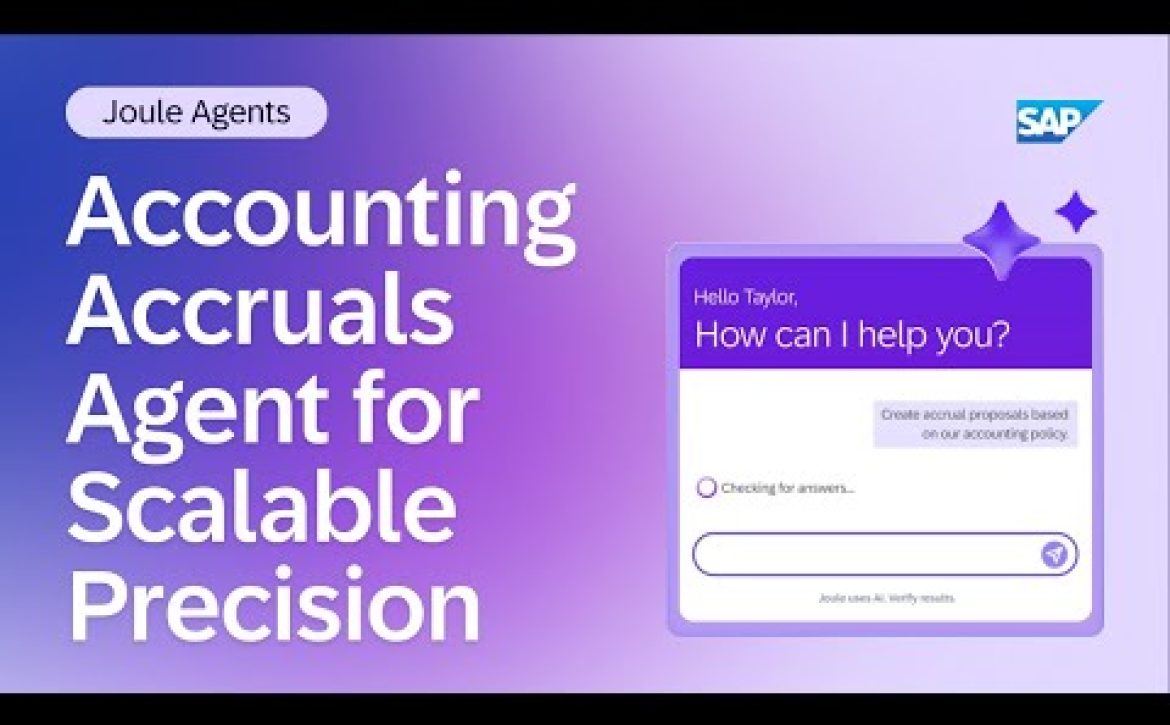
Accounting Accruals Agent for Scalable Precision | Joule Agents

See how the Accounting Accruals Agent helps finance teams save time, improve accuracy, and manage accruals with scalable precision.

Accruals management can be time-consuming and complex, especially when accounting teams need to apply corporate policies consistently across large volumes of data. With agentic AI, finance teams can move from manual accrual analysis to a more automated, governed, and audit-ready process.

In this video, discover how the Accounting Accruals Agent can create accrual proposals based on your accounting policy. The agent applies policy formulas, analyzes historical data in SAP Cloud ERP, calculates potential accruals, and presents summarized results that are consistent, traceable, and governed.

For organizations that have not recorded accounting policies in SAP Cloud ERP, teams can use an accounting policy template to execute with the same precision. The result is a faster, more reliable way to support accruals management, helping accountants spend less time on manual calculations and more time on strategic finance activities.

With the Accounting Accruals Agent, policy-driven precision is scalable, helping finance teams strengthen accuracy, governance, and audit readiness.

Transform financial closing with the Financial Closing Assistant: https://www.sap.com/use-cases/joule-assistant/financial-closing-ai

Follow us on social:
LinkedIn: https://www.linkedin.com/company/sap/
Instagram: https://www.instagram.com/sap
Facebook: https://www.facebook.com/SAP/
Threads: https://www.threads.com/@sap

About SAP:
As a global leader in enterprise applications and business AI, SAP stands at the nexus of business and technology. For over 50 years, organizations have trusted SAP to bring out their best by uniting business-critical operations spanning finance, procurement, HR, supply chain, and customer experience. For more information, visit: https://www.sap.com/index.html

#SAP #BusinessAI #Finance

A Look at a Typical Closing Calendar, Tasks, and Ownership in SAP S/4HANA

Financial close, like all things in life, follows a natural pattern.

Previous Next
Close
Test Caption
Test Description goes like this