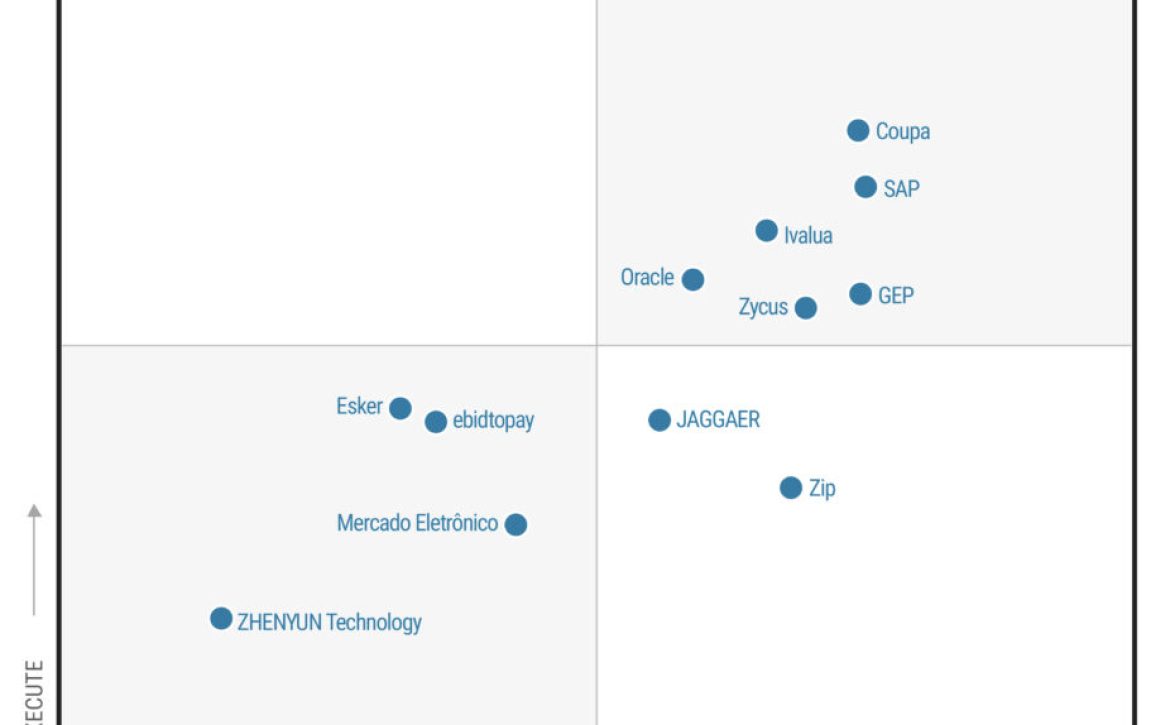
SAP Named a Leader in 2026 Gartner® Magic Quadrant™ for Source-to-Pay Suites

SAP has been positioned as a Leader in the 2026 Gartner® Magic Quadrant™ for Source-to-Pay Suites.* We believe this recognition reflects SAP’s continued commitment to delivering a comprehensive, enterprise-grade suite powered by platform modernization, agentic AI innovation, and global scale. SAP Ariba solutions and SAP Business Network together provide the depth, breadth, and intelligence required to support procurement and finance organizations worldwide.

This graphic was published by Gartner, Inc. as part of a larger research document and should be evaluated in the context of the entire document. The Gartner document is available upon request from SAP.

Building resilience and control across every category of spend

Organizations are under increasing pressure to manage costs, improve agility, and drive measurable outcomes. SAP’s connected and intelligence-driven source-to-pay suite is designed to help customers meet these challenges head on.

SAP Ariba solutions can deliver broad and deep functionality across the full source-to-pay lifecycle, spanning sourcing, contracting, procurement, invoicing, and supplier management. With the industry’s largest supplier network, SAP enables buyers and suppliers to collaborate with confidence, consistency, and scale.

SAP’s investment priorities: platform modernization and agentic AI innovation

Rather than reflecting external judgments, SAP’s strategic focus is centered on advancing its platform foundation, AI capabilities, and user experience to help customers operate with greater intelligence and agility. Our long‑term investments concentrate on three core areas:

Modernizing the platform for the future

A platform update arriving in 2026 will complete the modernization of SAP’s technical architecture. This modernized foundation can deliver greater extensibility, improved performance, and faster delivery of innovation, particularly in agentic and generative AI.

Harness the power of AI-enhanced procurement with the speed, intelligence, and scalability of an integrated source-to-pay suite

Built as an AI-native architecture, the next-generation platform can embed intelligence directly into workflows to help anticipate needs, guide decision-making, and automate actions across the entire source-to-pay process. This positions SAP to deliver the first truly AI-native source-to-pay suite built for the future of procurement.

Expanding intelligence with Joule

Joule plays a central role in bringing intelligence and insight to every stage of the source-to-pay process. Joule’s advanced AI agents can help automate tasks, support decision-making, enhance compliance, and unlock new productivity across sourcing, procurement, and supplier collaboration.

Reimagining the user experience

SAP is delivering an updated, consistent UI/UX across SAP applications. For procurement teams, this means smoother navigation, modernized interfaces, and enriched contextual intelligence, including enhanced supplier 360 profiles and strengthened collaboration capabilities.

Strengthening global scale and operational flexibility

SAP continues to demonstrate industry-leading global scale, supporting high-volume transactions and diverse compliance requirements across regions and industries. With multiple cloud deployment options across major hyperscalers and a robust portfolio of security and regulatory certifications, including FedRAMP, customers can operate confidently wherever they do business.

Connected solutions across SAP Business Network and the intelligent suite

SAP Business Network remains the largest supplier network in the source-to-pay market, spanning more than 190 countries. SAP’s broader spend ecosystem—including innovations such as SAP Ariba Category Management, the Spend Intelligence package in SAP Business Data Cloud, and SAP Ariba Intake Management—enables organizations to unify data, intelligence, and processes across sourcing, procurement, invoicing, and spend management.

Importantly, SAP’s capabilities extend well beyond traditional source-to-pay. Through connected solutions covering travel and expense, contingent workforce management, external labor, and additional spend categories, SAP provides a truly comprehensive spend management platform that can deliver visibility and control across the full spectrum of enterprise spend.

As organizations increasingly operate in heterogeneous application landscapes, SAP helps deliver openness, security, and extensibility so customers can maintain cohesive and connected processes throughout SAP and non-SAP environments.

Customer impact: outcomes that scale

Customers across industries and regions continue to demonstrate what’s possible with SAP’s source-to-pay solutions. Organizations report meaningful improvements in areas such as compliance, cost optimization, supplier collaboration, operational efficiency, and workforce productivity—from managing millions of invoices to running global sourcing initiatives to scaling AI-powered automation across distributed operations.

SAP remains deeply committed to helping procurement and finance organizations navigate complexity with confidence. Our investments in platform modernization, agentic AI, user experience, and cross-suite integration are all grounded in a single mission: to help customers achieve sustainable, long-lasting impact.

We’re grateful for this recognition and energized by the opportunity to deliver even greater value in the years ahead.

Learn more about source-to-pay solutions from SAP. Read the full Gartner Magic Quadrant for Source-to-Pay Suites report here.


Fang Chang is EVP and chief product officer for SAP Procurement and External Workforce Solutions.
Baber Farooq is senior vice president and head of Market Strategy for SAP Procurement and External Workforce solutions.

Get the latest SAP news delivered to your inbox once a week

*Gartner Magic Quadrant for Source-to-Pay Suites, January 21, 2026 – ID G00833291, by Micky Keck, Kaitlynn Sommers, Lynne Phelan, Magnus Bergfors, Alex Brady

Gartner does not endorse any vendor, product or service depicted in its research publications, and does not advise technology users to select only those vendors with the highest ratings or other designation. Gartner research publications consist of the opinions of Gartner’s research organization and should not be construed as statements of fact. Gartner disclaims all warranties, expressed or implied, with respect to this research, including any warranties of merchantability or fitness for a particular purpose.
Gartner and Magic Quadrant are a trademark of Gartner, Inc., and/or its affiliates.
How Howdens Joinery Is Revolutionizing Kitchen Production with Digital Manufacturing

Founded in 1995, Howdens Joinery has become one of the UK’s premier kitchen and joinery suppliers, producing over 4.5 million kitchen cabinets annually and distributing more than 44 million pieces through its extensive supply chain network.  

As the business expanded, so did the complexity of its operations and the expectations of its customers. The existing manufacturing development team, focused on small-scale factory applications, found it increasingly difficult to keep up with the pace. The data was often locked in silos or other systems. To address this, Howdens set out to automate and collect data from multiple points across its supply chain. 

Considering off-the-shelf solutions that could be tailored to its needs, Howdens Joinery needed a solution that would continue to evolve with the company. Through a detailed assessment of several manufacturing execution systems (MES), Howdens Joinery decided to replace all outdated manufacturing execution systems with the SAP Digital Manufacturing solution, making it the heartbeat of its production processes with the help of a featured partner, Eng

Reinventing kitchens with an innovative and customer-centric process 

The kitchen has evolved from a simple cooking space into the heart of the home. Knowing this, Howdens Joinery has adapted its offerings to meet the changing needs of its customers. “The kitchen market has changed a lot over the years,” says David Peacock, IS Manufacturing System technical lead at Howdens Joinery. “We don’t sell a kitchen; we provide a living space, the central part of their homes.” 

Howdens expanded its range beyond the standard kitchen colors and styles. This approach enables customers to experiment with various colors and styles before making a final decision. “It’s almost like a trial run,” Peacock explains. “We can see if a new color is worth adding to our main range. If it’s popular, we can roll it out on a larger scale.” 

This strategy not only helps customers find the perfect kitchen but also provides Howdens with valuable feedback on what works best. To support this expanded offering, the company invested in a new factory and upgraded paint lines. These improvements enhanced production capacity and equipped the team with new skills and expertise. 

Accelerate innovation across every stage of production with SAP software

Traditionally, the company made a stock model, but now customers can visit depots and order kitchens in any color and style they want. “We have a fast turnaround, with manufacturing and shipping taking just five days,” Peacock says. “To make this possible, we updated our entire order strategy and implemented the new system in less than 12 months.” 

By embracing innovation and listening to customer needs, Howdens Joinery has successfully transformed its business to stay ahead in a competitive market, making it easier than ever for customers to get the kitchen they truly want. 

“Having our own homegrown MES provided us a clear view of what needed to be produced on each production line,” he says. “In real time, operators could start or stop orders and receive confirmations. And we continued to add more features and functionalities to our MES.”

Reducing order production lead time from 21 days to 14 days 

Howdens Joinery faced two major challenges as it transformed its approach to kitchen manufacturing. The company sells the individual pieces of a kitchen, such as cabinet doors or shelves, that are ordered separately. 

Highlighting that the company is sales order-driven, Peacock further adds, “When you convert the sales orders into production orders, you get a sort of production order per piece. Tracking this is easier said than done.” Each piece follows a specific route through the factory, depending on its shape and the machinery it needs to pass through. Since the company isn’t selling finished panels that are simply waiting on a shelf, tracking each part and keeping everything together was a great challenge. 

Another major hurdle was managing the concept of process lots. Because of the specific routing required for different components, orders often needed to be split and sent down two separate production routes. These production orders would then be grouped into SFCs (shop floor controls), but this sometimes made the process more complicated rather than simpler. 

“We are potentially in a one-for-one relationship with the production order, so the SFC number became a bit redundant,” Peacock explains. The complexity increased when multiple orders were launched simultaneously. He adds: “We might be launching different production orders at a time, but we did not want in [SAP Digital Manufacturing] the guys on the shop floor to press start 40 times.” This led the company to create a mechanism for efficiently grouping orders, allowing, for example, all orders of a certain color to be processed together on the same production line. 

“When you purchase [SAP Digital Manufacturing], you’re not just buying manufacturing, but you’re buying the ability to build a manufacturing landscape. So you can do your own customizations,” he adds. 

With SAP Digital Manufacturing, Howdens Joinery enhanced operational efficiency and achieved a supporting mechanism to support both make-to-stock and make-to-order production models. 

Continuous improvement as a key driver for the future of manufacturing 

Howdens Joinery is leveraging diverse technologies in production systems. Particularly as a company expanding its manufacturing capabilities, this requires the integration of IT and operational technology, as well as seamless communication with machinery and the automation of production workflows—such as custom SAP Business Technology Platform (SAP BTP) processes and production connectors.  

With this integration, Howdens Joinery achieved direct communication with various types of machinery, thereby enhancing production efficiency and reducing the need for manual intervention. 

“With SAP Digital Manufacturing, we gained operational excellence in our supply chain processes, leading to more efficient planning and an enormous increase in production. We reduced order production lead time from 21 days to 14 days in 2023 to 2024, contributing to faster customer fulfillment,” Peacock says.

Moreover, Howdens achieved a 99.98% service level from primary sites to depots in 2024, demonstrating near-perfect product availability. “We will continue this journey of continuous improvement to deliver the best products for our customers,” he says. 

The innovative manufacturer plans to replace its legacy MES systems with a fully digital manufacturing solution, ensuring streamlined and efficient operations. With robust data quality and a flexible approach to integrating new technologies, Howdens Joinery is planning to integrate AI into its manufacturing processes as the next step. Its proactive approach to utilizing new technology for operational excellence is a great industry example for the broader manufacturing community.  

To learn more about Howdens Joinery’s transformation story, check out the full customer story here


Oyku Ilgar is part of SAP Supply Chain Management Thought Leadership & Awareness.

Get the latest SAP news delivered to your inbox once a week

10 New Customers a Day: The Global Success of SAP Business One

In the business world, scale shapes every decision. For smaller companies, the path to growth is rarely paved with the same stones as their larger counterparts. Their requirements are distinct and often more immediate; they need solutions that are nimble and adaptable.

Rather than a one-size-fits-all approach, the SAP Business One solution was designed to empower small businesses and the lower midmarket with an ERP solution that can grow with them and meet their evolving needs as they grow and prosper.

Introducing SAP Business One

Today, more than 83,000 customers and 1.2 million users across more than 170 countries rely on SAP Business One, supported by a global network of 850 partners and over 500 industry and country-specific extensions.

Experience a single, affordable ERP solution for managing your entire company

“It’s designed to be easy to start with,” said Darius Heydarian, head of Partner Solution Enablement SAP Business One. “Organizations can begin with just a single user and scale up as their needs grow, whether that means adding more people, locations, or subsidiaries.” The solution can adapt to how smaller organizations work, offering both quick setups for remote sites and coordinated rollouts across regions. It helps provide a modern, browser-based experience and can integrate smoothly with SAP’s analytic solutions and automation tools.

The role of partners

SAP recently reaffirmed the strategic importance of SAP Business One within the SAP solution portfolio. SAP Chief Partner Officer Karl Fahrbach emphasized SAP’s continued commitment to SAP Business One, highlighting the crucial role of the partner ecosystem: “SAP continues to invest in the future of SAP Business One. Our partner ecosystem remains at the heart of this success—driving autonomy, resilience, growth, and winning new customers every day.”

Partners play a central role in the SAP Business One ecosystem. SAP works closely with a vast network of partners that are experts in implementing and supporting SAP Business One. These partners have the expertise to tailor solutions to each customer’s specific requirements, whether it’s industry functionality, localization, or regulatory compliance.

“Partners also contribute to the extensibility of SAP Business One, developing extensions and industry solutions that help customers address unique challenges,” Heydarian said. The collaboration between SAP and its partners helps ensure that customers benefit from both SAP’s technology and the specialized knowledge of local experts.

Customers in scope

“Recently, one of our partners shared a customer example with me that perfectly reflects the nature of companies in the market segment we are targeting with SAP Business One,” Heydarian said. “The business had three employees when they started using the solution. Over the years, they expanded and employ 250 people today—without outgrowing their software platform.”

A typical SAP Business One customer is a small or midsize company looking for an affordable, flexible, and scalable ERP solution. These organizations often need to manage a range of business functions—from accounting and financials to purchasing, inventory, sales, customer relationships, and reporting—all in one place. SAP Business One helps them gain control, streamline processes, and make strategic decisions based on real-time information.

The solution is customizable to meet evolving business needs and supports international expansion with 28 languages and 50 country-specific localizations. Local support is provided by over 850 partners, helping to ensure that customers can get help tailored to their specific requirements.

“We are proud of the fact that SAP Business One is part of SAP’s solution portfolio,” Heydarian said. “Three thousand net-new customers choose SAP Business One every year. On average, 10 customers select SAP Business One every day.”

Developer Demo: AI Agent Interoperability | Open MCP Tools on SAP BTP | SAP TechEd 2025

See how SAP’s open, agentic stack lets you build practical AI agents – using your favorite tools with governance on SAP BTP.

In this SAP TechEd demo, we show how SAP’s developer experience opens up to the broader agent ecosystem so you can build with the tools and frameworks you prefer, without leaving the SAP BTP trust boundary. The session builds an agent that quality-tests a tutorial automatically, combining model intelligence with real tools like a browser and terminal. This reflects SAP’s newly announced agentic capabilities for developers: open interoperability, enterprise guardrails, and faster delivery from idea to impact.

We define the agent’s “brain” with the SAP Cloud SDK for AI (via Generative AI Hub), select a foundation model, and keep prompts in the Prompt Registry for reuse and governance. Tools are attached through Model Context Protocol (MCP) servers—including a Playwright MCP server for browser automation and SAP-specific MCP servers that give agents authoritative access to UI5/CAP knowledge and actions.

Running live, the agent streams its plan, chooses the right tool (navigate, click, fill), validates state, and loops until the workflow is complete—then returns structured feedback. This agentic pattern aligns with SAP’s TechEd updates: Joule Studio to build/extend agents and skills, A2A + MCP interoperability, and centralized monitoring, so teams move fast while staying compliant.

Speaker: Nora von Thenen, Developer Advocate, SAP

00:02 – Ecosystem open: compatible with many AI agent frameworks
00:19 – Build the agent: tools (browser, terminal, grounding)
01:36 – Implement: SDK, model selection & Prompt Registry
02:19 – Run live: stream plan, choose tools, loop to complete steps
04:54 – Results: agent feedback (grounding module clarity)

Watch all SAP TechEd replays: https://sap.to/60527O6Hg
Explore new agentic capabilities on SAP BTP: https://sap.to/60537O6H9

Follow us on social:
LinkedIn: https://sap.to/60547O6Hi
Instagram: https://sap.to/60557O6Hc
Facebook: https://sap.to/60567O6HY
Threads: https://sap.to/60577O6Hl

About SAP:
As a global leader in enterprise applications and business AI, SAP stands at the nexus of business and technology. For over 50 years, organizations have trusted SAP to bring out their best by uniting business-critical operations spanning finance, procurement, HR, supply chain, and customer experience. For more information, visit: https://sap.to/60587O6Hm

#SAPTechEd #AIAgents #A2A

SAP Analytics Cloud: Top 5 New Features | Q4 2025 Release Highlights

Explore the latest advancements in SAP Analytics Cloud with our Q4 2025 release highlights with Orla Cullen, Product Marketing Manager – Data & Analytics.

This short expert overview video showcases the most impactful product enhancements empowering finance, planning, and analytics professionals to make data-driven decisions with greater speed, precision, and control.

From AI-powered forecasting to enhanced security and visualization tools, these updates continue SAP’s commitment to unifying analytics and planning in the cloud. Whether you’re managing budgets, building dashboards, or optimizing enterprise performance, these new features help you stay agile and future-ready.

Here’s what’s new this quarter:
– AI-Powered Forecast Enhancements – improved predictive accuracy, scenario generation, and explainability to support better business outcomes.
– Unified Data Modeling – seamless cross-model linking and advanced semantic capabilities for consistent, connected analysis.
– Planning Workflow Automation – streamlined task orchestration, new collaboration tools, and version management for faster close cycles.
– Enhanced Visualization Experience – new chart types, layout flexibility, and improved story formatting for compelling dashboards.
– Administration & Security Updates – stronger audit logging, refined access control, and simplified role management for trusted insights.

For more on SAP Analytics Cloud release highlights: https://sap.to/60587JtgA

Read more on the blog: https://sap.to/60597Jtg7

00:00 – Intro
00:48 – Horizon Theme
02:13 – My Metrics for KPI Monitoring (𝘧𝘰𝘳𝘮𝘦𝘳𝘭𝘺 𝘞𝘢𝘵𝘤𝘩𝘭𝘪𝘴𝘵)
05:19 – Seamless Planning – Live Version
07:28 – Scheduling & Process Management: Factory Calendar
09:28 – SAP Analytics Cloud Performance Content: Model and audit table sizes
10:52 – Outro

#SAPAnalyticsCloud

Central Decision Management in SAP Build Process Automation

Decision and business rules have evolved over the years in SAP. With each platform, the business rules technology also evolved with time.

SAP to Release Third Quarter 2025 Results

WALLDORF — SAP SE (NYSE: SAP) will release its full results for the third quarter of 2025 on Wednesday, October 22.

SAP CEO Christian Klein as well as CFO Dominik Asam will host a virtual analyst conference to present third quarter financial figures, as well as an outlook on the current financial year.

Media representatives may listen in on the virtual analyst conference via Webcast at 11:00 p.m. CEST/ 5:00 p.m. ET.

Subscribe to the SAP News Center newsletter and get stories and highlights delivered straight to your inbox each week

i-Health’s Achievements in Consumer Packaging Makes Them a Winner at the SAP Innovation Awards 2025

i-Health is named a winner at the SAP Innovation Awards for enhancing efficiency and accuracy in product labeling through SAP’s public cloud technology.

To find out more about the SAP Innovation Awards and how to submit your own innovative ideas, visit: https://sap.to/6058fGA1Y

#SAPInnovationAwards

New SAP Learning Journey: Discovering High-Value Use Cases for Agentic AI

On July 21, SAP will launch a new AI-related learning journey, “Discovering High-Value Opportunities for Agentic AI,” the next enablement chapter after providing the SAP Learning Journey “Applying a Human-Centered Approach to Identify and Define Business AI Use Cases” in November 2024.

Get introduced to a structured and collaborative method to identify high-value agentic use cases

This latest course will enable attendees to facilitate a new Joule Agent Discovery Workshop, guide workshop participants to identify appropriate use cases, and tailor the workshop format to the needs of different audiences.

But what are SAP solutions for agentic AI? What do they stand for?

Joule Agents are AI systems that autonomously plan and execute multi-step workflows, collaborating to connect departments, speed up decisions, and streamline processes.

Discovering high-value opportunities for agentic AI

In the format of an SAP Expert Lecture, this course introduces participants to the Joule Agent Discovery Workshop, a structured and collaborative method to identify high-value agentic use cases in an organization. Attendees will learn how to inspire and guide participants, prioritize ideas, and describe the selected opportunities in detail. The course also covers how to adapt the workshop to different timeframes, team sizes, and virtual settings. By the end, attendees will be able to guide participants in identifying where AI agents can make the biggest impact and lay the groundwork for their agentic journey.

In detail, learners will be able to: 

  • Understand the purpose and structure of the Joule Agent Discovery Workshop and how it can be used to identify high-value agentic use cases
  • Facilitate the workshop exercises, guiding participants from idea generation to prioritization and a detailed description of agentic use cases
  • Adapt the workshop format to different team sizes, virtual environments, and timeframes to fit organizational needs

There are no prerequisites for this course, but experience with SAP Design Thinking and workshop facilitation will be helpful. It is a good learning opportunity for a variety of roles such as support consultant, business user, and SAP rookie.

The creative mind behind SAP AppHaus methods and this learning journey

For many years now, Karen Detken, an expert user experience designer at the SAP AppHaus, has worked in customer co-innovation projects and has gotten firsthand experiences and feedback when developing and hosting a variety of workshop formats with different methods and tools. Early on, the team decided to share these best practices and their tools and templates in the openly accessible innovation toolkit.

Karen Detken, Expert User Experience Designer at SAP AppHaus

When the topic of artificial intelligence arose and SAP solutions started to include generative AI and large language models (LLMs) in their solutions, such as SAP Business AI, followed by the latest step up with agentic AI, such as Joule Agents, the SAP AppHaus team worked with customers on exploring appropriate business use cases to benefit from this very latest in technology. Based on these first experiences, the team started sharing helpful methods, as a co-innovation frontrunner, so that other teams, partners, and customers could drive their own exploration projects involving latest technologies.

For Detken, it is not only about enabling in and applying those technologies: “New technologies are developing very fast and are becoming widely accessible,” she said. “What is important is that we have a very clear picture of why we want to use the technologies. Because technology only has a value when you find the right purpose to use it. Customers and users need to be clear about the outcomes they want to have with that technology. This is the first thing you need to answer before using it. With the methods we provide, we intend to help people first understand what this technology can do for them, for the business, for the people.”

This awareness and very conscious use of technology also includes the consideration of responsible and ethical guidelines that every new solution needs to follow (see SAP’s principles laid out in the SAP AI Ethics Handbook).

Bringing innovation and technology into the hands of people

The SAP AppHaus team gets feedback from many different customer and partner teams. For the team of experienced co-innovation coaches, it is fulfilling to see workshop participants, along with attendees of enablement sessions, understand the new technology better. From this deeper understanding they help participants — along their human-centered approach — start generating ideas related to their business needs. They help them, as Detken puts it, “think of different ways how they can use AI to solve real problems.”

The latest SAP Learning Journey for agentic AI is a compilation of helpful exercises to help customers and partners explore and approach this field of technology while discovering meaningful business use cases. In parallel and probably not that obvious at first sight, this new course testifies the openness of the team for novel applications such as using an avatar as speaker. It was built based on video recordings with Detken.

When asked about her view on agentic AI in contrast to generative AI, Detken describes it as follows: “Generative AI uses an LLM as a kind of intelligent system or ‘brain.’ The same LLMs are used by an AI agent. The difference is that the agent can not only ‘think’ and use these large language models to generate content or analyze data and make decisions, but it also uses ‘tools’ or other applications to act upon these decisions or make changes autonomously. To put it as an example: with Gen AI, we only had the brain and now it’s the next step, we have the brain and the hands. Maybe in the future, we will have the entire body as well, which would probably be the robots.”

What are AI agents?

AI agents are artificial intelligence-based applications that make decisions and perform tasks independently with minimal human oversight. Backed by advanced models, agents can decide a course of action and employ multiple software tools to execute. Their ability to reason, plan, and act lets agents tackle a wide range of situations otherwise impractical or impossible to automate with preconfigured rules and logic.


Imke Vierjahn is the communications lead for SAP AppHaus.

Subscribe to the SAP News Center newsletter to get highlights delivered to your inbox each week

Images courtesy of SAP employee Viktor Georg

Transforming SAP Implementations to Meet Evolving Customer Expectations

How the RISE with SAP Validated Partner recognition enables partners to unlock the power of SAP Business Suite


Businesses today rightly expect faster value realization, streamlined implementations, and solutions that are flexible, scalable, and embedded with intelligent technologies, such as AI.

SAP partners help you get the most from your software while enabling a smooth deployment

With the launch earlier this year of SAP Business Suite, a unified system integrating applications, data, and AI to seamlessly connect and optimize every business function, customers can benefit from a continuous cycle of value and unlock innovation faster and easier than ever before.

By embarking on the RISE with SAP journey, existing SAP ERP customers can modernize with a cloud ERP landscape and realize the full potential of SAP Business Suite. To ensure businesses have the foundation needed to fully leverage the suite’s capabilities, a successful implementation is crucial.

Our RISE with SAP project delivery is undergoing a profound shift, empowering our service partner ecosystem to meet these heightened expectations with innovative methodologies, comprehensive tools, and validation programs.

The new paradigm: customer priorities in SAP projects

Today’s organizations grapple with complex legacy processes, siloed data, and highly customized systems. They seek:

  • Speed to value: Building a resilient digital backbone that delivers measurable benefits within weeks or months
  • Industry-standard solutions: Minimizing costly customizations to enable faster deployment, simplified upgrades, and easier maintenance
  • Reusable intellectual property: Configurations over modifications ensure portability and scalability
  • Operational modernization: Leveraging automation and standardized processes to reduce redundancies and risks and improve data access
  • Embedded AI and automation: Accelerating decision cycles, reducing manual efforts, and enhancing accuracy

SAP’s response: enabling partners to drive customer success

SAP recognizes that delivering on these expectations requires a strategic partnership approach, combining the future-proof cloud and AI innovations with disciplined governance, clear ownership and accountability, and best practices. Our approach centers on the RISE with SAP Methodology, complemented by an integrated toolchain and a dedicated focus on partner capability enhancement.

RISE with SAP Methodology: framework for agile transformation

The RISE with SAP Methodology provides a comprehensive pathway that emphasizes a clean core architecture, standardized best practices, and collaborative implementation strategies. Included are:

  • Standardized framework: Building scalable, repeatable project road maps that cater to diverse industry requirements, from streamlined deployments to complex, multinational programs
  • Integrated toolchain: Enabling seamless collaboration with SAP tools, such as SAP Cloud ALM, SAP Signavio, SAP LeanIX, and SAP Build — powered by AI — to ensure data consistency and process automation
  • Expert guidance: From discovery to deployment, SAP and qualified partners guide projects, focusing on value creation and risk mitigation

The results speak for themselves. Customer outcomes include:

  • Up to 30 percent reduction in transformation costs
  • Up to 35 percent faster realization of benefits
  • Up to 70 percent increase in business agility
  • Up to 40 percent acceleration in innovation cycles

RISE with SAP Validated Partner recognition: elevating our service partner ecosystem

SAP is committed to ensuring our partners have the necessary skills and certifications to stay aligned with this evolving landscape. To that end, we’ve introduced the RISE with SAP Validated Partner recognition. Launched in 2024, this program recognizes partners that demonstrate excellence in delivering SAP large and complex cloud ERP projects with consistency and quality.

Qualified partners that accept SAP’s invitation must adhere to clear guidelines, including:

  • Global adoption of RISE with SAP Methodology: Ensuring consistency across all delivery teams and regions
  • Focus on clean core quality gates: Partner projects must document the respective clean core quality gates in SAP Cloud ALM
  • Enhanced toolchain utilization: A strong emphasis on automation, collaboration, and project governance through SAP’s integrated platform suite
  • Professional certifications: Equipping key roles — project managers, developers, architects, consultants — with updated, in-demand skills aligned with SAP’s cloud and AI innovations

Ensuring partner success: tools, training, and innovation

The RISE with SAP Validated Partner recognition is underpinned by a close alignment between qualified partners and SAP teams throughout all engagements, from sales to delivery, ensuring early identification of any potential barriers, to success.

Additionally, SAP invests heavily in supporting partners with resources such as funding and incentives, learning journeys and certification programs, certification academies and live sessions, and a vibrant Partner learning manager community where partners can share best practices, access the latest updates, and collaborate with SAP experts (log-in required).

To help customers harness the full potential of AI to drive value, partners must apply tools like Joule to effectively automate and optimize processes for superior outcomes. SAP Joule for Consultants empowers consultants to work smarter, automate routine tasks, and focus on strategic activities. Given its grounding in terabytes of both public and proprietary data, SAP Joule for Consultants can accelerate customer project delivery by up to 14 percent.  

Looking ahead

By aligning with SAP’s proven methodologies, leveraging our integrated toolchain, and maintaining high standards of certification and expertise, our RISE with SAP Validated partners are uniquely positioned to deliver solutions that truly meet customer expectations in today’s fast-paced, digitally driven environment.

Together, SAP and its service partners are committed to driving innovation, accelerating time-to-value, and enabling sustainable transformation — ensuring our customers remain competitive in a rapidly changing world.


Karl Fahrbach is chief partner officer at SAP.

Get the latest news and stories delivered straight to your inbox each week via the SAP News Center newsletter

Previous Next
Close
Test Caption
Test Description goes like this