From Idea to Email in Seconds with CX Q2 Innovations 🤝
From idea to engaging email content in seconds.
AI Content Composer for SAP Engagement Cloud helps marketers create relevant email content fast. In addition, RCS messaging enables richer, more interactive customer communications.
Check out these and other SAP CX Q2 innovations here:
https://sap.to/6058BGpQkA
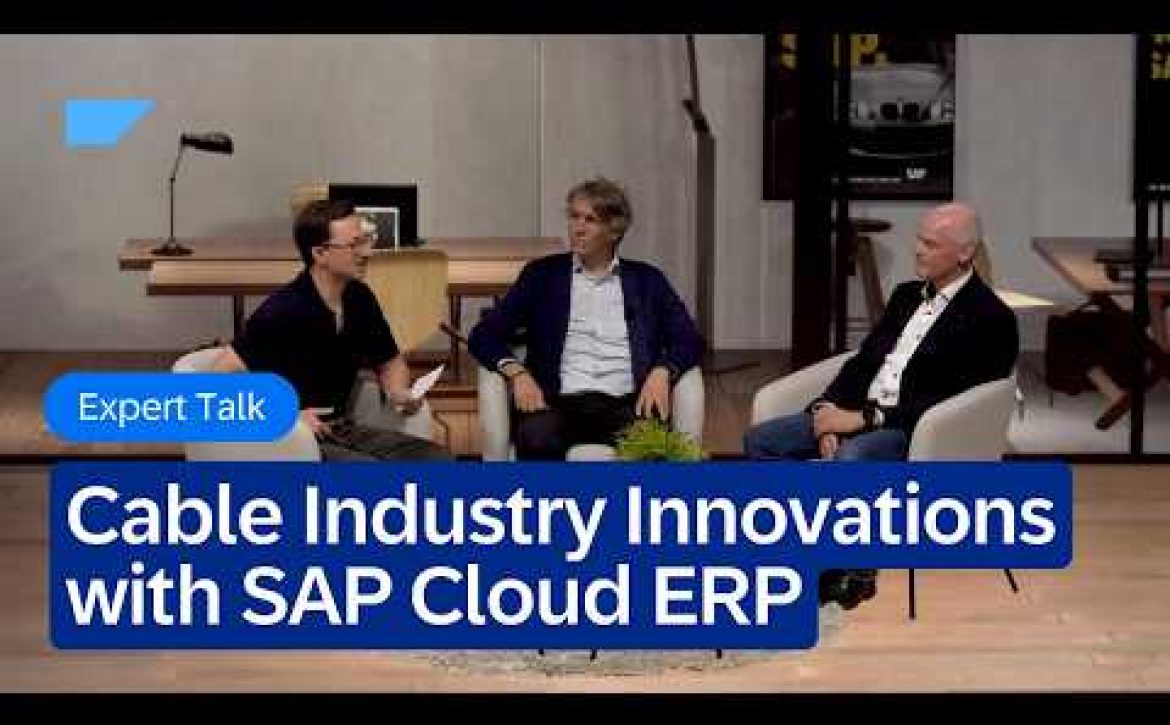
Cable Industry Innovations with SAP Cloud ERP | Expert Talk
Cable powers AI data centers, EV charging networks, and renewable energy projects. See how SAP helps cable manufacturers plan smarter.
Join host Simon Shores with SAP experts Mark Roepers, Stefan Weisenberger, and Chris Glander, plus Sandeep Mondkar, Partner at My Supply Chain Group (MSCG), part of NTT DATA, for a practical Expert Talk on the operational realities of cable and long products manufacturing.
Cable manufacturers face planning and pricing challenges that standard ERP systems were not built to handle: length-based materials, scrap minimization, real-time order promising, metal price volatility, and commodity pricing tied to exchanges such as LME and COMEX. This episode explores how SAP S/4HANA supports cable-specific requirements with embedded planning, advanced available-to-promise, PP/DS, commodity pricing, and a roadmap toward more autonomous, agentic supply chain planning.
In this Expert Talk, you’ll:
✔️ Learn why length-based planning can challenge traditional ERP—and how SAP Long Products Planning helps address it.
✔️ See a live demo of length-based aATP and MRP in SAP S/4HANA, including scrap minimization and real-time order promising.
✔️ Understand how SAP supports commodity pricing tied to LME and COMEX, including hedging and mark-to-market scenarios.
✔️ Hear how Prysmian, an SAP Innovation Award 2026 winner, achieved 70–80%+ efficiency gains with SAP Cloud ERP.
✔️ Get a partner perspective from MSCG, part of NTT DATA, on moving from SAP APO to embedded PP/DS and aATP architecture.
✔️ Discover what’s next for autonomous commodity management and agentic AI in supply chain planning.
Whether you work in cable, metals, long products, manufacturing, supply chain planning, or commodity-based industries, this discussion shows how SAP helps connect planning, pricing, execution, and business data in one integrated ERP foundation.
Chapters:
00:12 – Welcome and the cable industry
01:10 – Key challenges: Price volatility and length-based planning
05:52 – How SAP addresses cable-specific requirements
06:35 – Live demo: Length-based aATP and MRP in SAP S/4HANA
15:12 – Commodity pricing and metal exchange integration
17:12 – Customer story: Prysmian and partner perspective with MSCG / NTT DATA
25:57 – What’s next: Autonomous and agentic supply chain planning
Resources:
SAP Conference for Manufacturing, Materials, and Mining — Rome, October 2026: https://sap.to/6056BGR98w
Cable & Long Products Roundtable: https://sap.to/6057BGR98b
Product and release updates:
• Length-based planning in advanced available-to-promise: https://sap.to/6058BGR98j
• What’s new in SAP S/4HANA 2025 advanced available-to-promise: https://sap.to/6050BGR98e
• PP/DS in SAP Cloud ERP Private 2025: https://sap.to/6051BGR985
Follow us on social:
LinkedIn: https://sap.to/6052BGR98g
Instagram: https://sap.to/6053BGR989
Facebook: https://sap.to/6054BGR98i
Threads: https://sap.to/6056BGR98Y
About SAP:
As a global leader in enterprise applications and business AI, SAP stands at the nexus of business and technology. For over 50 years, organizations have trusted SAP to bring out their best by uniting business-critical operations spanning finance, procurement, HR, supply chain, and customer experience. For more information, visit: https://sap.to/6057BGR98l
#SAP #SAPS4HANA #SupplyChainPlanning
SAP Commerce Cloud and Vercel: A Faster Path to Better Customer Outcomes
Customers rarely think about the technology behind a storefront. They notice whether the site loads quickly, whether the price is right, whether a product is available, and whether the checkout works.
For commerce teams, delivering that experience is anything but simple. Behind every purchase sit catalogs, promotions, customer accounts, inventory, payments, orders, and fulfillment. A seemingly straightforward storefront change can quickly become part of a much larger release.
SAP Commerce Cloud and Vercel are working together to give teams a more flexible way forward. SAP Commerce Cloud continues to manage the commerce data and processes behind the transaction. Vercel runs the customer-facing experience and gives teams the infrastructure and workflow to build, review, release, and operate it.
The tools to transform customer experience are here, but tools alone don’t win. You must consider operating models too. Our partnership with SAP Commerce Cloud pairs Vercel’s web stack—including world-class performance, faster iteration, and scale that holds up under peak demand—with SAP’s trusted data and processes, and governance built in from the start.
Jeanne DeWitt Grosser, Chief Operating Officer, Vercel
The operating model is straightforward. Teams can change the storefront without having to change everything behind it at the same time.
A faster starting point for cutting-edge storefronts
Consider a commerce team preparing to enter a new market. It needs a localized storefront, a different customer journey, and a campaign built for that audience. In a tightly connected architecture, those changes can become dependent on a broader release involving pricing, inventory, orders, payments, and fulfillment.
Separating the storefront gives the team more freedom to work. It can design and release the experience for that market while SAP Commerce Cloud continues to provide consistent product data, prices, availability, customer information, and order processes.
Vercel is developing Next.js storefront templates for SAP Commerce Cloud to help teams get started. The templates connect to core capabilities such as product discovery, content, cart, checkout, and customer journeys.
The templates are backed by Vercel global delivery, managed scaling, deployment workflow, and observability, which improve engineering velocity and faster performance yielding more conversions.
As a result, frontend teams gain room to move, while commerce teams retain control of the rules that protect revenue and customer commitments.
What this changes for commerce teams
Campaigns and customer expectations move quickly. Vercel creates a preview deployment for each change, giving developers, designers, marketers, and business teams a working version to review before it reaches production. Teams can test the experience against SAP Commerce Cloud services, gather feedback, and release approved storefront changes with fewer dependencies on a larger backend release.
The same approach helps organizations manage different brands, regions, languages, and buying models. A consumer placing a quick order has different expectations from a business buyer working with negotiated prices, an account-specific catalog, or complex purchasing rules. Teams can build a distinct experience for each audience with SAP Commerce Cloud powering the operations behind it.
In addition, Vercel’s global network, edge routing, and caching bring storefront content closer to customers. Its managed infrastructure is built to scale with demand, including the traffic associated with major campaigns and peak shopping periods. Built-in observability gives teams visibility into traffic, errors, latency, and calls to external services, helping them identify problems that could affect the shopping experience.
Making AI impactful in commerce
AI-assisted development can dramatically accelerate the path from idea to experience. But speed without trusted context can simply produce more low-value experiences, faster and at greater cost.
Connected to SAP Commerce Cloud, AI experiences can draw on trusted commerce data and processes. This gives teams a stronger foundation for building impactful customer journeys that are accurate, brand-aligned, and connected to how the business actually operates.
Leveraging Vercel’s AI SDK, development teams get a common toolkit for building great commerce applications using the AI model provider of your choice.
For teams starting with an idea for a new interface, Vercel’s v0 offering can help marketers and developers design, iterate, and turn that idea into an experience they can review and refine.
The right storefront strategy depends on the business
There is no single storefront approach that fits every commerce operation.
SAP Commerce Cloud, composable storefront, is available for organizations that want a closely integrated, SAP-managed experience. Vercel provides the new SAP templates on the Vercel Frontend Cloud for teams building highly differentiated experiences on their own cadence using storefront technology used by millions of developers. Both options are backed by SAP Commerce Cloud with market-leading commerce capabilities to drive profitability for growing companies and the world’s largest enterprises.
Your customers expect storefronts to be fast and easy to use. They also expect accurate prices, reliable availability, and an order that arrives as promised. SAP Commerce Cloud and Vercel bring those two sides of commerce together: an experience that can keep changing, backed by the data and processes that keep the business running.
Learn more about the partnership here.
GROW the Business | SAP GROW AI Cloud ERP
When it’s time to grow, your ERP needs to keep up. SAP GROW is AI-powered cloud ERP built for companies ready to scale – without the complexity of a traditional implementation.
SAP GROW is a scalable platform with embedded AI, pre-configured industry best practices, and a lean implementation approach that gets you live in weeks, not quarters. No scope creep, no surprise overruns – just a clean, cloud-native foundation that scales as your business does.
What you get with GROW with SAP:
– Faster time to value: pre-configured workflows, live in weeks not quarters
– Embedded AI with Joule: automate routine tasks and get real-time insights across finance, supply chain, and HR
– Predictable costs: transparent pricing, predefined scope
– Fully managed cloud on SAP S/4HANA Cloud Public Edition: SAP handles upgrades, security, and infrastructure
– Best practices for 25+ industries: built in from day one
Learn more about SAP GROW: https://sap.to/6056BESJ3i
Follow us on social:
LinkedIn: https://www.linkedin.com/company/sap/
Instagram: https://www.instagram.com/sap
Facebook: https://www.facebook.com/SAP/
Threads: https://www.threads.com/@sap
About SAP:
As a global leader in enterprise applications and business AI, SAP stands at the nexus of business and technology. For over 50 years, organizations have trusted SAP to bring out their best by uniting business-critical operations spanning finance, procurement, HR, supply chain, and customer experience. For more information, visit: https://www.sap.com/index.html
#SAPGROW #CloudERP
What surprises companies the most when it comes to PLM? 👀
Fully connected data. That’s the real power of PLM.
In this short interview, Sarah Niesel from SAP speaks with Felix Finster, Partner at CIDEON Software & Services, about common misconceptions around PLM, and what surprises companies when integration really works.
SAP Datasphere & BDC: Top New Features | June 2026
New month, new capabilities. Get a quick tour of the June 2026 feature highlights across SAP Business Data Cloud and SAP Datasphere.
In this update, Klaus-Peter Sauer covers what shipped in June, including three releases packed with enhancements for data integration, replication flows, transformation flows, automation, monitoring, and system notifications. You’ll also see new ways to connect data sources, simplify ingestion, reduce manual work, and gain better operational control in SAP Datasphere.
You will see what is new in:
✅ Object Store Sources in Replication Flows: Use cloud and file-based sources like Amazon S3, Azure Data Lake Gen2, Google Cloud Storage, SFTP, SAP HANA data lake files, and Microsoft OneLake directly in replication flows.
✅ Oracle as a Source in Replication Flows: Use Oracle as a source in replication flows with initial-only load support and Oracle Wallet Authentication for secure connections.
✅ Snowflake as a Source in Replication Flows: Use Snowflake as a source in replication flows with initial-only load support and Cloud Connector support for private environments.
✅ Cloud Connector Support for Confluent Cloud Connections: Use Cloud Connector to reach Confluent Cloud through a TLS tunnel, even without public endpoints.
✅ SQL View Transform in Transformation Flows on File: Create view transforms on files using Apache Spark SQL, with autocomplete, validation, and data preview in your filespace.
✅ Direct Delta Sharing Client Integration for Transformation Flows: Access Delta Share tables directly in transformation flows, improving performance and reducing storage overhead.
✅ CLI Extensions for Replication Flows and Filespaces: Pause, resume, import, and export replication flow and filespace objects directly from the CLI.
✅ Enhanced Capacity Unit Monitoring: Analyze capacity unit consumption over time and view usage by space, including object store usage and premium outbound integration.
✅ System Notifications: Configure email notifications for replication flows and task chains, with options for success, failure, or both.
Learn more about SAP Datasphere: https://www.sap.com/products/data-cloud/datasphere.html
Join our SAP Datasphere community to stay up to date: https://pages.community.sap.com/topics/datasphere
Check out our product roadmap for SAP Datasphere: https://roadmaps.sap.com/board?PRODUCT=73555000100800002141
Chapters:
00:00 – Intro
00:30 – Object Store Sources in Replication Flows
01:09 – Oracle as a Source in Replication Flows
01:47 – Snowflake as a Source in Replication Flows
02:26 – Cloud Connector Support for Confluent Cloud Connections
02:47 – SQL View Transform in Transformation Flows on File
03:25 – Direct Delta Sharing Client Integration for Transformation Flows
04:00 – CLI Extensions: Pause/Resume and Filespace Import/Export
04:48 – Enhanced Capacity Unit Monitoring
05:37 – Enable System Notifications
06:12 – Summary and Outro
Follow us on social:
LinkedIn: https://www.linkedin.com/company/sap/
Instagram: https://www.instagram.com/sap
Facebook: https://www.facebook.com/SAP/
Threads: https://www.threads.com/@sap
About SAP:
As a global leader in enterprise applications and business AI, SAP stands at the nexus of business and technology. For over 50 years, organizations have trusted SAP to bring out their best by uniting business-critical operations spanning finance, procurement, HR, supply chain, and customer experience. For more information, visit: https://www.sap.com/index.html
#SAPBusinessDataCloud #SAPDatasphere #BusinessData
Sovereign Data Infrastructure in Europe: Essential or a Distraction?
The push for sovereign AI data centers in Europe (and elsewhere) reflects a shift in how IT infrastructure is perceived by enterprise customers, policy makers, and politicians. Because of the growing importance of business AI capability, compute capacity is no longer seen as “just” IT plumbing—it is strategic infrastructure, akin to energy or telecommunications.
AI infrastructure as strategic asset
Although infrastructure ownership is just one element of digital sovereignty strategy, European politicians and policymakers have argued that without domestic data centers, Europe risks dependence on U.S. and Chinese providers for critical AI capabilities.
This concern is echoed by some industry leaders—particularly those in finance and regulated sectors—who increasingly view AI infrastructure as a foundation of economic security. Specifically, they argue that sovereign data centers enable companies to comply with stringent European regulations on data protection and AI governance. They say that locally operated infrastructure ensures that data remains under European jurisdiction, reducing exposure to foreign legal regimes and enhancing trust among customers and regulators.
Security and compliance imperatives
European leaders also frame AI infrastructure as a hedge against geopolitical risk. They argue that dependence on external providers introduces vulnerabilities, whether through legal exposure, supply chain disruptions, or political tensions.
As Christian Klein, CEO of SAP SE, noted at the SAP Sapphire Madrid event last month, many European customers operate in the public sector or other highly regulated industries. “Geopolitical risk is a growing concern,” he said. “What if sanctions suddenly block data flows across borders? Or if the latest LLMs can’t be deployed in certain regions?”
Christine Lagarde, president of the European Central Bank, also highlighted this concern in her November 2025 speech titled “The transformative power of AI: Europe’s moment to act,” noting that Europe must “avoid single points of failure” in critical areas such as data centers and compute capacity.
Proponents of sovereign AI infrastructure also argue that it can stimulate broader economic growth. Data centers often anchor the ecosystems of startups, research institutions, and industrial applications, enabling Europe to capture more value from the AI stack.
From a technical standpoint, proximity also matters. Locally sited data centers reduce latency and improve performance for AI applications, particularly those requiring real-time processing or integration with industrial systems.
But despite these perceived advantages, many European business leaders have urged policymakers to take a more moderate, nuanced approach towards sovereign data. Their concerns are not about the need for data sovereignty itself, but about how it is implemented—particularly the push to rapidly build new, domestically controlled AI data centers. They emphasize that that data residency (location) is only one element of the four standard pillars of a sovereign data strategy, which also include legal sovereignty (jurisdictional control), operational sovereignty (independent operations), and technical sovereignty (data control).
In discussions with policymakers, European business leaders from diverse sectors have been warning that reducing reliance on U.S. technology too quickly is unrealistic. This reflects a structural reality: Europe remains deeply dependent on non-European providers for cloud infrastructure, chips, and AI platforms.
Research from Swiss cloud provider Proton suggests that around 75% of publicly listed European companies rely on U.S. tech services, (primarily Microsoft and Google) for critical infrastructure, including e-mail, cloud, and software. Therefore, attempting rapid substitution risks disrupting operations without delivering viable alternatives.
Barriers and concerns
Even the most ardent proponents of sovereign AI infrastructure acknowledge that there are major practical barriers to building massive AI data centers in Europe, including energy. AI data centers are extremely power-intensive, and Europe already faces grid constraints, high electricity prices, and long permitting timelines.
Without significant investment in energy systems, some European business leaders warn that new data center projects risk delays, cost overruns, or cancellation.
Another concern is that infrastructure-focused, sovereignty-driven policies may distort markets. Critics warn that infrastructure subsidies could flow to less competitive domestic providers resulting in slower innovation and the misallocation of capital resources to politically driven projects rather than economically viable ones.
In this view, sovereignty risks becoming industrial policy for its own sake, rather than a driver of efficiency or innovation. But perhaps the most significant critique is that the focus on infrastructure may distract from a more pressing issue: AI adoption.
Europe has historically lagged in deploying digital technologies. Some business leaders, including SAP’s Klein, argue that the priority should be accelerating AI use across industries and point out that infrastructure alone will not drive productivity gains. Over-emphasis on the infrastructure component of sovereignty could slow deployment through added complexity and cost. As Klein has noted, focusing primarily on infrastructure is a mistake if it is at the expense of developing AI applications and software.
Europe, he said recently, should prioritize “code over concrete.” At the World Economic Forum in Davos earlier this year, senior executives from major European firms, including Capgemini and Ericsson, also warned against an overly protectionist approach. They argued that excluding or limiting global providers would raise prices, slow tech adoption, and reduce competitiveness.
The business view
From a business standpoint, AI is rapidly becoming a general-purpose technology, and the costs of AI infrastructure directly impacts productivity. If European AI infrastructure is more expensive, European companies risk falling behind global peers.
While data residency and the other elements of digital sovereignty are essential for some businesses operating in sensitive and highly regulated sectors, the sovereignty debate in Europe risks oversimplifying a fundamentally global industry. As Henna Virkkunen, the European Commission’s technology chief, noted: “Nobody can be competitive alone.”
Indeed, since AI development depends on globally integrated supply chains, including semiconductors, software, and talent, fully localized infrastructure may be neither feasible nor desirable.
Rather than building duplicative infrastructure to support AI development, Europe’s real competitive advantage may lie in its treasure trove of operational data—a resource that is often difficult to access because of overly restrictive regulation and data access rules, prompting growing calls for reform from business leaders across Europe.
Easing and standardizing data access rules would help European businesses tap into this resource and compete more effectively with international rivals as they move into the next phase of AI enablement—the Autonomous Enterprise.
Procurement’s New Balancing Act: Cutting Costs, Adopting AI, and Proving Strategic Value
As cost pressures intensify, procurement leaders must find new ways to deliver savings, manage risk, and accelerate transformation.
Over the past several years, procurement has steadily expanded its influence inside the enterprise. As supply chains faced unprecedented disruption, procurement leaders became trusted advisors to the C-suite on resilience, risk management, and sustainability. Their visibility increased and so did the expectations placed upon them.
Now, the playbook is being rewritten once again.
Research from the 2026 Economist Enterprise Report titled Procurement at a crossroads: from optimism to realism, sponsored by SAP, finds that financial performance has reemerged as the primary benchmark of procurement’s success. Drawing on a global survey of 2,648 C-suite executives, the report found that 54% cite cost control as procurement’s greatest contribution to the business, up from 43% just one year earlier. The findings point to a function that is increasingly stretched, yet positioned to deliver measurable business outcomes—if it can navigate a difficult balancing act.
Cost control returns to center stage
The shift is not surprising given the environment. Persistent inflation, tariff uncertainty, and continued investment in supply chain resilience have pushed cost management back to the top of the executive agenda. At the same time, companies are investing in dual sourcing, nearshoring, and inventory buffering to reduce exposure—strategies that strengthen resilience but often raise costs. Procurement is expected to offset those increases elsewhere.
What makes this moment particularly challenging is that procurement’s broader responsibilities have not diminished. Teams are still expected to manage geopolitical risk, advance sustainability, and support digital transformation. The mandate has expanded significantly, often without a corresponding increase in capacity, tools, or operating model support. Delivering savings, limiting cost increases, and managing input costs while fulfilling a growing strategic role is the defining tension facing procurement leaders today.
AI is becoming procurement’s digital imperative
Technology, and AI in particular, is increasingly seen as the key to resolving tension. In the Economist Enterprise study, 60% of executives identified digital transformation as procurement’s top strategic priority over the next 12 to 18 months, up sharply from 38% in 2025. More than half (56%) identified AI as the primary driver of that transformation.
The emergence of agentic AI is accelerating expectations further. More than half of executives are planning to implement or evaluate agentic AI capabilities within the next 12 to 18 months. Unlike earlier generations of AI that focused primarily on generating insights, agentic AI introduces the ability to execute workflows—from guided buying experiences to automated purchase order creation—enabling procurement to move beyond recommendations and drive actions.
Even so, executive expectations remain grounded. Only 9% of survey respondents want AI to lead most procurement decisions within three years. Procurement’s highest-value work continues to rely on human judgment, strong supplier relationships, and the ability to navigate complex trade-offs. AI plays a critical role in strengthening these capabilities, but it does not replace them.
Realizing that potential, however, requires the right foundation. Connected data, clear governance, and close collaboration across procurement, finance, IT, and operations are prerequisites for generating AI outputs that are reliable and accountable.
Category management takes on greater importance
As procurement balances cost pressures with broader business priorities, category management is emerging as a critical discipline. The report found that category and demand management are expected to receive the second highest level of digital investment among procurement disciplines over the next three years, trailing only spend and performance analytics.
This reflects the growing complexity of procurement decisions. Category leaders are no longer simply awarding projects to the lowest-cost supplier. They are expected to weigh cost, risk, sustainability, and supplier performance simultaneously—a level of complexity that demands better analytics and faster insight-to-action capabilities.
That level of nuance can strengthen procurement’s impact, but it can also slow execution. More sophisticated category strategies require better data, sharper analytics, and faster insight-to-action capabilities. The report found that category strategy has become the third most common source of process delays, behind only contracting and sourcing.
Success increasingly depends not on collecting more data, but on turning data into confident decisions quickly. Organizations that close that gap will be better positioned to execute strategy, not simply develop it.
Procurement’s strategic value is being tested
Perhaps the most striking finding in the report is a growing confidence gap. While nearly three-quarters of executives still believe procurement collaborates effectively across the organization, that figure dropped from 90% in 2025 to 74% in 2026. Confidence in procurement’s role in shaping digital transformation strategy also declined meaningfully over the same period.
These numbers do not signal a retreat from procurement’s strategic importance. Rather, they reflect a broader shift in how enterprise decisions are being evaluated. As AI democratizes access to data across the organization, more stakeholders have the information to question decisions and demand clearer evidence of value.
Procurement leaders are now expected to control costs, manage risk, strengthen resilience, and help guide AI adoption, often simultaneously and without additional resources. The question is no longer whether procurement belongs at the leadership table. It is whether procurement can consistently deliver the value expected of it across an expanding and increasingly complex set of priorities.
Procurement’s next chapter
The Economist Enterprise findings paint a picture of a function at a pivotal moment. Cost savings has returned as the primary mandate, yet procurement is still expected to manage risk, protect supply continuity, and lead digital transformation.
Meeting those expectations will require more than layering AI onto existing processes. It demands connected data foundations that make AI outputs trustworthy, visibility across suppliers and spending, and technology that enables teams to move from reactive decision-making to proactive intervention.
The leaders who will define procurement’s next chapter are those who can turn AI, data, and connected processes into faster decisions, stronger resilience, and measurable business impact.
To learn more, join the upcoming Economist Enterprise–hosted webinar, “Leading the firm: The future of procurement,” on June 25, 2026, which will explore how leaders can accelerate AI adoption, prove digital value, and strengthen supply chain resilience.
Gordon Donovan is vice president of Research for Procurement and External Workforce at SAP.