To bolster its SAP solution portfolio, xSuite Group, a leading global software provider specializing in Accounts Payable Invoice Automation (APIA), has announced the acquisition of tangro, a prominent Inbound Document Management Software specialist based in Heidelberg, Germany. The acquisition, pending regulatory approval, marks a pivotal milestone in the strategic development of both companies as they […]
At the recent SAP Annual General Meeting (AGM), shareholders overwhelmingly supported the election of Pekka Ala-Pietilä as a new member of the company’s Supervisory Board. Ala-Pietilä, who received 95.50% of the vote, was subsequently elected as the new Chairman of the SAP Supervisory Board, taking over from the company’s co-founder, Prof. Dr. h. c. mult. […]
Stefan Steinle, executive vice president and head of Customer Support, SAP SE, shares more about how the Customer Support organization at SAP is harnessing artificial intelligence (AI) to help bring innovative improvements and deliver value to businesses.
Q: What are your views on the idea that businesses need to look beyond the customer to deliver outstanding customer support?
A: Customer support is a differentiating factor in the success of any business, as it directly impacts customer satisfaction and in turn customer retention.
While the primary role of customer support is to fix customer issues promptly and effectively, it is equally important to address the needs of support engineers. I would even go one step further and say that customer support is not just about customers. Yes, you heard that right. It may seem counterintuitive, but there’s another side to the story of retaining customers. The customer’s support experience and the engineer’s support efficiency are two sides of the same coin.
Support engineers are responsible for resolving complex issues and ensuring customer satisfaction. They are the first line of defense in protecting the company’s reputation. By investing in the well-being of support engineers, customer support can significantly elevate the customer support experience.
Q: What constitutes a great support experience for customers?
A: I can’t emphasize this enough: customers love self-help. They find satisfaction in testing workarounds, playing around with tips and tricks, and arriving at a solution without raising a ticket. What does this mean for us? It is our job to provide comprehensive SAP Knowledge Base Articles, guided tutorials, and other self-service options.
Next, we need to accept that customer preferences are diverse. Not everybody has the same choice when it comes to interacting with support teams. Some like tickets, some prefer live agents to bots, and some like talking on the phone. We address this by offering multichannel support.
Time is always a huge factor in a customer’s support experience. Maybe the issue they are facing is a minor speedbump or a major showstopper. Our job is to get them back on track. This includes personalization and the sharing of engagement history across support channels, to help ensure the customer is not forced to repeat its complaint at every desk.
There are many more, but if you asked me to pick one – I would think proactively addressing customers’ issues, even before they realize there is a problem, constitutes a great support experience.
Get AI-powered services and support resources, whenever you need our assistance
Q: What can improve support efficiency among support teams and engineers?
A: Any business that takes pride in offering exceptional customer support would address three areas and ask the following questions to ensure that their support teams are fully empowered:
People: Are your teams well-trained? How is the culture? Are employees collaborating and sharing knowledge? Are your systems set up to spotlight engineers who handle complex tickets with high quality solutions?
Processes: How well do you minimize manual efforts and automate repetitive tasks? Do you have clear protocols and escalation paths?
Technology and infrastructure: How robust is your ITSM system in managing and tracking customer queries? What productivity improvements have you implemented?
Q: How has SAP elevated support experiences among customers?
A: While we are invested in fine-tuning our Customer Support systems and processes regularly across multiple criteria, I would like to focus on our AI-powered solutions.
When it comes to elevating support experiences among customers, our efforts are toward providing a smooth journey – right from when they encounter a problem down to its successful resolution.
Those familiar with SAP systems know that our products are mapped to product functions, which you select when you create a new ticket. Now with AI, the system can predict the product function related to your case, and you can have the option to narrow your selection down very quickly. The system can also automatically suggest products when you try to select a product in the case creation form in SAP for Me. Similarly, the system can automatically route your ticket to the right queue by suggesting application components sorted by relevance for your new case.
Another valuable AI-powered service is customer solution matching, where the system displays solutions provided to other customers that match your customer profile. With Incident Solution Matching, the system provides suggestions in the side panel of the get support app on SAP for Me. You can also see the top content suggestions related to your issue description. Our predictors and categorization machine learning models help enhance Incident Solution Matching recommendations by providing the correct contexts for a given issue description.
SAP for Me helps bring together important alerts, metrics, and insights about your SAP product portfolio with a single access point. Built-In Support can embed the support experience into the product experience, offering context-aware guidance integrated into the user interface of cloud solutions from SAP.
At the end of the day, all of these translate to a smooth and effortless experience for end users trying to log a support request.
Q: How has SAP improved support efficiency among support teams and engineers?
A: When it comes to improving the efficiency of support engineers, we lean on minimizing tedious, manual efforts and automating what can be automated.
For example, with the expert finder, engineers can view a list of relevant experts who can handle the topic best. When intelligent swarming is applicable, the system can sort relevant swarming areas and experts by relevance, considering historical data. Given a case assigned to a category, the system can propose the most granular application component to which the ticket can be assigned.
Support engineers can view top SAP Notes and SAP Knowledge Base Articles matching the topic of the issues they’re handling. The system can detect outbreaks by matching a case with other cases where the same issue was reported. The system can also predict outbreaks by reviewing customers with similar profiles.
Other services include automatic translation, communication assistants, text extractors, channel recommenders, and solution recommenders. These are just a few examples of how AI is making the day-to-day of a support engineer a little bit better. And SAP is fully on board to explore exciting options in this area. For a detailed showcase of our AI-powered solutions, check out Your Ultimate Guide for SAP Sapphire Orlando in 2024.
Renuka Abraham is part of Customer Support at SAP.
Sign up to receive weekly news highlights from the SAP News Center
To solidify its position as a global leader in glycolic acid production, PureTech Scientific LLC has successfully implemented SAP S/4HANA Cloud Public Edition. The transition to the cloud-based platform is expected to streamline operations, enhance customer service, and support the company’s ambitious growth plans under the guidance of its new owner, Iron Path Capital. PureTech […]
In a groundbreaking move, NEC Corporation, a Japan-based multinational leader in IT and network technologies, has selected SAP S/4HANA Cloud through the RISE with SAP solution, running on Amazon Web Services (AWS). This strategic decision to migrate to the cloud marks a significant step in NEC’s digital transformation journey, leveraging the power of SAP and […]
Sarantis Group, a multinational consumer products company, has become the first customer worldwide to adopt the RISE with SAP S/4HANA Cloud, private edition, premium plus. This strategic move, coupled with the integration of SAP Business Technology Platform (BTP) as the foundational platform for their digital transformation, positions Sarantis Group at the forefront of innovation in […]
Aluminium Bahrain B.S.C. (Alba), a leading aluminum producer, has taken a significant step forward in its digital transformation journey by adopting the SAP intelligent ERP solution, SAP S/4HANA Cloud. This strategic move positions Alba at the forefront of Industry 4.0, enabling the company to optimize operations, innovate aluminum production processes, and adapt to the ever-changing […]
SAP Signavio solutions have been recognized as a Leader in the 2024 Gartner Magic Quadrant for Process Mining Platforms for the second consecutive year. This positioning highlights SAP Signavio’s strong execution and visionary approach in the market. In a recently published article, Dee Houchen, Global Head of Market Impact for SAP Signavio, said that the […]
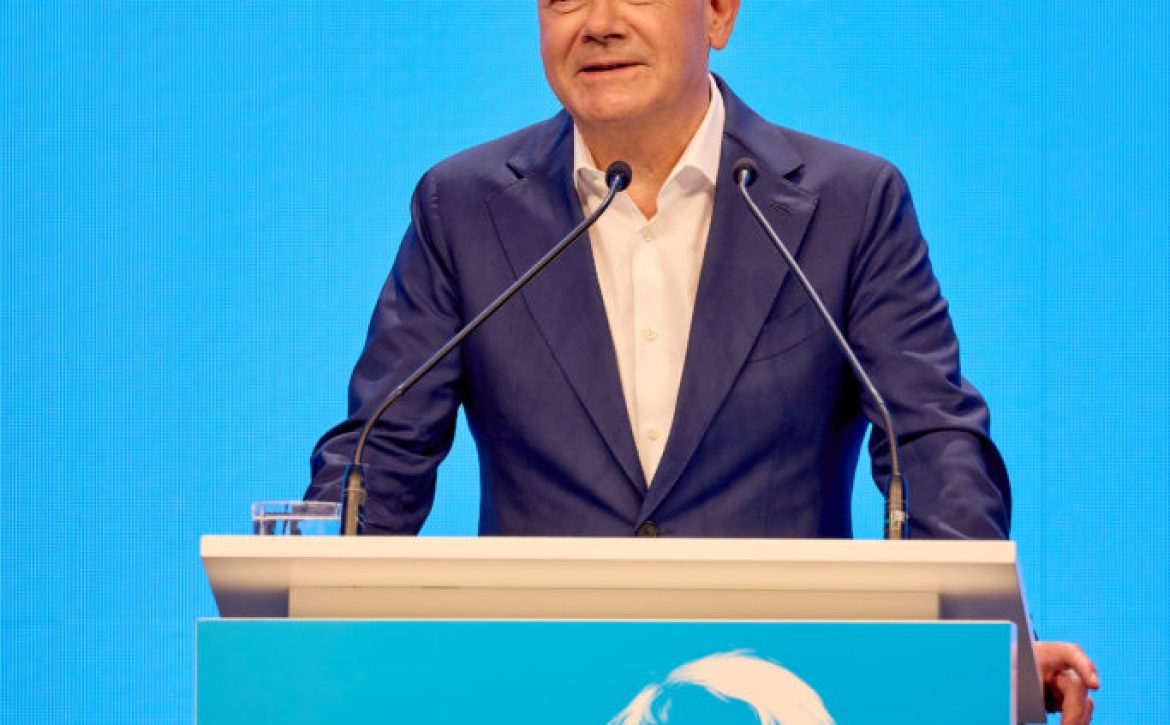
In a worthy send-off for a true great, at the farewell event for SAP co-founder and long-serving SAP Supervisory Board chairman Hasso Plattner, German Chancellor Olaf Scholz praised him for his life’s work.
“An incredible global success story made in Germany.” This is how Scholz opened his speech at the farewell event in honor of SAP’s last serving co-founder, Hasso Plattner. After more than 20 years as its chairman, Plattner had stepped down from the SAP Supervisory Board at the Annual General Meeting of Shareholders on May 15 and handed the reins to his successor, Finnish-born Pekka Ala-Pietilä.
Plattner, Scholz said, has been a key architect of SAP’s success as one of its co-founders, a boundless source of ideas and energy, its CTO, CEO, and then, for more than 20 years, chairman of the SAP Supervisory Board. He has written history in terms of economic development and globalization. “And, today, the entire global economy runs on SAP software,” he said.
German Chancellor Olaf Scholz: “Today, the entire global economy runs on SAP software.”
But he did not do it alone, Scholz continued. Rather, as was characteristic of Plattner, his every move was made in a spirit of productive competition with others. When Plattner founded SAP with four former IBM colleagues in 1972, he dreamed of one day employing 100 people. Now, SAP has 110,000 employees across the world, all inspired and motivated by Plattner’s “constant and unstoppable drive and energy.”
Scholz also quoted a wise observation of Plattner’s that served as a timely reminder for him: “You can’t put off making changes that need to happen for too long. If you do, this will eventually take its toll and then you’ll have less energy to get the job done.” Innovation was an opportunity, not a threat, said Scholz, adding that, today, artificial intelligence has the potential to inject brand-new momentum into SAP.
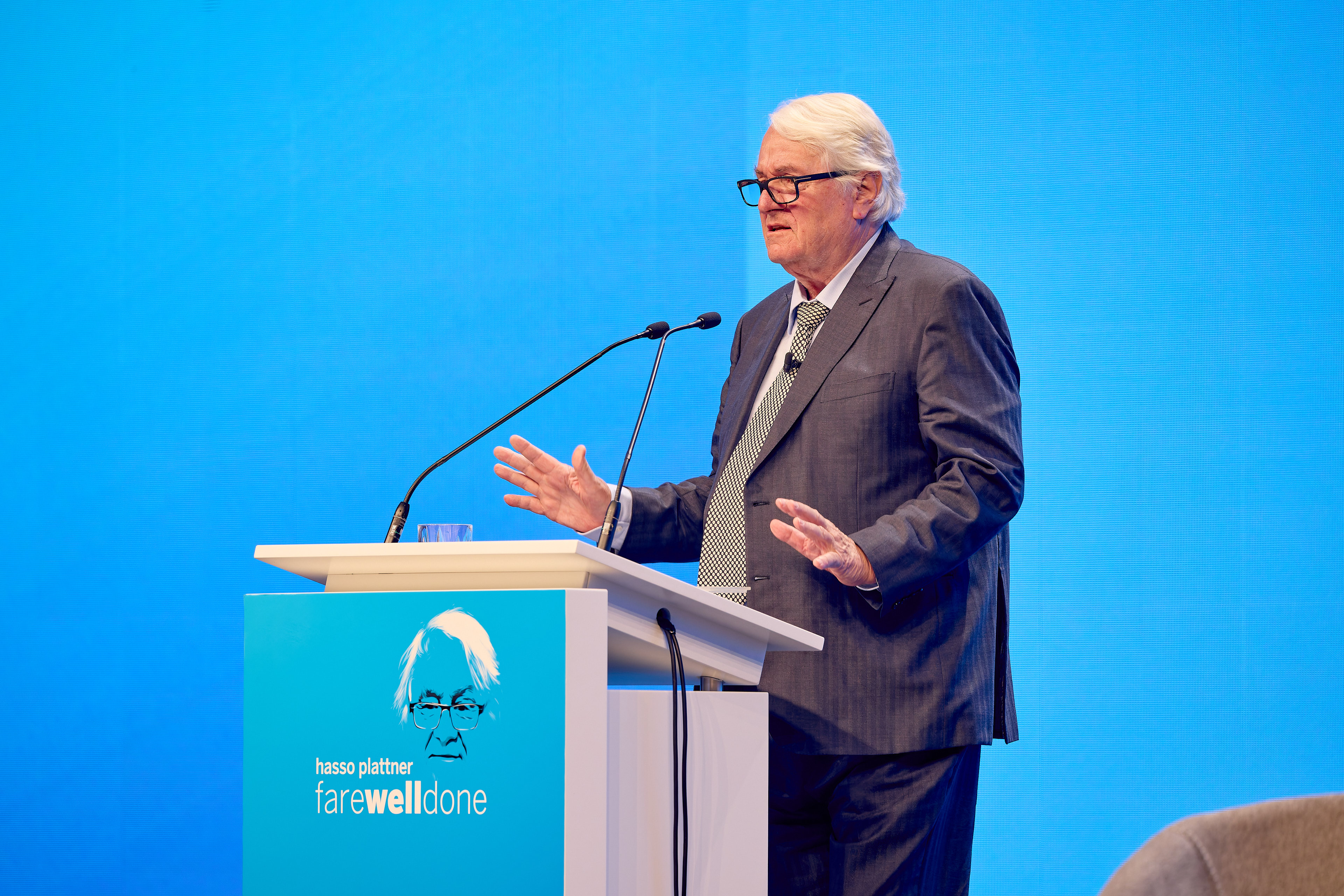
Some 5,000 guests – including 3,500 SAP employees – gathered at the SAP Arena in Mannheim, Germany, on May 16 to say goodbye to Plattner. German TV presenter Günther Jauch hosted the event and, in honor of avid rock fan Plattner, musical entertainment was provided by American singer-songwriter Anastacia, who was accompanied by the SAP Symphony Orchestra.
“Zigzag Like a Rabbit”
“We managed to keep up with most trends,” said Plattner, explaining what had made SAP so successful. And although things did not always go to plan, he recalled, “when we did set off on the wrong track, we realized in time and corrected our course.”
The most important thing, he said, was to avoid being too impatient or single-minded about pursuing a new strategy. “You need to be able to zigzag like a rabbit.”
After 21 years as chairman of the SAP Supervisory Board, the last SAP co-founder bid farewell.
“He Rocked It!”
How, asked SAP CEO Christian Klein in his farewell speech, could he possibly do justice to all of Plattner’s achievements in just 10 minutes? “My kids would say, ‘He rocked it!’” All five of SAP’s co-founders, driven by the desire to create something entirely new, had shown boundless courage in striking out on their own more than half a century ago.
Plattner was the epitome of what SAP must never be allowed to lose, said Klein, namely “a steadfast focus on customers and the ability to listen to and co-innovate with them.”
Klein spoke about the lasting impact Plattner’s global mindset had on SAP. “He drove SAP’s expansion across the world; today, we do business in more than 130 countries, and that is down to our founders and to Hasso.”
The success Plattner orchestrated for SAP in the United States is particularly symbolic of his tireless efforts to push the boundaries, said SAP Supervisory Board member Aicha Evans. He also stood for a future, she said, in which technology and humanity went hand in hand.
SAP CEO Christian Klein spoke about the founders’ boundless courage.
Dietmar Hopp: Long-Time Friend and Colleague
Among the audience members was Dietmar Hopp, one of SAP’s co-founders and a long-time friend and colleague of Plattner. “Dietmar was a huge influence on me,” said Plattner. “Most importantly of all, he taught me to work with customers. That changed the way I thought. I made it my mission to look in all areas of my life for ways to use software to improve people’s lives.”
Ambition and rivalry are part of the founders’ legacy, too. Many a racket was thrown in frustration when Hopp and Plattner faced off on the tennis court, recalled Klein. But Plattner had also given him this advice: “It’s important to win, but SAP is about more than winning; it’s also about helping others.”
CEO Christian Klein paid tribute to the founders’ legacy.
Philanthropist and Patron of Science
The Prime Minister of the State of Baden-Württemberg, Winfried Kretschmann, addressed the audience in a video message. As well as praising Plattner’s entrepreneurial spirit and creativity, Kretschmann paid tribute to his “immense sense of responsibility beyond the realms of business – particularly in education, art, and sport.”
Alongside his business career, Plattner always had a close affinity with research and development, said Kretschmann. In 1998, he founded the Hasso Plattner Institute (HPI) at the University of Potsdam, near Berlin.
As well as generously supporting educational and cultural causes, Plattner developed a particular love of art. One of the projects he funded was the reconstruction of a palace in the historic center of Potsdam that is now the Museum Barberini and home to an impressive collection of Impressionist works.
“Your hometown of Potsdam means the world to you,” said Scholz, describing Plattner’s work as a patron and philanthropist as “instrumental in helping Potsdam blossom and flourish over recent decades.”
Scholz added that he had no doubt whatsoever that Plattner would continue to hatch new ideas, make bold plans, and drive ambitious projects. “I believe that is simply the person you are. With or without an official role, it’s what you do.”
Explore further into SAP’s more than 50-year history of success that began with five entrepreneurial programmers
WALLDORF — SAP SE (NYSE: SAP) today announced that Alexandra Steiger will join SAP as new global head of Investor Relations on July 1, 2024, reporting to Dominik Asam, member of the Executive Board and CFO of SAP SE.
With over a decade of experience in the finance industry, Steiger has held roles at renowned institutions such as Goldman Sachs and UBS. She currently serves as executive director within Global Investment Research at Goldman Sachs, focusing on the U.S. Internet sector, including companies such as Alphabet, Meta and Amazon.
“I am very happy Alexandra is joining SAP,” said Asam. “We will benefit from her leadership and the wealth of expertise she brings from her previous responsibilities. In her new role, she can build on the strong foundation laid by Anthony Coletta and the entire Investor Relations team.”
Prior to her assignment at Goldman Sachs, Steiger was an executive director within UBS Equity Research, covering select U.S. Internet and Interactive Entertainment companies. She received a bachelor’s degree in International Business Administration from the University of Maastricht and a master’s degree in International Management CEMS from the Erasmus University Rotterdam and University of St. Gallen.