Deployment Conversion Run in SAP IBP | 2602 Release Highlight & Demo

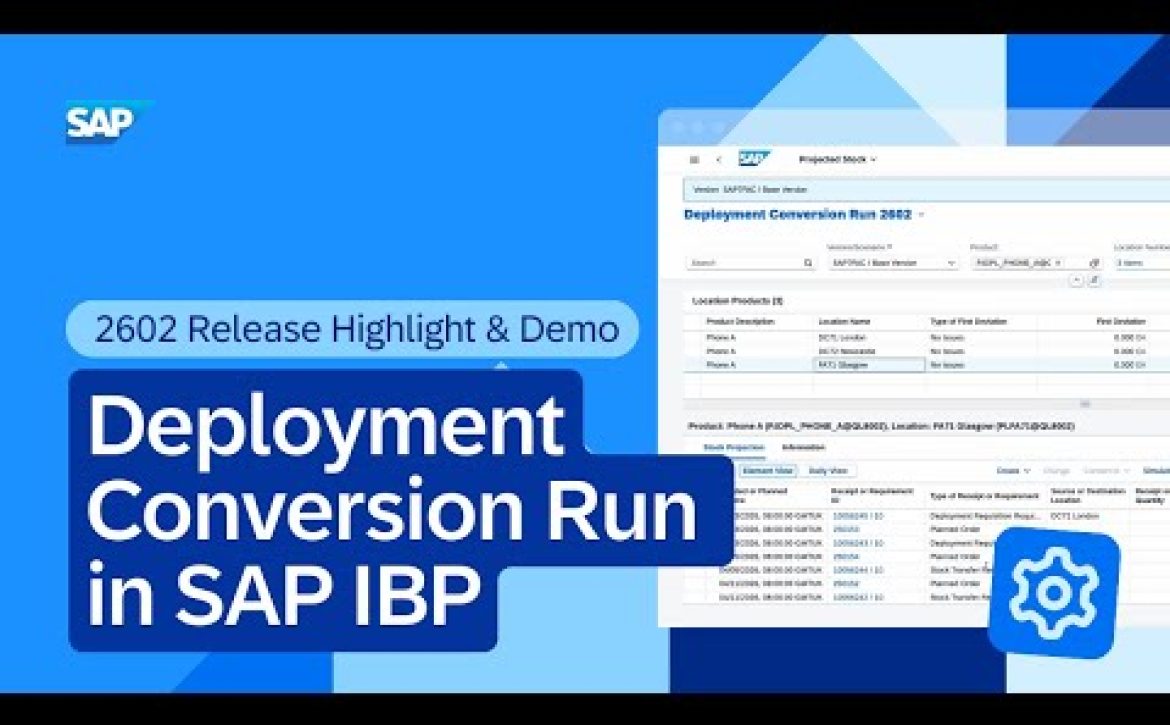
earn how SAP IBP 2602 introduces a new deployment conversion run that converts stock transfer requisitions (STRs) into deployment requisitions with advanced control and flexibility, helping you make more data-driven deployment decisions based on available-to-deploy (ATD) quantities and planning horizons.

In this highlight tour, you’ll see how the deployment conversion run uses your existing supply plan to allocate limited ATD supply across the network. With configurable demand and supply horizons (plus additional parameters like offsets and prioritization rules), teams can control which STRs are eligible for conversion and how fair-share situations are handled.

🔄 Convert STRs to deployment requisitions with ATD logic — Use a dedicated deployment algorithm to decide which STRs are best suited for execution, based on restricted ATD quantities.

🧭 New ATD horizons for better control — Maintain demand and supply horizons (for example, 50 days) to limit which STRs can be converted and which demand/supply elements impact ATD in the ship-from location.

⚙️ Configurable conversion parameters — Set planning start date, backward offsets, scope filters, fair-share rules (“Propagate ATD By”), prioritization options, and splitting settings—so deployment aligns with business priorities.

📈 Clear results review in Projected Stock — See which STRs were converted (and why others weren’t) based on your defined horizons and ATD availability.

Chapters:
00:00 – Introduction: deployment conversion run
00:32 – Scenario setup after supply planning (STRs created)
00:55 – ATD profile enhancements: demand & supply horizons
01:46 – Deployment conversion run job template + key parameters
03:34 – Execute the conversion run
03:38 – Review results in Projected Stock
04:22 – Wrap-up: flexibility + reliability

• What’s new (Help Portal): https://sap.to/6052hBRwr

• Learn more about SAP Integrated Business Planning: https://sap.to/6053cGTA3

Professional Services in SAP Cloud ERP 2602 | Release Highlights

Discover how SAP Cloud ERP 2602 empowers Professional Services teams with smarter billing, stronger project control, and deeper visibility into intercompany cost flows: helping you accelerate cash flow and strengthen end-to-end transparency.

In this highlight tour, the digital avatar from the Product Success Enablement team shares updates prepared by Katharina Stopf and SAP product management. The focus: reducing friction in internal project management, improving financial control across entities, and enabling billing to move forward even when plans don’t perfectly match the work delivered.

🔄 Intercompany cost allocations reconciliation (enhanced visibility) — The review booklet now links billed entries to the receiver’s FI journal entries and related expenses, so you can spot billing gaps faster and fix them quickly.

📁 Editable internal projects in Project Control – Professional Services — You can now edit internal projects directly in the app, assign future-start team members, and open billing plan details from billing due dates.

💸 Ad-hoc project billing for time & expenses and usage-based contracts — If there’s no matching billing plan item, you can still create the Billing Document Request. The system auto-creates the needed billing plan item (due today), removing blockers and speeding billing to support better DSO.

00:00 – Welcome & introduction
00:22 – Intercompany cost allocations reconciliation enhancements
01:18 – Adjusting internal projects within professional services project
02:12 – Time and expense billing without open billing plan item
03:17 – Summary & wrap-up

• Read more about the latest Professional Services innovations in SAP Cloud ERP 2602: https://sap.to/6059C755B
• Check out the SAP Cloud ERP Community: https://sap.to/6055CIrvT

Explore SAP Cloud ERP innovations: https://sap.to/6056CIrvp

#SAPCloudERP #ERP #ProfessionalServices

SAP Integrated Product Development in SAP Cloud ERP 2602 | Release Highlights

See how SAP Cloud ERP 2602 advances SAP Integrated Product Development with AI-generated hotspots, real-time visualization, and cleaner product structures, helping teams navigate faster, reduce manual effort, and keep product data consistent from engineering through manufacturing.

In this highlight tour, the digital twin of Annette Garcia Lorenzo (Cloud ERP & SCM Product Success Enablement) shares four innovations across Visualization and Enterprise Product Structure, designed to make product development more intuitive and data-driven.

🔥 AI-driven hotspot creation in 2D drawings (incl. P&ID) — Automatically generate hotspots and map them to backend business data—speeding setup and reducing manual errors while bringing context directly into the diagram.

📊 Dynamic visualization of production process data — Add real-time backend data to 2D visualizations via the Dynamic Content tab, with configurable auto-refresh intervals, thresholds, and templates to spot issues earlier.

📁 Documents in enterprise product structures — Add documents as describing entities in the product structure, link them to specific levels, and use variant parameters (like product series) to show the right manual or spec.

⚙️ Customer-specific properties for product structure instances — Create configurable property trees with values and units, and map CAD attributes via design items, supporting more accurate, flexible modeling for downstream processes.

00:00 – Welcome & introduction
00:23 – AI‑automated hotspot creation in 2D drawings
00:58 – Dynamic visualization of real‑time production data
01:36 – Defining documents for components of the product structure
02:33 – Defining customer‑specific properties for product structure instances
03:31 – Wrap-up & community invitation

• Read more about the latest Integrated Product Development innovations in SAP Cloud ERP 2602: https://sap.to/6054C7ezI
• Check out the SAP Cloud ERP Community: https://sap.to/6055CIrvT

Explore SAP Cloud ERP innovations: https://sap.to/6056CIrvp

#SAPCloudERP #ERP #IPD #AI

SAP Fieldglass: Recognized by Analysts and Customers as a Leader in Workforce Management

The extended workforce is now at the core of business transformation. Organizations everywhere are looking for technology partners that deliver not just scale, but also intelligence, agility, and innovation.

That’s why the latest recognition from two of the industry’s most respected research firms—Ardent Partners and Staffing Industry Analysts (SIA)—means so much to us at SAP. Their findings reinforce what we see every day: SAP Fieldglass isn’t just keeping up with the industry, we’re setting the standard for innovation, execution, and customer value.

Market leadership confirmed by independent analysts

The 2025 VMS Technology Advisor from Ardent Partners named SAP Fieldglass a “Market Leader,” a distinction reserved for providers with universal strengths and top-tier execution. The evaluation looked at every aspect of our portfolio, from supporting the full scope of managing the external workforce—requisitions, candidates, projects, direct sourcing, SOW/services procurement, integrations, and AI—to our execution ability, client success, references, talent ecosystem, product vision, and future of work readiness.

We’re especially proud to be recognized as an “Elite Performer” in four critical categories: AI Innovation, SOW and Services Procurement, Direct Sourcing, and Total Talent Management. Ardent Partners highlights SAP Fieldglass’ deep integration with SAP SuccessFactors solutions, SAP Ariba solutions, SAP Build Work Zone, and the AI solution Joule, positioning it as a strategic hub for managing external talent and optimizing services procurement. Joule is transforming how users interact with the portfolio, offering conversational, data-driven guidance for requisition creation, SOW intake, job description design, and workflow acceleration.

SIA’s VMS Global Landscape & Differentiators Showcase also confirms SAP Fieldglass’ global leadership. The portfolio operates in more than 180 countries, supports 22 languages, and enables invoicing in 118 countries, making it the largest footprint in the industry. This extensive reach is further underscored by consistently strong customer retention, reflecting the deep trust and satisfaction SAP Fieldglass enjoys among global enterprises.

Customer-validated leadership

Recognition from leading analyst firms is important, but what matters most is the experience of our customers. SAP Fieldglass has also been ranked as a category leader by TrustRadius, a respected platform for verified customer reviews. TrustRadius rankings are based on direct feedback from real users, making it a powerful complement to analyst evaluations. While analyst reports validate market position and strategic capabilities, TrustRadius highlights the day-to-day value customers experience, such as ease of use, depth of functionality, and overall satisfaction. This dual endorsement, from both industry experts and actual practitioners, reinforces SAP Fieldglass’ commitment to delivering solutions that can meet business needs and exceed customer expectations.

Boost productivity with workforce management from SAP Fieldglass

Innovation at the core: AI, automation, and analytics

Innovation is at the heart of SAP Fieldglass’ value proposition. The portfolio’s embedded AI solution, Joule, helps users initiate job requisitions, design and translate job descriptions, and accelerate approvals through a conversational interface. Rate benchmarking helps ensure customers stay competitive with market rates. Document AI can automate structured SOW creation, while machine learning and skills ontology models can power advanced candidate matching and workforce planning.

SIA notes that SAP Fieldglass’ “AI-first” product strategy is embedding intelligence into every workflow, emphasizing seamless data extraction, intuitive user experiences, and impactful use cases across applications. The business intelligence suite delivers real-time and historical analytics, benchmarking tools, and persona-based dashboards, empowering organizations to make data-driven decisions at every stage of the talent lifecycle.

Comprehensive capabilities for a modern workforce

What distinguishes SAP Fieldglass is its wide-ranging and comprehensive set of features. The portfolio allows users to effectively manage all kinds of external labor expenses—whether that’s contingent labor, services procurement, independent contractors, high-volume workers, or field services. It offers streamlined onboarding, advanced and customizable tools for global compliance, AI-driven workflows, and robust skills extraction, helping to ensure depth and efficiency in every area. Additionally, its compliance and audit capabilities, mobile accessibility, and dashboards supporting diversity, equity, and inclusion help create a holistic solution.

SIA’s research, based on 23 in-depth VMS surveys and 36 customer assessments, found SAP Fieldglass excels in supplier management, time/expense/billing, SOW capabilities, candidate sourcing, technical functionality, and customer perceptions. Customers cite the portfolio’s innovation, influence over roadmap evolution, and ability to scale with their programs. The open API framework, pre-built integrations, and strong MSP partnerships create a connected ecosystem that can support even the most complex workforce strategies.

Customer experience and ecosystem strength

Customer experience is another area where SAP Fieldglass shines. SIA’s customer perception data shows high marks for platform stability, ease of use, integration quality, adaptability, and support. Customers appreciate the portfolio’s innovation, the ability to influence roadmap evolution, and its capacity to scale with their programs.

Both Ardent Partners and SIA emphasize SAP Fieldglass’ commitment to continuous innovation. The “AI-first” and “suite-first” strategies focus on embedding intelligence into every workflow and delivering seamless, end-to-end business processes across the SAP ecosystem. Key areas of ongoing investment include skills-based hiring, AI, enhanced analytics, and high-volume workforces for SOW management.

A portfolio for the future of work

The latest findings from Ardent Partners and SIA reaffirm SAP Fieldglass’ leadership, vision, and relentless focus on customer value. Combined with customer-driven recognition from TrustRadius, SAP Fieldglass stands as a proven leader in delivering solutions that can empower organizations to unlock the full potential of their extended workforce—today and for the future of work.

Learn more about SAP Fieldglass.


Amber Roth vice president of Global Presales & Strategy for SAP Fieldglass.

Sign up to receive weekly news highlights from the SAP News Center

SAP Business AI: Release Highlights Q4 2025

We want our customers to get value from AI. So when organizations cite barriers to deriving value, such as integration complexity, regulatory compliance, AI sovereignty, or data quality, we work to alleviate them.

SAP Business AI: Be more productive, faster, across every team in your business

That’s why, in Q4 2025, we significantly enhanced the way customers work with AI through new models, sovereign cloud offerings, and partnerships, alongside numerous product updates. Let’s dive straight in.

SAP-RPT-1 is a novel AI model that is optimized explicitly for predictions on tabular data. While LLMs predict the next word in a text sequence, SAP-RPT-1 forecasts the next field in a table row; it can interpret relational business data and handle virtually any predictive task. Additionally, as our single, universal AI engine, SAP-RPT-1 enables customers to simplify their approach to working with AI by eliminating the need for a myriad of narrow AI specialist models, each requiring arduous training, maintenance, and investments. SAP-RPT-1 also requires 50,000 times less energy, 100,000 fewer GPU FLOPs, and offers up to 3.5 times better predictions and 50 times more speed than state-of-the-art LLMs. Announced at SAP TechEd and now available in our generative AI hub, customers can leverage the SAP-RPT-1-small and SAP-RPT-1-large models.

EU AI Cloud is our new full-stack sovereign cloud offering that supports EU data residency and full sovereignty. It makes meeting regulatory and operational requirements easier by giving customers complete control over their infrastructure, platform, and software. Customers can deploy it on SAP’s own data centers, on trusted European infrastructure, or as a fully managed solution on-site. Now, European enterprises and public sector organizations can benefit from the latest AI innovations securely, in full compliance with European standards and with the sovereignty and flexibility they need.

We also took steps to simplify our customers’ data landscape and preserve the business context of all data. SAP Snowflake combines Snowflake and SAP Business Data Cloud (SAP BDC). This partnership enables zero-copy data sharing across Snowflake and SAP BDC Connect. Customers using Snowflake can integrate their existing instances with SAP BDC for seamless, real-time access to combined, semantically rich SAP and non-SAP data in SAP BDC. SAP Snowflake will be made generally available in Q1 2026, and SAP BDC Connect for Snowflake will be available later in H1 2026.

Furthermore, SAP’s generative AI hub includes the latest frontier models from Mistral, OpenAI, Gemini, and Anthropic, allowing customers to implement the model that best suits their specific use cases. The 350 AI features, including Joule Agents, along with the over 2,400 Joule skills, are already delivering unparalleled value to customers—built on AI Foundation in SAP Business Technology Platform (SAP BTP).

Here are some of the highlights from Q4 2025:

  • Joule was more integrated than ever in Q4. The bidirectional integration with Microsoft 365 Copilot offers a unified user experience, allowing users to access insights directly within their workflows. Joule for Consultants has enhanced citation visibility, while Joule deep research capability provides users with synthesized explanations for complex inquiries that draw on both internal and external data—structured or unstructured—using capabilities like Model Context Protocol, document grounding, and Perplexity. Joule analytics center offers customers granular insights into user adoption, and the Joule preview landscape provides a dedicated customer environment for testing and validating software updates before they are released to production. Explore all the new capabilities for Joule in the section below as well as within the specific products.
  • SAP Business AI for supply chain delivers unprecedented clarity. New analysis capabilities in SAP Integrated Business Planning summarize complex optimization, inventory, and forecast results, translating intricate calculations into clear, natural language. The new Production Planning and Operations Agent automates prerequisite checks for releasing production orders by identifying material shortages and suggesting workarounds to prevent delays. There’s more to discover below.
  • SAP Business AI for human resources is transforming talent management and reducing administration. The Performance Preparation Agent automates data collection and generates talking points to ensure managers are fully prepared for more impactful one-on-one meetings. Employees can also boost internal mobility by identifying and surfacing hidden skills directly from their resumes. There is so much more to explore; dive into everything below.
  • SAP Business AI for finance is packed this quarter, with new agents automating more complex processes. The Accounting Accruals Agent helps expedite the period-end close. The International Trade Classification Agent ensures robust compliance for global shipping, and the Cash Management Agent provides unparalleled oversight of cash flow. Joule also now assists with master data governance, analyzes allocation run results, and simplifies risk management tasks. There is just the beginning in finance, so check out everything below.
  • With SAP Business AI for IT and developers, customers can build, automate, and analyze more quickly and easily than ever. Joule Studio agent builder is in GA and enables users to create custom AI agents that automate complex, end-to-end business processes. To manage this growing landscape, the new AI agent hub in SAP LeanIX offers a central dashboard for governing agents. SAP is also introducing its own foundational models: SAP-RPT-1, a new model for structured business data, and SAP-ABAP-1 to accelerate ABAP code generation. See more below.
  • The latest SAP Business AI innovations for spend management, procurement, and customer experience are simplifying complex processes and making them more personalized. In spend management, the new Booking Agent simplifies trip planning with tailored recommendations, while the Receipt Analysis Agent ensures accurate expense reports. Procurement customers can use natural language to route demands in SAP Ariba and automate the creation of statements of work in SAP Fieldglass. In customer experience, marketers can now instantly build reports in SAP Emarsys using simple prompts, and service agents receive AI-generated summaries to resolve billing inquiries more efficiently.

Joule

Joule with Microsoft 365 Copilot
General availability

Bidirectional integration between Joule and Microsoft 365 Copilot has been completed. This integration helps deliver a unified user experience across enterprise systems. Users can now access Joule capabilities directly from within Microsoft 365 Copilot, bringing Microsoft-powered insights into the generative AI environment in Joule.

This tight interoperability will help strengthen how organizations work, collaborate, and make decisions within their SAP and Microsoft landscapes.

Redefining CX: The Overlooked Secret to CX Success with Shirish Shrinet | Trending Chats

In this episode of Trending Chats, Shirish Shrinet, Senior Solutions Advisor at SAP, explores the most overlooked secret to CX success and how businesses can bridge the gap between automation and human interaction.

From choosing the right channels to using AI without losing the personal touch, we’ll uncover strategies to create meaningful customer experiences that drive loyalty and growth.

Tune in now to learn how to connect with customers in a way that truly makes an impact.

00:05 – Welcome + the simplest way to delight customers
00:26 – The core idea: meet customers in their preferred channels
00:55 – Why it matters: trust, confidence, and feeling heard
01:34 – Step 1: choose channels and prepare teams + processes
01:53 – Step 2–3: respond fast, and keep the human touch (don’t over-automate)

Learn more about customer experience solutions from SAP: https://sap.to/6054Cr8Bp

🎧 More episodes of the Trending Chats podcast:
Watch on YouTube: https://sap.to/6055Cr8BV
Listen on Spotify: https://sap.to/6056Cr8Bn
Listen on Apple Podcasts: https://sap.to/6057Cr8BX

#TrendingChats #CX #AI

Retail Reimagined: Power of Unified Data with Claudia Huynh | Trending Chats

In this episode, Claudia Huynh, Customer Advisor at SAP, steps into the role of a Head of Retail Operations to reveal the hidden costs of disconnected data—and why unifying retail data is no longer optional.

Learn how breaking silos and enabling smarter, AI-driven insights can help retailers move from reactive firefighting to proactive, predictive growth.

00:04 – Guest narrator takes over: meet Claudia
00:23 – The pain of disconnected data across retail
01:03 – Unified data strategy: one version of truth
01:55 – When data’s unified, AI can level up operations
02:22 – Reality check: AI is only as good as your data
02:40 – Recap: break silos, enable AI, deliver seamless CX

Take the SAP Retail tour: https://sap.to/6053CrDHF
Dive into more retail innovation: https://sap.to/6053CrDHF

🎧 More episodes of the Trending Chats podcast:
Watch on YouTube: https://sap.to/6056CrDH4
Listen on Spotify: https://sap.to/6058CrDHA
Listen on Apple Podcasts: https://sap.to/6059CrDH7

#TrendingChats #Retail #CX

7 Tips for Developing SAP AI Skills

Artificial intelligence (AI) is currently transforming the world of work. Investments are enormous and the technology is evolving rapidly—as we’re currently seeing with agentic AI.

Create transformative impact with powerful AI and agents

Beyond the technologies being deployed, the ability to use them meaningfully in daily work is becoming central. This is also seen as the major challenge of AI adoption. Developing AI skills has thus become a strategic priority.

For SAP customers and partners, the question is how to upskill their teams effectively. Because without the right skills and abilities, the best software is useless.

Here you’ll find seven tips for developing AI skills specifically for the SAP context.

1. Learn the fundamentals of AI

There are many learning resources for the basics in the form of e-learning courses or webinars. Some are even free, such as many courses from SAP. We’ve compiled key AI learning offerings here: on AI in general, Joule, and SAP Business AI, as well as the important topic of ethics and responsible AI.

2. Self-assessment: Where do I stand?

Everyone should understand the fundamentals of AI; after that, you can deepen your knowledge in targeted areas. The SAP Business AI self assessment can help with this self-reflection. Here you can rate yourself in the areas of awareness, m, knowledge, and application skills. The topic areas include Joule, including copilot and agents; embedded AI; machine learning services on SAP Business Technology Platform; SAP Build and Joule Studio; responsible AI; and implementation of SAP Business AI. First results show that many respondents show a high motivation, while technical application skills still need more improvement. 

3. Deepening by topic and role: Which AI skills are still needed?

Once you’ve assessed yourself as a team or individual, the various SAP learning offerings—information also available here on the SAP AI Training page—can help you create your own learning plan. Looking at the relevant topic areas, your own role, and preferred learning formats makes orientation and selection easier.

4. Set learning goals and document successes

Many people find it helpful to set concrete learning goals and schedule specific learning times; for example, in their own calendar. Documenting and reflecting on learning progress and “aha” moments also helps you and others, whether through blogs on SAP Community, a personal learning journal in digital notes, or simply verbally within your team. AI certification like for generatice AI developers might also be a more formal way to check and document your skills.

5. Learn from and with others

In peer learning, you learn through barcamps, workshops, discussion rounds, communities, study groups, networking meetups, or promptathons, a type of hackathon where small groups solve challenges from their daily work using AI tools. Along with SAP, companies like Deutsche Telekom and Continental are already using this format.

Learning through exchange in communities—such as the SAP Community on SAP Business AI with its many blogs and discussions—is another format for learning with peers. SAP Learning Hub also offers numerous AI live sessions led by SAP experts where you can ask questions.

6. Learn through experience and doing

With such generic technologies as AI, it’s important for everyone to explore for themselves where AI can help them and to try things hands-on. Whether in learning projects where you experiment with and reflect on new AI tools, or in team workshops. For workshops, the SAP AppHaus innovation toolkit with templates can help—including for Joule agent discovery, AI agent design, SAP Business AI design, and SAP Business AI exploration. Discovery and exploration should happen at the strategic level, but it’s also very helpful at the team level. The practice systems in SAP Learning Hub can also assist with hands-on practice as you see Joule and embedded AI features in many training systems.

7. Regularly review and update your AI skills: How can I keep up to date?

The field of AI is evolving rapidly, so regular learning, updating, and trying out new tools is essential. Podcasts, the resources mentioned in this article, SAP’s AI newsletter, and the diverse array of SAP events can help with this. Or why not build your own news-update agent for your own context?

Summary and outlook

AI learning in the SAP ecosystem is a business-critical, continuous task. You only understand AI by applying it and actively engaging with it. Additionally, it’s important to adapt to these new technologies—or even to completely rethink tasks and processes. Complete a self-assessment, create a learning plan by yourself and with your peers, and book the learning offerings relevant to you today.


Thomas Jenewein is a business development manager at SAP.

Drive success with in-demand SAP skills and achieve your goals faster with learning solutions from SAP

Lithuania Hosts SAP CSR Pro-Bono Consulting Program

The SAP Social Sabbatical for global engagement program is SAP Corporate Social Responsibility’s (SAP CSR) flagship pro-bono consulting initiative, where SAP employees offer pro-bono consulting to impact businesses like non-profits, social enterprises, and startups around the world. In July, the program took place in its 59th location: Vilnius, Lithuania.

Indeed, Lithuania is fertile ground for social enterprises and impact businesses. At the end of 2024, Lithuania participated in the European Social Enterprise Monitor (ESEM) for the first time. The resulting report provided a comprehensive assessment of the current social enterprise environment in Lithuania and allowed for comparison with the 30 other European countries assessed. According to the ESEM report, there are about 200 social businesses in Lithuania currently, but the potential is 10 times that number.

“According to a study done by LISVA (Lithuanian social business association) in 2022, each euro invested into social enterprises yields a net benefit of €0.63, with positive effects,” Kristina Balčiauskaitė, local project manager for Pyxera Global, explained. “Approximately 60% of social enterprises in Lithuania operate outside major cities, being active in smaller towns and rural areas. This contributes directly to strengthening local economies, creates new jobs for underserved populations, and helps reduce regional disparities in economic development and access to services.”

SAP CSR initiatives rise to emerging global challenges by accelerating impact business, building future skills, and engaging and developing people

As part of SAP CSR’s mission of powering equitable access to economic opportunity, education and employment, and the circular economy, the pro bono portfolio works with social impact businesses that are pursuing innovative solutions to societal issues. The impact businesses gain access to private-sector professional expertise, the opportunity to address critical strategic challenges, advance their service provision, and facilitate transfer of skills and know-how to their staff.

For the SAP Social Sabbatical program, SAP employees are placed in highly diverse teams to apply their skills and professional expertise in a unique, short-term assignment, solving concrete strategic challenges for client organizations, developing leadership skills, and advancing SAP’s purpose to help the world run better and improve people’s lives. The program has been running since 2012, and in that time worked with 619 client organizations across 61 host countries impacting 7 million lives.

Lithuanian impact businesses

For one month, 11 SAP employees worked with four Lithuanian impact businesses to help address unique challenges.

Looptex

Looptex is a circular fashion solutions platform on a mission to drive sustainable solutions and inspire the world to rethink, re-love, and recycle textiles. The startup gathers used clothing and other textiles in Lithuania and prepares them for resale and upcycling to give them a second life, managing the entire process from collection to recycling. The re-loved pieces are available for sale through an online store and brick-and-mortar locations. The SAP Social Sabbatical team helped optimize Looptex’s business model and processes, enabling it to grow and drive sustainability and social impact.

“Participating in the SAP Social Sabbatical program was transformative for Looptex. We’re usually immersed in doing and building, but this program gave us the rare chance to pause, get outside expertise, map our processes, analyze stakeholders and flows, and strengthen our resilience,” Erikas Marcinkevičius, innovation project manager at Looptex, said. “For an organization like ours, bringing something new to the market as a circular fashion platform, it was a huge boost to structure ourselves better at this early stage of the startup.”

OSMOS

OSMOS is a non-profit think-and-do tank that aims to become the leading hub for mutually-beneficial international partnerships in the Baltic States. Its Digital Explorers program fosters ICT talent exchange and cooperation activities between the Baltics and like-minded countries. Founded in 2015 as an Africa-oriented non-profit, OSMOS is now looking to bring its exchange expertise to other continents and countries. Working with the SAP Social Sabbatical team, OSMOS was able to explore its options to scale its positive impact.

“Working together with [the SAP Social Sabbatical team], we found the time to sit down and sketch out our future service portfolio aimed at the private sector,” Žilvinas Švedkauskas, managing director at OSMOS, said. “As a non-profit, we are used to complex grant writing and implementing projects with competing objectives. The SAP Social Sabbatical pushed us to think in a stricter way and clarify what are the main private sector demands we ought to target transitioning to a social venture, diversifying our revenue streams, and continuing connecting IT companies and talents from emerging markets at a greater scale.”

Ukreate Hub

Ukreate Hub is a Vilnius-based initiative dedicated to displaced Ukrainians in Lithuania, equipping them with the knowledge, skills, networks, and tools they need to unlock their potential for the future of sovereign, democratic Ukraine. The community strengthens the concept that Ukrainians abroad are not passive recipients of aid, rather agents of change who are building communities, strengthening resilience, and shaping democratic futures even while displaced. After two years of functioning under and being funded by a larger NGO (Open Lithuania Foundation), Ukreate Hub is on a journey to become a fully independent, community-based NGO and scale its vital work for the Ukrainian community in Lithuania. The SAP Social Sabbatical team helped Ukreate Hub develop a road map to accomplish just that.

“The SAP Social Sabbatical gave us the time and support to deeply rethink our mission and strategic direction. Over the course of four weeks, the program became not only a period of transformation for Ukreate Hub, but also a powerful experience of personal growth. It allowed us to pause, reflect, find new sources of inspiration, and develop a clear plan for transforming Ukreate Hub into an independent organization—a step that will strengthen our capacity and long-term impact in Lithuania,” Oleksandra Cherednichenko, project manager at Ukreate Hub, said. “We also found wonderful friends and like-minded partners within the SAP team. It was inspiring to combine business tools and approaches with the mindset of the non-profit sector—a true synergy of two worlds that opened new perspectives for collaboration and learning. We believe this experience will help us better support and empower the Ukrainian community in Lithuania, creating more opportunities for their growth and integration.”

Women Go Tech

What began in 2017 as a mentorship program for women in Lithuania has grown into a non-profit organization on a mission to help women in the CEE region navigate towards careers in tech. Women Go Tech offers courses and mentorship opportunities to its community of 29,000 women—which only continues to grow. With the guidance provided by the pro-bono consultants as part of the SAP Social Sabbatical initiative, Women Go Tech audited all its internal processes to identify opportunities for simplification and automation.

“This program gave us a much needed outside perspective that helped us see how we could work better together, share knowledge more openly, and solve problems faster,” Liucija Pažarauskė, operations manager at Women Go Tech, said. “The experts confirmed things we already knew but also brought fresh, actionable recommendations with practical tools we can actually use. We realize it won’t be a quick fix—it will take 6 to 12 months to fully implement—but we’re starting with small wins and building from there.”

Cross-cultural exchange via skills-based volunteering

The SAP Social Sabbatical program not only has clear benefits for the impact businesses, but for the SAP employees involved as well. Long-term career impact, influence on personal life, growth of skills and knowledge, increased community engagement, and an improved sense of purpose are all reported consequences participants have shared.

According to the SAP Social Sabbatical 2024 Annual Report, 99% of participants agree that the program helped them learn valuable things about themselves personally, and 92% agree that the program prompted them to search for other ways to get engaged in local or international communities.

“Participating in the SAP Social Sabbatical program was a transformative experience that challenged me to step outside my comfort zone and realize the power of collaboration and unlocking people’s hidden potential,” reflected Anita Fava, part of the Lithuania team and a senior product learning specialist at SAP. “This journey taught me that real growth comes when we dare to embrace uncertainty and lift each other up. It’s not just about helping or giving back—it’s about active listening, learning, growing together, and discovering new perspectives that shape not only our careers but our lives. By setting aside our egos, we open doors to possibilities far greater than ourselves, creating a wave of impact that reaches beyond what we could have imagined. I am deeply inspired and grateful for the privilege of being alive and contributing to something truly meaningful.”


Gillian Hixson is an integrated communications specialist for SAP News.

Top photo courtesy of Gillian Hixson

Get the latest SAP news delivered to your inbox once a week

Business Object Interfaces in the ABAP RESTful Application Programming Model

From a purely technical point of view, the interface layer for ABAP RESTful application programming model (RAP) business objects and the business object interfaces based on it are a special behavior definition with the interface type.

Previous Next
Close
Test Caption
Test Description goes like this