The AI Race Is Being Fought in the Wrong Place

The enterprise AI race is quickly becoming a contest over interfaces.

Autonomous Enterprise: where people set direction and AI executes, with governance at every step

Every week brings another announcement about smarter copilots, more capable agents, or new orchestration layers designed to automate work across the enterprise. The progress is undeniable. But much of the market is not optimizing for how businesses operate.

That distinction is more important than many realize. Because enterprises do not run on prompts. They run on execution.

A global manufacturer deciding how to reroute inventory during a supply chain disruption needs more than simply an answer. It must evaluate supplier alternatives, inventory availability, customer commitments, and financial tradeoffs simultaneously. A CFO forecasting liquidity exposure during market volatility needs context that a simple chatbot interaction can’t provide. These are interconnected operational decisions shaped by dependencies, preferences, approvals, financial consequences, and tradeoffs that ripple across the business in real time.

In countless conversations I’ve had with executives over the past year, the discussion inevitably shifts from AI capability to operational reality. The models are improving quickly. The harder question is whether AI understands the business environments it is operating within.

Today, too much of the AI conversation still assumes that better models alone will produce better business outcomes. They will not. Enterprises are discovering that intelligence disconnected from operational context – the processes, the data, the rules and policies that govern and protect your organization – can generate activity without creating much progress. In some cases, it can create more fragmentation and risk.

A generated recommendation may sound convincing while missing critical dependencies elsewhere in the system. An AI agent may automate one workflow efficiently while disrupting planning assumptions in another. Enterprises do not suffer from a shortage of AI outputs. They suffer from a shortage of AI systems capable of understanding operational consequences.

That is the real challenge now emerging in enterprise AI and solving it requires something deeper than orchestration. It requires context.

For decades, enterprise software has quietly served as the operational backbone of the global economy. Finance systems, supply chains, procurement networks, workforce planning platforms, manufacturing operations, and customer fulfillment processes all run through interconnected systems that capture not just information, but the logic of how businesses function. They contain years of accumulated process knowledge and data, governance structures, authorizations, policies, and economic relationships that shape every decision a company makes. They are the institutional memory of the enterprise.

In the AI era, that business context becomes enormously valuable. Without it, AI’s outputs remain educated guesses rather than grounded judgments.

When AI is grounded directly inside operational processes, it can begin to reason across the full reality of the enterprise. That changes the role software plays inside organizations. Enterprise systems are beginning to participate directly in execution itself.

AI can identify risks earlier, coordinate responses across functions, recommend actions in real time, and automate routine execution within defined boundaries. Not as isolated agents operating independently, but as intelligence connected to the economic and operational fabric of the enterprise itself. 

Importantly, autonomy in enterprise does not mean removing humans from decision-making. It means reducing the friction, fragmentation, and administrative drag that prevents organizations from operating with speed and coherence at scale.  People still define priorities, make judgment calls, and hold accountability. But AI can help coordinate and execute the operational work surrounding those decisions.

Consider a supplier disruption affecting a critical manufacturing component. Most AI systems today can summarize the issue or predict likely delays based on learned patterns. But operationally grounded AI can move beyond insight into coordinated execution. It can identify affected production schedules, evaluate inventory positions globally, assess alternative sourcing options, estimate financial exposure, flag customer delivery risks, and recommend actions across procurement, logistics, finance, and customer operations simultaneously.

That is not simply workflow automation. It’s an entirely new way for humans and systems to interact.

This is also why I believe the AI era will increase the strategic importance of enterprise systems, not diminish it.

As AI moves closer to execution, the systems that matter most will be the ones capable of grounding intelligence in operational and transactional reality. The value shifts toward systems that understand permissions, policies, dependencies, processes, financial consequences, and organizational accountability at enterprise scale.

This shift also changes how leaders should think about transformation.

The first phase of enterprise AI adoption focused heavily on experimentation. Companies tested copilots, deployed pilots, and automated isolated tasks. Few delivered productivity gains and fewer fundamentally changed how organizations operate.

The companies that lead in the next phase will approach AI differently. They will connect intelligence directly to the operational systems where decisions carry real economic consequences. They will recognize that trustworthy AI depends not only on governance, but on context, data quality, process integrity, and transactional understanding.

Most importantly, they will understand that successful AI adoption in enterprises is not only a technical shift. It is a change management challenge. Real value comes to life only if AI agents, processes, and humans work in concert.

The future belongs to enterprises that strike this balance: humans defining priorities and holding accountability, while intelligent systems coordinate and execute with precision – enabling businesses to navigate an increasingly complex world with greater resilience, productivity, and intelligence.


Christian Klein is CEO of SAP SE.

SAP Sapphire in 2026: SAP unveils the Autonomous Enterprise, introduces a unified SAP Business AI Platform

This article originally appeared on Fortune.com.

Moving Toward a More Autonomous Supply Chain

Supply chains play a central role in how businesses deliver for their customers and grow profitably. Every decision—from planning and sourcing through manufacturing, logistics, and service—has an impact on cost, service levels, and resilience.

SAP Sapphire in 2026: Advancing the Autonomous Enterprise

While expectations for reliable, on-time delivery remain high, organizations are navigating faster‑changing demand, more complex global networks, and increasing pressure on cost and working capital. And they’re looking for ways to turn insight into action more quickly and consistently across the supply chain.

SAP has been helping organizations build more connected and intelligent supply chains for over 50 years. At SAP Connect in October, we introduced SAP Supply Chain Orchestration, establishing a foundation for detecting issues, coordinating responses, and connecting execution across complex supply networks.

The innovations announced this week at SAP Sapphire extend that vision further. By introducing a new set of AI-driven assistants and agents, we’re moving orchestration toward an autonomous operating model, where planning, manufacturing, logistics, and asset operations increasingly anticipate, coordinate, and resolve without manual intervention at every step.

AI grounded in real operations

AI delivers lasting value in supply chain management only when it is embedded where work actually happens. Autonomous agents do not operate independently of enterprise applications; they rely on deeply integrated processes and trusted data. Precision, compliance, and resilience depend on this foundation. Without it, AI does not scale or earn trust.

At SAP, the Autonomous Enterprise represents a vision for how organizations will run their businesses in the future: with insight, decision-making, and execution increasingly connected, while people remain firmly in control. Autonomous Supply Chain Management is a practical step toward that vision.

Autonomous Supply Chain Management reflects an evolution in how planning, execution, and operations work together. People define goals and priorities, assistants orchestrate activity across domains, and agents execute the work—all within governed, end‑to‑end processes.

At SAP Sapphire, we’re introducing Autonomous Supply Chain Management, enabled by new Joule Assistants and Industry AI scenarios that apply this model to daily operations across planning, manufacturing, logistics, engineering, and asset management. General availability will be phased throughout 2026, starting now.

Joule Assistants across the supply chain

Rather than disconnected AI tools, the following assistants will be embedded directly into core SAP supply chain applications, where deep process knowledge, semantically rich business data, and enterprise‑grade governance already exist.

Each will support a distinct area of responsibility while sharing context, data, and outcomes across the supply chain:

  • Asset and Service Assistant: Changes how work gets detected and dispatched, turning signals and anomalies into action rather than queue items
  • Business Network Assistant: Extends this coordination outward across suppliers, logistics providers, and service partners so execution doesn’t stall at the edges of the enterprise
  • Logistics Assistant: Keeps warehouse and transportation execution moving as conditions change, coordinating agents rather than waiting for human handoffs at every step
  • Manufacturing Assistant: Connects shop floor signals with broader operational context so teams can act on disruptions faster
  • Planning Assistant: Helps planners stay ahead of exceptions and constraints without having to manually piece together signals from across the network
  • Product Design Assistant: Helps engineering and manufacturing teams stay aligned as products evolve, surfacing the downstream implications of changes before they create rework or delays

From assistants to autonomous agents

In addition to these assistants, SAP is delivering more than 60 purpose‑built agents across supply chain processes. These agents are designed to sense events, analyze impact, and take guided action within defined business guardrails, helping coordinate execution while keeping people firmly in control.

In manufacturing, agents such as the Production Excellence Agent and Production Master Data Readiness Agent continuously monitor production, quality, and machine signals to detect issues early and keep routings and work instructions aligned with enterprise plans. In asset and service operations, the Asset Performance Alert Processing Agent and Technician Briefing Agent are designed to assess asset conditions, prioritize work, and increase first time fix rates, helping reduce downtime and improve responsiveness.

Beyond supply chain-specific scenarios, these assistants and agents will also extend into SAP’s cloud ERP environment, including SAP Cloud ERP Private, supporting SAP’s broader Autonomous Enterprise strategy. General availability will be phased through 2026, starting now.

Building on this foundation, SAP Industry AI adds industry-specific intelligence that complements the core assistants. Rather than standalone features, Industry AI brings together purpose-built agents, process expertise, and business data to drive measurable outcomes. This value-led approach helps organizations apply AI in ways that reflect regulated requirements, complex production models, and asset-intensive operations – accelerating information across entire industry value chains.

People remain responsible for strategy, oversight, and the decisions that require judgement. What changes is how consistently high-volume, time-sensitive coordination happens across the supply chain.

Where this shows up in practice

The Autonomous Enterprise is our vision, and the innovations we’ve announced at SAP Sapphire are concrete steps that customers can build on within current SAP environments. They are focused on addressing value leakage caused by fragmented handoffs, delayed decisions, and manual work.

In planning, new SAP Integrated Business Planning capabilities will connect commercial decisions directly with supply planning, linking promotion and pricing plans to inventory and replenishment to reduce stockouts, minimize write-offs, and improve planning consistently. New capabilities include vendor-managed inventory, transportation load building, deployment optimization, and co- and by-product planning.

In manufacturing and engineering, updates to SAP Digital Manufacturing will strengthen compliance and traceability in regulated environments. AI capabilities in the engineering-to-manufacturing handover will help teams understand the downstream impact of design changes before they reach the shop floor, surfacing implications for bills of materials, routings, lead times, and costs directly in context.

In logistics, new Joule Agents will support execution-level decisions across warehouse and transportation operations, validating inbound receipts, aligning labor with real workload, and helping organizations respond faster to shifting constraints. Predictive labor planning in SAP Extended Warehouse Management will allow operations teams to anticipate workforce needs rather than react to gaps.

In asset and service management, a new SAP Field Service and Asset Management solution will bring planning, scheduling, dispatching, and field execution together in a single experience, connected to SAP Cloud ERP so work execution, parts usage, and costs stay aligned across service, operations, and finance.

These capabilities will become available in phases through 2026, aligning with customers’ existing SAP landscapes. Together, they represent incremental but meaningful progress toward more connected, automated, and resilient supply chain operations.

The path forward

Supply chains don’t become autonomous overnight. This evolution happens workflow by workflow, expanding automation where it delivers real value, while keeping people firmly in control. As AI becomes embedded in execution, supply chain teams spend less time monitoring and firefighting, and more time shaping decisions, managing trade-offs, and building resilience.

This shift is bigger than any single organization. In a new white paper, Navigating the New Supply Chain Paradigm, we explore how leading organizations are moving beyond isolated AI pilots toward AI embedded across end-to-end supply chain processes, and what it takes to get there. This article draws on multiple sources, including analytical support from McKinsey & Company.

That’s the direction we are moving, from reacting toward supply chains that anticipate, absorb, and adapt. What we’re introducing at SAP Sapphire reflects that commitment.For more details on all announcements made this week, please refer to the SAP Sapphire Innovation News Guide.


Dominik Metzger is president and chief product officer of SAP Supply Chain Management.

SAP Sapphire in 2026: Discover our bold new vision for how businesses will run from now on

Expanding the Global RISE with SAP on Microsoft Azure Initiative: Elevating Customer Success with Microsoft and SAP

Microsoft and SAP are excited to announce the expansion of the global RISE with SAP on Microsoft Azure initiative, a joint program between Microsoft and SAP designed to deliver technical expertise, support, and innovation for RISE with SAP on Microsoft Azure customers.

Access continuous innovations with RISE with SAP

In 2026, we will more than double the number of customers allowed into the program, marking an important milestone in our mission to provide RISE with SAP on Azure customers extraordinary support and expertise throughout their experience. Thousands of enterprise customers are already transforming their businesses with RISE with SAP on Azure, including Nestle, Migros, and Samsung

First publicly announced in January 2025, this initiative brings together the best technical teams from SAP and Microsoft to enable a more seamless, high-touch migration and onboarding experience for the customer with no additional cost for an accelerated path to business transformation and faster cloud innovation.

A collaborative approach to success

The program is a joint customer experience that complements and enhances the RISE with SAP customer journey, providing

  • Designated resources: Access to a global team of SAP-skilled Microsoft product engineers, cloud solution architects, and support experts
  • Proactive services: Recommendations based on proven best practices from years of close cooperation between Microsoft and SAP engineering teams, delivered via Microsoft Engineering and Customer Success subject matter experts
  • Access to Cloud Accelerate Factory: For all customers in the program, access to Microsoft Cloud Accelerate Factory, which delivers hands-on support to help customers streamline modernization on Azure
  • Enhanced support: Streamlined escalation paths across SAP and Microsoft to ensure aligned oversight and guidance at every step
  • Zero cost: Program offered free of charge to approved customers

“RISE with SAP on Microsoft Azure ensures customers experience the best of both worlds: SAP’s business process leadership and Microsoft’s trusted cloud platform,” SAP Chief Partner Officer Karl Fahrbach said. “Together, we’re helping organizations move faster, reduce risk, and innovate with confidence as they embrace the future of the intelligent enterprise.”

“This program reflects our deep commitment to helping customers modernize mission-critical SAP workloads on Azure with confidence,” said Sandy Gupta, vice president of Global ISV Ecosystem at Microsoft. “By combining Microsoft’s cloud innovation with SAP’s business expertise, we’re delivering a secure, predictable, and AI-ready journey that accelerates time to value and unlocks new opportunities for transformation.”

Joint value: Why this matters for customers

The RISE with SAP on Microsoft Azure initiative is more than just a technical offering; it’s a strategic investment in customer success, delivered jointly by Microsoft and SAP.

Key benefits of the initiative for customers include:

  • Frictionless go-lives:  The program helps reduce technical downtime, risk, and post-processing cutover delays
  • Enhanced reliability: Proactive health checks, architecture reviews (Azure environment), and direct communications paths to Microsoft Customer Success and Engineering
  • Go-live readiness support: Azure health checks and engagement at key project milestones

Accelerating your digital transformation

Whether your organization is just beginning its RISE with SAP journey or looking to accelerate an ongoing migration, this program ensures you have the expertise, visibility, and partnership needed to succeed.

To learn more or nominate your organization, contact your SAP or Microsoft account representative.

SAP Sapphire: A bold new vision for how businesses will run

AI in the Flow of Business Execution: What’s New in SAP Customer Experience Q1 2026

Customer experience has entered a decisive new phase.

Connect AI, data, and customer-facing applications to deliver winning experiences

AI alone is no longer a differentiator: What matters is where intelligence operates inside of a business. As demand volatility increases, fulfillment windows tighten, and customer expectations rise, organizations need more than insights or task assistance. They need intelligence inside quotes, product content, service interactions, and campaigns, guiding decisions as they happen and continuously adapting as conditions change.

This shift lays the foundation for a new generation of executional AI, where capabilities evolve from supporting users to actively monitoring flows, anticipating risk, and over time acting as intelligent agents within core customer-facing processes.

With the Q1 2026 release of SAP Customer Experience solutions, SAP advances this shift by bringing AI closer to day-to-day customer-facing execution across sales, service, commerce, and engagement. Intelligence now operates closer to where outcomes are realized—helping organizations protect revenue, reduce friction, and deliver consistent, trusted experiences at scale.

Optimize revenue streams with confidence

Revenue becomes more reliable when customer intent is captured early and executed consistently across sales and commerce workflows. The execution depends on speed and accuracy: accurate product information, relevant content, and seamless handoffs from inquiry to quote creation. When these are disconnected, teams face delays, manual rework, and missed revenue opportunities.

From customer inquiry to executable quote

  • Email to quote with AI: Automatically add SKUs from a deal using opportunity and email data with the Microsoft Outlook add-in for SAP Sales Cloud. Users can choose to generate a quote, and the quote is quickly created in SAP Sales Cloud in just a few clicks. After review, sellers can hit send; it is that easy.  
  • Deep research: Accelerate account planning and reviews by synthesizing SAP Sales Cloud and SAP Service Cloud data with external market intelligence. For example, the deep research capability can deliver a detailed brief that can be used to better understand the account, their industry, and other crucial information like news and SWOT. Sellers will be able to engage prospects and buyers more effectively while customers will have more relevant and personalized information delivered.  
  • Media attachments for product descriptions: Use AI to extract details from product documents, such as manuals, spec sheets, and PDFs, and automatically generate or enrich product descriptions in SAP Commerce Cloud. This accelerates catalog updates and improves product data quality so that shoppers, search engines, and agentic commerce are rich with the most accurate product descriptions—ensuring product descriptions are detailed, differentiated, and discovered.

Delivering reliable service at scale

  • Digital Service Agent handoff for case creation: Connect every step of the service journey from conversational AI self-service to field resolution so service teams can resolve customer issues faster and provide personalized service engagements that build trust. Using conversational cues, Digital Service Agent summarizes intent identification for ticket creation while capturing essential information required for handoff to underlying solutions like SAP Service Cloud.
  • Agent inbox: Give service teams a single, real-time command center in SAP Service Cloud, consolidating cases, tasks, and service orders into one view with visual workload insights so agents can prioritize faster, stay on top of commitments, and resolve more issues per day. 
  • Retail Intelligence (SAP Early Adopter Care): Announced at NRF, Retail Intelligence provides one closed-loop, AI-enhanced retail supply chain planning environment that ties together planning, execution, and engagement. The result: human and agentic teams that don’t just execute tasks but reshape strategies, reimagine retail supply chain planning, and master autonomous growth and lasting differentiation.
    Learn more at the SAP Sapphire session.

Orchestrating engagement across the customer life cycle

Customer engagement spans browsing, purchasing, fulfillment, and service across multiple channels. SAP CX connects engagement directly to operational context.  

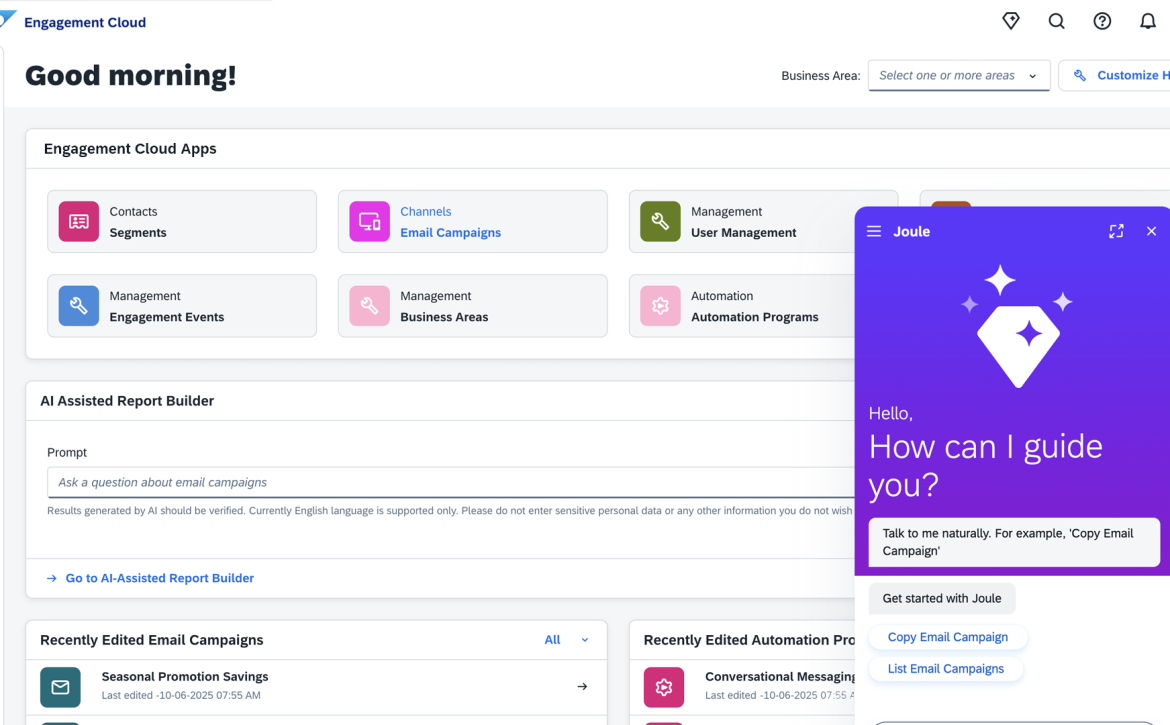
  • SAP Engagement Cloud delivers personalized, AI-personalized communications and interactions across every channel powered by connected customer and operational data all fully integrated across SAP. Teams can deliver consistent, intelligent engagement that builds loyalty and drives business impact.
SAP Engagement Cloud 
  • AI-assisted report builder (SMS channel support): Extend conversational analytics to SMS campaigns. A new data context model narrows analysis to the right dataset, returning faster, more precise answers to natural language questions, such as “What was SMS revenue last month?”
AI-Assisted Report Builder for SMS
  • AI segments for mobile push: Predictively identify contacts who are likely in the next 30 days to engage, become inactive, or remain inactive, so marketers can target outreach where it will deliver the strongest results.   
AI Segmentation for Mobile Push

Accelerate transformation with the advanced success plan for SAP CX

To assist customers on their transformation journeys, SAP launched the new Advanced Success Plan in the SAP Services and Support portfolio. This will help customers increase the value of individual applications, accelerate cloud transformation across SAP Business Suite, and enable consistent adoption of new innovations and SAP Business AI.

With expanded coverage with additional SAP CX solutions, including SAP Enterprise Service Management and SAP Sales Performance Management, the advanced offering is comprised of three powerful elements:

  • Success expert: Regular SAP expertise driving strategic customer outcomes
  • Adoption guidance: Structured, AI-driven enablement accelerating adoption
  • Activation and optimization services: Hands-on services to maximize performance and impact

Check out the webinar to learn how the new service offering unlocks more of the transformative value of SAP solutions: Success Unleashed: Be Future-Ready with SAP Services and Support.

Intelligence where execution happens  

With SAP Customer Experience, AI moves beyond isolated assistance to operate directly within business execution flows. Intelligence is embedded where work happens—inside quotes, product content, service interactions, and campaigns—helping organizations respond in real time and deliver consistent customer outcomes at scale.

Learn more about SAP CX in Q1 2026  

Read the SAP Help documentation to get started with these new capabilities.  


Balaji Balasubramanian is president and chief product officer for SAP Customer Experience and Consumer Industries. 

For news, stories, and highlights delivered each week, subscribe to the SAP News Center newsletter

SAP Extends Contract with Chief People Officer Gina Vargiu-Breuer

WALLDORF — SAP SE (NYSE: SAP) today announced that it has extended the contract of Gina Vargiu-Breuer (51), Chief People Officer of SAP SE, for another three years until January 31, 2030.

“In her role as chief people officer, Gina Vargiu-Breuer has laid important foundations for SAP’s continued success by strengthening how we attract, develop and lead our people,” said Pekka Ala-Pietilä, Chairman of the Supervisory Board of SAP SE. “We appreciate her energy and dedication and are convinced she will further drive SAP’s transformation into the age of AI.

“I am grateful for the trust of the Supervisory Board and look forward to shaping SAP’s transformation in the age of AI,” said Vargiu-Breuer. “This is about rethinking how we operate as a company: how we work, make decisions and deliver value to our customers. Together with my People & Culture team, we will continue what we started two years ago and turn this transformation into tangible business impact at scale.”

Vargiu-Breuer became a member of the Executive Board of SAP SE in 2024. Prior to joining SAP, she served as Senior Vice President of Human Resources at Siemens Energy. Earlier in her career, Vargiu-Breuer held multiple roles at Siemens AG.

Visit the SAP News Center. Get SAP news via LinkedIn and Bluesky.

Note to editors: 
To preview and download broadcast-standard stock footage and press photos digitally, please visit www.sap.com/photos. On this platform, you can find high resolution material for your media channels.

Media Contact:
Bjoern Emde, +49 6227 7755107, b.emde@sap.com, CEST
SAP Press Roompress@sap.com

Get SAP news, stories and highlights delivered straight to your inbox each week

This document contains forward-looking statements, which are predictions, projections, or other statements about future events. These statements are based on current expectations, forecasts, and assumptions that are subject to risks and uncertainties that could cause actual results and outcomes to materially differ.  Additional information regarding these risks and uncertainties may be found in our filings with the Securities and Exchange Commission, including but not limited to the risk factors section of SAP’s 2025 Annual Report on Form 20-F.
© 2026 SAP SE. All rights reserved.
SAP and other SAP products and services mentioned herein as well as their respective logos are trademarks or registered trademarks of SAP SE in Germany and other countries. Please see https://www.sap.com/copyright for additional trademark information and notices.

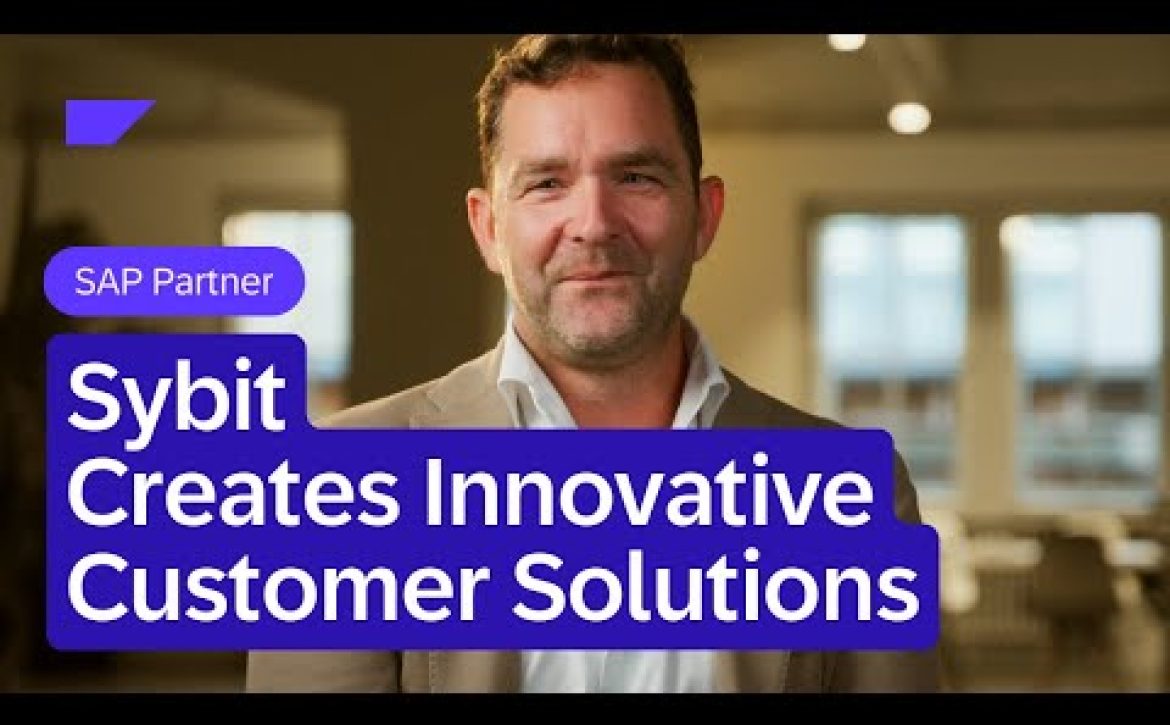
How Sybit Creates Innovative Customer Solutions with SAP Business AI | SAP Partner

AI creates the biggest advantage when it’s applied end-to-end, not as a one-off experiment. In this short partner story, Sybit shares how it approaches AI holistically so customers can stand out from competitors, using SAP Business AI to turn real-world signals and company data into action.

Sybit highlights two practical examples that are already in place: first, spare part determination from a photo. An AI-based solution analyzes an image, identifies the required spare part, and recognizes the underlying pattern behind it. That helps teams respond faster and with greater accuracy, especially when time matters and details are hard to capture in a ticket.

Second, an AI chatbot grounded in company data. By taking internal data into account, the chatbot can recommend the best-fit action and the best-fit answer, helping customer-facing teams deliver more consistent, context-aware responses. It also reduces the back-and-forth that happens when information is scattered across systems or buried in documentation.

Together, these examples show how SAP Business AI can support smarter service experiences by cutting time spent searching, improving first-time accuracy, and helping teams move from insight to resolution more quickly.

Explore SAP Business AI: https://www.sap.com/products/artificial-intelligence.html

Follow us on social:
LinkedIn: https://www.linkedin.com/company/sap/
Instagram: https://www.instagram.com/sap
Facebook: https://www.facebook.com/SAP/
Threads: https://www.threads.com/@sap

About SAP:
As a global leader in enterprise applications and business AI, SAP stands at the nexus of business and technology. For over 50 years, organizations have trusted SAP to bring out their best by uniting business-critical operations spanning finance, procurement, HR, supply chain, and customer experience. For more information, visit: https://www.sap.com/index.html

#SAPBusinessAI #CustomerService #SAPPartner

How SAP S/4HANA Improves Procure-to-Pay (P2P) Across Industries

Procurement is the process of sourcing, buying, receiving, and inspecting all the raw materials, whether goods or services, to run a business.

Molton Brown Reinvents Peak‑Season Luxury with SAP Customer Experience

Molton Brown has long been synonymous with British luxury—known for its fragrance craftsmanship, premium bath and body formulations, and commitment to sustainability.

In today’s omnichannel reality, delivering that elevated experience consistently and at scale is essential to protecting brand trust and loyalty. Peak moments like Black Friday and Cyber Monday amplify the challenge, when traffic surges and expectations for fast, personalized service are at their highest.

The team recognized that legacy systems couldn’t provide the speed, stability, or connected view required to meet those expectations at scale, prompting a shift to a modern customer experience (CX) foundation with SAP.

SAP Commerce Cloud: Fuel embedded AI with holistic, end-to-end business data

Modernizing the digital core with SAP Commerce Cloud

Moving from legacy technology to SAP Commerce Cloud gave Molton Brown a high‑performance engine designed for peak‑season reliability and continuous innovation. The results came quickly: 100% uptime during peak trade, even as volumes spiked to one order every three seconds during major events, freeing teams to focus on enhancing the customer experience rather than firefighting, and ensuring uninterrupted service for customers across global markets.

“Peak performance isn’t a one‑time effort; it’s about reliability. We have to rely on technology operations to achieve 100% efficiency so the business can succeed, which in turn helps our customers succeed. Technology should enable business success, not block it—and SAP has proved that multiple times.”

Naresh Krishnamurthy, Senior Manager – Business Transformation, Prestige, Kao UK Ltd

That stability also matters as product discovery increasingly begins beyond owned channels—from social platforms to emerging AI‑powered assistants—where consistent, trustworthy content and availability help the brand stay visible and credible wherever customers choose to engage. SAP’s evolving agentic commerce innovations anticipate this shift, ensuring products remain discoverable, trusted, and actionable across both human and AI agents.

A seamless luxury journey across channels

With SAP Commerce Cloud and SAP Engagement Cloud (formerly SAP Emarsys) working together, Molton Brown aligns what customers see online with what they experience in store. Product categories, storytelling, and navigation are mirrored across channels; store associates can act on online browsing signals; and store teams are enabled with real‑time insight to deliver high‑touch clienteling experiences.

The result is an unbroken, premium journey that reduces friction and reinforces trust in the brand—exactly what luxury shoppers expect.

Personalization that builds loyalty, not just transactions

SAP Engagement Cloud helps Molton Brown deliver channel‑appropriate experiences, from mobile‑first engagement to email and in‑store clienteling, aligned to evolving customer preferences. These programs are complemented by thoughtful gifting moments, personalized birthday acknowledgments, and sustainability‑focused communications that strengthen repeat‑purchase behavior.

Crucially, the team treats every holiday period as a data‑rich learning cycle: months of performance testing, UX refinements, and campaign iteration inform what customers experience in the following season. Those insights help the team refine the experience so it remains consistent, intuitive, and premium, even under peak pressure. That consistency is what sustains loyalty, not just the promotions themselves.

As Naresh Krishnamurthy explains: “Black Friday is not just about revenue; it’s about brand engagement and building the strong foundation that enhances the relationship through loyalty.”

Ready for the next era of intelligent commerce

With a dependable CX core in place, Molton Brown is now exploring SAP Business AI to anticipate risks ahead of campaigns, sharpen decision‑making, and streamline fulfillment—augmenting the experience behind the scenes without compromising luxury standards.

This direction aligns naturally with SAP’s broader agentic commerce vision, where AI systems help interpret intent and keep trusted products discoverable and transactable across new surfaces—another reason a reliable, “machine‑readable” CX foundation matters.

“Everything we’re doing ladders up to one goal: a truly connected customer experience—personal, consistent, and effortless in every channel.”

Molton Brown’s partnership with SAP CX has reset what’s possible at peak, and every day after: dependable operations, consistent omnichannel experiences, and personalization that earns loyalty. The brand now scales confidently during its biggest moments, and stays ready for what’s next as AI changes how people (and agents) discover and buy.

This transformation positions Molton Brown to adapt quickly as customer expectations and digital commerce behaviors continue to evolve.

To explore how SAP Commerce Cloud can elevate your customer experience, visit sap.com/commerce.

Subscribe to the SAP News Center newsletter for weekly updates

Top 3 Tips to Sell More with SAP Business Network | With SAP Customer, Unite | B2B Exchange

Zachary Rubio Grundell from SAP customer Unite shares how SMEs can reach more customers and grow their business through a B2B business network.

POV: You use AI to survive your HR to-do list ✅

Time is your most valuable asset ⏳

Joule helps you save it, from crafting job descriptions to understanding your pay slip. Discover your new AI-powered productivity hack. 💎 https://sap.to/6050hyOL0

#joule #ai #sapsuccessfactors

Previous Next
Close
Test Caption
Test Description goes like this