SAP, a global leader in enterprise software, is advancing its AI capabilities through a strategic partnership with Mistral AI, a pioneering company in large language models (LLMs). This collaboration aims to enhance the SAP suite, bringing state-of-the-art AI solutions to its customers. The alliance between SAP and Mistral AI represents a significant leap in enterprise […]
Data integrity company Precisely has unveiled new modules for SAP Fiori and SAP GUI for HTML in their Automate Studio, in a significant move to streamline data automation processes. These additions are set to simplify the SAP S/4HANA data journey for organizations by providing greater flexibility and improved governance capabilities across various SAP ERP environments. […]
SAP is delivering AI capabilities that transform everyday tasks in HR – saving time, improving outputs, and helping organizations lead with an employee-first mindset to make every employee a success story.
The acceleration of AI is changing how organizations attract, hire, retain, and skill their employees. In fact, research conducted by a team of SAP SuccessFactors organizational psychologists, published in Top HR Trends for 2024, identifies AI and skills as the top two meta-trends that every HR professional is talking about today. Also, among CEOs and CIOs, these two trends are topping the list of business priorities that require action.
“We are in the midst of a transformative era,” said Aaron Green, chief marketing and solutions officer for SAP SuccessFactors, while speaking to an audience of SAP customers and HR leaders at SAP Sapphire (watch on demand).
“This is a pivotal moment for HR, because it’s not just about keeping up. Now it’s about leapfrogging; it’s about how we stay ahead,” he said. “It requires investing in your people and investing in their skills in a fundamentally different way. The only way to do this is by investing in technology to help your people work smarter, faster, and to help them make data-driven decisions – because the future is undeniably people-led.”
Making AI Available to Customers Here and Now
More than 10,000 customers and 290 million people use the SAP SuccessFactors HCM suite for HR processes spanning the employee experience from hire to retire. A thriving partnership with the global customer community helps SAP understand the challenges and opportunities faced by organizations of all sizes, geographies, and industries.
Throughout the community are individual success stories showing how using the AI-led power of SAP SuccessFactors is helping organizations drive agile change at scale while simultaneously delivering more personalized experiences to the workforce. That’s because SAP’s AI-led capabilities are available right now – not in the far-off future, as Green underscored.
Döhler Puts People at the Heart of Digital Transformation
Döhler Group, a global producer of natural ingredients for the food and beverage industry, is among those customers using the AI solutions in SAP SuccessFactors HCM to achieve real business outcomes. Based in Germany, Döhler takes an SAP-first approach to its use of technology in support of its company values of innovation, trust, quality, and sustainability.
With SAP SuccessFactors solutions, Döhler puts people at the heart of its digital transformation by putting AI directly in the hands of its HR professionals and its entire workforce. Strategically, Döhler delivers change to the workforce by introducing AI-led capabilities and then layers additional functionality on top, so that employees get used to the new technology and start to work with it more efficiently and effectively.
Pierre Wiese, head of Business Applications, Döhler Group, articulated the company’s approach to AI: “We expect SAP to deliver business AI innovations with empowering built-in functionalities,” said Wiese. “With our AI consumption, we move forward as quick as possible because we plan to have massive impact on the daily work of our people at Döhler.”
SAP Business AI in HR: Relevant, Reliable, and Responsible
In the first half of 2024, SAP SuccessFactors delivered new AI-enabled capabilities across SAP SuccessFactors HCM that are now being used by organizations to help free HR teams of time-consuming tasks, enhance organizational efficiency, and drive future growth. “We’ve reimagined the HCM suite, and we’ve made huge investments across the board in our user experience [to help] employees, managers, power users have a truly delightful experience with SAP SuccessFactors,” said Daniel Beck, president and Chief Product Officer, SAP SuccessFactors.
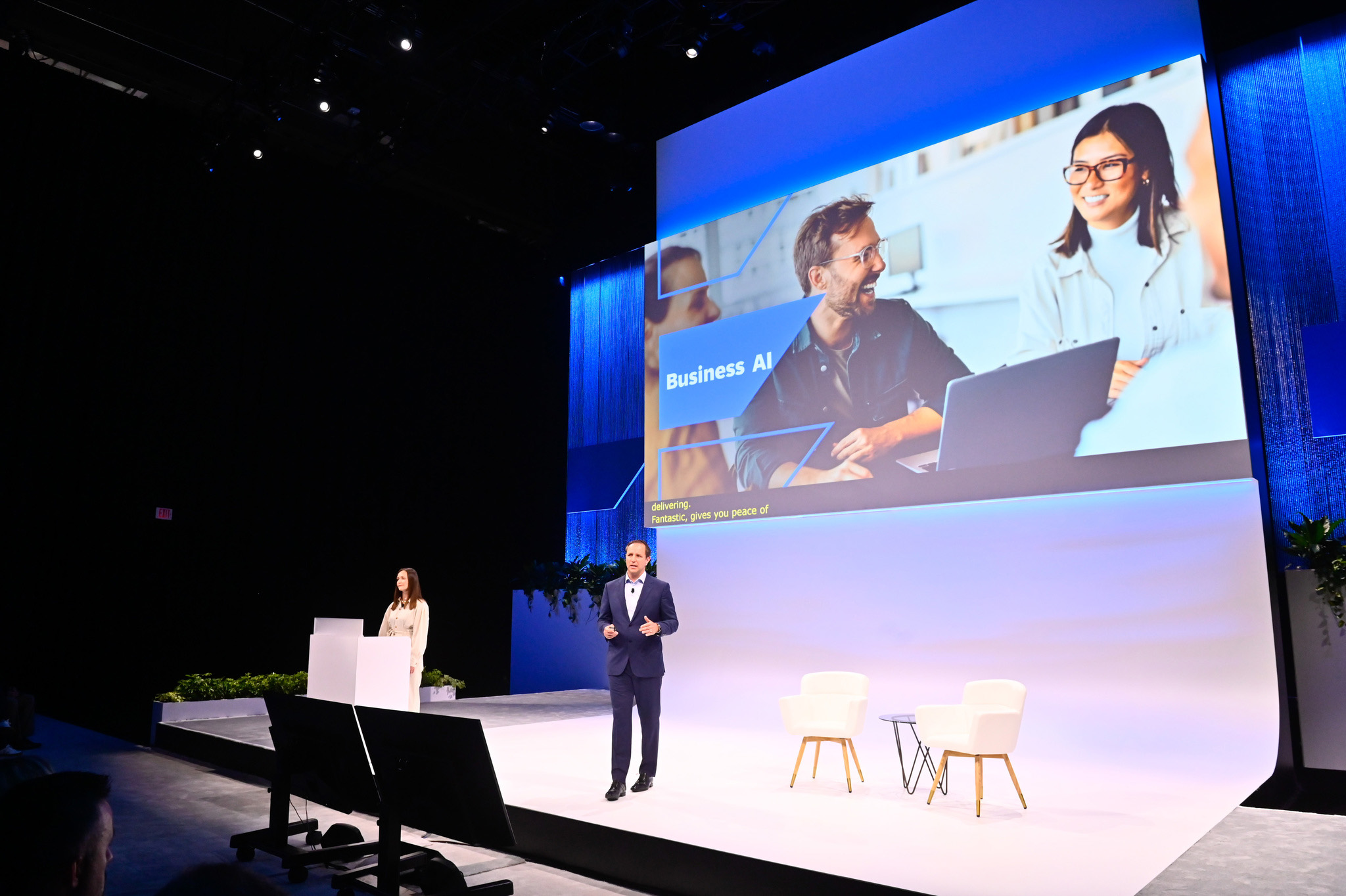
SAP’s Daniel Beck and Nadja Ericsson on stage at SAP Sapphire Orlando.
Beck highlighted how SAP is delivering customers world-class AI technology and large language models (LLMs). With SAP Business AI in human resources, SAP is committed to delivering AI that is relevant, reliable, and responsible within use cases for HR professionals.
For example, SAP has put controls in place through the SAP AI Global Ethics organization and legal experts to evaluate AI use cases – ensuring that they will be used safely, responsibly, and without bias – before they are made available to customers. Beck said, “When you’re deciding, whose business AI can I trust? I think you will be well served with the data, security, the legal frameworks, the ethical frameworks that SAP is delivering. It gives you that peace of mind.”
In a software demonstration on stage, HR leaders saw the power of the expanded AI capabilities of SAP SuccessFactors HCM. New technologies like retrieval augmented generation (RAG) enable SAP solutions to combine the strengths of LLMs and personal or business information to quickly deliver contextualized insights and answers for HR teams.
Some of the new new AI-led capabilities include: a generative AI writing assistant to help SAP SuccessFactors users complete tasks, such as writing learning course descriptions; the ability to help employees draft performance and development goals; candidate skill matching to help recruiters quickly screen and filter job candidates; and generative AI to summarize an employee’s compensation and job history, based on data in SAP SuccessFactors, so managers can have more informed compensation discussions.
For the foreseeable future, rapid advancements in AI technology will continue to bring new use cases to customers. “This is a super exciting time. I think the next two years in HR technology will be the most innovative – even better than the prior 20 years,” Beck said. “We want to be your trusted partner in that journey.”
Customers Can More Easily Identify Partners with Deep Expertise and Experience in Large and Complex RISE with SAP Implementations
The RISE with SAP Migration and Modernization program helps bring renewed focus on the cloud transformation journey by enabling smooth, secure migration of on-premise SAP ERP Central Component (SAP ECC) and SAP S/4HANA customers to the cloud.
SAP Sapphire: Taking Business to the Next Level in the Era of AI
One of the key pillars of the program is RISE with SAP Methodology. The methodology is designed to provide a consistent approach — from planning to go-live to ongoing operations and evolution — that can meet customers’ business transformation goals leveraging specific implementation stages and success KPIs.
To support customers’ RISE with SAP transformations, SAP is training and validating partners to use RISE with SAP Methodology and collaborating closely with these partners on quality and consistency. By following the methodology, customers can drive predictable timelines for implementations and provide progress transparency with key milestone assessments.
SAP customers with complex SAP ERP landscapes starting their journey to RISE with SAP can now identify their ideal cloud transformation partner through the new RISE with SAP Validated Partner recognition.
These select partners meet elevated capability and experience criteria for the RISE with SAP offering, have proven experience in large enterprise engagements, and demonstrate their implementation approach is aligned with RISE with SAP Methodology. Using this methodology, the validated partners can ensure customers are cloud compliant and innovation ready, with an accelerated time to value.
Partners that have been validated as part of this program include Accenture, Capgemini, Deloitte, EY, IBM, Infosys, NTT DATA, and PwC.
In addition to adhering to the principles of RISE with SAP Methodology, these validated partners complement it in several ways, such as by leveraging specialized tools, templates, architecture patterns, and pre-configured solutions that speed up transformation of our enterprise customers. Additional eligible partners will be validated in the second half of 2024.
“Empowering our partners with RISE with SAP Methodology isn’t just about alignment; it’s about forging a standardized path to success,” said SAP Chief Partner Officer Karl Fahrbach. “By formalizing our engagement model, we reinforce a commitment to excellence, ensuring every project delivers with precision and consistency, driving unparalleled results for our most valued customers. Our partners can lead the way with our support, igniting a paradigm shift in how we approach innovation and collaboration.”
Companies also have the option to leverage SAP Partner Finder and the Competency Framework to find the expertise they need, no matter their business challenges, company size, industry, or location. Partners that have attained the essential level have met the minimum training and delivery requirements for delivering RISE with SAP implementations. This gives customers confidence that the partner has the necessary level of maturity and has demonstrated customer success through effective project delivery.
RISE with SAP Validated partners are required to attain the expert level of multiple competencies, including RISE with SAP S/4HANA Cloud Private Edition, SAP Business Technology Platform, and SAP Business Process Transformation. These designated partners must also maintain bi-annual performance requirements and eligibility checks with a focus on clean core quality gates.
What if enterprise decisions considered both profit and planet, empowering every level of a company to make better product, pricing, financial, and investment choices? It’s not only possible, it is an achievable reality according to new research conducted by SAP and Technical University of Munich.
SAP Sapphire: Taking Business to the Next Level in the Era of AI
Carbon management can add emission quantities to existing financial accounting and connect emissions and finance at the transactional level — transforming carbon accounting practices, producing a more comprehensive view of a company’s sustainability position. With this added dimension, decision-making becomes more integrated and efficient. By shifting the carbon management mindset, companies can also provide investors with more decision-useful information.
The research shows there are clear benefits and opportunities to businesses that are ready to rethink carbon management, embrace transparency, and treat carbon as money in their financial accounting and reporting practices.
Reimagining Carbon Management
A recent study by the Technical University of Munich and SAP generated some promising results and opportunities for carbon management enhancements with an ERP-centric approach. The study introduced the concept of consistently adding carbon data to a company’s general ledger transactions. This significant change allows carbon accounting to be transaction driven, with journal entries consisting of both monetary values and carbon emissions. The modification enables integrated thinking, on all hierarchical levels, by considering carbon emissions at the same level of reliability and consistency as financial information.
Beyond environmental responsibility, this innovative approach unlocks additional advantages. Merging carbon data with financials strengthens the very foundation of a company: the data itself. Balance sheets and income statements will represent a more complete picture of a company’s impact. This level of transparency and elevated quality of data empowers investors and decision makers while advancing decision-useful information.
Quality of data — from inside and outside a company’s core operations — is also critical when moving toward embedding artificial intelligence (AI) across business processes and analytics. AI will help companies accelerate their sustainability impact by improving operational efficiency, fostering greater transparency around emissions, automating reports, and complying with ever-evolving regulations.
Global Transparency
Carbon reporting is rapidly becoming a standard requirement for business. The common denominator is the set of requirements put forth by the Greenhouse Gas (GHG) Protocol. SAP proactively anticipated and closely monitors the laws and regulations developing in this sector.
With the global trends toward a low-carbon, modern economy driving business transformation, SAP developed SAP Green Ledger, an ERP-centric solution that builds on existing financial accounting practices and applies them to carbon accounting standards.
This new ledger-based accounting elevates greenhouse gas counting to true accounting using financial steering dimensions. By doing so, SAP Sustainability solutions are set apart through deep integration with SAP cloud ERP solution business processes, providing precise and actionable insights rather than the estimates/averages in competing solutions. This unique approach will empower companies to go beyond regulatory compliance and embed sustainability into their operation to drive meaningful change. By aligning business processes with sustainability goals, companies can pave the way for a sustainable future.
Make Carbon Audit-Ready
To reach net-zero targets, most companies must consider carbon offsets as part of their decarbonization journey. SAP’s carbon management approach recognizes offsets as intangible assets.
With SAP Green Ledger, both carbon and financial information are recorded, resulting in a carbon flow statement that shows carbon emissions across all three scopes. The flow items incorporate initial, additional, exiting, and ending carbon balances, as well as emissions not allocated to an asset position in the balance sheet. Adoption of this new carbon accounting process could take different forms, but all leverage the existing ERP system and general ledger accounts.
Standard auditing procedures were also considered and accommodated for in this methodology. Since carbon emissions are allocated to transactions as quantities expressed in tons of CO2e, auditors can verify these transactions and their corresponding internal controls. Auditors can also perform an assessment covering the assertions of completeness, existence, accuracy, valuation, and presentation.
Reporting of sustainability-related data is within the purview of the governing bodies and subject to change. Downstream Scope 3 emissions and non-financial transactions are not yet part of this approach; however, future research could find ways to integrate those components.
Don’t Just Report Profits, Report Progress
Carbon reporting is a crucial aspect of a decarbonizing economy. Our new methodology fosters integrated thinking — between finance and sustainability — producing a clearer view of a company and their products’ carbon footprint.
“Our study has the potential to significantly transform carbon accounting practices,” Professor Dr. Jürgen Ernstberger, a primary contributor to this research, affirms.
It’s a win-win for the planet and the bottom line.
Lemongrass has announced the launch of its new RISE with SAP Advisory services, designed to assist enterprises in navigating their digital transformation journey using SAP technologies. This comprehensive service suite aims to facilitate the transition to a dynamic, cloud-based environment, leveraging the RISE with SAP platform to streamline and accelerate the migration process. RISE with […]
DXC Technology, a global technology services provider, has introduced the DXC Fast RISE with SAP service. This innovative offering aims to significantly speed up SAP deployments, enabling businesses to leverage the extensive benefits of SAP S/4HANA in under a year. The DXC Fast RISE with SAP service is designed to drastically cut down the implementation […]
This week at SAP Sapphire, four industry-leading companies joined SAP Executive Board Members Scott Russell and Thomas Saueressig on stage in Orlando to discuss how they are using SAP technology to deliver high-value results for their businesses.
Taking Business to the Next Level in the Era of AI
Russell told the crowd that customer stories and conversations is what SAP Sapphire is all about, saying that what makes the event special is having “a collective group that comes together, both here in the room and virtually, and being able to understand how SAP can bring out your best.”
Russell emphasized that the news from SAP Sapphire is a “demonstration of our commitment to continually innovate, to continually strive to bring more creative value to your business.”
He noted that a perfect example of this is the announcement that SAP has entered into an agreement to acquire WalkMe, a leader in digital adoption platforms. Reflecting on the acquisition, Russell said “We are obsessed not only about great applications and great platforms to deliver value for your business, we also care passionately about the transformation journey to get there.”
SAP AI Core is set to transform enterprise operations through a strategic partnership with Amazon Web Services (AWS). This collaboration integrates advanced generative AI models from Amazon Bedrock into SAP AI Core, enabling businesses to streamline processes, enhance efficiency, and drive innovation across their operations. SAP SE and Amazon Web Services (AWS) have announced a […]
In their SAP Sapphire Orlando keynote, Executive Board Members Muhammad Alam, SAP Product Engineering, and Juergen Mueller, chief technology officer, shared how the latest SAP innovations will help businesses drive true, end-to-end digital transformation and address their toughest business challenges.
Taking Business to the Next Level in the Era of AI
In the keynote, which featured several real-world product demos by SAP employees, Alam and Mueller touted the value of SAP’s best-of-breed solutions with an outlook of what the next 50 years of innovation by SAP may look like.
Who better to inspire the keynote than Hasso Plattner, co-founder and recently retired chairman of the SAP Supervisory Board, who both Alam and Mueller invoked during the session. To spell out SAP’s legacy and vision for the future, Mueller quoted Plattner’s farewell message: “Keep innovating, keep pushing boundaries, and keep making a difference in the lives of our customers and the world at large.”
Keep Innovating
To kick off his first SAP Sapphire appearance as the head of SAP Product Engineering, Alam began by describing the importance of harnessing innovation to deliver an end-to-end picture across all business functions and unlock true value.
Simply put, businesses exist to build and deliver products and services to customers, he explained. But the materials, assets, people, and processes that come together to achieve this task is far from simple. “The reality is that each part of the business is deeply and intricately connected to all the others,” Alam said, meaning a pain point in one area impacts the rest. That’s why SAP’s modular cloud ERP approach is so successful: “We allow our customers to drive true digital transformation as opposed to running systems integration projects disguised as digital transformation,” he added.
Alam presented GROW with SAP as an example of this composability and extensibility, as it can work for and scale to many sizes and types of business. And now, SAP Sales Cloud and Concur Expense are natively integrated into GROW with SAP, making the offering even more comprehensive. Sinit Foto, product manager for UX, Cloud ERP at SAP, joined Alam on stage to show how GROW with SAP and SAP Business AI can help achieve integrated processes, demoing use cases such as communicating with customers about sales quotes, creating expense reports, and supporting financial analyses. In fact, Alam announced that SAP is implementing the demoed application internally to manage sales worldwide. And Mueller emphasized: “We are committed to helping you in this transformative AI moment by creating business outcomes that were unthinkable before. That’s why we’re embedding SAP Business AI deeply in our processes and analytics.”
Keep Pushing
AI was woven throughout the entire keynote, with both Alam and Mueller discussing SAP’s strategy and product enhancements in this space. AI must be high value, easy to adopt into the flow of work, and trustworthy for it to truly transform how we do business, Alam said. “Equally important is whether it’s done in a way where it keeps your data secure and private – and is executed in a responsible manner,” he added. “And that is really the core promise of SAP Business AI.”
There’s no doubt that AI is a powerful technology, which is why it’s essential that businesses view it as a “responsibility” not just an “opportunity,” Alam said. Megan Fife, executive solution advisor for SAP SuccessFactors, showed how SAP executes on its responsible, reliable, and relevant business AI by demoing how SAP’s AI copilot Joule in SAP SuccessFactors HCM can help fill skills gaps and collaborate across teams, among other meaningful tasks. Key to this endeavor is SAP’s expanded partnership with Microsoft announced earlier in the day, which Scott Guthrie, executive vice president of Cloud and AI at Microsoft, discussed with Alam on stage.
Mueller echoed the importance of responsible AI, saying that the technology depends highly on data that is reliable and that allows customers to look at their business end-to-end. Here, SAP Datasphere and SAP Spend Control Tower – which was demoed by Orla Cullen, product marketing manager for Data and Analytics at SAP – can help simplify data management and view and manage spend and sustainability data holistically.
This transformation is supported by SAP Business Technology Platform (SAP BTP), and Mueller demonstrated the newest generative AI features in SAP Analytics Cloud, SAP Integration Suite, and SAP Build solutions. He showed how Joule can help create and summarize financial reports for controlling teams; generate integration flows between SAP and non-SAP applications; and create custom skills and content based on specific business needs. Greater insights, faster reaction times, and increased productivity are the result. Soon, Mueller added, it will even be possible to enhance and extend Joule’s knowledge by creating custom skills using SAP Build and having the copilot interact with data housed in SAP and non-SAP systems, helping businesses run even more efficiently.
SAP BTP is the key to being “innovation-ready,” maintaining a clean core, and tailoring standard offerings to unique needs, Mueller explained. More than 24,000 companies running live on SAP BTP, including Blue Diamond Growers and Lufthansa Technik, can attest to this.
“SAP BTP’s extensibility and enterprise automation capabilities can help businesses turn process insights into actual improvements,” Mueller said. Cecilia Huergo, product manager for SAP BTP, showed this in her demo on how identifying improvement opportunities, realizing needed changes while maintaining a clean core, and gaining an up-to-date view of your IT landscape can be enabled with the combined power of SAP Signavio solutions, SAP LeanIX, and SAP BTP.
Keep Making a Difference
The innovations demoed and discussed in Alam and Mueller’s keynote, in addition to the many others announced at SAP Sapphire in 2024, are just the latest steps forward in SAP’s journey to bringing out the best in its customers. “The future is here, and it’s defined by those who innovate first,” Mueller said. “And we are here to give you the right tools at hand, such that you can be a leader not just today, but also tomorrow.”