SAP Extends Contract with CEO Christian Klein

WALLDORF SAP SE (NYSE: SAP) today announced that it has extended the contract of CEO and Member of the Executive Board Christian Klein (44) for three years, until the end of 2028.

The company has also strengthened Klein’s role, making him chairman of the Executive Board, where he was previously speaker. Klein joined the SAP Executive Board in 2018 and was named co-CEO in October 2019 before being appointed the sole CEO of SAP SE in April 2020.

“In his role as CEO, Christian Klein has consistently driven SAP’s transformation to a cloud company,” said Professor Hasso Plattner, chairman of the Supervisory Board of SAP SE. “I would like to thank Christian Klein for his outstanding contribution to SAP’s success. With the early extension of his contract and a further strengthening of his position, we are clearly underlining his important role in SAP’s ongoing transformation. We are convinced that this will lay the foundation for SAP’s continued growth in a highly dynamic IT industry.”

“I would like to thank the SAP Supervisory Board for their trust in me. I look forward to continuing the strong cooperation with my SAP Executive Board colleagues as well as our employees, partners, customers and investors,” said Klein. “Together, we have successfully driven our strategy, and it is a privilege to lead SAP on its journey to be the number one enterprise application and business AI company.”

Klein started his career at SAP in 1999 as a student. After holding various positions across the company, including chief financial officer of SAP SuccessFactors and SAP’s chief controlling officer, he was appointed chief operating officer of SAP in 2016, a role in which he continued until 2021.

Visit the SAP News Center. Follow SAP at @SAPNews.

Media Contact:
Marcus Winkler, +49 6227 767497, marcus.winkler@sap.com, CEST 
SAP Press Room; press@sap.com

Sign up for the SAP News Center newsletter to receive weekly updates on company news, stories and coverage

This document contains forward-looking statements, which are predictions, projections, or other statements about future events. These statements are based on current expectations, forecasts, and assumptions that are subject to risks and uncertainties that could cause actual results and outcomes to materially differ.  Additional information regarding these risks and uncertainties may be found in our filings with the Securities and Exchange Commission, including but not limited to the risk factors section of SAP’s 2023 Annual Report on Form 20-F.
© 2024 SAP SE. All rights reserved.
SAP and other SAP products and services mentioned herein as well as their respective logos are trademarks or registered trademarks of SAP SE in Germany and other countries. Please see https://www.sap.com/copyright for additional trademark information and notices.

Defining the AI Opportunity for SAP and Our Partners

Artificial intelligence is by far the disruptor of the decade. It can search, summarize, and analyze vast data stores, putting data-driven insights at employees’ fingertips in a matter of minutes. It can also generate content, anything from text to software code, streamlining workflows and saving precious time and money.

And that’s just the surface. We are still learning just how far reaching the implications could be in the workplace.

SAP Business AI: Revolutionary technology. Real-world results.

As we explore this new realm and AI’s vast potential, SAP has adjusted its strategy with the goal of becoming not only the leading enterprise application provider but also the No. 1 business AI company. The foundation is now available with SAP Business AI that offers SAP customers a reliable, relevant, and responsible AI solution portfolio.

A key element of that strategy is leveraging SAP partners’ expertise. The trusted relationships our partners have developed with our joint customers are essential to communicating the value of AI solutions from SAP and finding the best SAP products to meet their business objectives. It also poses a great opportunity for partners to expand their business.

But first, let’s take a step back and explore why SAP is best positioned to deliver on the business AI opportunity.

SAP’s AI Advantage

Deep Business Process Knowledge
Before AI can make operations faster, data-driven, and more effective, organizations must optimize business processes. SAP brings a deep understanding of business processes to AI applications, enabling solutions that orchestrate workflows, data sharing, and automation for the greatest efficiency and productivity.

SAP Data
AI solutions require data to train their algorithms to provide accurate, relevant, real-world outputs. SAP can draw on business data from thousands of customer systems across the value chain, helping to address our customers’ challenges and drive their digital transformation.

Focus on Application Creation
SAP is partnering with technology providers to make the most of the AI opportunity by creating value with new applications. For example, large language models (LLMs) will become solution differentiators. LLMs perform a range of natural language processing tasks. Combining LLMs with AI solutions automates insight delivery, freeing users from the need to wait for help from their IT or data science departments. It allows companies to focus on data insights, rather than devoting focus to the technology that produces them.

Strong Partner Ecosystem
SAP recognizes that it cannot reach the full addressable market alone. That is why our more than 25,500 partner ecosystem is a huge advantage when offering business AI solutions. Working together, we can drive innovation, accelerate AI road maps, and expand AI capabilities beyond its own limitations.

I cannot underscore enough how important that fourth component is to our AI strategy. It is a linchpin to our success. That’s why we must ensure we are creating win-win scenarios for our partners that benefit us both for the long term.

Partner Opportunities

While AI offers a range of benefits to SAP customers, it also represents a significant business opportunity for SAP partners. As a part of the SAP ecosystem, partners can provide advanced functionality out of the box with embedded AI capabilities within SAP applications. They must also take advantage of the virtually endless opportunities that AI offers regardless of the chosen SAP partner business model:

  • Sell: Partners that resell SAP solutions can leverage the embedded AI portfolio from SAP to accelerate RISE with SAP and GROW with SAP deals. Sell partners can also enhance the appeal of the cloud with AI capabilities exclusive to SAP cloud solutions and enlarge deals with AI units from SAP required for premium AI capabilities.
  • Service: Service partners can drive adoption of SAP’s AI portfolio and custom AI capabilities built on SAP by bundling them with services and support. This approach enables customers to gain value through customized generative AI use cases built on the foundation of SAP Business Technology Platform (SAP BTP), including the generative AI hub, and accelerate their cloud migrations and business transformation, backed by partners’ expertise.
  • Innovate: Partners also have the opportunity to develop innovative AI solutions and extensions to enhance the SAP portfolio. Partners can build customer-specific and repeatable use cases with AI services from SAP on SAP BTP and augment customer business processes.

Take the Next Step

Ready to expand your partnership with SAP to build on the AI opportunity? Explore our AI portfolio and visit SAP Partner Portal site to learn more. If you’re not currently an SAP partner, there’s never been a better time to explore the benefits of becoming a part of the SAP ecosystem.

If you’re ready to start your SAP partnership journey and provide businesses in your market with reliable, effective AI solutions, get started here today.


Karl Fahrbach is chief partner officer at SAP.

Win more customers and grow revenue with the help of SAP’s award-winning partner program and portfolio of industry-leading solutions

EY-SAP Fioneer Alliance Drives Financial Transformation

The rapidly evolving financial services landscape demands innovative solutions and large-scale transformations to keep pace with the changing market dynamics. Recognizing this need, EY has forged a strategic alliance with SAP Fioneer, a leading provider of software solutions for the financial services industry. The EY-SAP Fioneer alliance aims to empower financial institutions by offering comprehensive […]

The post EY-SAP Fioneer Alliance Drives Financial Transformation appeared first on InsideSAP.

SAP Signavio Is a Leader in the 2024 Gartner® Magic Quadrant™ for Process Mining Platforms

In the 2024 Gartner Magic Quadrant for Process Mining, SAP Signavio has once again been recognized as a Leader in the market based on Completeness of Vision and Ability to Execute.

Complimentary copy: 2024 Gartner® Magic Quadrant™ for Process Mining Platforms

This is the second year in a row that SAP Signavio has been positioned as a Leader in the report. We believe that this positioning implies that SAP Signavio is a key driver for SAP’s growth and long-term strategy.

According to the Gartner Magic Quadrant research methodology, “Leaders execute well against their current vision and are well positioned for tomorrow.”

Our solutions solve today’s real and diverse customer use cases — operational excellence, compliance, automation, transformation, etc.– and recognizes that we have a compelling vision for a future in which process automation and process AI open up new opportunities for our customers and partners.

SAP Signavio continues to focus on ensuring the long-term success of all of our customers and partners.

Revenue NSW

In the Australian state of New South Wales, the tax collected by Revenue NSW accounts for more than 35% of finances, helping fund essential services, from healthcare to education and policing.

With a vision to be the world’s most innovative and customer-centric revenue agency, Revenue NSW set out with a very specific objective: it wanted to analyze cases in which clients had overpaid land tax to identify why these overpayments occur and what experience clients received when obtaining refunds. This analysis would not only help reduce overpayment volumes and improve the client experience, but also enable the agency to work more efficiently for its diverse stakeholders.

“As part of our Aspire 2032 strategy, our vision is to be the world’s most innovative and customer-centric revenue collection agency,” shared Jocelyn Yem, director of Strategy and Innovation at Revenue NSW.”‘Embrace Innovation’ is one of our strategic focus areas, where we can respond to our customers’ needs by embedding a culture of continuous improvement. SAP Signavio Process Intelligence has helped us achieve our first stage in this journey.”

“SAP Signavio Process Intelligence has painted a clear picture of why clients pay too much land tax and how we can process refunds smoothly, along with a detailed road map to help us put these insights into action,” confirmed Sabrina Bazouni, director of Land Tax at Revenue NSW.

Fujitsu Limited

Recognizing the wide-ranging effect of business process transformation solutions, Fujitsu Limited has embraced SAP Signavio solutions across its operations and portfolio.

At one of its manufacturing plants in Japan, Fujitsu used the SAP Signavio Process Intelligence solution to gather process execution data directly from the shop floor into the continuous improvement model the company had been using for many years. Integrating process data into the Kaizen discussions delivered never-before-seen insights, which helped the company further optimize its shop-floor processes and transform their Kaizen from traditional to digital, using process mining to generate data-driven insights.

This firsthand experience of the solutions has also allowed Fujitsu to enrich its customer offerings with new frameworks, insights, and tools that can help customers realign their organizations and make changes at speed.

Having seen the potential of SAP Signavio solutions, Fujitsu now plans to extend its use both internally and externally. One such planned initiative involves combining the concepts of the digital twin on an organization and the intelligent enterprise, using business process transformation solutions as the mechanism of change.

Download a complimentary copy of the report here.


Dee Houchen is global head of Market Impact for SAP Signavio.

Optimize and transform business processes fast and at scale

Gartner, Magic Quadrant for Process Mining Platforms, Marc Kerremans, David Sugden, Nick Duffy, 29 April 2024 

GARTNER is a registered trademark and service mark of Gartner, Inc. and/or its affiliates in the U.S. and internationally, and MAGIC QUADRANT is a registered trademark of Gartner, Inc. and/or its affiliates and are used herein with permission. All rights reserved. Gartner does not endorse any vendor, product or service depicted in its research publications, and does not advise technology users to select only those vendors with the highest ratings or other designation. Gartner research publications consist of the opinions of Gartner’s research organization and should not be construed as statements of fact. Gartner disclaims all warranties, expressed or implied, with respect to this research, including any warranties of merchantability or fitness for a particular purpose.

Expanded SAP Preferred Success Services Fast-Track the Value of Cloud ERP

Navigating disruption and uncertainty is always daunting, especially in economies and industries that evolve at different speeds. The influences of AI, post-globalization trends, regulatory changes, constrained capital, and other factors are impacting every region and industry, albeit at different rates and levels of severity.

By using any of a variety of SAP Preferred Success services when implementing and adopting SAP S/4HANA Cloud, customers can strategically and effectively handle each change. Their efforts include 44% improved user experiences, 40% faster incident resolution, 38% better enablement and upskilling, and 38% faster time to value from their technology investments, according to a Forrester Consulting analysis.

And now, with the latest offering for SAP Preferred Success, customers are going beyond navigating turbulence. They can also maximize opportunities, reduce risks, and understand how dynamic economic and market forces impact their long-term success.

Introducing SAP Preferred Success for RISE with SAP, premium

The SAP Preferred Success service for RISE with SAP, premium can deliver more guidance and insight to help accelerate and optimize the value of the cloud ERP journey, in addition to the foundational services of SAP Preferred Success.

With personalized services designed to meet unique business needs proactively, customers can realize benefits, including:

  • Improved productivity with access to SAP knowledge and best practices
  • Accelerated ROI with tailored guidance and expert support to organize SAP solutions faster and more efficiently
  • Fewer risks by following best practice recommendations that minimize system disruptions and help ensure smooth operations
  • Better alignment by matching SAP solutions with organization goals, capitalizing on the features and innovations of every release
  • Higher efficiency by consistently fine-tuning and providing personalized recommendations aligned with specific business value drivers

For customers such as Kyocera Document Solutions Australia (Kyocera), SAP Preferred Success helps create a solid foundation for modernizing business operations. “Using SAP Preferred Success enabled us to accelerate the business acceptance of change and drive a continuous improvement landscape. It has provided an avenue to reevaluate our processes and create a more efficient business,” states Rohan Higgins, chief financial officer of Kyocera Document Solutions.

As a result of the quality and caliber of the SAP expertise and active engagement, Kyocera has successfully moved 100% of its ERP processes to the cloud, leading to zero manual touchpoints across its forecasting processes. Other customers have realized additional benefits, such as more efficient business processes, smaller database sizes, infrastructure simplification, and reduction of cost centers.

A personalized, proactive partnership for the lifetime of your cloud solution

SAP Preferred Success for RISE with SAP, premium can provide additional elements for modernizing business operations, including:

  • A dedicated, named enterprise adoption expert with a strong technical and functional background, who can provide expertise and help orchestrate how-to conversations supporting the build of outcome-focused plans
  • Assistance and guidance based on recommended best practices to help increase the customer’s understanding of its business processes and how the solution is being used
  • Ongoing innovation and transformation through continuous review of the customer’s calendar and plans – including the adoption of entitlements, such as business AI, sustainability, intelligent technologies exploration, and process management
  • Clean core guidance and quality checks for each project phase to help ensure the customer can leverage existing and future innovations within RISE with SAP

With a dedicated focus on sustainability exploration, SAP Preferred Success for RISE with SAP, premium helps ensure that businesses can embrace a more sustainable future while driving growth and success in the digital age. By leveraging the comprehensive suite of tools and resources provided by SAP and orchestrated by an enterprise adoption expert, organizations can navigate their sustainability initiatives with confidence and precision.

SAP Preferred Success for RISE with SAP, premium also offers a unique avenue for harnessing the transformative power of AI with cloud ERP. Through a tailored approach, customers are guided by seasoned enterprise adoption experts facilitating a comprehensive exploration of business AI. Customers are then empowered to innovate, automate, and optimize their business processes using the cutting-edge AI capabilities seamlessly integrated into the SAP ecosystem.

Access to such a wealth of products, tools, and frameworks gives invaluable insights on configuring and customizing AI solutions to suit unique needs. By leveraging built-in AI capabilities from SAP, customers are not only equipped to streamline operations but also to drive innovation and achieve sustained growth in today’s dynamic business landscape.

Accelerating Competitive Outcomes from Cloud ERP

As businesses continue to compete in an ever-evolving landscape, the need for innovative solutions that drive growth and efficiency has never been more critical. And SAP Preferred Success for RISE with SAP, premium is ready to help, offering the functional and technical guidance, personalized services, and ongoing support necessary to realize the full potential of the cloud.

As demonstrated by success stories worldwide, including that of Kyocera, SAP Preferred Success for RISE with SAP, premium is helping customers not only adapt to change but also seize new opportunities for growth. This service is not just a solution; it’s a strategic partnership that can empower organizations to thrive in an ever-evolving world.

Ready to amplify the impact of your cloud ERP transformation? Visit us online or contact your local SAP representative to learn more about SAP Preferred Success for RISE with SAP, premium.


Mine Ecevit is cloud ERP lead for Cloudified Services Sales and Go to Market at SAP.

Receive the latest SAP News right in your inbox

Hannover Messe: What Can AI Do for Manufacturing?

At this year’s Hannover Messe trade fair, SAP and its partners showed how they are embedding artificial intelligence (AI) in their products to help companies achieve new levels of excellence in manufacturing and other industries.

The glass bottles on the high-speed filling line made quiet clinking sounds as they sped around the bend of the track. The visitors to the SAP booth at the internationally renowned industrial trade fair were waiting for the moment when an optical sensor, using AI support, spotted the bottle that was only three-quarters full and kicked it out of the line and into a defects bay. “This system has a capacity of 6,400 bottles per hour,” said a grinning Ben Hughes from SAP’s Solution & Innovation Experience team. “In comparison, the original system from our partner Krones can fill 50,000 bottles, but that would be much too loud here at the trade fair booth.”

The showcase demonstrated how the cloud-based SAP Digital Manufacturing solution could serve as the process order management system for SAP customers, whether they typically work with a lot size of one or with continuous manufacturing at higher speeds. The purchase order could have come from an SAP S/4HANA system, for instance, and ended here with execution in production. “We can see the hardware integration with our own eyes,” said Hughes.

AI was also involved: a camera captured the fill level of each bottle. If it was outside the defined tolerance, the bottle was rejected and this information was sent to the SAP system. A manufacturer could use this data to calculate the production costs for the system and the profitability of every work center, all with AI support. The data from all systems would give experts and management insights into how well the production process was working. This, in turn, would help improve planning.

UN Plastics Treaty: Good for Business and the Planet

Last week the UN Plastics Treaty reached its final stages of negotiations at INC-4 in Ottawa, Canada, to develop a legally binding, international agreement to tackle plastic pollution across the entire plastics life cycle. The fifth and final round of negotiations is due to complete by the end of this year, where an agreement is expected to be formally ratified in 2025.

The treaty represents a once-in-a-lifetime opportunity to unleash the potential of business to solve the plastic crisis. Its success is crucial. Production of new plastic is forecast to double by 2040 without new and effective action. Only 10% of plastic is currently recycled, and each year 19 to 23 million tons of plastic end up in our rivers, lakes, and seas. In addition, greenhouse gas emissions from plastics production, management, and disposal represent around 3.3% of global emissions. Exposure to plastics also has implications on human health, with plastic traces being found in our blood.

Fortunately, there is global consensus on the pressing need to end this ecological and environmental crisis, which is why 160 countries and hundreds of observer organizations are working together on this unique opportunity to end plastic pollution.

A Treaty Addressing the Entire Plastics Value Chain

The existing plastics ecosystem is heavily fragmented. Under current conditions, financial flows fund the creation of virgin polymers while a linear material flow continues bringing new plastics to market.

Centered on regulating production and consumption, the negotiations take every stage of the plastic value chain into account, from creation of the primary polymers to how plastic waste is managed. It covers product design for plastic reduction and recycling as well as extended producer responsibility to increase accountability among the most polluting entities while ensuring a just transition for affected communities.

Together we can enable a future with zero emissions, zero waste, and zero inequality

This is an ambitious project. It will involve redesigning products, making circularity possible through repair, reuse, and recycling, and making recycled polymers more economically viable than virgin plastics.

New jobs, markets, and business opportunities will be created by the treaty. Research and development into plastic alternatives will be accelerated to eliminate the health-harming pollutants from plastic that are released at every stage of plastic production. Additionally, it will require the evolution of waste management systems to deal with the legacy of plastic waste.

SAP Endorses the Business Coalition

The Business Coalition for a Global Plastics Treaty, convened by the Ellen MacArthur Foundation and WWF, assembles businesses and financial institutions committed to supporting the development of an ambitious, effective, and legally binding UN treaty to end plastic pollution.

“To end plastic pollution, we require both ambitious government policy and accelerated business action. The global plastics treaty offers a once-in-a-generation opportunity to put in place the right legally binding rules, measures, and incentives to tackle this global problem,” says Rob Opsomer, executive lead, Plastics and Finance, Ellen MacArthur Foundation.

With over 200 members, including SAP, the Business Coalition for a Global Plastics Treaty is calling for global business rules underpinned by harmonized regulations to tackle the full life cycle of plastic products. This will level the global playing field, making it easier for businesses and investors to scale both upstream and downstream solutions, mobilize the right investments, and support new innovations. 

“For decades, SAP software has been instrumental in enabling our customers to manage material flows, including plastics,” says Natasha Pergl, global sustainability lead, SAP Consumer Products. “We understand first-hand the challenges our customers face in managing the complex and fragmented web of regulations in place today that make it difficult to understand current material flows and align upstream efforts with downstream solutions.”

SAP Calls for Harmonization

Achieving systemic change will require collaboration and joint innovation, which depends on effective, well-functioning communication. Software and network technology are central to bridging the information gap and operationalizing an inclusive plastics ecosystem. The treaty must lay the foundations for harmonized regulations and simplified information flow as well as accelerate the implementation of global rules.

To achieve this, four essential elements need to be in place:

  • Common definitions for plastics and packaging to ensure mutual understanding and interoperability: This applies to the categorization of various plastic polymers, how products are structured and denominated, and how they are packaged and sold.
  • Harmonization across the plastics life cycle, covering criteria for product design, extended producer responsibility schemes, and assessment for recyclability: This will support businesses to design for circularity and recyclability, ensure that strategic decisions are guided by the capabilities of existing downstream infrastructure, and highlight where new capital investments are needed.
  • Harmonized national disclosure schemes to ensure uniformity, comparability, and information transparency: This is essential for giving investors and regulators a base of information for policy steering and decision-making. It will also allow business to harness the full potential of AI-driven innovation to accelerate solutions at scale.
  • Recognition of the role of digital tools for traceability: Improved data and the application of digital tracking will enable true progress.

“The treaty goals are ambitious, but with an agreement that focuses on global rules covering product design and material fate, extended producer responsibility schemes, and chemicals of concern, we can unleash the power of global business to deliver the solutions necessary. Importantly, SAP is ready with the processes and systems to help businesses quickly grasp the opportunity and scale impact to end plastic pollution,” says Stephen Jamieson, global head of Circular Economy Solutions, SAP.

Software solutions, such as SAP Responsible Design and Production and SAP Green Token, already allow companies to monitor, measure, and act to facilitate the design of products for a more sustainable and circular economy. But a more effective information flow for better collaboration and innovation is required to achieve systemic change.

The Role of AI

An obvious benefit of agreed common terminology and harmonization of criteria and disclosure rules is that it can open the door for businesses to leverage AI. Some envisaged applications in the production process include reducing virgin polymers and boosting material and supply chain efficiency. Downstream uses such as waste sorting, material recovery, quality control, identifying waste flow trends, and predictive analytics would also be made possible.

A Bold Approach

Discussions in Ottawa were productive and focused on decreasing and restricting plastic production. During the talks, Rwanda and Peru submitted a motion to reduce the production of primary plastic polymers worldwide by 40% by 2040, from a 2025 baseline. Their vision is for this to be legally binding, much like the Paris Agreement to limit global warming.

Robust data clarity and systems for sharing information are crucial for enabling businesses in the implementation of such a treaty. Only by connecting data points throughout the supply chain and across jurisdictions can material flows and emission sources be fully understood.

Work will continue towards INC-5 in Busan, South Korea, in November, where the final text will be agreed prior to being ratified in 2025.

For more information:


Heather Davies is a brand journalist.

Sign up to receive weekly news highlights from the SAP News Center

Esports Powerhouse Team Liquid Wins Big with SAP Business AI 

Picking the Right Champions to Win the Game

Gaming is something that keeps inspiring me. I’m amazed by the speed, accuracy, and level of concentration of professional players. It’s impressive how this industry has evolved and grown over just a couple of decades.

Team Liquid commands an imposing presence in the esports world, boasting over 160 professional players across more than 15 different games and a staggering fan base of over 10 million followers on various social media platforms. With more than 75 premier events won, Team Liquid is one of the most successful organizations in competitive gaming.

Team Liquid: Mining rich esports data to help players, managers, and teams compete and win

The game with the highest viewership and extensive fandom is League of Legends. Team Liquid successfully competes with their League of Legends team, which recently won the League of Legends Championship Series (LCS) 2024 Spring tournament.

In League of Legends, the goal is to create a strong and balanced team consisting of five characters, called “champions,” in order to outplay and outsmart the opponents during the game by being one step ahead of competition.

Teams participate in a pre-game draft process to select champions before a match. This involves banning and picking champions from a pool of 166 choices to create a strong team.

Champions are the in-game figures controlled by each player. Each champion has particular skills and areas in which they excel. Putting the champions together allows the team to play in various strategic directions to win the match.

After choosing five champions (“pick”), each team is also allowed to remove five champions from the pool (“ban”). Those players cannot be picked by either side. This can be utilized to remove specific parts that would otherwise counter a strategy or hinder the other team from playing their favorite style and/or composition.

Esports teams and their analysts need to prepare for the draft process, as it requires knowledge of the opponent’s favorite picks and strategies. Imagine a five-a-side dodgeball match, but before the match begins, the five players from each team draw their champions from a pool of 166 individual champions.

With bi-weekly updates to the game (“patches”), especially affecting the champions as well as indirectly teams practicing and developing new strategies, competitive League of Legends is an ever-changing game. It creates the need to constantly adapt your draft to a new environment, to analyze both your own and the opposing team’s behavior.

Furthermore, the nature of the draft process and the varying strategies of opponents make accurate predictions difficult. Esports teams have only a week to prepare for the game and gather knowledge about the other team’s favorite champion picks, strengths, and weaknesses.

Previously, Team Liquid coaches prepared draft scenarios based on manual analysis of the opponent team’s draft behaviors and champion preferences. However, the challenge was that manual analysis is done before the draft, with the best potential pick or ban changes based on the decisions of the other team. Additionally, the sheer number of potential matches to choose from and the different strategies employed by opponent teams make manual draft prediction very difficult.

Modernizing Benefits Enrollment to Boost Employee Satisfaction and Retention

Employee satisfaction is driven by more than paychecks and perks – it’s also about everyday work experiences. One often-overlooked aspect that can significantly impact how employees feel about their workplace is the benefits enrollment experience.

A confusing benefits enrollment experience is a significant source of frustration for many employees and can leave them feeling uncertain about their benefits elections. The majority of employees struggle to understand their benefits options and navigate through the enrollment process.

As a result, many employees choose to simply roll over their previous year’s elections rather than review and update their choices to ensure they are getting the most out of their benefits. This often leads to missed opportunities to take advantage of lower-cost options or benefits that are a better fit for them and their family and can even lead to increased attrition of top talent.

With the first half 2024 release, updates to the SAP SuccessFactors Employee Central Global Benefits solution can enable you to empower your employees to take control of their benefits with an intuitive guided enrollment experience.

Extend your benefits capabilities with SAP SuccessFactors

Making Benefits Enrollment More Seamless, Simple, and Intuitive

The new benefits enrollment experience in SAP SuccessFactors Employee Central Global Benefits introduces a process-driven approach to benefits enrollment that helps simplify and streamline the activity. Available for insurance, savings plans, and pension benefit types, this new enrollment experience can enable employees to make better, more informed benefits choices without the unnecessary hurdles.

Here are some key highlights:

Guided Enrollment

A step-by-step progression flow guides employees through the process, working to simplify navigation and helping them complete benefits enrollment. Real-time benefits eligibility updates help employees continually understand the choices and options available by presenting them with all the benefits for which they are eligible to enroll.

Personalized User Experience

Customizable text and instructions enable a tailored enrollment experience aligned with organizational policies.

Screenshot of benefits enrollment welcome page in SAP SuccessFactors Employee Central Global Benefits
Benefits enrollment welcome page. Click to enlarge.

Flexible Framework

Benefits admins can now have more flexibility in designing the enrollment experience to meet their organization’s needs with a new framework that helps support the capture of life insurance guaranteed issue amounts, customizable terms and conditions, and enhanced localization capabilities.

Anytime, Anywhere Access

Available on both desktop and the SAP SuccessFactors Mobile app, employees can complete benefits enrollment from any location using a mobile-friendly platform that helps ensure a seamless experience across devices.

Screenshots of benefits enrollment on mobile device and desktop
Benefits enrollment on a mobile device or desktop. Click to enlarge.

Employee Educational Resources

Simplified on-screen access to additional resources and information helps employees better understand their benefits and can promote more informed decision-making throughout the enrollment process.

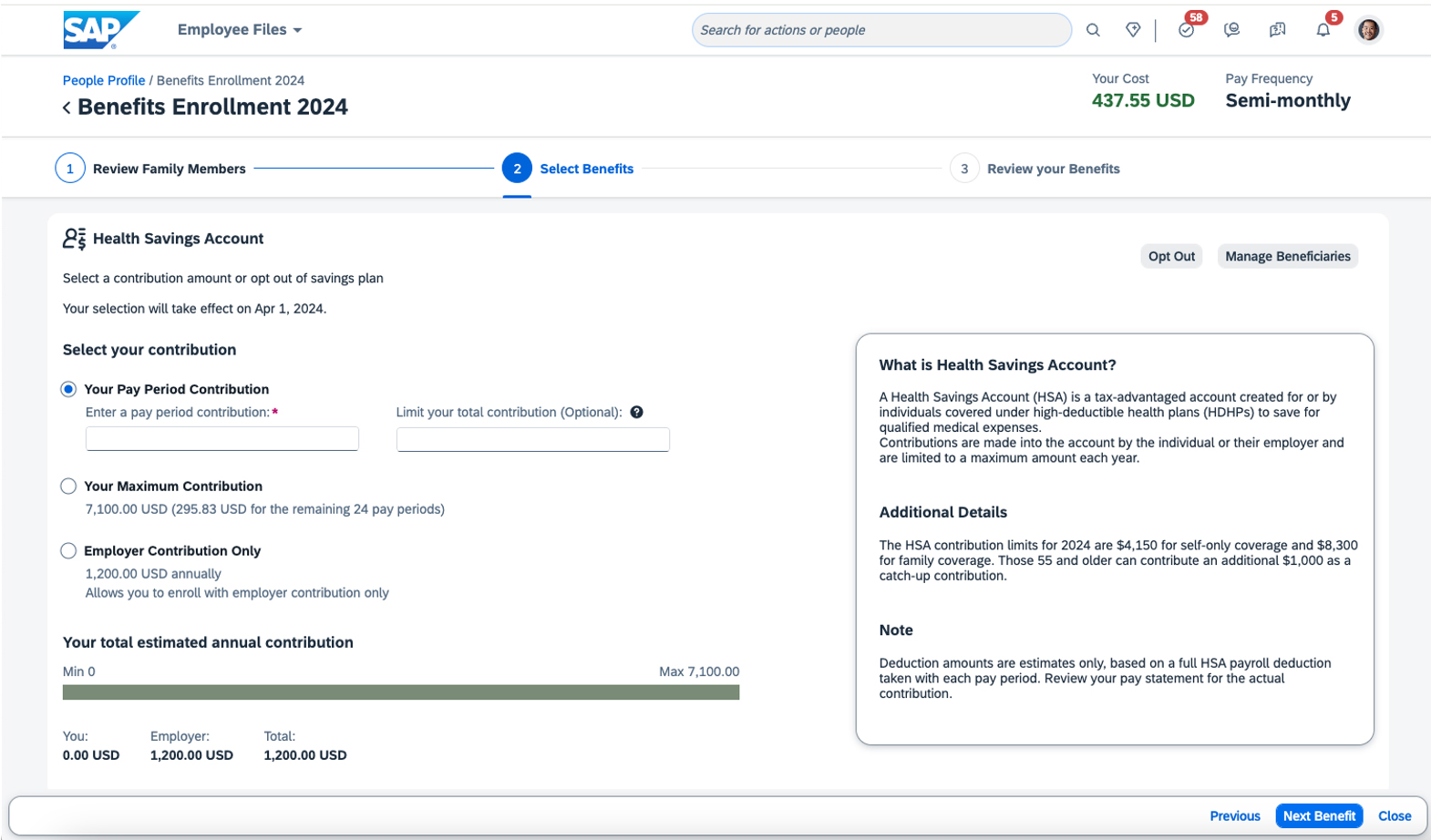
Side-by-side benefit plan comparisons of costs and plan details help employees assess their plan options and select the best-fit plan. Localizable instructional text on each page helps ensure that the benefits and enrollment processes are well understood. Additionally, flexible options for defining contribution amounts within the IRS limits can make it easier for employees to make decisions regarding savings plans and pension elections.

Screenshot showing flexible options for defining HSA contribution amount
Flexible options for defining HSA contribution amount. Click to enlarge.

Consolidated Benefits Enrollment Process

Employees can complete all benefits-related tasks including reviewing and updating dependents, completing health declarations, enrolling in benefits, managing beneficiaries, and more through a single consolidated process, helping to improve employee engagement and satisfaction.

Watch the demo to learn more about the new enrollment experience in SAP SuccessFactors Employee Central Global Benefits.

To learn about all the other innovations in the SAP SuccessFactors first half 2024 release, read the release highlights brochure and watch the 1H 2024 release highlights video.


Nicole Ramirez is senior director of Product Marketing at SAP.

Get the latest SAP news delivered straight to your inbox

How Companies Are Using AI to Better Analyze and Manage Their Spending

The current era, characterized by geopolitical conflicts, energy crises, and climate challenges, has been termed a “polycrisis” by experts. This environment results in fragile supply chains and volatile markets that often struggle to adapt to changes in demand. To remain operational in such turbulent times, companies must reevaluate their business models and make adjustments. Expense management, the strategic control and optimization of all company expenses, comes into focus in this context. 

Let’s be honest – do you know what your company spends daily across different areas like office management, production, or logistics? Expense management sheds light on this expenditure, allowing companies to analyze, document, and manage their expenses effectively. 

Digital solutions for spend management provide transparency and visibility across all expenses, enabling companies to identify potential risks faster and address them proactively. Additionally, they make CO2 emissions transparent along the value chain, empowering companies to implement decarbonization measures and reduce their carbon footprint. 

AI as a Booster for Procurement and Purchasing Processes 

Artificial intelligence (AI) has become an integral part of our daily lives, optimizing search engine results, personalizing advertising, and facilitating automatic text translation. On smartphones, we have streaming services, online shopping platforms, and even household appliances. AI is subtly integrated to make cumbersome, everyday tasks easier and more efficient. Since the rise of generative AI, companies and entire industries have been diligently working to incorporate it into their solutions for improved processes and efficiency. 

Procurement is one field where the impact of polycrisis is keenly felt, which has driven important changes. Resilience, transparency, and sustainability are the keywords here – and AI can make the crucial difference. 

AI can digitalize the procurement function, making it more efficient. Stakeholders rightly expect AI implementation to enhance decision-making, automate processes, and expedite insights. AI can also contribute to cost reduction and error rate mitigation. The question is no longer whether companies will adopt AI but when they will do so. And that time has to be now.

AI Strategies: Think Holistically 

To ensure the success of such projects, a holistic approach is needed. AI should become an integral part of the entire procurement process to benefit all areas. This begins with a consistent transformation strategy aligned with the company’s goals and values. It is important to have a strategic, solutions-oriented approach that makes it possible to find answers to real-life business challenges. By effectively integrating AI into data analysis and prediction models, companies can unlock tangible value and drive meaningful outcomes. The quality of the results depends on the quality and availability of corporate data – and this is where the greatest potential for improvement lies. Companies should clean up their data pool so that only valid and meaningful data is included. 

Eliminate the mundane and elevate the strategic with generative AI

For spend management, procurement, and purchasing, generative AI in particular holds enormous potential. As in every area where AI is deployed, SAP has committed to strictly adhering to the principles of relevance, reliability, and responsibility in spend management, thoroughly examining each application accordingly. Employees can be relieved of repetitive, manual, and time-consuming tasks, allowing them to focus better on their core tasks. For example, Joule, SAP’s generative AI copilot, will be embedded across SAP’s portfolio, including procurement solutions.

As an intelligent copilot, it can understand natural language, process data from SAP and third-party systems, and derive new insights from them. Thanks to unified data models, it can provide users with appropriate answers to their questions that fit the specific business context and thus helps to ensure that AI makes a meaningful contribution, enhancing business success. Moreover, it can offer meaningful advice to help them solve their daily tasks more intelligently and quickly, thereby helping to increase their efficiency in a secure and compliant manner. The practical use cases are numerous, ranging from HR or finance to supply chain management, procurement, and customer experience. Following our principle of responsibility, Joule can, for example, assist the HR department in eliminating potential bias from job descriptions and can even formulate suitable interview questions based on these job descriptions.

Category management plays a significant role in procurement, enabling companies to optimize their procurement strategies, strengthen supplier relationships, and reduce costs. Accordingly, 33% of procurement experts consider it a top technology trend to focus on in the next 12 to 18 months. A digitalized and AI-enhanced category management company integrates generative AI to increase efficiency and precision in product categorization and procurement. By applying AI-supported algorithms, relevant data is automatically analyzed, leading to informed insights for optimized inventory management and strategic purchasing decisions. 

With the steadily growing amount of data generated by daily business operations, it is becoming increasingly challenging for companies to find the resources to make the most of their own data, all while ensuring data privacy and security aspects are maintained. This data needs to be made accessible, visualized, and processed in a way that it can be leveraged. Therefore, it is important to rely on strong partners like SAP that bring both technical and strategic expertise to develop goal-oriented solutions with a strong focus on data protection and integrity. Now is the time to advance procurement through intelligent collaboration, smart category management, and an AI mindset. 

Practical Example: Category Management at OMV 

OMV, a global chemical and energy company based in Austria, is transitioning its linear value chain into a circular one with the aim of becoming a leading provider of more sustainable fuels, chemicals, and materials. Procurement plays a key role in this transformation. OMV is automating and streamlining all procurement and supply chain processes. The company is now planning to digitalize category management. 

At the core of this initiative is SAP Ariba Category Management, based on SAP Business Technology Platform (SAP BTP) and supported by generative AI. This solution helps procurement teams develop more effective category strategies by helping to accelerate the market analysis process and provide targeted recommendations. This can lead to faster and more efficient category management processes and increased cost savings. 

Complex planning processes that were once done manually can now be easily executed with SAP Ariba Category Management. The solution integrates features and tools to help leverage data for Big Data analytics, and it can provide comprehensive end-to-end visibility throughout the procurement process. 

The adoption of SAP Ariba Category Management offers OMV numerous benefits, including improved efficiency, cost savings, and the promotion of sustainability through the selection of more environmentally friendly suppliers and products. By implementing SAP Ariba Category Management, OMV successfully bridges the digital gap in procurement and takes another significant step towards a circular value chain. 

Curious to Learn More?

Learn more about intelligent category management and watch the recording of the virtual SAP Spend Connect Innovation Day. A live event will take place on-site on April 23 in Karlsruhe, Germany.


Elena Parker is chief revenue officer for Intelligent Spend and Business Network, MEE, at SAP.

Connect with us by following SAP News on LinkedIn

Previous Next
Close
Test Caption
Test Description goes like this