Cyber Week has once again been an incredible success for SAP customers and given us interesting insight into market trends.
Through Cyber Week, SAP Commerce Cloud powered US$12.2B in gross merchandising value (GMV) for our customers, with a 23.42% year-over-year (YoY) increase in number of orders processed through the solution and 100% uptime. This level of success requires personalized customer engagement, and, for Cyber Week 2024, SAP Emarsys Customer Engagement delivered a 10% YoY increase of overall engagement across all channels, with mobile channels seeing a 200% growth YoY.
But more than just numbers, we’re drawing insights and learnings from some of the largest brands we serve around the world.
Imitation Is a Form of Flattery for B2B Companies
Many industries have looked at how B2C retail companies reach their customers historically and used it as a model. This year, we saw our wholesale distribution customers running Black Friday and Cyber Week promotions to their customers – B2B buyers – with outstanding results. In fact, customers in the wholesale distribution industry saw a 125.2% increase YoY in GMV.
Drive profitable outcomes with connected, insightful, and adaptive commerce experiences
Holiday Shopping Continues to Start Earlier Each Year
E-mails, SMS, social ads, and more for Black Friday sales have been circulating since well before November 29th. Understandably so, as retailers compete for market share. According to the U.S. Commerce Department, retail sales saw an increase of 2.3% in October, which beat analyst predictions and is a good early indicator for the holiday shopping season. For SAP customers in electronics, appliances, and personal care and beauty, we saw spikes in sales in mid- to late-October, which supports the U.S. Commerce Department’s findings.
However, getting started early doesn’t mean that retailers are simply shifting their sales and then finished. Instead, getting started early allows retailers to do both – lean into a first round of promotions earlier than the “shopping season” and a second round during peak Cyber Week shopping, leading to a higher total year-end volume. In addition, by providing two rounds of promotions, companies were able to capture customers who may have missed the initial offering. SAP customers, particularly in the home improvement and personal care industries, were able to achieve this success with a “two-hit” strategy.
Consumers Perceive Deals May Get Sweeter If They Wait
It’s been the belief for years that the best deals happen on Black Friday, but we’ve seen a shift this year. Our data shows that on Cyber Monday the GMV values were significantly more than Black Friday, with an explosive 71.8% increase YoY. Was this trend due to shoppers rushing to take advantage of sales on the last day of the sales event? Or have shoppers been re-conditioned to wait for the best deals on Cyber Monday? We’ll see if this shift has a stronghold in the upcoming years.
Cyber Week Isn’t About the American Thanksgiving Holiday Anymore
To achieve this kind of success takes months of work from entire teams – both from our customers’ side and from SAP. By infusing artificial intelligence (AI) and automation tools to predict, prevent, and address issues proactively, our team of dedicated engineers created 360-degree action plans for our customers and created recommendations to help achieve peak holiday success. With 24×7 control room support, real-time monitoring, and risk mitigation, SAP helped ensure seamless performance and availability during peak traffic periods like Black Friday and Cyber Monday, with 100% uptime, setting a new benchmark for holiday readiness.
The 29th UN Climate Conference (COP29) in Baku, Azerbaijan, aimed to advance a new climate finance goal and inspire stronger national climate commitments. While progress was made, the private sector must now play a pivotal role in turning these ambitions into actionable outcomes. Central to this effort is the energy transition, one of the key economic growth drivers of our time.
SAP Sustainability: Building a sustainable world together
The energy transition is creating a profound shift across industries and global economies. Amplified by technological innovation and intense competition, it is reshaping sectors and shifting economies toward renewable energy. This change is not only an environmental necessity but also a catalyst for economic growth, challenging the traditional dominance of fossil fuels. With capital investments increasingly directed toward renewable energy infrastructure, investors are aligning their priorities with sustainability, signaling that profitability and environmental stewardship can coexist. Yet, the ongoing prominence of oil and gas underlines the complexity and scale of this transition.
In parallel, the circular economy is gaining momentum as businesses address the dual challenges of material scarcity and carbon reduction. At COP29, there was significant discussion about how a circular approach focused on rethinking supply chains, redesigning products, and optimizing resources could reduce dependency on finite materials while driving sustainable economic growth. By adopting circular economy principles, businesses can minimize waste and keep valuable materials in circulation, contributing to a more resilient and sustainable future.
The Role of Business in Transforming Climate Commitments into Tangible Outcomes
One of the central discussions at COP29 was the need for harmonizing global standards for carbon reduction and accounting. Foreign policy players, along with the private sector, stressed the importance of mobilizing finance for sustainable capitalism. In particular, there was a call for clearer and standardized reporting frameworks to simplify the process and ensure transparency. One critical area was the importance of accurate data collection for carbon markets and product-level carbon accounting, which can help businesses engage consumers and reduce emissions.
There are three ways technology plays a pivotal role in addressing some of these challenges:
Sustainability data is available in every organization’s ERP system, so it’s time to start automating data collection and reporting processes to ease some of the regulatory burden.
Companies should leverage IT spending to support sustainability initiatives, specifically by applying generative AI to optimize climate solutions and create circular products.
From Policy to Practice: How Technology and Global Standards Can Accelerate Climate Action
Empowered by technology and guided by clear policies, businesses have a unique opportunity to bridge the gap between high-level climate commitments and actionable, on-the-ground strategies.
Central to this is aligning sustainability and financial priorities. Effective climate action demands collaboration between chief sustainability officers and chief financial officers, as climate change has evolved from an ethical and environmental issue to a pressing financial imperative.
To accelerate progress, we need globally harmonized policies, rigorous carbon accounting frameworks, and advanced technology solutions. By embedding AI-driven innovation, robust reporting standards, and actionable insights into business operations, we can ensure that COP events, such as COP29 in Baku, are remembered as turning points – not just discussions. While the challenges ahead are formidable, the opportunities for transformative action are even greater – and SAP is here to lead the way on a low-carbon, circular future.
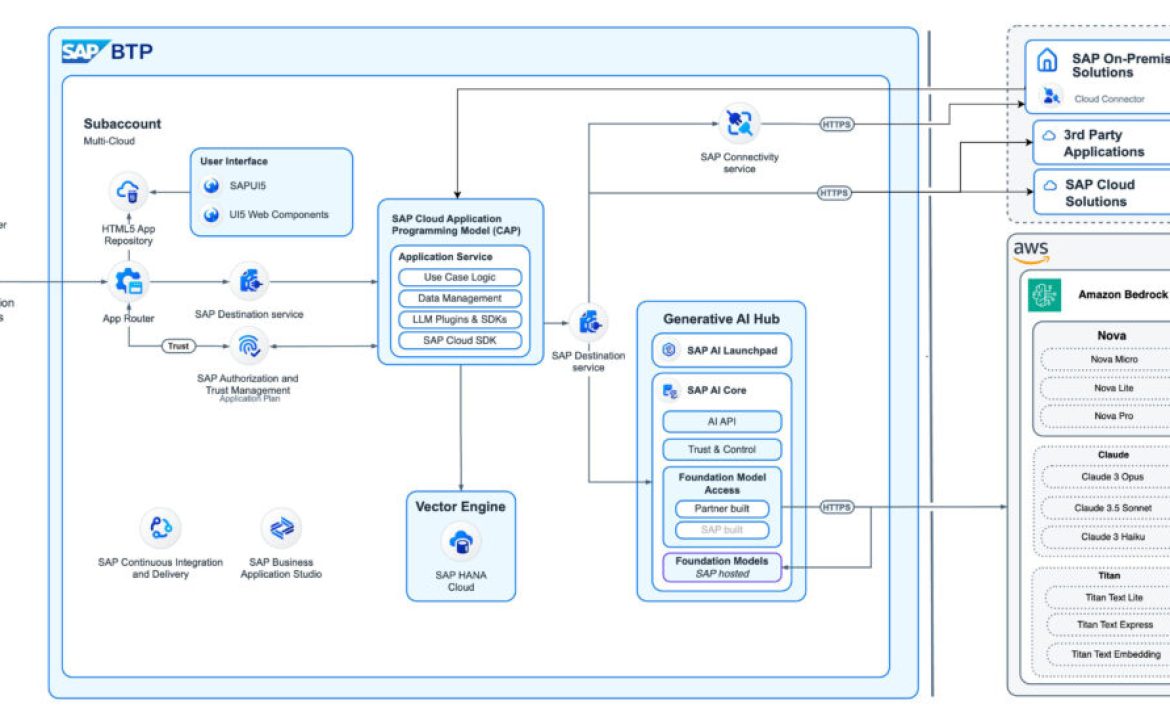
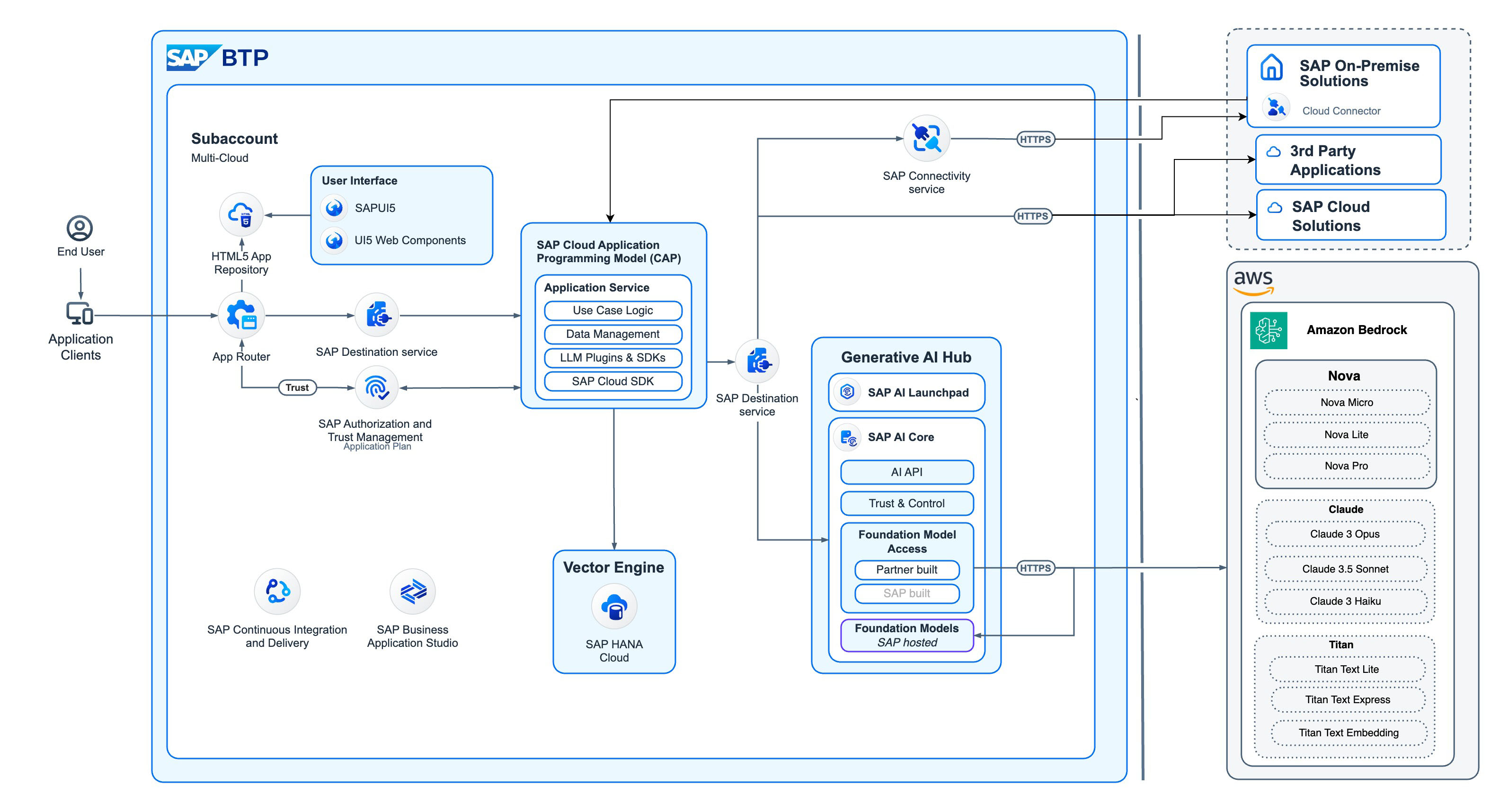
At SAP, we are committed to delivering transformative AI technologies that drive meaningful business impact. Today, at AWS re:Invent 2024, we’re thrilled to unveil the immediate availability of Amazon’s new foundation models (FMs) — Amazon Nova Micro, Amazon Nova Lite, and Amazon Nova Pro — through SAP’s generative AI hub, a capability of SAP AI Core, adding to existing access to Anthropic Claude and Amazon Titan models from Amazon Bedrock.
The generative AI hub enables enterprise customers to easily access a broad range of commercial and open-source large language models (LLMs) in a safe and secure environment. This milestone marks a new chapter in our long-standing partnership with AWS, combining SAP’s AI innovations and enterprise expertise with Amazon’s latest and most advanced AI capabilities and technology solutions to unlock powerful opportunities for businesses.
Click to enlarge.
Amazon Nova joins a growing portfolio of top-tier commercial and open-source models available through the generative AI hub. By making the new Amazon Nova models publicly available simultaneously with their release on AWS, SAP helps ensure that customers can immediately leverage the latest innovations to build AI-driven solutions that harness the full business context in SAP data.
Tailored AI Solutions for Every Need
The Amazon Nova release includes three state-of-the-art understanding models that are available today, enabling businesses to choose the right model for their unique needs:
Amazon Nova Micro: Text-only model that delivers the lowest latency responses at very low cost
Amazon Nova Lite: Very low-cost multimodal model that is lightning fast for processing image, video, and text inputs
Amazon Nova Pro: Highly capable multimodal model with the best combination of accuracy, speed, and cost for a wide range of tasks
With these models now accessible through the generative AI hub, developers can efficiently leverage them alongside the extensive capabilities of SAP Business Technology Platform (SAP BTP) to build and scale AI-powered solutions that seamlessly work with SAP applications.
Streamlined Access and Integration
SAP’s generative AI hub helps simplify how businesses access and deploy advanced AI models. The Amazon Nova models, alongside other leading offerings, are available through a unified interface deeply integrated with SAP BTP. This helps ensure customers can automate workflows with precision, build multimodal AI solutions tailored to specific challenges, and fully utilize the business context embedded in SAP data.
By combining Amazon Nova models with SAP BTP services like workflow automation and vector databases, businesses can develop customized AI solutions that can scale effortlessly. For example, developers can create new skills for Joule, SAP’s AI copilot, leveraging Amazon Nova models and SAP HANA’s vector capabilities to process enterprise-specific data. This helps ensure AI outputs are not only accurate and relevant but also actionable, driving measurable results across operations.
SAP and AWS: Unlocking the Future of Business AI
The availability of Amazon Nova models on the generative AI hub marks a significant milestone in SAP’s long-standing collaboration with AWS. Together, we continue to address critical enterprise challenges such as data security, regulatory compliance, and scalability, ensuring businesses can confidently adopt AI solutions that deliver tangible value. This partnership underscores our shared vision of making advanced AI accessible and impactful for businesses worldwide, unlocking new levels of efficiency and innovation.
With access to Amazon Nova Micro, Amazon Nova Lite, and Amazon Nova Pro, SAP customers can reimagine their operations — automating workflows, enhancing insights, and driving complex decisions. We’re excited to see how our customers and partners leverage these capabilities to achieve impactful business outcomes.
The rapid pace of digital transformation is reshaping how businesses operate, pushing companies to adopt more agile, efficient, and innovative solutions. Today, I’m excited to announce a significant step forward in our mission to help companies of all sizes harness the full potential of cloud computing through our strengthened collaboration with Amazon Web Services (AWS). Together, SAP and AWS are introducing GROW with SAP on AWS, an initiative that merges SAP’s enterprise resource planning (ERP) expertise with AWS’s robust cloud infrastructure, offering organizations a streamlined path to modernize their operations and unlock new business opportunities.
This integration represents more than just a technical achievement – it’s a strategic milestone in our commitment to delivering exceptional value to our customers of all sizes. It highlights the capabilities of GROW with SAP on AWS, exploring its technical foundation and the transformative impact it can have on businesses embracing SAP S/4HANA Cloud Public Editionto drive innovation and operational excellence.
What Exactly Is GROW with SAP on AWS?
Grow without limits and build your own breakthroughs with a ready-to-run cloud ERP
At its core, GROW with SAPis a comprehensive cloud ERP solution designed to help businesses adopt SAP S/4HANA Cloud Public Edition quickly and effectively. By leveraging AWS’s global infrastructure, this offering can provide a ready-to-run cloud ERP system that integrates industry best practices, preconfigured processes, and continuous innovation. Our customers have consistently told us they need three things: seamless scalability, ironclad security, and the ability to innovate rapidly. This new offering delivers on all three fronts. Key features of GROW with SAP include prebuilt industry solutions for a broad array of manufacturing-centric and services-centric industries; rapid deployment using guided tools and methodologies like the SAP Activate process; scalability and flexibility; and embedded AI capabilities that are built into our end-to-end processes to enable real-time insights and process automation.
By leveraging AWS’s global infrastructure with SAP’s deep enterprise expertise, GROW with SAP on AWS via AWS Marketplace can empower businesses to adopt a modern, intelligent ERP system designed for agility, scalability, and innovation. It brings together the best of SAP S/4HANA Cloud Public Edition and AWS’s cloud capabilities and offers a comprehensive solution tailored to meet the evolving needs of businesses. Here’s how it helps deliver value:
Empowering financial and operational excellence with AI-driven insights: GROW with SAP integrates SAP Business AI-powered processes, enabling businesses to make faster and more accurate decisions through real-time, data-driven insights and actionable recommendations. With Amazon Bedrock models available through SAP’s generative AI hub, customers can innovate further by embedding generative AI into core business processes. For CFOs, this can mean enhanced financial control, compliance, and cost optimization. For COOs, the solution helps streamline operations with AI automation, boosting productivity and enabling scalable infrastructure for agile business growth. It also improves cross-functional collaboration, encouraging innovation and efficiency. These features help CFOs and COOs improve overall financial performance and operational flexibility, setting their organizations up for long-term success.
Comprehensive SaaS ERP built for industry needs: At its core, GROW with SAP can provide a full-featured, software-as-a-service (SaaS) ERP solution designed to address both product- and service-centric industries. Leveraging over 50 years of SAP’s expertise in helping customers run at their best, the solution comes with prebuilt industry-specific capabilities. Its modular structure helps ensure customers can future-proof their operations by easily adding advanced features or new functionalities as their needs evolve.
Faster rollouts and prebuilt processes: The solution helps accelerate time-to-value by offering preconfigured processes, guided tools, and proven methodologies like SAP Activate. These elements can ensure a predictable implementation scope and timeline, helping business go live in months – a significant improvement over traditional ERP deployment approaches.
Accelerate Deployment with AWS Marketplace
The availability of GROW with SAP on AWS through the AWS Marketplace allows for customers to work collaboratively with joint SAP and AWS partners to quickly implement and scale their ERP systems. Key benefits include:
Simplified procurement and billing: AWS Marketplace offers an integrated purchasing experience, reducing administrative overhead and accelerating adoption. Customers can procure GROW with SAP alongside complementary SAP solutions available on AWS Marketplace, consolidating billing into one unified invoice for easier financial management.
Accelerate seamless deployment: By partnering with designated GROW with SAP and AWS experts, businesses can deploy a ready-to-run SaaS ERP on AWS in a matter of months versus years with traditional approaches. This approach can reduce complexity and ensure predictable outcomes, allowing companies to focus on achieving business goals rather than navigating lengthy implementation cycles.
Why GROW with SAP Stands Out
The combination of SAP S/4HANA Cloud Public Edition and AWS infrastructure creates a transformative platform for businesses looking to modernize their operations. With embedded intelligence, modular design, rapid deployment options, and seamless integration through AWS Marketplace, GROW with SAP on AWS is more than just an ERP solution – it’s a strategic enabler for digital transformation. For organizations seeking to stay competitive in today’s fast-paced digital economy, GROW with SAP on AWS offers not just a path forward but a platform for continuous innovation and growth.
Looking Ahead: The Future of Cloud ERP
The introduction of GROW with SAP on AWS represents more than just a technological advancement; it’s a paradigm shift in how businesses approach ERP adoption. By combining the strength of SAP’s enterprise expertise and AWS’s cloud innovation, this solution creates a powerful foundation for digital transformation. Together, we’re not just helping businesses adapt to change – we’re empowering them to drive it.
As organizations continue navigating an increasingly digital economy, solutions like GROW with SAP on AWS via AWS Marketplace offer a clear path toward agility and resilience. Whether you are a mid-sized company looking to modernize or an enterprise seeking advanced AI-driven insights, this collaboration can provide the tools you need to succeed in today’s competitive landscape. I’m particularly excited about how this collaboration will enable our customers to leverage the full potential of our partnership.
For more information about how GROW with SAP on AWS can transform your business operations, reach out to your SAP representative or visit our website.
Jan Gilg is president and chief product officer for Cloud ERP at SAP.
Get the latest SAP news delivered to your inbox once a week
GROW with SAP in AWS Marketplace to Help Customers Rapidly Adopt Cloud ERP and Innovate with Advanced Generative AI Solutions
WALLDORF — At AWS re:Invent, Amazon Web Services, Inc. (AWS), an Amazon.com, Inc. company (NASDAQ: AMZN), and SAP SE (NYSE: SAP) today announced GROW with SAP on AWS, which will allow customers of all sizes to rapidly deploy SAP’s enterprise resource planning (ERP) solution while leveraging the reliability, security and scalability of the world’s most broadly adopted cloud.
The collaboration will simplify and accelerate the adoption of SAP S/4HANA Cloud Public Edition and unlock new generative artificial intelligence (AI)-assisted innovation for customers. This expands on the two companies’ longstanding joint commitment to help customers transform their businesses and establishes AWS as the first cloud provider to offer the GROW with SAP solution through its cloud marketplace.
ERP solutions provide organizations with a centralized platform for optimizing and automating functions such as finance, human resources, supply chain and customer service with end-to-end visibility into all critical aspects of the business. Historically, these deployments required high upfront costs to provision hardware and software licenses, as well as burdensome change management processes to adapt workflows around mission-critical operations. The GROW with SAP solution is a software-as-a-service solution that helps customers adopt cloud ERP quickly. Unlike on-premises deployments, customers who deploy the GROW with SAP on AWS initiative will benefit from simplified and reduced deployment time—from years to months—with no upfront provisioning or licensing costs. Customers also benefit from one unified bill, the opportunity to use their existing AWS credits and commitments, and the availability, flexibility and scalability of the cloud.
Cloud ERP adoption with speed, predictability, and continuous innovation
GROW with SAP will make it easier for customers to streamline business operations to better serve their end users and build secure generative AI applications by combining their SAP data with AWS industry-leading generative AI services, such as Amazon Bedrock. Available through the generative AI hub in the SAP AI Core infrastructure on SAP Business Technology Platform (SAP BTP), and directly on AWS, Amazon Bedrock offers a broad selection of foundation models from leading AI companies, such as AI21 Labs, Anthropic, Cohere, Meta, Mistral AI, Stability AI and Amazon. These capabilities will complement Joule, SAP’s generative AI copilot, which works across business applications from SAP.
“For more than 16 years, we’ve worked to empower thousands of customers to transform their businesses through seamless integration of SAP solutions with AWS,” said Ruba Borno, vice president, Specialists and Partners at AWS. “We were the first cloud provider certified to support the SAP portfolio, and GROW with SAP on AWS represents our shared commitment to continuing to make it easy to realize the benefits of cloud ERP.”
“Our collaboration with AWS will provide customers of all sizes a simplified path to deploy cloud ERP with powerful automation and insights via Joule embedded across our business applications,” said Muhammad Alam, member of the Executive Board of SAP SE, SAP Product Engineering. “Today’s announcement will allow customers to transform in the cloud more easily with the proven security, reliability, and availability of AWS. By using Amazon Bedrock via the generative AI hub capability from SAP, customers can unlock even more business AI innovation.”
GROW with SAP on AWS will leverage the AWS Nitro System, a collection of hardware and software components designed to provide high performance, availability, privacy and security for cloud-based workloads. This allows customers to confidently run their critical SAP ERP applications in the cloud with enhanced performance, reliability and data protection, and without the constraints of traditional hardware configurations. Additionally, GROW with SAP on AWS will take advantage of AWS Graviton chips, which use up to 60% less energy than comparable Amazon Elastic Compute Cloud (EC2) instances for the same performance.
GROW with SAP on AWS builds on the success the two companies have achieved with the RISE with SAP solution, helping thousands of customers, including Fortune 500 companies such as BBC, Hyundai, Moderna and Zurich Insurance Group, combine the strength of SAP and AWS for complex, mission-critical workloads.
“Making GROW with SAP available in AWS Marketplace will unlock tremendous opportunities for us to accelerate widespread customer adoption of SAP cloud ERP solutions infused with embedded business AI capabilities,” said Steve Niesman, executive vice president & president, Americas region, at NTT DATA Business Solutions. “The combination of SAP’s proven cloud ERP solutions combined with the security, reliability and scalability of AWS, plus the integration of cutting-edge generative AI solutions and services, will empower customers with significant productivity gains and the ability to innovate and thrive in the digital age.”
GROW with SAP on AWS is planned to be available through AWS Marketplace in the coming months. Customers can explore GROW with SAP and other SAP solutions in AWS Marketplace at aws.amazon.com/sap/grow.
As a global leader in enterprise applications and business AI, SAP (NYSE:SAP) stands at the nexus of business and technology. For over 50 years, organizations have trusted SAP to bring out their best by uniting business-critical operations spanning finance, procurement, HR, supply chain, and customer experience. For more information, visit www.sap.com.
Note to editors: To preview and download broadcast-standard stock footage and press photos digitally, please visit www.sap.com/photos. On this platform, you can find high resolution material for your media channels.
For customers interested in learning more about SAP products: Global Customer Center: +49 180 534-34-24 United States Only: 1 (800) 872-1SAP (1-800-872-1727)
Grown from a one-man business into a global leader, STIHL Group develops, manufactures, and distributes power tools for professional forestry and agriculture, garden and landscape maintenance, the construction sector, and private garden owners. The product range is complemented by digital solutions and services. Products are distributed through authorized dealers and STIHL’s own online shops – which will be expanded internationally over the next few years – including 44 sales and marketing subsidiaries, about 120 importers, and more than 55,000 servicing dealers in over 160 countries.
Founded in 1926 and with headquarters in southern Germany, STIHL has been the world’s top-selling chain saw brand since 1971. With a workforce of almost 20,000 employees, the family-owned business generated 5.3 billion euros in revenue in 2023.
Siloed Supply Chain Planning Insufficient for Informed Decision-Making
In the past, STIHL’s subsidiaries and production companies relied on their own SAP ERP Central Component (SAP ECC) systems, deployed on premise, with a heterogenous landscape for supply chain planning processes across 35 sales and eight production companies that were tailored to the needs of each subsidiary.
“We lacked an end-to-end, consolidated view and overall transparency to improve decision-making for the company as a whole and not only for one subsidiary,” said Lena Domhan, global process owner for Integrated Planning at STIHL. “Previously, we spent a lot of time analyzing and verifying data and had no single source of truth. In addition, disconnected planning systems hindered collaboration and coordination between subsidiaries.”
Market Trends Drive Change
With the introduction of new product lines with integrated batteries, STIHL found itself in a new business, selling to end customers also. “This VUCA world required us to react even faster to volatility and changing demand,” explained Axel Erhard, senior vice president, global ONE STIHL program lead. “To optimize planning, we needed a better overview of the different production and sales companies.”
The company established the ONE STIHL program with the goal to consolidate all subsystems across all sales and production companies into one integrated SAP S/4HANA system. Moreover, STIHL aims to bring several solutions into one hybrid ecosystem, such as the SAP Integrated Business Planning for Supply Chain solution (SAP IBP) with the applications for sales and operations and response and supply, the SAP S/4HANA Manufacturing solution for planning and scheduling, and SAP Transportation Management. “One goal of the ONE STIHL project is to reduce fixed capital and get more transparency on different management levels. SAP IBP with SAP S/4HANA Manufacturing for planning and scheduling play crucial roles in this process, serving as the starting point for planning,” Erhard said.
SAP Integrated Business Planning for Supply Chain: the cornerstone of a risk-resilient supply chain
Synchronized Planning Approach for Distribution Center Refills
“We were one of the first customers to introduce SAP IBP in combination with SAP S/4HANA Manufacturing for planning and scheduling and SAP Transportation Management,” explained Fabio Fender, interim global process owner for Integrated Planning at STIHL. “With real-time integration, our planners can quickly react. For example, when tackling issues on the planning or production side, they immediately see the impact on the distribution side and vice versa. That provides confidence and trust.”
Georg Fuchs, director of Integrated Planning and global solution architect, ONE STIHL project, added: “Order-based planning and real-time integration are the heartbeat of our production. For instance, in Austria, finished goods are produced and then shipped to distribution centers in Germany or the Czech Republic. The order-based planning process in SAP IBP is used to allocate, prioritize, and schedule the delivery of these goods. We are decoupling this from our production plan in SAP S/4HANA Manufacturing for planning and scheduling.”
With this synchronized planning approach, STIHL consolidates supply planning, distribution planning, and production planning into one seamless process, enabling a holistic workspace for planners. Detailed scheduling results from SAP S/4HANA Manufacturing for planning and scheduling are visible in SAP IBP in real time, helping to ensure maximum transparency. In addition, the integration of SAP Transportation Management allows for the creation of freight orders to ship STIHL’s finished products. “STIHL’s vertically integrated supply chain gives us the potential for end-to-end control,” Erhard said.
Higher Transparency Enables Accurate Planning
SAP IBP is live at two production sites in Austria and Switzerland and is used by several planners and others utilizing its reporting capabilities. “The integration with SAP S/4HANA Manufacturing for planning and scheduling and SAP Transportation Management was the most effective solution to meet our business needs,” Fuchs said.
STIHL already recognizes and anticipates a range of immediate and long-term benefits, including:
Better visibility across subsidiaries, enabling accurate and feasible plans that can adapt to production constraints
Increased efficiency with sales and production teams using the same system with one source of truth for all relevant data
End-to end transparency for global planning processes with optimized planning for the network
Time savings for planners who see real-time impact of changes and can instantly make better-informed decisions
Creation of feasible production plans to meet customer demand
Real-time integration with SAP S/4HANA Manufacturing for planning and scheduling ensures planners and production teams are using the same data for decision-making
Logistics planners can efficiently plan truck load orders and promptly fulfill logistics requirements
Improved customer service while reducing inventory costs through network planning
Enhanced decision-making between quantity and revenue planning provides a crucial element to business processes and reporting
Future Plans and Leveraging AI
“We have four to five rollouts ahead of us on our journey. Over the next few years, we will integrate about 40 global subsidiaries into one network planning solution,” Domhan said.
In relation to the utilization of artificial intelligence (AI), Erhard said, “STIHL will invest in AI in the future. That is a clear focus of our owners.”
“We are starting to explore potential opportunities to determine what would benefit us. However, regarding SAP IBP, we are already fit for the future,” Fender concluded.
Karin Fent is senior director of global Customer Success Digital Supply Chain at SAP. Top photo courtesy of STIHL
Tech companies are evolving rapidly and creating a new culture of innovation. Will this open up new opportunities for women? On a mission to find out, a group of researchers set up the #100TechFrauen (100 Women in Tech) project and recently published their findings.
The “Making the Future Visible: 100 Innovative Women in Tech” project saw female scientists from the Institute for Research in Social Sciences (ISF) in Munich, Germany, and the University of Erlangen-Nuremberg study the tech industry to discover whether it is creating opportunities for women. The project’s researchers interviewed 100 trailblazing women who are driving a new culture of innovation and transformation at tech companies, but don’t necessarily have a background in STEM.
100 Women in Tech
The results of the study are in, and one thing is clear: women have a bright future in tech. This was also the message from the female trailblazers who were interviewed as part of the project.
“Our key finding is optimistic: the digital transformation is opening up new opportunities for women,” Kira Marrs from ISF Munich says. It is important here, she notes, to think about how digitalization and gender equality fit together. We need to consider how we can break with existing structures and look at what we can do to create even more possibilities, she says.
According to Christine Regitz, cofounder of the Business Women’s Network from SAP, head of SAP Women in Tech, and president of the German Informatics Society, the number of women in tech has stagnated over the last 15 years. Yet the sector needs women who will shape its progress, especially given the skills shortage, she says. “We need digital sovereignty to make conscious decisions. It’s about more than programming,” she continues. “We also need the skills and expertise to make digital technologies work for us.”
Anja Bultemeier from the University of Erlangen-Nuremberg agrees that it is no longer about the technology itself, but about how people interact, which is why new factors, such as customer and user experience, are becoming increasingly important. “Seeing technology through this new lens has created opportunities for women who do not have a technical background,” she says. One quote from a study participant explains this change very neatly: “I don’t sell technology; I sell solutions.” Increasingly, non-tech women are heading up technical teams and shaping the strategies and visions that will produce the best possible customer experience.
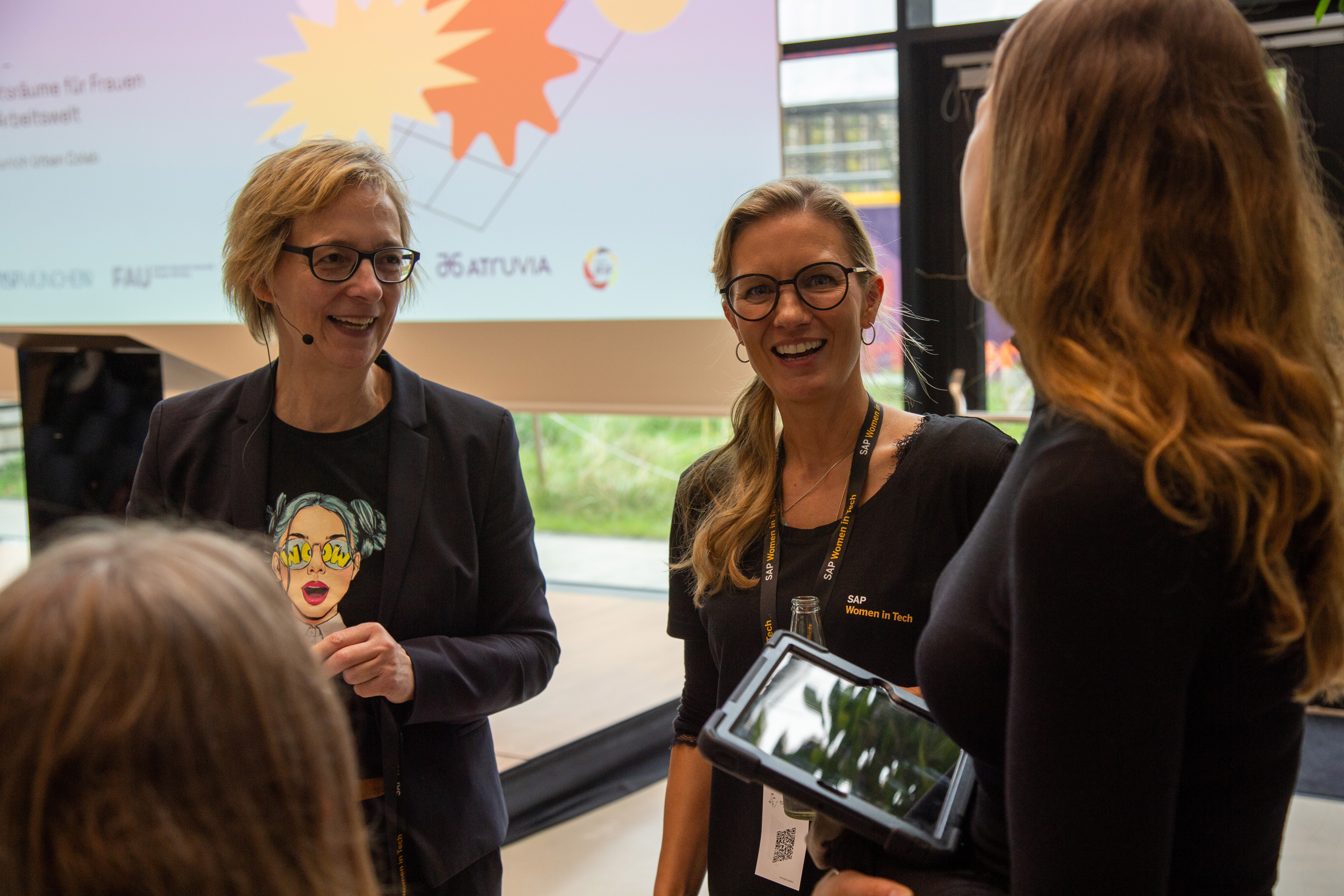
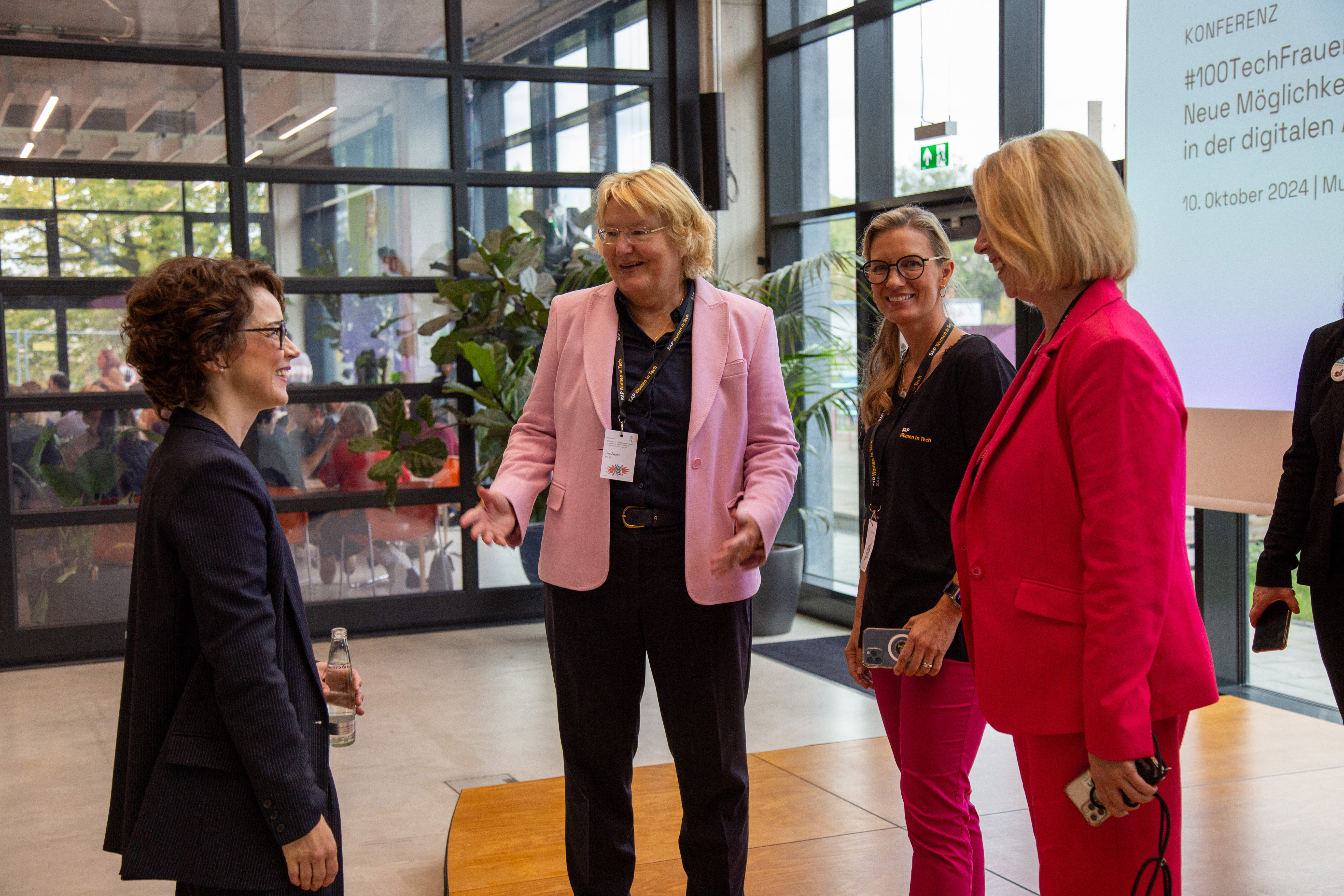
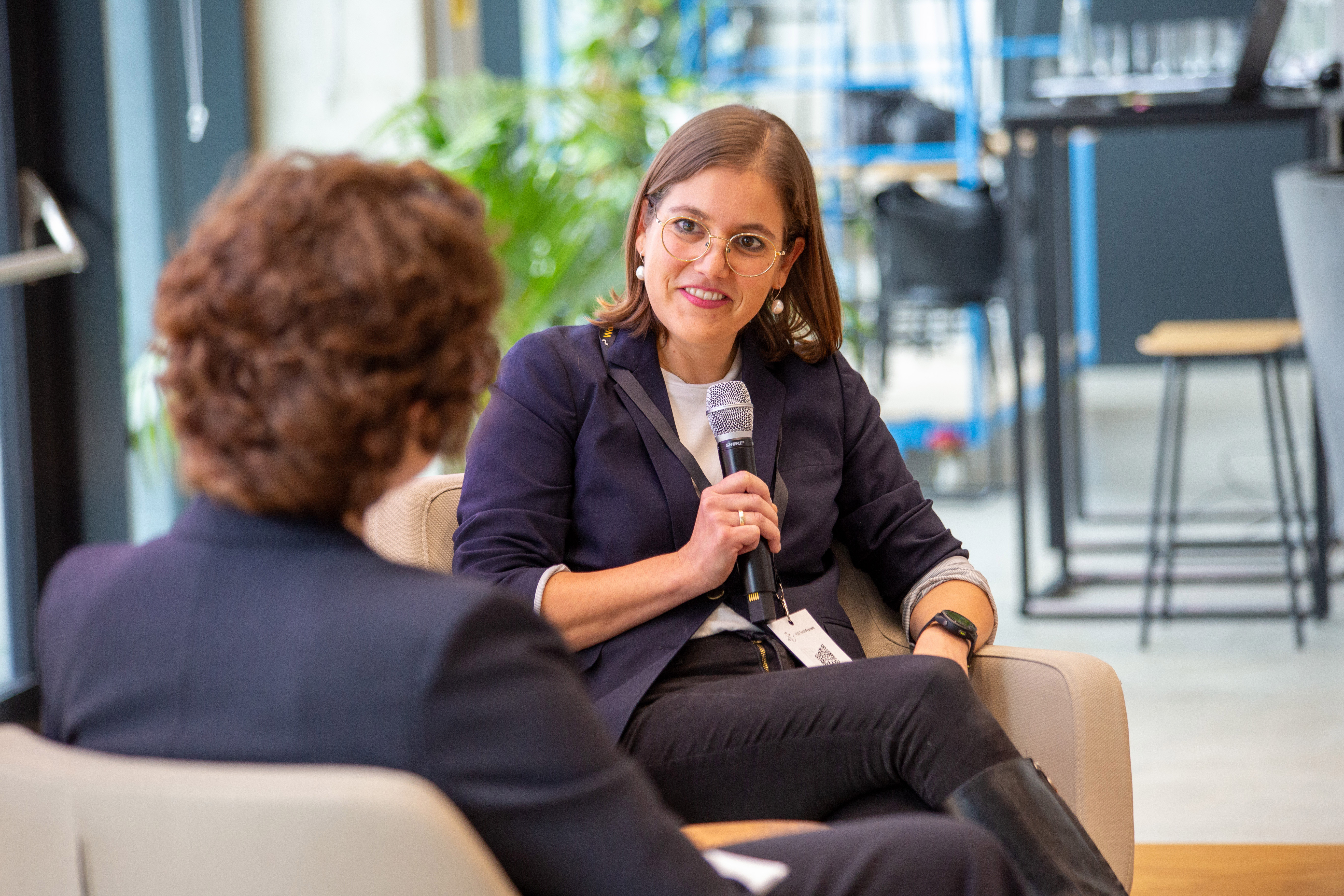
Christine Regitz (left) and Verena Laumayer would like to see more women in networks such as Business Women’s Network or SAP Women in Tech.From left: Kira Marrs, Eva Zauke, Verena Laumayer, and Anja Schneider discuss new opportunities for women in the tech industry.
From Literary Studies to Google: Examples of Innovative Career Paths
The researchers also found that taking a less traditional approach to hiring makes it easier for women to get a foot in the door – after all, when roles are flexibly defined, they are open to people who have an atypical background. Take these women for example.
Eva Bacon’s patchwork and rather unconventional career path took her from studying literature to working for Google in New York – a perfect example of a non-tech woman at the center of the tech world. Bacon now oversees transformation projects as a senior program manager at Google. “Anything is possible in this job,” she says enthusiastically. Part of her work involves motivating and guiding her employees. At a workshop, she recalls, the participants were tasked with building houses out of spaghetti, and the instructor said to her, “You need to be the glue that holds everything together. We have enough people building houses. We now need someone who can make a city out of them.” Being a born organizer, she found that an easy task. Abstract thinking, she says, is something that comes to her naturally. What really helped her gain a foothold in the tech world, though, was the fact that she had taken the time to learn about HTML. Whenever she needed to know anything else, she would ask the computer geeks, adding that it is nevertheless important to have “a certain affinity for technology and to have the confidence to tackle new topics and ask questions.”
Back when Sarah Mang-Schäfer was at high school, she set an ambitious goal in her art class of one day coming up with the advertising image of the century. These days, as head of a public cloud engineering team, she flexes her creative muscle in a more technical capacity. Although she went on to study computer science, she found that art and technology were not so different after all. “To solve problems, you need to be creative,” she says. She worked initially in neuroscience, which taught her the importance of networking. She then poured her energy into cancer research, teaming up with doctors to test software. It was in this role that she realized what successful IT implementation was all about, namely understanding what customers want without them needing to ask for it. Today, we call that customer or user experience, fields which are growing in the IT industry and where women in particular have the breadth of skills and expertise required.
One thing is clear: women have a bright future in tech
At BSH, one of Europe’s largest makers of home appliances, the officer in charge of manufacturing strategy is Fiona Taylor. A scientist by training, Taylor is on a mission to attract more women into manufacturing, because she firmly believes that gender diversity benefits companies. With so few women in industry, she knows all too well how it feels to be the lone woman in the room, which is one reason why she wants to see the situation change.
Passionate about her work, she loves the variety her job brings: “I work with so many different people across the company, from purchasing and manufacturing to logistics.” Her task is to ensure everyone on the operational side pulls together. “Being one of the people who determines where we invest and where we build new manufacturing plants, I can help ensure that we remain competitive as a German company. And it means I can influence our corporate culture.” When she returned to work after having her second child, Taylor was pleased to discover that the company’s thinking had shifted. She was asked to head up manufacturing for the very reason that she thinks out of the box and asks the questions that need asking – and would be an ideal role model for combining a leadership position with working part-time. Taylor urges women to “have the courage to start the conversation and drive change,” and calls on other female leaders to reach out to two other women to help them progress as well.
Stephanie Karger, head of Standard and Safety at BSH, is further proof that you do not have to work full-time nor have technical expertise to be an effective leader. “We’ve adopted a new leadership style, one that is based on trust and equality,” Karger says. “Whenever I need specialist technical knowledge, I simply ask my team.” Women are more likely to see leadership roles in this way, which is something their team members appreciate too, because it gives them the autonomy that many of them desire.
Anja Schneider has been global head of Premium Engagement & Advisory, Customer Services & Delivery at SAP, since April 2024. Prior to this, she was chief operating officer of Technology & Innovation for many years. “I enjoy creating impact – and being the person who is ultimately responsible when customers have a problem,” Schneider says. “Bringing together a whole network of experts to find a solution is rewarding.” At SAP, she says, she has never encountered anyone who doubted women’s ability to lead. Schneider’s career has taken an unconventional path, too: she joined SAP from Germany’s civil service. Leaving the public sector for the private one was a leap into the unknown for her. But, as Schneider puts it, challenges like this push us out of our comfort zone so that we can learn and grow. In her case, it took an open mindset and an interest in technology. Besides, she adds, having a different perspective is also an advantage when it comes to being an advocate for the customer. According to Schneider, a team of developers does not need another developer to lead it.
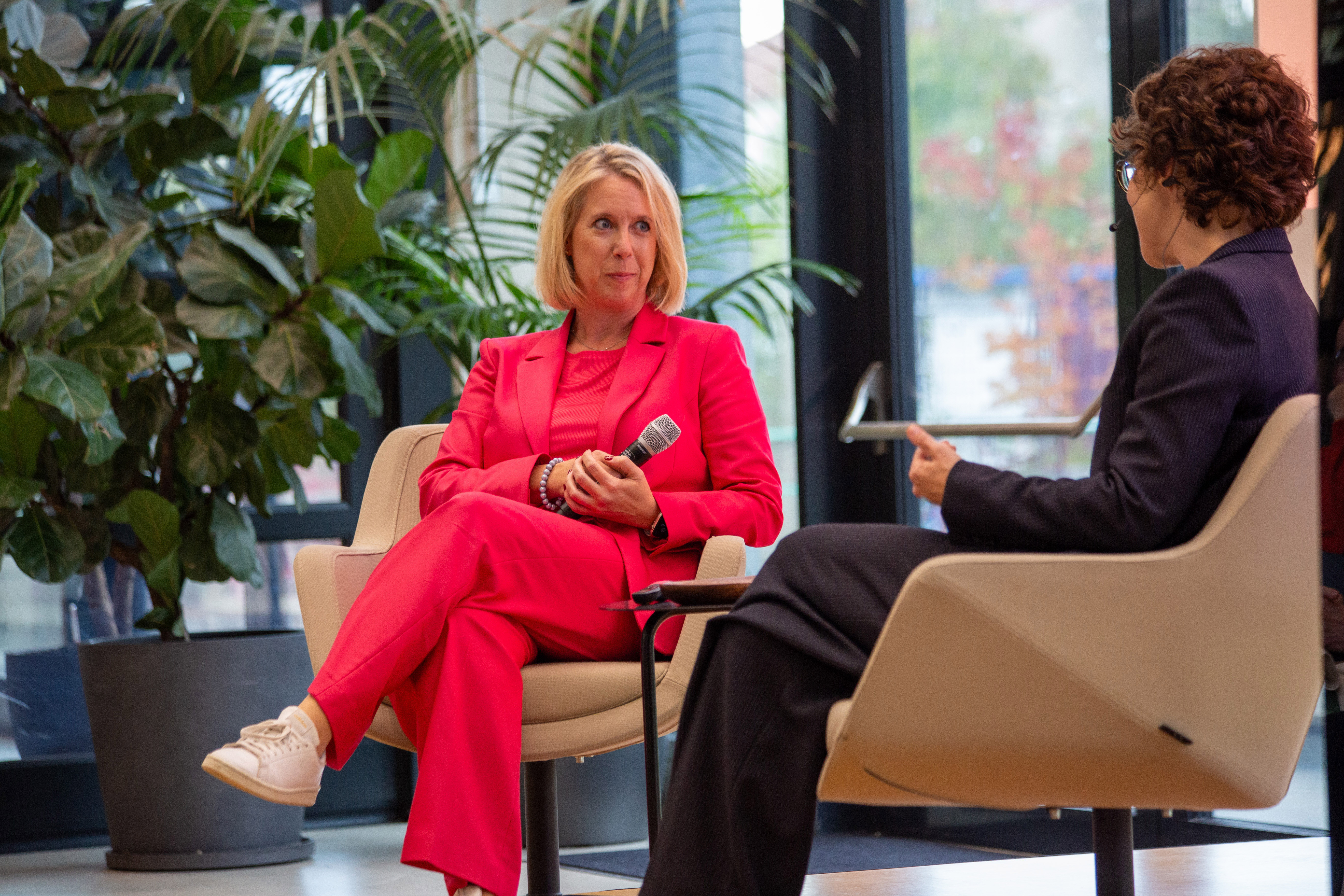
Anja Schneider in conversation with Kira Marrs at the conference for the 100 Women in Tech project.Eva Bacon explains how she made her career as a literary scholar at Google.
AI Creates New Opportunities and Reduces Bias
Eva Zauke, executive vice president of SAP Enterprise Adoption and engineering location lead for SAP Labs Walldorf and St. Leon-Rot at SAP SE, is involved in examining how artificial intelligence (AI) is changing the way we work and creating new careers for women. “AI is opening up opportunities to women who are ready to enhance their skills.” For instance, AI is leading to new roles in IT beyond traditional programming ones. According to Zauke, data scientist, prompt engineer, ethics expert, interface designer, model engineer, and user experience designer are just some of the careers emerging in the field of AI. They also appeal to a wider spectrum of applicants, including graphic designers, people with a humanities background, and psychologists. However, while AI can unlock opportunities for women, it can also perpetuate gender disparities because, as Zauke says, data is biased: “AI inherits bias from the humans who program it, who, more often than not, are white men.” Having more women working on AI would, Zauke believes, not only reduce data bias but also help fill the talent gap in Europe’s tech sector.
Verena Laumayer is a member of the SAP Women in Tech strategy team, which is part of the Office of the CEO. She often finds herself at business events where not one speaker is a woman. Whenever she mentions this to the organizers, invariably the answer is that they simply could not find one, which is why she calls on women to have more confidence in their expertise and to increase their visibility. Public speaking skills can be learned, she says. Laumayer has no doubt that women need to be at the forefront of the tech economy and help shape its future.
Making the Future Visible: 100 Innovative Women in Tech
Germany’s ISF Munich research institute and University of Erlangen-Nuremberg have teamed up on a two-year project (from October 2022 through October 2024) that puts the spotlight on 100 pioneering women in the technology industry and on the important role they play in innovation today. Called #100TechFrauen, the project is part of a German government initiative to raise the profile of women in innovation and is supported by a network of partners from the services sector, industry, and the startup scene, including AUDI AG, IT service provider Atruvia AG, Bosch Siemens Hausgeräte GmbH (BSH), SAP SE, and Siemens AG. For more information (in German), visit #100TechFrauen.
In modern society, our perception is constantly bombarded with a never-ending stream of visual and auditory stimuli, overwhelming our senses and making it difficult to stay grounded in the present moment. Despite the challenges posed by our fast-paced society, it is essential to remain mindful and in the present to navigate the complexities of our perception and experiences.
SAP’s new art exhibition explores this concept and features the work of three artists, each offering their unique perspective on “The Tapestry of Perception.” It highlights the interconnectedness of perception, transformation, transition, memory, and the awareness of our surroundings. The art gallery is open to the public until February 2, 2025; the works can be viewed virtually or in person at the SAP International Training Center in Walldorf, Germany.
One of the key challenges we face in this information-saturated world is filtering out extraneous noise and differentiating between reality and our subconscious experiences. It can be difficult to discern what is truly happening in the present moment, as we draw from fragmented memories to make sense of our surroundings. Everyone sees and experiences life through a different lens, making the theme of perception open to interpretation.
The Interplay of Materials, Perception, and Memory Fragments
Litfass – Petra Goehringer Machleid. Click to enlarge.
As we navigate through life, we undergo various transformations and transitions, which further shape our perception of the world around us. Our memories, often fragmented and incomplete, play a significant role in how we interpret and understand our surroundings. German artist Petra Goehringer Machleid focuses on the interplay of wax and concrete and how the two different materials merge together over time. In her work “Litfass,” the peeling of all the different layers off the pillar represent all the stories held together, making it a unique representation of how experiences transform an individual.
Ultimately, our perception is shaped by our ability to draw from memories and differentiate between reality and subconscious experiences. Our awareness of time and surroundings also plays a significant role in shaping how we experience the world around us. Austrian artist Petra Fohringer captures the experience of memory and present experiences in her work “Winter’s Coming,” featuring Tyrion Lannister from the prominent TV series “Game of Thrones.” Throughout the series, the characters undergo significant changes, facing various challenges and setbacks that shape who they are. The relationships formed and the memories shared by the characters play a crucial role in their individual growth and transformation, serving as a reminder of the importance of the memories we create and the impact they have on our lives. “My artistic works open up the question of true and traditional memories, the influence and manipulation of memory, both individual and collective,” Fohringer notes.
Winter’s Coming, 2019 – Petra Fohringer. Click to enlarge.
Stefan Mittlboeck-Jungwirth-Fohringer, a multidisciplinary artist from Austria, delves into the world of transformation by recreating a beehive with copper encased in concrete. The honeybees, in his work of art “bodies,” represent unity and cooperation during times of transformation. The piece also represents the cyclical nature of life, as bees work tirelessly to gather resources and sustain their hive, mirroring the constant flow and transformation of life. This series of life and the fragile balance of it is a crucial component of his artwork. At the exhibition in Walldorf, an additional short film of the artist creating his work is on display.
bodies, 2019 – Stefan Mittelboeck-Jungwirth-Fohringer. Click to enlarge.
The components of the SAP art exhibition “The Tapestry of Perception,” which are memories, perception, and reflection of the world around us, contribute to our self-image, shape our experiences, and influence our general well-being. By understanding and appreciating the significance of these elements, we can cultivate a deeper awareness and appreciation for the richness of our human experience.
Top image: Mindatlas, 2022 – Stefan Mittelboeck-Jungwirth-Fohringer
Since 1972, SAP has supported contemporary art in all its forms – and the artists who create it
The holidays are a season of traditions, like gathering with loved ones and exchanging gifts that bring joy. But what if your gifts could also create a ripple effect of positive impact? This question drives the SAP Corporate Social Responsibility (SAP CSR) team every year as we and our partners prepare the SAP community holiday gift guide – a collection of organizations that prioritize people and the planet, redefining what it means to give meaningfully.
Redefine what it means to give this holiday season
Consider this: What if the scarf you gifted your friend helped provide fair wages to artisans in underserved regions? Or if the chocolates you gifted to a colleague supported sustainable farming practices and reduced carbon emissions? With the 2024 SAP community holiday gift guide, these scenarios aren’t just possibilities – they’re realities.
The SAP community holiday gift guide has become a meaningful way to connect holiday traditions with SAP’s mission to help the world run better and improve people’s lives. This year’s guide features over 200 purpose-driven businesses from around the world. These businesses offer unique, high-quality goods and services while reinvesting in their communities and ecosystems, creating a virtuous cycle of positive change.
The world is grappling with urgent challenges, from climate change to growing inequality. As consumers, we hold immense power to influence how businesses operate through our purchasing choices. Every item in this year’s guide represents an opportunity to support a business that aligns with these values – companies that ensure ethical supply chains, foster inclusivity, and reduce their environmental footprint.
Take Ekatra for example. It produces handcrafted paper goods, and its mission is to engage women from marginalized communities to co-create, providing a new path to financial independence. By choosing its products, you’re not just buying a gift, you’re becoming a part of a bigger story of resilience and innovation.
Exploring the SAP community holiday gift guide is simple, but its impact can be profound. Every purchase you make sends a clear message: that you value businesses that act sustainably and prioritize the greater impact.
We encourage you to:
Share the guide with your networks and inspire others to rethink their holiday shopping.
Use the hashtag #SAP4Good to amplify the stories of businesses making a difference.
Reflect on how small, intentional choices can lead to a better future for everyone.
This holiday season, let’s redefine what it means to give. Together, we can transform holiday traditions into acts of purpose and hope. Let’s spark joy, not just for those receiving our gifts but also for the communities and ecosystems that benefit from them.
SAP and AWS are collaborating to enhance the BBC’s IT infrastructure by moving key systems to the cloud. The BBC, a globally recognized public broadcaster, has undertaken a strategic shift towards modernizing its IT systems to optimize performance, increase scalability, and reduce operational costs. At the heart of this initiative is the adoption of SAP […]