For Retailers, Agentic Commerce Is Here

The clear message for retailers attending National Retail Federation’s 2026 Big Show in New York last week was that they need to urgently address the challenge brought about by the rapid adoption of generative AI tools by consumers and update their back-office and data systems if they are to thrive in the agentic commerce era.

Agentic AI was everywhere at NRF, emblazoned across the booths of technology exhibitors and the focus of many of the daily conference sessions. The message was simple: retailers face a major upheaval as consumers switch from traditional browser-based search to AI-enabled product discovery.

Consumers are rapidly adopting AI agents to help them find, compare, and, increasingly, buy products—this while many brands are still optimizing for search engines and are quietly disappearing from the models driving the next generation of product discovery.

“Agentic commerce—shopping powered by AI agents acting on our behalf—represents a seismic shift in the marketplace,” McKinsey, the strategic management consultancy, noted in a report published late last year. “It moves us toward a world in which AI anticipates consumer needs, navigates shopping options, negotiates deals, and executes transactions, all in alignment with human intent yet acting independently via multistep chains of actions enabled by reasoning models.”

This, as speakers and panelists at the NRF conference acknowledged, isn’t just an evolution of e-commerce; it’s a rethinking of shopping itself, in which the boundaries between platforms, services, and experiences give way to an integrated, intent-driven flow through highly personalized consumer journeys that deliver a fast, frictionless outcome.

As the McKinsey report noted, the stakes are high. By 2030, the U.S. B2C retail market alone could see up to US$1 trillion in orchestrated revenue from agentic commerce, with global projections reaching as high as $3 trillion to $5 trillion.

From discovery to delivery, create effortless experiences at every step

This means all the participants in the retail chain, from brands and retailers to logistics and payment service providers, will need to adapt to the new paradigm and successfully navigate the challenges of trust, risk, and innovation.

To help retailers address the immediate challenges posed by the shift to agentic commerce, SAP argues that three steps are necessary: first, restructuring web-page product data to be machine-readable; second, adding semantic summaries for LLM reasoning; and third, tagging products by the problems they solve, not just their attributes.

SAP announced a series of AI-enhanced retail innovations at NRF 2026, including a new storefront model context protocol (MCP) server that enables retailers to make their digital storefronts intelligible to AI and the new AI-native Retail Intelligence solution in SAP Business Data Cloud that leverages data from across SAP software and third-party systems to help provide accurate demand planning, improved forecast accuracy, and lower inventory costs to drive more seamless omnichannel engagements.

SAP Customer Experience has also unveiled a Digital Service Agent recently that can be combined with the Shopping Agent, creating one conversational AI that can handle the entire journey from product discovery and transaction to post-sales support.

These moves reflect a recognition that that LLMs have become a legitimate shopping channel, and that product discovery is moving from search engines to AI recommendations.

This shift challenges years of SEO and brand building. To stay relevant, SAP believes retailers must take an AI-first approach and have strong, connected data that helps agents understand products, predict demand, and respond quickly. Without this strong data foundation, brands will be at risk because if customers get poor recommendations and errors in pricing, trust can disappear fast.

Although some early agentic AI adopters in the retail sector are already seeing the benefits of agentic commerce, many global retailers are still ill-prepared for the holistic transformation they need to succeed in this new retail environment.

As McKinsey noted in a separate report published to coincide with NRF, “while most retail merchandising teams have invested in automation tools and experimented with AI, 71% of merchants say that AI merchandising tools have had limited to no effect on their business so far.”

“The challenge,” McKinsey said, “often lies less in the technology than in how it’s integrated and used. Systems remain fragmented, data is too messy to use to deliver useful recommendations, and adoption is uneven: 61% of respondents say that their organization isn’t at all or is only slightly prepared to scale AI across merchandising.”

Onstage at NRF, Andre Bechtold, president for SAP Industries & Experience, also emphasized that retailers should prepare now for agentic commerce and noted that simply “bolting on” AI tools to existing systems is not enough.

“Retailers are operating in an environment defined by volatility—tariffs, margin pressure, supply chain disruption, and customers that expect real-time, hyper-personalized experiences everywhere,” Bechtold said during a discussion with Gymshark, the workout apparel retailer. “At the same time, boards and investors are asking a tougher question than ever before: what outcomes are we actually getting?”

“The challenge,” he said, “isn’t a lack of innovation. In fact, most retailers have plenty of tools, pilots, and point solutions. The real issue is that disconnected technology doesn’t translate into resilient growth. That’s why the conversation is shifting. It’s no longer about isolated AI use cases or shiny new features. It’s about whether AI and data are embedded across the business—connecting supply chains, finance, merchandising, and customer engagement—in ways leaders can trust.”

Echoing the same point, Thomas Saueressig, member of the Executive Board of SAP SE, Customer Services & Delivery, commenting in a Handelsblatt article this week about a PwC survey of global CEOs that found that companies rarely achieve lower costs or higher sales through the use of AI, emphasized that AI only contributes value when consistently embedded in business processes.  “As long as AI runs alongside the core business as an isolated project, the effects remain limited,” he said.


Sign up to receive weekly news highlights from the SAP News Center

SAP Introduces Demo Data Personalization Add-On for SAP Demo Environment 2.0

In a sales cycle where every conversation counts, the quality of a demo can shape the direction of a deal. Buyers expect to see their world reflected back to them—their language, their metrics, their industry reality—not a one-size-fits-all scenario. Yet tailoring demos traditionally requires time, coordination, and changes that risk impacting complex landscapes.

That is why SAP has introduced the demo data personalization add-on for SAP Demo Environment 2.0, a way to adapt and personalize demos in minutes while keeping backend systems untouched and preserving confidence across presales, sales, and IT stakeholders.

From generic to personal

Revolutionize your demo experience with SAP Demo Environment

The demo data personalization add-on, powered by third-party provider Saleo, extends SAP Demo Environment 2.0, the already widely adopted platform for SAP partners used by more than 2,000 partner companies and over 10,000 qualified users, with a continuously growing library of partner demo scenarios. Offered to partners at an exclusive partner price, it enables teams to create personalized, predefined data-rich demos with the help of embedded AI functionality, quickly safely, and directly in the browser. Instead of building multiple demo variants or relying on time-consuming environment changes, teams can start from proven, preconfigured foundations and layer on relevant context for each meeting, bringing the right narrative to the right audience at the right moment.

At the core is the ability to adjust surface-level elements within the demo scenario in real time. With Saleo Live, teams can change specified UI components—such as text and images—on the fly via a Chrome browser plug-in. This allows a single demo to speak in the terminology of different industries or roles, from executive outcomes and board-level KPIs to practitioner workflows and day-to-day tasks, while preserving the integrity of the underlying systems. It can make last-mile tailoring part of the conversation rather than a separate workstream, helping presenters respond to questions, highlight specific use cases, and align quickly to customer priorities without switching environments.

Building on that, Saleo Capture converts those tailored moments into guided, ready-to-share, HTML-based demo experiences. By turning demo data into interactive journeys, sellers can offer scenario-based experiences that extended buying teams can review at their own pace and in the right context to make the customer feel like they are the system without being in the system. This is especially helpful for complex deals with diverse stakeholders, where asynchronous exploration and consistent messaging can accelerate consensus and keep momentum between meetings.

Together, these capabilities shift demos from a static show-and-tell to dynamic conversations grounded in the customer’s world. Teams can reuse consistent foundations from SAP Demo Environment 2.0’s preconfigured partner demos and broad solution library, then apply last-mile personalization to match specific priorities and use cases. The combination promotes repeatability and governance while preserving flexibility—an approach that helps reduce demo preparation time, elevate the relevance of each interaction, and support a scalable model for high-quality demo delivery across regions, industries, and segments.

Proven impact on speed and win rates

Early feedback points to meaningful efficiency and effectiveness gains: time saved in crafting personalized demos, a drastic reduction in weekly demo maintenance, and a positive influence on customer satisfaction and win rates. In fast-moving opportunities, that can translate into clearer storytelling, smoother collaboration between presales and sales, and greater confidence for customers evaluating complex solutions. Over time, organizations can build a durable library of guided, personalized flows that help shorten ramp-up for new team members and can ensure a consistently high standard for customer engagements.

By combining SAP Demo Environment 2.0 with the demo data personalization add-on, organizations can move beyond generic demonstrations to experiences that resonate—quickly, safely, and at scale. As Karl Fahrbach, chief partner officer at SAP, noted, “The new personalization option for SAP Demo Environment 2.0 is a significant leap forward in giving SAP partners the right tool to tailor demos to their customers’ needs—smarter, faster, more personalized.”


Andre Bechtold is president and head of SAP Industries & Experiences.

Connect with us! Stay up-to-date with all things SAP News on LinkedIn

Agentic AI Is Reshaping Commerce: The Next Frontier of Discovery, Payments, and Trust

At NRF 2026, agentic AI was everywhere. At SAP, we’re moving beyond the hype and turning AI into real, scalable outcomes. Agentic AI represents a fundamental change in how commerce works, reshaping discovery, payments, fulfillment, and long-term customer loyalty.

Our vision for agentic commerce is bold. In our latest video, we showcase a future where humans and AI agents collaborate to drive intelligent recommendations, proactive operations, efficient business processes, and deeper customer relationships. While this vision points forward, SAP’s focus is firmly grounded in helping retailers take practical steps today. This isn’t about flashy demos of a distant future—it’s about building the foundation now for how consumers will buy and retailers will sell in the years ahead.

Unlike traditional AI systems that respond to prompts, agentic systems act on intent. They learn from preferences, make proactive recommendations, and can complete transactions on a shopper’s behalf. These agents are increasingly becoming the starting point of the buying journey, reshaping how brands compete for visibility, trust, and loyalty.

This evolution introduces both opportunity and risk. As AI agents mediate more interactions between brands and consumers, retailers must rethink how they capture intent, transact with agents, and deliver post-purchase experiences that reinforce trust.

A C-Suite Framework for Climate Capability in 2026

For decades, climate adaptation lived on the fringes of corporate strategy. It was typically addressed through insurance coverage, emergency protocols, and risk registers. These tools were helpful at the time as they helped organizations respond to disruption, but they often positioned climate considerations as something to manage episodically, rather than as part of how a business operates day-to-day and plans for growth.

In 2026, that distinction is becoming increasingly blurry. Extreme heat, water scarcity, flooding, wildfires, and energy volatility are affecting cost structures, disrupting supply chains, and constraining labor productivity and capital planning. These factors increasingly show up in routine operational and financial decisions and interact with broader economic dynamics. Climate impacts intersect with geopolitical competition, supply-side volatility, and regional fragmentation. At the same time, the transition to a low-carbon economy continues to progress unevenly across markets, with carbon increasingly subject to pricing, regulation, and disclosure expectations.

Together, physical climate impacts and transition pressures are influencing how companies plan, invest, and operate. Many organizations are approaching adaptation and mitigation as an integrated business capability, on par with financial management, supply chain planning, or cybersecurity.

Why adaptation and mitigation demand sustained leadership attention

S&P Global Energy Horizons projects that physical climate risks could more than triple corporate financial exposure by 2050, driven by asset damage, supply disruptions, and productivity losses. Despite this growing exposure, however, fewer than one in five companies have implemented adaptation measures at scale.

This widening gap between risk and readiness has profound implications for CEOs and boards, who recognize this threat. A new report from WEF found that business leaders identified extreme weather events as the greatest long-term business risk, with cascading effects across economic stability, supply chains, and social cohesion. Climate risk is now:

  • Financial, affecting margins, asset values, insurance availability, and cost of capital
  • Operational, disrupting production, logistics, and workforce availability
  • Strategic, influencing where companies invest, source, and grow
  • Reputational, shaping trust with investors, customers, regulators, and employees

For many leadership teams, climate adaptation and mitigation have become part of the broader challenge of enterprise readiness. In some cases, they are also influencing access to capital, insurance terms, talent attraction, and long-term market positioning.

Put sustainability at the core of your business with AI-driven solutions from SAP

Going beyond the contingency mindset

A common constraint on progress is how climate adaptation is still framed inside organizations.

When it is treated primarily as contingency planning, it tends to be reactive and episodic. Plans are developed, documented, and revisited only after disruption occurs, while ownership is often spread across risk, sustainability, operations, and finance teams with limited integration into core decision-making.

A capability-based approach works differently. Business capabilities are embedded and inform everyday decisions, supported by data, systems, governance, and incentives.

Climate capability emerges when organizations integrate climate risk, resilience, and carbon considerations into the core of how the enterprise runs.

The four pillars of climate capability

1. Supply chains designed for disruption

Global supply chains are increasingly exposed to climate volatility and regulatory pressure. Highly optimized, linear supply chains designed primarily for cost efficiency have shown limitations under these conditions. Many organizations are adjusting value chains to improve resilience and address emissions. Supplier diversification, regionalization, circular material flows, and better data sharing can reduce exposure to physical disruption and, in many cases, lower Scope 3 emissions. In practice, efforts to improve decarbonization and resilience often reinforce one another.

What this requires is more reliable, timely data across supply chains, so that COOs are empowered to turn insights into meaningful outcomes.

2. Assets and infrastructure built for a changing climate

Facilities, equipment, and logistics networks are increasingly exposed to chronic stresses, such as heat and water scarcity as well as acute events like flooding. At the same time, carbon-intensive assets face growing transition risk as energy systems and regulations evolve.

A capability-based approach evaluates assets through a dual lens: physical climate exposure and carbon intensity. This informs where companies locate facilities, how they maintain them, and when they invest in retrofits, electrification, or renewable energy.

Investments in energy efficiency and clean energy can reduce emissions while also moderating exposure to energy price volatility and supply disruptions.

3. Workforce resilience as a business priority

Climate impacts are also affecting people. Rising temperatures and extreme weather are already reducing labor productivity and increasing health and safety risks in many roles and regions.

The International Labour Organization estimates that heat stress alone could result in the equivalent of 80 million full-time jobs lost globally by 2030 under a 1.5°C warming scenario. Organizations that treat workforce resilience as a core business issue are adjusting schedules, working conditions, training, and safety protocols, protecting people while maintaining productivity.

4. Financial decision-making informed by climate reality

Despite growing awareness, climate data is often still disconnected from financial planning and analysis. CDP reports that while 67% of companies identify climate-related risks with potential financial impact, only a fraction can quantify those risks with enough precision to guide investment decisions.

A capability-based approach incorporates carbon and climate risk into financial models. This allows leaders to assess physical risk, transition risk, and return on investment together, turning climate action into a disciplined, value-driven decision process. SAP’s carbon accounting solutions, like SAP Green Ledger and SAP Green Token, can empower organizations to drive actionable climate strategies and unlock measurable impact by helping them integrate sustainability into core business processes through the combination of trusted financial data and granular carbon insights.

A C-suite framework for climate capability in 2026

Across industries, five leadership actions will define those organizations building true climate capability:

  1. Embed climate and carbon assumptions into core business planning and governance.
  2. Redesign value chains for resilience and emissions reduction.
  3. Protect assets and people with predictive, forward-looking insight.
  4. Align mitigation and adaptation with financial strategy.
  5. Measure resilience and emissions together, not in isolation.

Together, these actions help shift climate efforts from parallel initiatives into a managed enterprise capability, one that determines operational continuity, financial resilience, and long-term competitiveness.

Learn more about how you can build a more compliant, sustainable, and resilient business with SAP Sustainability solutions.


Sophia Mendelsohn is chief sustainability and commercial officer at SAP.

Get the latest and greatest SAP news delivered to your inbox once a week

SAP Fieldglass: Recognized by Analysts and Customers as a Leader in Workforce Management

The extended workforce is now at the core of business transformation. Organizations everywhere are looking for technology partners that deliver not just scale, but also intelligence, agility, and innovation.

That’s why the latest recognition from two of the industry’s most respected research firms—Ardent Partners and Staffing Industry Analysts (SIA)—means so much to us at SAP. Their findings reinforce what we see every day: SAP Fieldglass isn’t just keeping up with the industry, we’re setting the standard for innovation, execution, and customer value.

Market leadership confirmed by independent analysts

The 2025 VMS Technology Advisor from Ardent Partners named SAP Fieldglass a “Market Leader,” a distinction reserved for providers with universal strengths and top-tier execution. The evaluation looked at every aspect of our portfolio, from supporting the full scope of managing the external workforce—requisitions, candidates, projects, direct sourcing, SOW/services procurement, integrations, and AI—to our execution ability, client success, references, talent ecosystem, product vision, and future of work readiness.

We’re especially proud to be recognized as an “Elite Performer” in four critical categories: AI Innovation, SOW and Services Procurement, Direct Sourcing, and Total Talent Management. Ardent Partners highlights SAP Fieldglass’ deep integration with SAP SuccessFactors solutions, SAP Ariba solutions, SAP Build Work Zone, and the AI solution Joule, positioning it as a strategic hub for managing external talent and optimizing services procurement. Joule is transforming how users interact with the portfolio, offering conversational, data-driven guidance for requisition creation, SOW intake, job description design, and workflow acceleration.

SIA’s VMS Global Landscape & Differentiators Showcase also confirms SAP Fieldglass’ global leadership. The portfolio operates in more than 180 countries, supports 22 languages, and enables invoicing in 118 countries, making it the largest footprint in the industry. This extensive reach is further underscored by consistently strong customer retention, reflecting the deep trust and satisfaction SAP Fieldglass enjoys among global enterprises.

Customer-validated leadership

Recognition from leading analyst firms is important, but what matters most is the experience of our customers. SAP Fieldglass has also been ranked as a category leader by TrustRadius, a respected platform for verified customer reviews. TrustRadius rankings are based on direct feedback from real users, making it a powerful complement to analyst evaluations. While analyst reports validate market position and strategic capabilities, TrustRadius highlights the day-to-day value customers experience, such as ease of use, depth of functionality, and overall satisfaction. This dual endorsement, from both industry experts and actual practitioners, reinforces SAP Fieldglass’ commitment to delivering solutions that can meet business needs and exceed customer expectations.

Boost productivity with workforce management from SAP Fieldglass

Innovation at the core: AI, automation, and analytics

Innovation is at the heart of SAP Fieldglass’ value proposition. The portfolio’s embedded AI solution, Joule, helps users initiate job requisitions, design and translate job descriptions, and accelerate approvals through a conversational interface. Rate benchmarking helps ensure customers stay competitive with market rates. Document AI can automate structured SOW creation, while machine learning and skills ontology models can power advanced candidate matching and workforce planning.

SIA notes that SAP Fieldglass’ “AI-first” product strategy is embedding intelligence into every workflow, emphasizing seamless data extraction, intuitive user experiences, and impactful use cases across applications. The business intelligence suite delivers real-time and historical analytics, benchmarking tools, and persona-based dashboards, empowering organizations to make data-driven decisions at every stage of the talent lifecycle.

Comprehensive capabilities for a modern workforce

What distinguishes SAP Fieldglass is its wide-ranging and comprehensive set of features. The portfolio allows users to effectively manage all kinds of external labor expenses—whether that’s contingent labor, services procurement, independent contractors, high-volume workers, or field services. It offers streamlined onboarding, advanced and customizable tools for global compliance, AI-driven workflows, and robust skills extraction, helping to ensure depth and efficiency in every area. Additionally, its compliance and audit capabilities, mobile accessibility, and dashboards supporting diversity, equity, and inclusion help create a holistic solution.

SIA’s research, based on 23 in-depth VMS surveys and 36 customer assessments, found SAP Fieldglass excels in supplier management, time/expense/billing, SOW capabilities, candidate sourcing, technical functionality, and customer perceptions. Customers cite the portfolio’s innovation, influence over roadmap evolution, and ability to scale with their programs. The open API framework, pre-built integrations, and strong MSP partnerships create a connected ecosystem that can support even the most complex workforce strategies.

Customer experience and ecosystem strength

Customer experience is another area where SAP Fieldglass shines. SIA’s customer perception data shows high marks for platform stability, ease of use, integration quality, adaptability, and support. Customers appreciate the portfolio’s innovation, the ability to influence roadmap evolution, and its capacity to scale with their programs.

Both Ardent Partners and SIA emphasize SAP Fieldglass’ commitment to continuous innovation. The “AI-first” and “suite-first” strategies focus on embedding intelligence into every workflow and delivering seamless, end-to-end business processes across the SAP ecosystem. Key areas of ongoing investment include skills-based hiring, AI, enhanced analytics, and high-volume workforces for SOW management.

A portfolio for the future of work

The latest findings from Ardent Partners and SIA reaffirm SAP Fieldglass’ leadership, vision, and relentless focus on customer value. Combined with customer-driven recognition from TrustRadius, SAP Fieldglass stands as a proven leader in delivering solutions that can empower organizations to unlock the full potential of their extended workforce—today and for the future of work.

Learn more about SAP Fieldglass.


Amber Roth vice president of Global Presales & Strategy for SAP Fieldglass.

Sign up to receive weekly news highlights from the SAP News Center

Why AI Without Humanity Is Incomplete

Artificial intelligence (AI) has moved far beyond experimentation. It is already reshaping how industries operate, how economies evolve, and how people experience work.

Create transformative impact with powerful AI and agents fueled by the context of all your business data

Recent McKinsey research shows that almost all organizations now use AI in some form, yet most are still at the beginning of scaling it responsibly and effectively. At the same time, there is no question that technological change continues to happen at a remarkable pace, and it demands careful guidance through constant organizational transformation, strong leadership, and the key ability to learn and unlearn.

I am convinced that the future will not be human versus AI, despite this still-dominant narrative. It will be determined by how effectively human insight, judgement, and expertise shape AI’s integration into work and society. The real opportunity lies in combining human and AI across creative and analytical domains, applying the right competencies in the right context.

Built on trust and ethical intent, AI can amplify human potential while inevitably transforming certain roles and tasks. The Intelligent Age is not about technological dominance, but about purposeful progress through human-AI collaboration.

The rise of human-AI power couples

Imagine working with a new colleague who has not been trained in a classroom but by algorithms processing vast datasets. Simply put, this AI teammate delivers speed, scale, and precision while you bring judgement, context, and creativity. Together, you achieve outcomes neither could deliver alone.

This is already happening across industries. The real differentiator is how well humans and intelligent systems complement each other’s strengths—mainly combining AI’s capacity for data-driven execution with human adaptability and vision. These human-AI power couples are becoming a new source of competitive advantage, able to solve problems faster, spot opportunities earlier, and innovate more boldly.

Yet this potential only materializes when people trust the AI tools they use: trust built not just on transparency, but on daily experience of systems that help them succeed.

Designing the new architecture of work

To set these human-AI power couples up for success, organizations must rethink the very architecture of work. Trust and collaboration are not enough if the underlying structures remain rigid. Traditional roles and hierarchies cannot keep pace with continuous technological change. Work will become increasingly fluid, shaped by skills, collaboration, and shared intelligence. Our time demands adaptive organizations that continuously learn and enable their teams to take on new challenges as they arise.

Consequently, this shift also places new expectations on leaders. As AI progresses, human leadership becomes increasingly important, not less. Leaders must design environments where human and artificial intelligence reinforce each other, and they must actively drive the effective use of AI to deliver business outcomes. This requires adopting a new model, in which leaders fluently manage integrated systems of people and AI agents. They are accountable not only for their human teams’ performance, but also for the limitations of the AI models they deploy. This means creating a working environment where experimentation is encouraged and where people feel supported as their roles evolve.

As shown in SAP’s own Future of Work research, employees express growing openness toward AI-enabled coaching and support. When AI takes on parts of the coaching role, leaders must focus on what only humans can provide: context, empathy, and the ability to inspire. AI can track progress, but it cannot build trust or shape culture.

The human skills that will shape the Intelligent Age

As humans and intelligent systems collaborate more closely, the skills people need will also continue to evolve. Research from the OECD and the World Economic Forum shows that skills have a shorter lifespan than ever before. Traditional job profiles no longer keep pace. The real differentiator is how quickly people can learn and keep up as technology advances.

A skills-led organization takes a holistic view of employees’ skills across the entire employee life cycle—from recruiting and learning to talent development and succession management. Its defining capability is the ability to adapt with speed to external changes and disruptions. A company can adjust required skills almost in real time. This is a prerequisite to staying competitive and responding quickly to customer and market needs.

AI is the catalyst for this adaptability: it identifies skill gaps in real time, personalizes learning journeys, and enables talent to move fluidly to where it is most needed. This turns skills management from a static process into a dynamic system, preparing a workforce that evolves alongside technology rather than being overtaken by it.

Culture as the true algorithm

At the same time, culture becomes equally decisive. Technology may accelerate change, but culture determines its impact. Responsible AI adoption depends on strong cultural foundations. A culture of trust enables people to take ownership and try new approaches without fear of failure. The goal is to have a workforce with a true growth mindset. A mindset that is defined by the inner drive to grow turns change from uncertainty into progress. It is the ability to learn and unlearn, to let go of outdated approaches and embrace new ones.

In fast-moving industries like technology, the pace of transformation is beyond any single person’s control; what can be shaped is how we respond to it. When curiosity and adaptation become a constant core element of organizational agility, change is met with confidence.

Building inclusive and forward-looking societies

When such strong organizational cultures guide responsible AI adoption, their influence naturally extends beyond the workplace, shaping how technology transforms societies, economies, labor markets, and education systems. Whether this shift leads to broader opportunity or deeper inequality depends on the decisions we make now.

AI is already widening access to learning, democratizing coaching, creating more opportunities, and enabling people to focus on meaningful, uniquely human work. The challenge now is to scale these gains, so the Intelligent Age drives shared progress—not deeper inequality—under a responsible, human-centric approach.

What matters now

In the Intelligent Age, technological progress will not wait—nor should it—but it does require leaders to redesign how work and organizations function so that human and artificial intelligence advance together.

This demands a radical rethinking of structures, skills, and leadership models to match the pace of innovation. Three imperatives stand out.

  • Design for trust: Ensure transparent governance and explicit human accountability, embedded in every stage of AI design; this is essential to building trust in human-AI collaboration.
  • Build human capability: Make continuous learning, upskilling, and mobility the default, powered by AI insights that connect talent to opportunity in real time.
  • Lead with humanity: Anchor empathy, purpose, and ethical judgment in every decision.

Technology can amplify performance and even inspire to think out of the box, but only when guided by clear intent and values. The future will favor organizations that reimagine work at the speed of technology—and keep humanity at its core.

AI will accelerate our potential, and while technology’s advance is largely unstoppable, it is our values and leadership that will determine how we respond to and guide its impact. AI without humanity is simply incomplete.


Gina Vargiu-Breuer is chief people officer, labor director, and a member of the Executive Board of SAP SE.

This piece originally appeared on the World Economic Forum website.

Get news, stories, and highlights delivered straight to your inbox each week via the SAP News Center newsletter

Updates to SAP’s Integration Certification Program for Partner-Built Solutions

I am excited to share important updates regarding the integration certification program for partner-built solutions, managed by the SAP Integration and Certification Center (SAP ICC).

Find the right SAP-certified solution for your business

As SAP accelerates our strategy around applications, data, and AI, these certification enhancements will help ensure our growing ecosystem is aligned—both technically and directionally—with our clean core, cloud-forward, and AI-ready approach. 

A framework designed around partner and customer needs 

SAP is committed to delivering business innovations across applications, data, and AI. With this update, we have listened closely to partners and customers and introduced enhancements that make it easier for partners to validate their solutions while maintaining SAP’s high standards: 

  • Empowering customers to leverage data-driven business and enterprise AI—securely and at scale 
  • Supporting intelligent apps, seamless cloud connectivity, and adoption of SAP Business Technology Platform (SAP BTP)
  • Adhering to SAP’s “clean core” extensibility guidelines, ensuring future-ready, upgradable integrations

Integration certification and the new interoperability review 

Our refreshed framework offers two clear paths for partners.

Integration certification (use-case based) 

  • For partner solutions aligned with SAP strategic priorities (SAP BTP-based, using SAP Business AI, clean core, public cloud, and intelligent apps)
  • Certification awarded for specific use cases that adhere to SAP strategic priorities for integration, data, and development guidelines
  • Benefits include certified status, branding rights, and access to go-to-market support, with clear guidance and transparency throughout the process

Interoperability review (open and inclusive) 

We are especially excited to introduce the interoperability review, a new open program designed in response to partner and customer feedback.

  • Open to all partner and independent software vendor (ISV) solutions, including those that may not be eligible for integration certification
  • Showcase technical compatibility with SAP solutions through compliance with technical integration standards 
  • Solutions listed as interoperable on SAP Notes and receive detailed review summery
  • Helps partners demonstrate interoperability and SAP compliance to customers.

This new interoperability review reflects our commitment to listen to the SAP ecosystem and enable more partners and ISVs to participate, fostering innovation across our platform. 

How this benefits partners and customers  

For partners:

  • Easier access to SAP’s integration framework, even if formal certification is not applicable
  • Clear pathways for strategic alignment and accelerated development of maintainable, future-ready solutions
  • Co-marketing visibility for certified solutions

For customers: 

  • Access to a broader set of partner solutions that are future-ready, upgradable, and compliant with SAP’s clean core standards
  • Confidence in interoperability and technical quality across SAP’s business application landscape
  • Faster adoption of data-rich solutions built on robust foundations

Looking forward 

The new framework, planned to launch in Q3 2026, is designed to empower partners, build trust with customers, and accelerate innovation across SAP’s platform.

Our Partner Ecosystem Success team will support this transition throughout the second half of 2026. Partners can preview the criteria for the integration certification and the interoperability review in the SAP Integration Certification framework reference guide or reach out to your SAP partner manager or the SAP ICC team with questions. 


Karl Fahrbach is chief partner officer of SAP SE.

Get news, stories, and highlights delivered weekly via the SAP News Center newsletter

AI in Healthcare: SAP and Fresenius Accelerate Digital Healthcare Delivery

WALLDORF SAP SE (NYSE: SAP) and Fresenius today announced that both companies intend to enter a strategic partnership to accelerate innovation for stronger digital healthcare delivery.

Create tangible value across every part of your business with AI from SAP

Together, the companies plan to create the digital backbone for a sovereign, interoperable and AI-supported healthcare system. The solutions will combine the expertise of Fresenius, one of the world’s largest healthcare companies, with future-oriented SAP technologies and meet high requirements for data sovereignty, security and regulatory compliance. The plan is to provide an open, integrated and data‑driven digital health ecosystem that enables hospitals and medical facilities worldwide to use AI securely and to handle health data responsibly.

Digital sovereignty for healthcare

SAP and Fresenius plan to jointly build an individual, scalable healthcare platform that enables connected, data-driven healthcare processes. Based on this, the companies will develop joint, future-oriented and AI-supported healthcare solutions to sustainably increase quality, transparency and efficiency across the entire care chain and set new standards for digital innovation in the healthcare sector. The foundation will be proven SAP technologies and products such as SAP Business Suite, SAP Business Data Cloud (SAP BDC), SAP Business Technology Platform (SAP BTP) and SAP Business AI. These core elements help create a unified, compliant, open and expandable base for the more-secure exchange and use of data as well as for operating AI models in a controlled environment.

Together, the companies also plan to build a sovereign, European solution for an integrated healthcare ecosystem that supports the integration of modern hospital information systems (HIS) based on SAP’s “AnyEMR” strategy. Interfaces based on open industry standards such as HL7 FHIR will enable the more-seamless connection of HIS, electronic medical records (EMRs) and other medical applications.

“With SAP’s leading technology and Fresenius’ deep healthcare expertise, we aim to create a sovereign, interoperable healthcare platform for Fresenius worldwide. Together, we want to set new standards for data sovereignty, security and innovation in healthcare. Thanks to SAP, Fresenius can harness the full potential of digital and AI-supported processes and sustainably improve patient care,” says Christian Klein, CEO and Member of the Executive Board of SAP SE.

“Together with SAP, we can accelerate the digital transformation of the German and European healthcare systems and enable a sovereign European solution that is so important in today’s global landscape. We are making data and AI everyday companions that are secure, simple and scalable for doctors and hospital teams. This creates more room for what truly matters: caring for patients,” adds Michael Sen, CEO of Fresenius.

As part of the joint transformation project, both companies plan to invest a mid three-digit million euro amount in the medium term to consistently drive the digital transformation of the German and European healthcare system through the use of digital and AI-supported solutions.

The partnership is implemented through various forms of collaboration. These include joint investments in startups and scaleups, joint technological developments and close cooperation within coordinated governance structures between the two companies.

Visit the SAP News Center. Get SAP news via LinkedIn and Bluesky.

Media contact:
Dana Roesiger, +49 62277 7 63900, dana.roesiger@sap.com, CET
SAP Press Room; press@sap.com

Sign up for the SAP News Center newsletter to get stories and highlights delivered each week

This document contains forward-looking statements, which are predictions, projections, or other statements about future events. These statements are based on current expectations, forecasts, and assumptions that are subject to risks and uncertainties that could cause actual results and outcomes to materially differ.  Additional information regarding these risks and uncertainties may be found in our filings with the Securities and Exchange Commission, including but not limited to the risk factors section of SAP’s 2024 Annual Report on Form 20-F.
© 2026 SAP SE. All rights reserved.
SAP and other SAP products and services mentioned herein as well as their respective logos are trademarks or registered trademarks of SAP SE in Germany and other countries. Please see https://www.sap.com/copyright for additional trademark information and notices.

Unlocking Growth by Embracing the Paradoxes of the Intelligent Age

The Intelligent Age is marked by rapid technological progress, societal shifts and complex paradoxes. We’re more connected yet more isolated; flooded with information but uncertain of truth; empowered and threatened by technology.

Create transformative impact with powerful AI and agents fueled by the context of all your business data

As companies and governments face challenges around sovereignty, security and competitiveness, they need to embrace approaches that initially appear contradictory: investing boldly despite limited resources, sharing data while protecting it and competing while collaborating. These are not contradictions – this is the new operating model.

Against this backdrop, it becomes clear that organizations must adopt a three-pillar approach to navigate this new normal of paradoxes.

First, they must ground themselves in flexible digital foundations; second, embed AI deeply and responsibly into their operations; and third, view collaboration as a strategic advantage rather than a compromise.

These principles form the backbone of a sustainable way of working in the Intelligent Age, where progress depends on navigating paradoxes with agility and shared purpose.

Laying the foundation for flexibility

Progress is moving at breakneck speed. Technologies that seemed futuristic yesterday are mainstream today and by tomorrow, they could even be obsolete. To keep pace, organizations need a foundation that is rigid but adaptable – a platform that can evolve as quickly as the world around it.

That foundation is the cloud. A cloud migration is more than an IT project: it is the digital foundation for a thorough modernization of the entire enterprise, for moving from “good “to “great.”

Modern cloud infrastructure enables data, applications and AI to interoperate seamlessly, creating an environment where innovation can flourish. It accelerates the deployment of software updates and new applications, reduces complexity and provides the scalability needed to respond to shifting demands.

True flexibility, however, goes beyond technology. Organizations must foster a mindset that embraces change, encourages experimentation and prioritizes resilience over perfection. This means empowering teams to adapt quickly, learn continuously and view change as an opportunity rather than a threat.

Drive AI innovation on your terms

As AI rapidly reshapes how we live, study and work, no organization can afford to ignore it, yet many still have questions about how to apply it.

In the business-to-business realm, AI cannot be treated as a standalone technology. To unleash its full potential, AI must be deeply embedded in business processes. This requires three pillars:

  • Modern cloud software
  • Advanced data management
  • A consistent stack of AI technologies

Companies that move from legacy on-premises software to integrated cloud applications unlock AI’s ability to access, understand and facilitate transactions across the enterprise. This enables AI agents to function as digital coworkers, capable of executing complex workflows spanning the business.

The power AI offers is undeniable and in today’s volatile world, this often leads to questions around digital sovereignty. True digital sovereignty is about maintaining control over critical data and assets while leveraging the best technologies available in line with national interests.

Data protection and compliance are non-negotiable. Companies and governments must ensure that sensitive information remains under appropriate jurisdictional control.

Internationally aligned sovereignty standards – such as ISO (​​International Organization for Standardization) and IEC (International Electrotechnical Commission) – would enable secure, compliant scaling across borders, unlocking the full potential of AI without compromising trust.

Not all data requires the same level of protection. Information essential to national security or public safety requires the highest levels of control. At the same time, less sensitive data can be managed in trusted cloud environments that comply with recognized cybersecurity standards.

This nuanced approach allows organizations to balance innovation with responsibility.

Compete with collaboration

The paradox of competition and collaboration is perhaps the most striking of all. In a hyperconnected world, no company or government can tackle today’s challenges alone. Cybersecurity threats, climate change and economic inequality are global issues that demand collective solutions.

The competitive advantage now lies in partnerships – across industries, sectors and borders. Public-private collaboration is essential to co-create AI use cases, build open ecosystems and invest in digital education. Such partnerships are strategic imperatives that strengthen our society and our economy for long-term growth.

Collaboration also extends to governance. Establishing shared frameworks for ethical AI, data privacy and sustainability will require dialogue among stakeholders with competing interests. Yet, this dialogue is the cornerstone of progress.

Dialogue: the operating principle

While the opportunities AI provides are immense, they are by no means guaranteed. The determining factor will be our ability to engage in meaningful dialogue – as companies and governments, technology experts and policy-makers, innovators and citizens.

In the Intelligent Age, the question is not whether we will face paradoxes, but how we face them. Dialogue must be our operating principle – the means through which we reconcile paradoxes, build trust and chart a course toward shared prosperity. The future will belong to those who embrace complexity, act with courage and collaborate across divides.


Christian Klein is CEO and member of the Executive Board of SAP SE.

This piece originally appeared on the World Economic Forum website.

Get news, stories, and highlights delivered straight to your inbox each week via the SAP News Center newsletter

Out-of-the-Box AI Agents, AI-Assisted Insights and Loyalty Tools: What’s New with SAP Customer Experience in Q4 2025

The recent holiday shopping season signaled a major shift in how people interact with brands, moving from traditional search toward conversational agents that do more than answer questions. These agents anticipate intent and orchestrate entire workflows: retrieving information, summarizing options, taking actions, and closing tasks.

Accelerate growth and deliver winning experiences with SAP CX

This isn’t just a consumer trend; it is reshaping engagement models across industries.

The Q4 2025 SAP Customer Experience (SAP CX) release propels this transformation further with new out-of-the-box agents designed for customer service and the ability to easily build custom agents with Joule Studio. Additionally, AI features like predictive segmentation and AI-assisted reporting expedite planning and decision-making—foundational catalysts for future-ready businesses.

With WalkMe Premium now available across SAP CX applications, teams can upskill and reskill with in-the-moment guidance. And SAP Customer Loyalty Management takes new engagement models to the next level, helping businesses strengthen relationships and drive long-term growth.

Here, explore more of the highlights from the Q4 2025 release.

Better customer engagement with out-of-the box agents and custom tools

With SAP, customer experience applications, data and AI come together as one—powered by SAP Business Technology Platform. Whether it’s resolving an issue or managing inventory, CX applications connected to SAP ERP keep processes running smoothly. AI agents take it further, by reasoning and acting directly in core processes, turning complexity into clarity. One of the most critical areas is in customer support.

  • Digital Service Agent: Deliver instant and accurate self-service by putting knowledge at customers’ fingertips. Deflect common inquiries, resolve complex questions with AI, and escalate seamlessly to human agents when needed—reducing contact center load while improving customer satisfaction.

    Digital Service Agent can be combined with Shopping Agent, creating one conversational AI that handles the entire journey—from product discovery and transaction to post-sales support. Customers can ask questions, get answers, and complete purchases in a single frictionless interaction. Together these agents unlock agentic commerce and intelligent service, which strengthens customer relationships and deliver experiences that truly stand out.

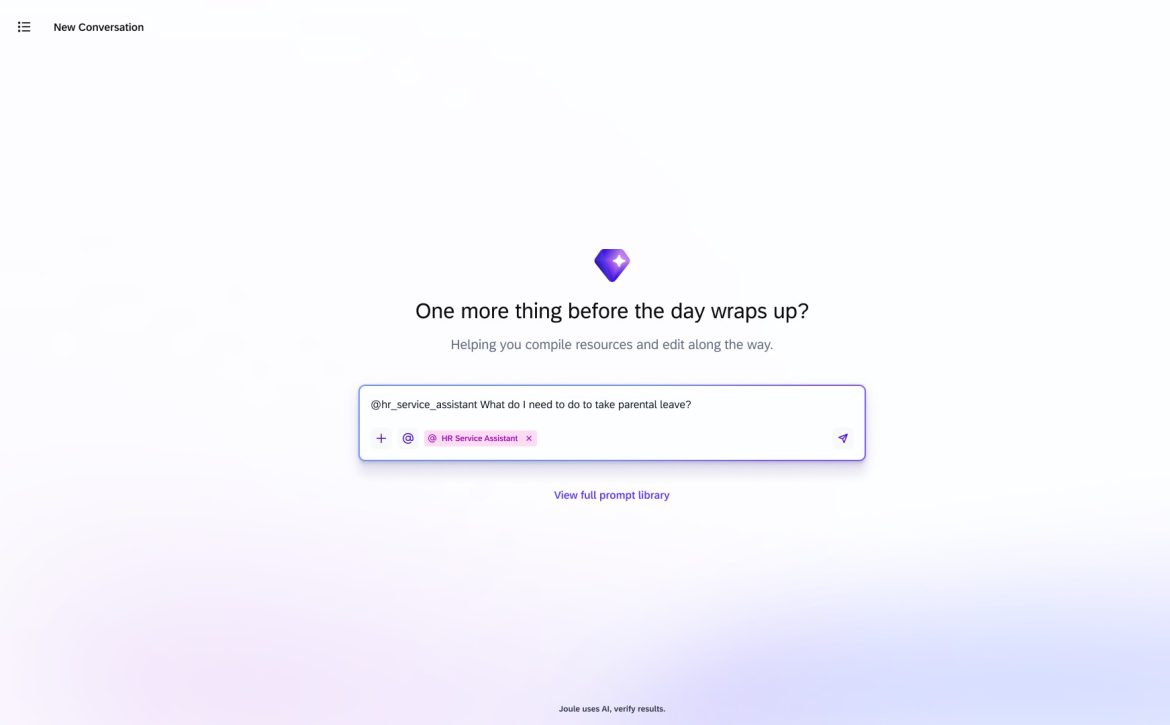
Product screenshot: Digital Service Agent
Digital Service Agent
  • Joule Studio, agent builder: Create custom, business-ready AI agents for SAP Customer Experience Cloud applications—fast and without complexity. Joule Studio, a part of SAP Build, gives developers a powerful low-code, no-code environment to create and deploy AI agents and connect them seamlessly to Joule, SAP CX apps and third-party systems. These agents can retrieve information, complete tasks, and run autonomous actions grounded in enterprise data from SAP CX, SAP Knowledge Graph, and non-SAP systems.

    For example, users can build a sales assistant agent that instantly pulls historical purchase records, analyzes buying patterns, and recommends the most relevant products or offers—helping sales teams increase conversion rates and shorten sales cycles. Learn how to activate Joule Studio and start building, testing, and deploying AI agents.

Previous Next
Close
Test Caption
Test Description goes like this