SAP Joule, the generative AI copilot, is at the forefront of SAP’s innovative AI advancements, introduced during SAP TechEd. SAP Joule’s evolution reflects a significant shift in how enterprises use artificial intelligence to enhance business operations. At SAP TechEd, SAP showcased new functionalities for Joule, highlighting its role in simplifying business processes through collaborative AI […]
All businesses generate spend data. But capturing, rationalizing, and deriving insights from that data – especially when it is scattered across multiple systems, in different formats, and of questionable accuracy – is why we announced the development of SAP Spend Control Tower, our command center for enterprise-wide spend analysis, last year.
SAP Spend Control Tower can enable business leaders to answer questions, like where and how much did my organization spend? With what suppliers? Can we break that down by normalized categories? Where are my cost-savings opportunities? What about compliance with environmental and social regulations?
I am happy to announce that SAP Spend Control Tower is now available for all businesses.
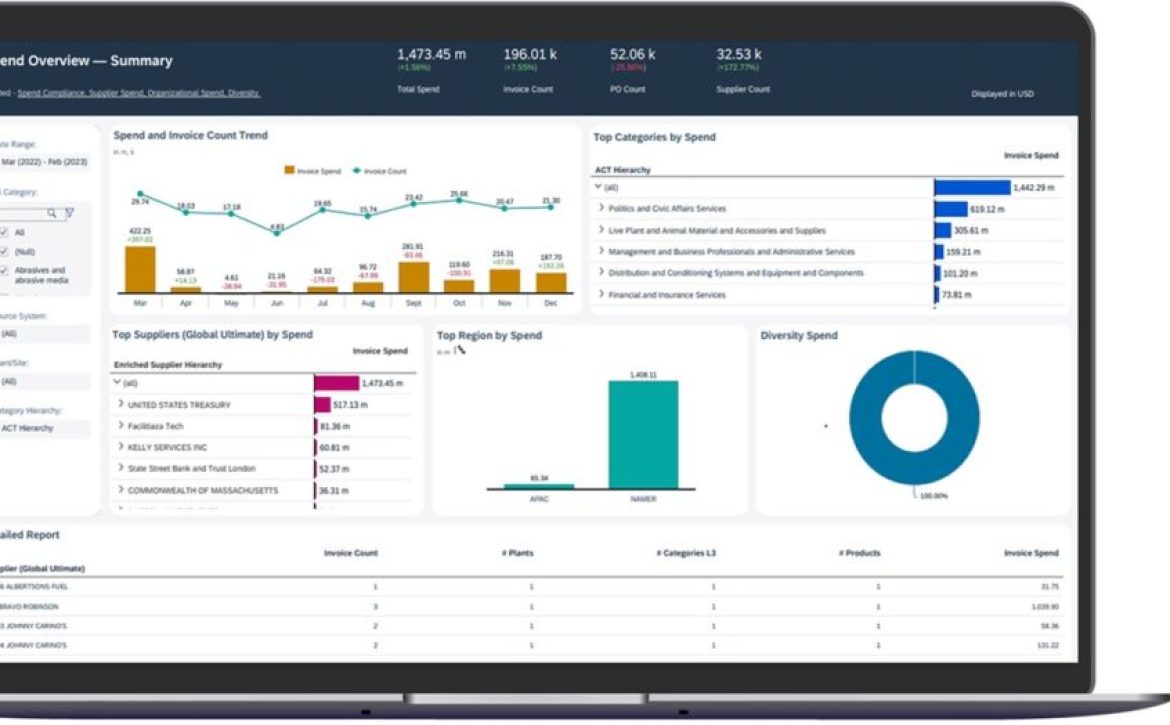
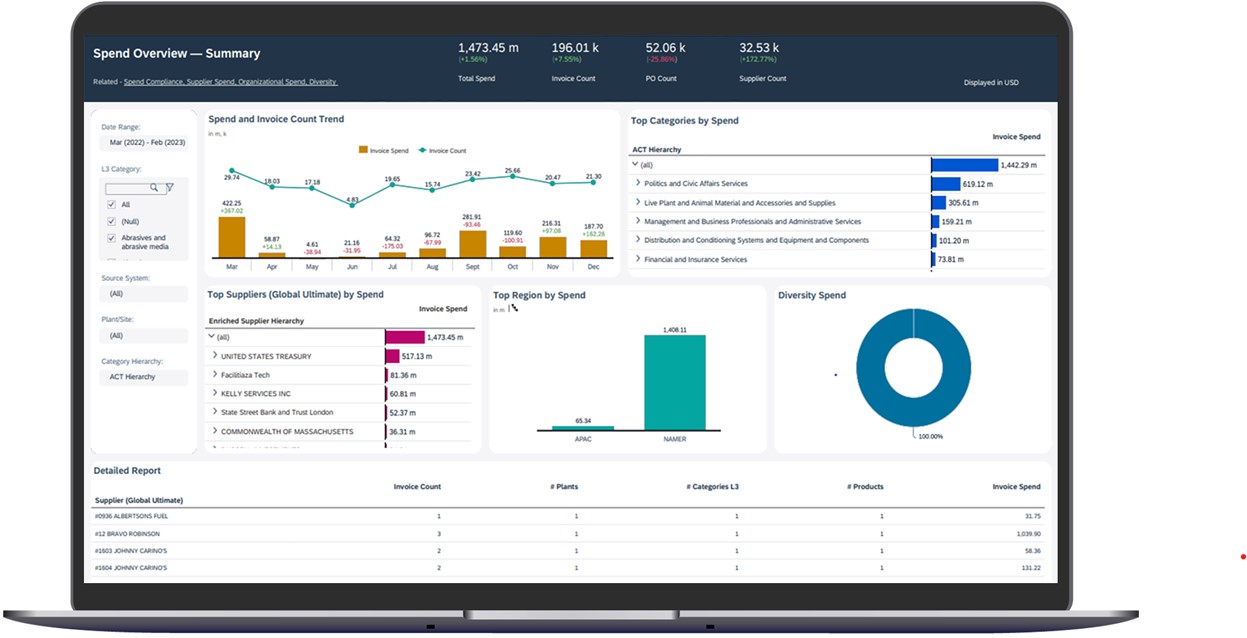
SAP Spend Control Tower Spend overview summarizes spend across the entire enterprise with enriched supplier and spend data classified into common categories. Click to enlarge.
Addressing Your Spend Data Challenges
I frequently discuss spend management challenges with CPOs and CFOs. They consistently seek visibility and insights into their spending, key suppliers, and ways to enhance savings and cash flow, which enable them to make better-informed decisions.
This aligns with our formal market research. In a new Economist Impact study sponsored by SAP – Across the procurement-verse: Changing trends in the procurement function – 44% of all respondents and 49% of CPOs identified spend analytics as the top driver of digitization in procurement in 2024.
Of course, it’s not just about procurement spend. It’s about all enterprise spend. And that’s our sweet spot. SAP delivers intelligent spend solutions covering the entire enterprise – from procurement to travel and expense to contingent labor and beyond.
As we’ve worked to bring together spend data across the enterprise, it’s become clear to me that many organizations face similar challenges:
Poor data quality
Too much data for individuals to process
Lack of visibility into cost-saving opportunities and ways to improve cash flow
SAP Spend Control Tower is specifically designed to help address these challenges. It can provide visibility and actionable insights into enterprise spend that flows to SAP solutions, such as SAP S/4HANA or SAP ERP Central Component (SAP ECC), and non-SAP systems. Spend information can then be further enhanced with data from SAP Ariba, SAP Fieldglass, and SAP Concur solutions.
SAP Spend Control Tower helps address the challenges of spend data management by providing:
A single location for all spend data: Enterprise data for all spend-related applications is centralized in a single “data layer.” This can provide visibility into your overall organizational spend while allowing users to drill down and see data within specific solutions, for example SAP Ariba, SAP Fieldglass, or SAP Concur solutions.
Data analysis driven by AI and machine learning: Embedded SAP Business AI solutions can enable users to analyze spend data, clarify categories, and make data-driven decisions.
Data harmonization and enrichment: Systems use a variety of formats to store data, which makes it difficult to combine or compare data sets. SAP standardizes data into a unified structure, making it possible to analyze a cohesive data set. Additionally, data enrichment helps improve accuracy by adding supplemental, third-party data to your own, then comparing them to ensure completeness and accuracy.
Six Ways SAP Spend Control Tower Helps Drive Spend Performance
The process of driving enterprise spend performance is a journey. First you need to explore what you’re spending and where you’re spending it. Then you uncover opportunities for savings. Finally, you measure regulatory compliance and how your spending programs stack up against your industry competitors.
SAP Spend Control Tower can help every step of the way, providing visibility into accurate data sets that can enable you to:
Consolidate Spend, Category, and Contract Data
Spend across your enterprise is a maze of suppliers, invoices, and contracts. How many suppliers do we really have? Which invoices fall into the “other” bucket? SAP Spend Control Tower can produce a consolidated list of suppliers and categories by employing artificial intelligence and machine learning classification and matching algorithms.
Improve Compliance and Deliver Savings
Once you identify categories and suppliers, you can look for opportunities to increase compliance and achieve cost savings. For instance, you may find that your business has five contracts with smaller suppliers, all under the same global ultimate parent company. This information allows you to consolidate your contracts, resulting in cost savings and improved cash flow.
Drill Down for Efficient Spend Visibility
With SAP Spend Control Tower, you can have visibility across all areas of your enterprise spend – for example, contingent labor, maintenance, repairs and operation, or travel and expense – providing a single view of all spend from SAP or non-SAP systems while enabling visibility into the source of spend via SAP Ariba, SAP Fieldglass, or SAP Concur solutions.
Identify Cost-Savings Opportunities and Provide Actionable Insights
SAP Spend Control Tower utilizes SAP Business AI to help guide you toward relevant and timely savings opportunities. Data from SAP Spend Control Tower can seamlessly integrate with the SAP Ariba Category Management spend profile. Furthermore, within opportunity analysis, AI can identify opportunities for end users in SAP Spend Control Tower, which are accessible to SAP Ariba Category Management. This integration allows category managers to set goals and develop effective category plans. By leveraging SAP Business AI, category managers can efficiently narrow down suppliers and deliver procurement opportunities within categories, streamlining the process and optimizing cost saving.
Drive Enterprise-Level Diversity and Sustainability Compliance
Even if you know who your suppliers are, it’s likely you don’t have direct access to all their corporate social responsibility credentials. Through data enhancement using generative AI and the SAP Sustainability Footprint Management solution, SAP Spend Control Tower can layer compliance and diversity data onto your supplier and spend data. This can help enable the evaluation of spend for compliance with diversity requirements and sustainability measures like Scope 3 emissions.
Achieve Best-in-Class Spend Performance Based on Industry Standards
A significant portion of the world’s business runs through SAP systems. We leverage this information to help provide realistic benchmarks from leading businesses in your industry. For example, a consumer products company may direct 22% of its total spend on marketing. Using SAP Spend Control Tower, they can find out that for leading competitors of similar size and revenue, the average marketing spend is much lower. This will help inform decisions about how to align their costs with the competition.
Over the last months, the drumbeat of urgency for climate action has been growing ever louder. Fittingly, this year’s New York Climate Week theme was “It’s time” — a clarion call for immediate and focused action as the climate crisis intensifies.
Two weeks ago, SAP joined global business leaders, political changemakers, decision-makers, and representatives from civil society for a week of focused discussions on the transition to a low-carbon, circular economy. Across dozens of in-person and virtual sessions, SAP reaffirmed its commitment to enabling a more sustainable world through an ERP-centric, cloud-based, AI-enabled approach.
At Climate Week, SAP’s focus on AI, precise carbon accounting, and expanded commitments to nature conservation highlighted its proactive approach to addressing the climate crisis.
AI’s Role in Advancing Sustainability
A major topic during New York Climate Week was the role of artificial intelligence in advancing sustainability. Key discussions highlighted how AI can assist chief sustainability officers (CSOs) and their teams in managing the complex data necessary for effective sustainability initiatives. By processing disjointed and multimodal data, AI empowers companies to monitor, predict, and optimize their systems, leading to improved sustainability outcomes across supply chains and energy grids.
AI serves not only as a tool for automation but also as a strategic ally, embedding sustainability into core business processes. Last month, SAP shared two innovative AI-driven use cases: SAP Sustainability Control Tower, AI-assisted ESG report generation and emission factor mapping capabilities. These capabilities help companies enhance carbon footprint calculations and streamline sustainability reporting. With real-time data, companies can make decisions faster and align with their sustainability goals.
SAP Sustainability solutions: ERP-centric, cloud-based, AI-enabled
However, the discussions also acknowledged the challenges associated with AI deployment, including high energy consumption, potential biases, and data privacy concerns. Addressing these challenges is crucial for ensuring AI’s sustainable application.
Sector-specific applications of AI were also explored. In the energy sector, AI can optimize consumption patterns, while in construction and consumer goods it can aid in waste reduction and resource efficiency. By integrating AI with SAP solutions, companies can enhance supply chain optimization, route planning, and demand forecasting.
Toward More Precise Carbon Accounting
Another critical topic at Climate Week was the need for companies to accurately track, report, and manage their carbon emissions while aligning their environmental impacts with financial operations. To thrive in today’s regulatory landscape, organizations must adopt robust sustainability management systems. With regulations like the Corporate Sustainability Reporting Directive (CSRD) on the horizon, businesses are transitioning from voluntary to mandatory reporting, navigating over 600 global regulations and frameworks.
To address these challenges, SAP will make the SAP Green Ledger solution generally available in December 2024. This innovative solution can integrate carbon and financial data, helping provide the real-time visibility essential for precise carbon accounting. This integration not only helps enhance compliance, but can also allow companies to gain a competitive edge by speeding up action towards sustainability.
Expanding Commitments to Nature Conservation
Starting in 2024, SAP is enhancing its net-zero strategy by committingto nature conservation and financing global climate projects for carbon removal and carbon reduction. It aims to plant and protect 25 million trees by 2030 and invest in wetland conservation. These initiatives align with SAP’s goal of achieving net-zero emissions by 2030, 20 years ahead of the original timeline.
SAP believes that financing climate projects beyond its value chain is essential to restoring ecosystems and fostering resilient, low-carbon economies. This comprehensive approach supports broader climate action and shifts corporate perceptions, demonstrating that sustainability is integral to long-term business success, not merely an operational add-on.
Through an ERP-centric, cloud-based, AI-enabled approach, SAP is well-positioned to lead the charge toward a more sustainable future while enabling customers to navigate the complexities of climate action. As always, collaboration and commitment from all sectors will be vital in driving truly meaningful change, and COP29 in Baku, Azerbaijan, will be an opportunity for the sustainability community to unite in accelerating global action, fostering new partnerships, and advancing innovative solutions.
By integrating technological innovation with strategic sustainability initiatives, SAP is not just adapting to the evolving landscape of sustainability, but is actively shaping it and charting the course for a resilient, low-carbon economy where businesses can thrive while safeguarding the planet for future generations.
Hear from SAP Sustainability executives and customer Ambipar at Climate Week 2024 and listen to our post-Climate Week podcast on how data and tech drive corporate sustainability.
Many organizations still using SAP ERP or the on-premise version of SAP S/4HANA are planning to migrate to the cloud. The new edition of the “Mapping Your Journey to SAP S/4HANA” guide provides the perfect orientation, with valuable insights, step-by-step instructions, best practices, and comprehensive background information.
The digital landscape is changing rapidly, and companies must constantly adapt to new circumstances. Failure to keep pace can lead to significant challenges, as the automotive industry and its supply chains are currently experiencing. To help companies navigate this dynamic environment, SAP introduced a guide in 2018 that quickly became a standard reference. A completely revised edition is now available.
Dozens of SAP experts from across the company have contributed to this comprehensive guide, which addresses all issues related to the transition to SAP S/4HANA Cloud Private Edition. By focusing on the essential technology, IT decision-makers can confidently plan their road map to cloud ERP, avoid pitfalls, and accelerate the time it takes to go live.
At the heart of the guide is the consolidated experience of thousands of successful transformation projects, presented in text and images. It also includes numerous links to additional resources, making the guide a single point of reference for all transformation issues at every project stage. The concept has been well received by customers, with more than 180,000 downloads since the first edition.
“The paper offers a comprehensive and detailed overview of the success factors and essential activities for your journey toward the latest SAP product portfolio.”
– Geoff Scott, CEO, ASUG
Updating an Essential Reference
Why a new edition now? “We have regularly updated the guide because it was always intended to be a living document,” said co-authors Bjoern Braemer, head of Adoption Execution & Enablement for SAP Customer Evolution, and Niclas Weidner, senior project consultant. “However, the SAP world has changed dramatically in the last six years with the emergence of many innovative tools and methodologies. In addition, the RISE with SAP offering, which we use to help customers move to cloud ERP, has grown significantly. As a result, we have completely revised and reissued the guide, incorporating valuable feedback from our customers and partners.”
“Why invest effort in forging your own path when you can follow the well-traveled paths of fellow community members?”
– Geoff Scott, CEO, ASUG
The goal remains the same: to provide IT managers with all the information they need to successfully implement SAP S/4HANA Cloud Private Edition in one place. The guide is divided into three sections:
1. Strategic Choices
The first section provides guidance on making informed decisions about various aspects of transitioning to SAP S/4HANA, including choosing between public and private cloud options, understanding the benefits and features of the GROW with SAP and RISE with SAP offerings, and the implications of changes to cloud operations.
2. Ingredients for Project Success
The second section focuses on the critical factors for project success. These include change and knowledge management, customer and supplier master data integration, the partner ecosystem, and more.
3. Essential Tools from SAP
The final part describes the 15 most important tools that companies can use to assess their system’s current state, plan and implement the migration, and monitor the project’s progress. These tools include SAP Data Services, SAP Readiness Check, ABAP development tools, and the SAP S/4HANA migration cockpit.
The Only Book You Need to Read About SAP S/4HANA
“Mapping Your Journey to SAP S/4HANA” is designed to help IT leaders navigate the transformation journey with confidence. It provides the right combination of theoretical knowledge and practical tips to help keep organizations digitally fit beyond 2027. You can read it from cover to cover for a complete understanding or keep it handy for quick, targeted advice on specific stages or challenges. Download it now for free.
Thomas Bamberger is president of SAP Customer Evolution.
Planning to migrate your SAP landscape to the cloud? The RISE with SAP Migration and Modernization program offers comprehensive support
The opening keynote of SAP TechEd in 2024 clearly brought to life SAP’s vision to make customers’ lives easier, showing the SAP portfolio come together to deliver a suite-like experience with highly configurable software and meaningful AI. As Muhammad Alam, member of the Executive Board of SAP SE, SAP Product Engineering, put it: “Our innovations don’t exist in isolation; they are deeply embedded within our product portfolio. We’re making sure the technology isn’t just advanced, but it’s accessible and impactful.”
The keynote featured demos of new cross-portfolio solutions and innovations, showing how they can work together to tackle challenges like scaling and expanding into new markets, managing complexity, and delivering personalized experiences. “Innovation is only as powerful as the product experience it delivers,” Alam said. “It’s one thing to have cutting-edge tools at your disposal, but it’s another thing to integrate those technologies into the products you rely on every day to solve real-world challenges.”
The transformative power of generative AI has already started to reshape productivity. From generating detailed reports to automating customer service tasks, AI helps streamline day-to-day activities.
Joule: Reimagine productivity with collaborative agents
However, the promise of AI-driven transformation has yet to be fully realized. This is largely because true business transformation doesn’t hinge only on improving individual productivity; it’s about unlocking the power of collaborative capabilities that enable cross-functional teams to solve ever-evolving business challenges. This shift paves the way for a new era of automation, driving the next industrial revolution.
This year at SAP TechEd, we extended our business AI strategy with a greater focus on transforming how businesses operate through autonomous, collaborative AI agents. Seamlessly infused into our AI copilot Joule, these agents span across business processes, breaking down silos and enhancing cross-functional collaboration.
At SAP, we believe that AI’s next frontier goes beyond isolated efficiencies and is about seamlessly unifying people, data, and processes to create business value and amplify the impact of outcomes.
New Features in SAP S/4HANA Cloud Private Edition 2023 FPS02 Aim to Revolutionize Enterprise Operations
SAP has announced the release of SAP S/4HANA Cloud Private Edition 2023 FPS02, which includes advanced AI-assisted capabilities and the expansion of SAP’s copilot Joule, the cutting-edge digital assistant designed to transform the user experience.
Combined with a suite of other innovations, these features are set to deliver unprecedented efficiency and intelligence across various business functions.
Rise into the Future: See these capabilities in action at our October 22 virtual event
SAP S/4HANA Cloud Private Edition 2023 FPS02 harnesses the power of artificial intelligence (AI) to automate routine tasks, provide predictive insights, and streamline decision-making processes. New capabilities in this release include:
AI-Assisted Sales Order Fulfillment: Sales departments can now leverage AI to monitor and resolve order fulfillment issues to greatly enhance order accuracy and customer satisfaction. Sales orders are summarized on header and item level in natural language, fulfillment issues are identified and resolved, sales orders can be updated, and document flows are made transparent.
Conversational Planning in Transportation Cockpit: The supply chain management module introduces AI-driven conversational planning. This feature allows users to interact with the system using natural language, simplifying complex transportation decisions and significantly reducing planning time.
Inbound Cargo Document Creation: The automation of inbound cargo document creation through AI reduces administrative burdens and minimizes errors. It improves operational efficiency by reducing manual checks at the gate and waiting time for trucks.
Maintenance Order Recommendations: In asset management, AI assists in predicting maintenance needs. The system analyzes asset performance data to recommend proactive maintenance strategies, helping extend asset lifespan and reduce downtime.
Introducing Joule for SAP S/4HANA Cloud Private Edition: The Future of Digital Assistance
At the heart of this release is Joule, a revolutionary digital assistant designed to streamline user interactions and boost productivity across the SAP ecosystem. Joule offers both transactional and navigational support, providing context-sensitive suggestions and shortcuts that significantly enhance the user experience.
With this release, Joule supports:
Project Management Support: Joule simplifies project management tasks by offering intuitive navigation and transaction handling. This makes it easier for project assistants to manage complex projects, ultimately improving project flow and efficiency.
Master Data Governance: Generative AI allows changes to master data and provides a summary of changes using natural language, reducing the time to change master data attributes and increasing the transparency of changes for reviewers.
Hybrid Sourcing in Advanced Available-to-Promise (ATP): This functionality allows for a more dynamic approach in covering sales order demands, leveraging both internal and external suppliers to meet demand efficiently.
Additional Innovations Across Functional Areas
In addition to AI-assisted functionalities and Joule, this latest release is packed with enhancements aimed at refining procurement, finance, R&D, and service management.
Procurement
Version and Pricing Comparison for Purchasing Contracts: Enables procurement professionals to efficiently evaluate different contract versions and pricing, ensuring optimal decision-making
Controlled Information Access for Sourcing Projects: Enhances security by allowing defined access levels for contributors, safeguarding sensitive information and fostering secure collaboration
Finance
Centralized Plan-Versus-Actual Analysis: Integrates plan data for a cohesive comparison between projected and actual financial performance, aiding precise budget management
Subscription Order Management with SAP GTS Integration: Streamlines handling of subscription-based revenue models and ensures compliance with global trade regulations
Manufacturing
Renewed Production Planning and Detailed Scheduling KPI Monitor: Provides in-depth analysis of key performance indicators (KPIs), enabling informed production planning and scheduling decisions
Engineer-to-Order Production Models: Facilitates seamless integration of engineering requirements into production plans, reducing lead times and aligning manufacturing with customer-specific configurations
R&D
Simplified Handling of In-Planned Services in Lean Service Procurement: Ensures efficient processing of service requirements, reducing administrative overhead and accelerating procurement cycles
Service Management
Combined In-House Repair and Field Service: Enhances service efficiency by enabling combined in-house repair and field service within a single service order
Non-Serialized Products in In-House Repair: Broadens the range of items that can be managed and repaired under the same system, driving operational flexibility
Asset Management
Inspection Checklists Management: A new SAP Fiori app simplifies the management of inspection checklists. This new app shows an overview of inspection checklists in the Inspection Lots view, or the corresponding inspection characteristics in the Characteristics view. The planner can filter the result list and perform actions, like setting the usage decision.
Cross Topics
Analyze Direct Project Transfers in Migration Cockpit: Facilitates smoother data migrations and offers analytical insights to ensure data integrity
The SAP S/4HANA Cloud Private Edition 2023 FPS02 release is a testament to our commitment to leveraging advanced technologies like AI and digital assistants to transform enterprise operations. With the introduction of AI-assisted capabilities and Joule, enterprises can expect significant improvements in efficiency, accuracy, and user experience.
As businesses worldwide navigate the complexities of the digital age, SAP’s latest innovations provide the tools needed to stay ahead of the curve, driving strategic growth and operational excellence.
SAP is expanding its partnership with Mistral AI by hosting some of Mistral’s commercially available models, including Mistral Large 2, on SAP’s operated infrastructure. This provides customers with a trusted and secure environment to use Mistral AI in conjunction with SAP.
Achieve real-world results and attain your full potential with embedded AI capabilities across your business that leverage your data responsibly
The addition of Mistral Large 2 broadens the choice of large language models (LLMs) that organizations can use for custom AI solutions that complement and extend SAP applications. By hosting the model on SAP’s operated infrastructure, SAP can better streamline its delivery and deployment of SAP Business AI across the enterprise. This is essential to meet regulatory requirements in certain regions or industries.
Customers, particularly those in heavily regulated industries, require solutions that not only address their innovation needs, but also ensure their data is not exposed to third-party entities. Customers with specific needs can adopt generative AI solutions with greater confidence, knowing their data is managed through a secure SAP environment.
“By adding Mistral Large 2 to SAP’s generative AI hub, we’re providing our customers with a leading large language model that runs in SAP data centers and on European infrastructure. This provides customers with the ability to build innovative solutions and can help them to comply with regulations in certain regions or industries,” shared Philipp Herzig, chief AI officer of SAP SE. “Our expanded partnership with Mistral AI reinforces SAP’s commitment to responsible AI, enabling businesses to harness the power of generative AI while maintaining control over their data and intellectual property — a key milestone toward more sovereignty for the European market.”
“We look forward to bringing Mistral’s advanced language models, including Mistral Large 2, to SAP Business AI, providing AI solutions that help customers meet the highest standards for data security and regulatory compliance,” Gianna Lengyel, head of Business Development at Mistral AI, said. “Our partnership with SAP enables businesses to benefit from state-of-the-art generative AI without compromising on control or compliance, particularly for organizations operating in highly regulated environments.”
Mistral AI’s models are accessible via the generative AI hub in SAP AI Core, making it simple to build generative AI use cases for SAP applications. Customers can leverage these models to embed advanced AI capabilities into their SAP applications or create custom solutions on SAP Business Technology Platform (SAP BTP).
To learn more, customers can reach out to their SAP point of contact or visit the SAP Business AI site for further details on how to begin leveraging these AI capabilities in their specific use cases.
Get all the latest news and coverage from SAP TechEd in 2024
Innovations at TechEd 2024 Showcase SAP’s Vast Collection of Business AI Game-Changers, from Collaborative Agents to Knowledge Graph Capabilities and Generative AI Developer Features in SAP Build
WALLDORF — SAP SE (NYSE: SAP) today unveiled groundbreaking AI innovations across a technology foundation that drives 87% of global commerce, putting its generative AI copilot Joule at the center of a new way of doing business.
Joule: The AI copilot that truly understands your business
At its annual SAP TechEd conference, SAP announced powerful new capabilities that complement and extend Joule, including collaborative AI agents imbued with custom skills to complete complex cross-disciplinary tasks. Other innovations include the SAP Knowledge Graph, a next-generation solution poised to help developers unlock the full value of SAP data by connecting it with rich business context, and new tools to ensure developers can continue driving Business AI innovation.
“SAP’s innovation drives real business outcomes, and today’s advancements help customers harness the power of AI, data and new development solutions to catalyze growth,” said Muhammad Alam, member of the Executive Board of SAP SE, SAP Product Engineering. “Drawing on SAP’s unmatched business and technology expertise, the AI innovations we’re announcing at TechEd forge a new human-AI partnership to transform the landscape of modern business.”
Supercharging Joule
On the eve of its first birthday, Joule marks a watershed in how business gets done. SAP introduces collaborative AI agents to a copilot that truly speaks the language of business, expands Joule’s capabilities to support 80% of SAP’s most-used business tasks and embeds Joule more deeply within the company’s portfolio.
Collaborative multi-agent systems deploy specialized AI agents to tackle specific tasks and enable them to collaborate on intricate business workflows, adapting their strategies to meet shared objectives. SAP is infusing Joule with multiple collaborative AI agents that will combine their unique expertise across business functions to collaboratively accomplish complex workflows. These AI agents enhance productivity by breaking down silos and freeing workers to concentrate on areas where human ingenuity thrives.
Two use cases debuted at TechEd showcase the agents’ transformative power:
A dispute management use case employs autonomous AI agents to analyze and resolve dispute resolution scenarios including incorrect and missing invoices, unapplied credits and denied or duplicate payments.
A financial accounting use case employs autonomous AI agents to streamline key financial processes by automating bill payments, invoice processing, and ledger updates while quickly addressing inconsistencies or errors.
Harnessing the Power of Data
SAP’s AI innovations also draw on the company’s unmatched business data expertise. The new SAP Knowledge Graph solution, accessible through SAP Datasphere and Joule in Q1 2025, will give users a deeper layer of business understanding by seamlessly mapping relationships and context across SAP’s vast data landscape, empowering organizations to make better decisions with their data. By offering ready-to-use relationships between business entities like purchase orders, invoices, and customers, the solution can significantly reduce the complexity of manual data modeling. SAP Knowledge Graph grounds AI in SAP-specific business semantics, which reduces the risk of inaccurate or irrelevant results and makes it easier for organizations to build intelligent applications and leverage generative AI more effectively.
Empowering Developers
SAP also launched a swathe of innovations for developers to continue driving Business AI innovation. New generative AI developer capabilities such as code explanation and documentation search in SAP Build, the company’s platform for extending its solutions, will reduce development time for Java and JavaScript developers. SAP Build is also adding an Extensibility Wizard feature that will let developers access SAP Build directly from SAP S/4HANA Cloud Public Edition, simplifying the extension process. Meanwhile, ABAP developers and fusion teams will get seamless access to ABAP Cloud development tools from SAP Build.
Finally, SAP announced that it has already fulfilled its pledge to upskill 2 million people worldwide by 2025. Through its learning opportunities, the company has lowered the world’s digital skills gap through role-based certifications, free training materials, hands-on opportunities for developers, and more. SAP continues to expand its growing portfolio of AI-related learning opportunities, including courses on generative AI, AI ethics and SAP’s advanced AI tools and platforms.
As a global leader in enterprise applications and business AI, SAP (NYSE: SAP) stands at the nexus of business and technology. For over 50 years, organizations have trusted SAP to bring out their best by uniting business-critical operations spanning finance, procurement, HR, supply chain, and customer experience. For more information, visit www.sap.com.
Note to editors: To preview and download broadcast-standard stock footage and press photos digitally, please visit www.sap.com/photos. On this platform, you can find high resolution material for your media channels.
For customers interested in learning more about SAP products: Global Customer Center: +49 180 534-34-24 United States Only: 1 (800) 872-1SAP (1-800-872-1727)
Two years ago, we introduced SAP Build, a unified low-code environment that enables developers of all skill levels to create, extend, and automate business applications with drag-and-drop simplicity. Last year, we broadened its capabilities and integrated Java and JavaScript development with AI.
With more than 16,000 customers now leveraging SAP Build globally, momentum continues to surge, enabling developers to build, automate, and innovate with greater speed and ease.
Today, we are thrilled to announce new enhancements of SAP Build, combining the power of ABAP development, more generative AI capabilities, as well as deeper integration with SAP S/4HANA and other business applications. SAP Build streamlines extension creation and accelerates ERP modernization. It connects all SAP development tools — ABAP, Java, JavaScript, and low-code — so teams can collaborate easily regardless of skill set.
Let’s look at what developers can achieve with SAP Build.