How SAP BTP Becomes the Trusted Platform for Business AI

Artificial intelligence (AI) – generative AI particularly – is changing the way business processes can be designed and optimized. By embedding AI in business applications, users can experience immediate value in their day-to-day work. For implementing AI across processes and applications and for SAP Business AI overall, SAP Business Technology Platform (SAP BTP) plays a critical role.

Across processes and applications, SAP BTP helps improve operational efficiency, enhance the customer experience, and drive innovation. The latest SAP BTP strategy paper offers a preview of what the future holds for our customers and partners.

SAP BTP already offers features such as code generation, application logic, data models, and test scripts, enabling businesses to modernize their IT landscapes, streamline their processes, and make more informed decisions through a consistent data foundation. As we continue to embed generative AI across the platform toolbox, SAP BTP is the trusted business AI platform for SAP-centric landscapes.

Here are some highlights:

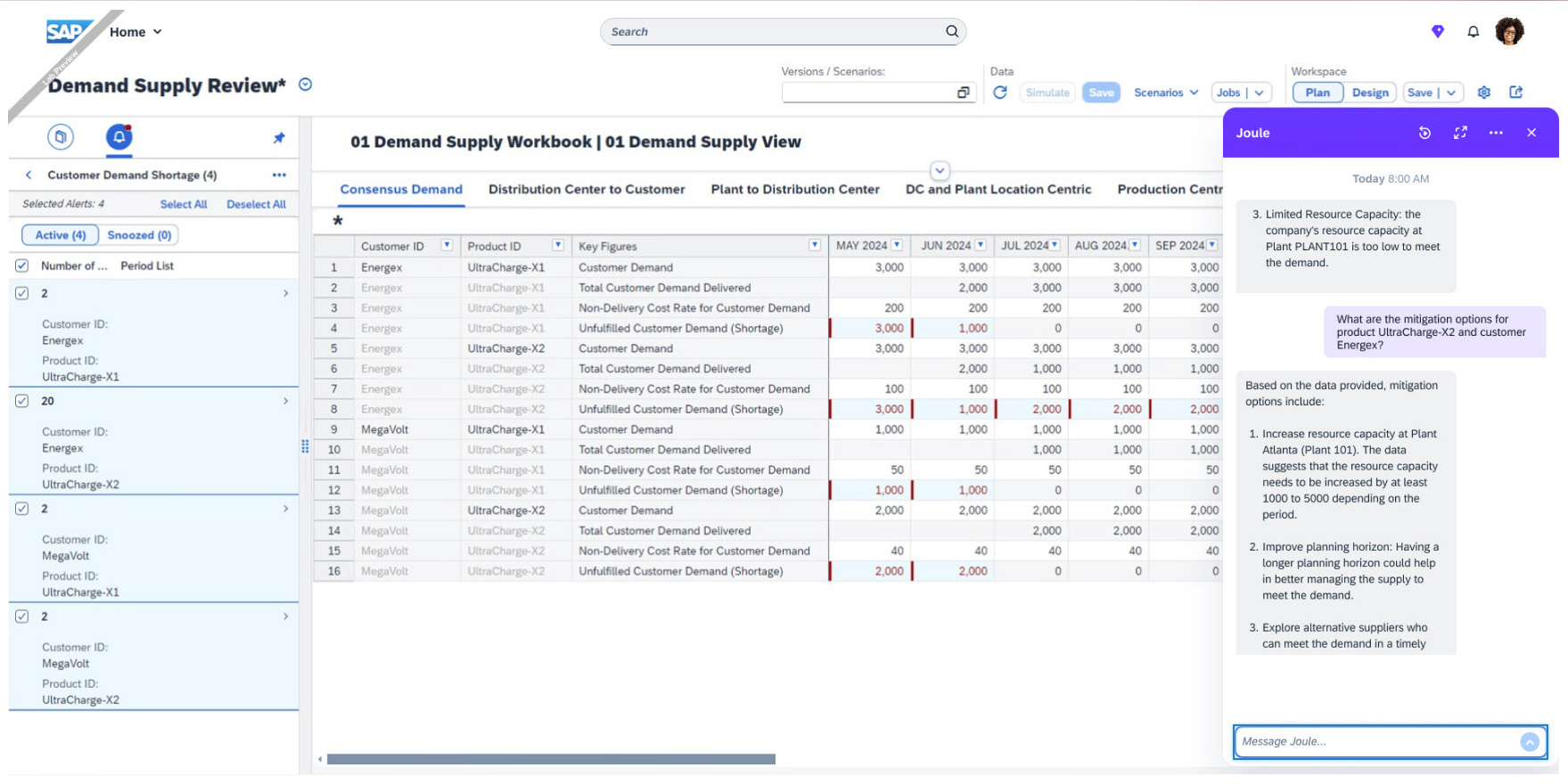
  • Joule, our AI copilot, will see increasing adoption across SAP BTP to help provide information and data, give intelligent recommendations, and execute tasks based on natural language interactions. Looking forward, we will extend Joule to empower customers to build their own generative AI agents and skills. 
  • We aim to enhance all SAP BTP services by incorporating additional AI functionalities. Beyond generating code and application logic such as with SAP Build solutions, SAP Build Code, and SAP BTP for the ABAP environment, this will include managing processes and business rules (SAP Build Process Automation), handling integration mappings and flows (SAP Integration Suite), and creating analytical charts and stories (SAP Analytics Cloud). 
  • SAP HANA Cloud vector engine and the knowledge graph in SAP Datasphere will help enable customers to better contextualize their input to large language models (LLMs) to achieve high-precision results.
  • The set of AI partner offerings accessible in the generative AI hub in SAP AI Core, which is part of SAP BTP, will continue to grow. Customers will soon be able to use them in the context of their business process directly. 
  • SAP BTP Cockpit will also include more generative AI capabilities that can simplify the experience around day-to-day administration tasks.

SAP BTP is our secure and reliable engine that helps drive business innovation in organizations. And we will make it available to even more customers in the future: SAP recently announced a substantial expansion of regional SAP BTP availability by the end of 2025.

By ensuring access to SAP BTP in more locations via new data centers, we are empowering more customers and partners around the globe to modernize IT landscapes, streamline business processes, and utilize data for better decision-making. While increasing the footprint of SAP BTP globally, we are also infusing our platform with AI capabilities.

With global expansion on the horizon and the addition of AI, it’s all set to help businesses run smoother and make smarter decisions. If you’re curious about our strategic direction and what’s next, I highly recommend taking a look at our latest SAP BTP strategy paper.


Michael Ameling is executive vice president and chief product officer of SAP Business Technology Platform.

Unleash digital innovation across business functions

NEC Leverages RISE with SAP and AI to Build Business AI in Move to the Cloud

WALLDORF and TOKYOSAP SE (NYSE: SAP) today announced NEC Corporation (TSE: 6701 “NEC”) has selected SAP S/4HANA Cloud through the RISE with SAP solution, running on Amazon Web Services (AWS).

Modernize your ERP capabilities
through the RISE with SAP Methodology

Together with implementation partner ABeam Consulting, the migration will leverage NEC’s generative AI technology and SAP’s natural language, generative AI Joule copilot.

NEC, a Japan-based multinational leader in the integration of IT and network technologies, was seeking to optimize costs and streamline data systems to increase integration across its lines of business. As part of advancing its digital transformation, NEC will migrate from on-premise SAP S/4HANA software to SAP S/4HANA Cloud and adopt a clean-core approach, which emphasizes standard offerings and extends them while also reducing future upgrade and operational costs.

NEC is currently operating a large-scale system that includes 1,200 add-ons and more than 200 external interfaces. To migrate to the cloud, NEC will use generative AI to facilitate a clean-core transformation, streamline migration costs and improve operational efficiency. NEC’s generative AI and SAP’s Joule copilot for natural language processing will automate critical processes such as add-on analysis, report interpretation, code generation from specifications and test automation. Joule is SAP’s generative AI assistant that understands the user’s unique role and acts as a work copilot across SAP applications to streamline tasks. NEC will be among the first companies to leverage AI tools from SAP to streamline its migrations.

“NEC sees itself as the first customer of its own innovations, applying cutting-edge technologies internally and sharing the gained insights and know-how with customers and society,” NEC President and CEO Takayuki Morita said. “This milestone implementation with SAP creates a new industry blueprint for other businesses looking to migrate to the cloud, underscoring NEC’s commitment to leading by example in technological adoption and societal contributions.”

By migrating to SAP S/4HANA Cloud, NEC anticipates more-efficient system operations by tapping into AI to support version upgrades and reduce future operation-related costs while being able to quickly respond to market changes. By leveraging innovative technologies including AI, NEC aims to digitally drive societal and industry transformations. This migration to the cloud is a key part of NEC’s 2025 mid-term management plan focusing on internal, customer and societal digital transformations.

“Our shared vision with NEC of creating a sustainable society through digital transformation is the foundation for our long-term partnership,” said Christian Klein, CEO and member of the Executive Board of SAP SE. “This project marks a milestone in our relationship, and we’re excited to support NEC on their continued transformation journey.”

Visit the SAP News Center. Follow SAP at @SAPNews.

SAP S/4HANA Cloud: ERP for every business need – from mission-critical operations to business model innovation

About SAP

As a global leader in enterprise applications and business AI, SAP (NYSE: SAP) stands at the nexus of business and technology. For over 50 years, organizations have trusted SAP to bring out their best by uniting business-critical operations spanning finance, procurement, HR, supply chain, and customer experience. For more information, visit www.sap.com.

Note to editors:
To preview and download broadcast-standard stock footage and press photos digitally, please visit www.sap.com/photos. On this platform, you can find high resolution material for your media channels.

For customers interested in learning more about SAP products:
Global Customer Center: +49 180 534-34-24
United States Only: 1 (800) 872-1SAP (1-800-872-1727)

For more information, press only:
Yuri Shimizu, +81 80 9262 6621, y.shimizu@sap.com, JST
Lesa Plingen, +49 622 776 9000, lesa.plingen@sap.com, CET
SAP Press Roompress@sap.com

This document contains forward-looking statements, which are predictions, projections, or other statements about future events. These statements are based on current expectations, forecasts, and assumptions that are subject to risks and uncertainties that could cause actual results and outcomes to materially differ. Additional information regarding these risks and uncertainties may be found in our filings with the Securities and Exchange Commission, including but not limited to the risk factors section of SAP’s 2023 Annual Report on Form 20-F.
© 2024 SAP SE. All rights reserved.
SAP and other SAP products and services mentioned herein as well as their respective logos are trademarks or registered trademarks of SAP SE in Germany and other countries. Please see https://www.sap.com/copyright for additional trademark information and notices.
Please consider our privacy policy. If you received this press release in your e-mail and you wish to unsubscribe to our mailing list please contact press@sap.com and write Unsubscribe in the subject line.

Maximizing Efficiency: Integrating AI into Corporate Processes & Information Technology

Dr. Benjamin Blau was recently appointed chief process and information officer and head of Corporate Processes and Information Technology at SAP. Here, he shares how he defines his new role as well as the future of his organization and the impact of artificial intelligence (AI).

SAP Business AI: Revolutionary technology, real-world results

Blau joined SAP in 2010 and has held various executive leadership positions with a strong track record in process management and business transformation. As chief process and information officer (CPIO), he represents the Corporate Processes & Information Technology (CPIT) organization with the main objective to enable SAP to scale and increase productivity through process transformation and optimization powered by AI. At the same time, the unit functions as the company’s own best reference customer showcasing how SAP runs SAP.

In this interview, Blau discusses his role and the transformation of the IT industry in general.

Q: For those not familiar with the Corporate Processes & Information Technology organization, what is its role within SAP?

A: It is widely recognized and acknowledged that the traditional concept of IT Services has undergone a significant shift in recent years, thanks to advancements in cloud computing, AI, and Big Data. Companies need to double down on their core strength and USP while demonstrating their ability to scale. To do so, IT has become a strategic instrument to enable every business to be more adaptable, scalable, and intelligent.

At SAP, we have invested a considerable amount of time and resources in this transformation, turning IT into a strategic enabler for business growth and a trusted technology partner. However, companies need to rethink their strategies to outperform their competitors by demonstrating operational efficiency and accelerated scalability. We see a substantial requirement to focus on process excellence and automation powered by AI. This means unleashing productivity through simplification and standardization of processes, powered by business AI and SAP’s own technology.

With that in mind, our strategic focus has evolved beyond information technology to support end-to-end process excellence with clear accountabilities that drive autonomy and quick decision-making. And that is the leading aspect of the CPIT organization.

Q: How would you describe the difference between the CIO and CPIO?

A: For me, the key difference lies within the approach to problem-solving. Rather than focusing solely on products or tools, the CPIO tends to tackle issues at the process level, where the root causes are often found. Especially as a SaaS company, we tend to solve every issue with another tool or a customization and/or a worst-case modification of a system, while in many cases the problem can be solved by standardizing and simplifying the way we work.

Hence, in addition to our information technology strategy, it is crucial for our organization to fulfill our mandate as SAP’s business process design authority, emphasizing our responsibility to oversee and optimize business processes. This means the business defines the strategy and clear objectives — aka the “why” and “what” — while we define “how” to get there in the most end-user friendly and productive way.

Q: What are you most looking forward to in your new role? 

A: Coming from my former role leading Industry Engineering for SAP, I love working close to products and customers. To this extent, I have the perfect job as we are SAP’s customer and first adopter of new technology, all while I am in the luxury position of being able to authentically talk to SAP’s customers about our challenges and solutions, being their trusted “peer” in the industry. This also means demonstrating how we boost productivity for SAP mainly through our fast-growing AI portfolio.

Q: The past five years have seen a tremendous amount of innovation, especially with the rise of generative AI. How will this influence the role of CIOs or that of an IT organization in the next two to five years?

A: In the coming two to five years, the influx of generative AI promises to revolutionize the landscape of IT organizations and the role of CIOs. Let me give you three examples.

First, it will significantly boost IT productivity by automating repetitive tasks and streamlining processes, which will free up valuable resources to either “do more with the same” or elevate those roles to even higher value-adding ones. Second, as CIOs in SaaS companies are customer zero, it is our task to showcase how AI can unlock value in highly differentiating parts of our value chain as innovation leaders of the industry. Third, with data even further emerging as a crucial competitive advantage, CIOs will increasingly focus on harnessing and maximizing the value of data assets. This entails not only owning and controlling data, but also developing new data products and mastering provisioning, management, and analysis, thereby cementing data management as a core responsibility of the IT organization.

For SAP, this clearly is the competitive edge in the AI game, as we have access to the probably largest amount of business data to feed high-value AI scenarios.

Q: Considering the fast-tracked development of AI and its potential impact, what is your approach for CPIT and SAP at large?

A: The strategic role of my organization in that context is twofold. First, we are the early adopter of every AI case ideated and developed at SAP, with an obligation to challenge the level of quality, maturity, and value on behalf of our customers. Second, I expect my team to also come up with new ideas and potential AI use cases, try them out, and be equally strict in their assessment regarding desirably, feasibility, and especially viability.

At the end of the day, business AI is about quality not quantity. To accelerate AI innovation, we have started an internal initiative to identify use cases with the highest value. This includes a process that also ensures we focus on the most effective solutions. By implementing quality gates in each step of the process, we also prioritize quality over quantity. This enables us to implement use cases that clearly demonstrate business value.


Marcus Kabat is head of CPIT Business Operations at SAP.

Sign up to receive weekly highlights on news, stories, and coverage from the SAP News Center

Double exposure of success businessman and Office workplace with laptop and smart phone on wood table and big city blurred background

SAP-IBM Partnership Accelerates Innovation with Generative AI

In a significant move aimed at empowering clients to become next-generation enterprises, SAP and IBM have announced their plans to expand their long-standing collaboration. The SAP-IBM partnership envisions leveraging generative AI capabilities and industry-specific cloud solutions to help enterprises unlock business value and drive innovation. With a shared approach to generative AI, built on an […]

The post SAP-IBM Partnership Accelerates Innovation with Generative AI appeared first on InsideSAP.

SAP Signavio Solutions Leads 2024 Gartner Magic Quadrant

SAP Signavio solutions have been recognized as a Leader in the 2024 Gartner Magic Quadrant for Process Mining Platforms for the second consecutive year. This positioning highlights SAP Signavio’s strong execution and visionary approach in the market. In a recently published article, Dee Houchen, Global Head of Market Impact for SAP Signavio, said that the […]

The post SAP Signavio Solutions Leads 2024 Gartner Magic Quadrant appeared first on InsideSAP.

Pekka Ala-Pietilä Elected Chairman of SAP Supervisory Board — Strong Shareholder Support

MANNHEIM SAP SE (NYSE: SAP) today announced that at the company’s Annual General Meeting of Shareholders (AGM), Pekka Ala-Pietilä (67) was elected as a new member of the company’s Supervisory Board. Ala-Pietilä’s election was supported by 95.50% of shareholders. Subsequently, Ala-Pietilä was also elected the new Chairman of the SAP Supervisory Board, completing the handover from former Chairman of the Board, Prof. Dr. h. c. mult. Hasso Plattner.

“I am happy to pass the baton to Pekka Ala Pietilä to accompany SAP’s ongoing successful transformation,” said Plattner. “Pekka profoundly understands SAP and the technology industry and will strongly support the company in expanding its leadership in cloud ERP and business AI.”

Ala-Pietilä added, “I am grateful to the SAP shareholders and Supervisory Board for the opportunity to rejoin Europe’s most important software company and I’m looking forward to help SAP broaden this strong position.”

As announced in 2023, SAP Co-Founder and former Chairman of the Board Hasso Plattner left the SAP Supervisory Board after the 2024 AGM.

During Plattner’s tenure as Chairman of the Supervisory Board (May 2003 to May 2024), SAP’s market capitalization increased from c. €30 billion to c. €200 billion, making SAP Germany’s most valuable listed company. Plattner’s innovative and competitive spirit has been a foundation of SAP’s success for more than 50 years, from the company’s first pioneering innovations in ERP to its strategic shift as an enterprise cloud and business AI leader. He will continue to serve as an advisor to SAP, ensuring his knowledge and experience remain available to the company.

Aicha Evans (55), Gerhard Oswald (70) and Dr. Friederik Rotsch (51) were re-elected as members of the Supervisory Board with 93.39%, 89.82% and 92.45% of the vote respectively. Prof. Dr. Ralf Herbrich (50) was elected with 99.29% of the vote as successor to Punit Renjen, who left the SAP Supervisory Board at the end of the 2024 AGM.

The AGM also supported all other proposals of the Executive Board and Supervisory Board. That included approving the actions of the Executive Board and Supervisory Board for fiscal 2023, 99.51% and 99.44% support respectively, and approving the adaptation of the compensation of the Chairman of the Supervisory Board. An overview of the resolutions of the Annual General Meetings 2024 and of previous years can be found here.

For 2023, SAP shareholders will receive a dividend of €2.20 per share. This is an increase of €0.15, or seven percent compared to the dividend paid for 2022. The total payout to shareholders will thus amount to around €2.6 billion. The dividend is expected to be paid out from May 21, 2024.

Visit the SAP News Center. Follow SAP at @SAPNews.

Get the latest financial news and information about SAP and company performance

About SAP

As a global leader in enterprise applications and business AI, SAP (NYSE: SAP) stands at the nexus of business and technology. For over 50 years, organizations have trusted SAP to bring out their best by uniting business-critical operations spanning finance, procurement, HR, supply chain, and customer experience. For more information, visit www.sap.com.

Note to editors:
To preview and download broadcast-standard stock footage and press photos digitally, please visit www.sap.com/photos. On this platform, you can find high resolution material for your media channels. To view video stories on diverse topics, visit www.sap-tv.com. From this site, you can embed videos into your own Web pages, share video via email links, and subscribe to RSS feeds from SAP TV.

For customers interested in learning more about SAP products:
Global Customer Center: +49 180 534-34-24
United States Only: 1 (800) 872-1SAP (1-800-872-1727)

For more information, financial community only:
Anthony Coletta, +49 6227-7-60437, investor@sap.com, CET

For more information, press only:
Joellen Perry, +1 (650) 445-6780, joellen.perry@sap.com, PT
Daniel Reinhardt, +49 6227-7-40201, daniel.reinhardt@sap.com, CET
SAP Press Roompress@sap.com

This document contains forward-looking statements, which are predictions, projections, or other statements about future events. These statements are based on current expectations, forecasts, and assumptions that are subject to risks and uncertainties that could cause actual results and outcomes to materially differ. Additional information regarding these risks and uncertainties may be found in our filings with the Securities and Exchange Commission, including but not limited to the risk factors section of SAP’s 2023 Annual Report on Form 20-F.
© 2024 SAP SE. All rights reserved.
SAP and other SAP products and services mentioned herein as well as their respective logos are trademarks or registered trademarks of SAP SE in Germany and other countries. Please see https://www.sap.com/copyright for additional trademark information and notices.

PureTech Scientific Scores Leading Position in the Market with Move to the Cloud

BELLE, W. Va. SAP SE (NYSE: SAP) today announced that PureTech Scientific LLC, a global leader in the production of glycolic acid products, with a range of uses from skin care to clean and disinfect, has gone live with SAP S/4HANA Cloud Public Edition to position itself for further growth.

Iron Path Capital, a private equity firm that acquired the company in 2023, has significant growth ambitions for PureTech Scientific. The first milestone for PureTech Scientific transformation was the move to the cloud to build a unified technology platform that would fully transition employees, customers and vendors with minimal disruption. Completed in 14 weeks, the implementation has already seen improved operational visibility and more timely transactional discipline.

“The real-time insights and automation PureTech Scientific plans to gain from implementation of SAP S/4HANA Cloud Public Edition will help to streamline our operations and significantly enhance our ability to serve our customers with greater speed and accuracy,” PureTech Scientific CEO James Kanicky said. “This is just the beginning, and we’re excited for the opportunities ahead as we continue to drive growth and innovation with glycolic acid in the personal care and health care markets.”

GROW with SAP: Cloud ERP adoption with speed, predictability and continuous innovation

With its entire ERP now in the cloud, PureTech Scientific, the only North American glycolic acid producer, has real-time insight of its daily production and the ability to employ and automate barcoding. PureTech Scientific is now able to complete SAP goods issue and goods receipt transactions automatically with mobile devices, further reducing time needed for reporting.

“SAP S/4HANA Cloud Public Edition provides a best-in-class foundation for enterprise scalability, security and compliance,” said James Smith, executive advisor for Iron Path Capital and PureTech board member. “After an impressive 14-week implementation, PureTech Scientific is now able to have real-time business analytics and implement industry-best-practice, fit-to-standard workflows. The commencement of digital manufacturing cloud, barcoding and sales cloud capabilities will eliminate manual transactions, automate production recording and material movements, and employ mobile data collection for improved enterprise productivity and customer satisfaction.”

Glycolic acid is used as the core agent in multiple industries, ranging from industrials to life science. PureTech Scientific expects the market to grow 10% CAGR over the next five years. SAP S/4HANA Cloud Public Edition was selected specifically to support PureTech Scientific’s vision for growth. With scalability and integration as top priorities, SAP S/4HANA Cloud Public Edition allows the company to now focus on pursuing growth opportunities in new markets and new capabilities for new and existing customers.

“PureTech Scientific has undergone a significant transformation in the past year,” SAP North America President Lloyd Adams said. “It has completely revamped its ERP system and moved to the cloud. Doing so allows for quick and data-driven business decisions as it enhances its capabilities and deepens its market share in key markets.”

Learn more at PureTech Scientific.

Visit the SAP News Center. Follow SAP at @SAPNews.

Media Contacts:
Bridget Carroll, +1 (267) 615-3589, bridget.carroll@sap.com, ET
Lesa Plingen, +49 622 776 9000, lesa.plingen@sap.com, CET
SAP Press Room; press@sap.com

Get the latest news, coverage and highlights from the SAP News Center delivered to your inbox each week

This document contains forward-looking statements, which are predictions, projections, or other statements about future events. These statements are based on current expectations, forecasts, and assumptions that are subject to risks and uncertainties that could cause actual results and outcomes to materially differ.  Additional information regarding these risks and uncertainties may be found in our filings with the Securities and Exchange Commission, including but not limited to the risk factors section of SAP’s 2023 Annual Report on Form 20-F.
© 2024 SAP SE. All rights reserved.
SAP and other SAP products and services mentioned herein as well as their respective logos are trademarks or registered trademarks of SAP SE in Germany and other countries. Please see https://www.sap.com/copyright for additional trademark information and notices.

Kyndryl Adopts Next-Generation Tools for Sales Performance Management

At a time when many companies are still using guesswork and spreadsheets as the basis of territory and sales quota planning and commission calculations, top-performing sales teams use science. With the right modern tools and data-backed methodology, planning doesn’t need to be overly complicated or time-consuming to deliver a powerful incentive for sales reps through clarity and transparency.

When global technology services company Kyndryl Holdings Inc. was spun out of IBM in November 2021, it became the world’s largest provider of IT infrastructure services. The company has over 80,000 employees in 60 countries and 3,500 sales reps. With a focus on continuously improving the vital systems at the heart of the digital economy, Kyndryl works with partners and customers worldwide to co-create solutions to help enterprises reach their peak digital performance.

When Kyndryl spun from IBM, a transition service agreement (TSA) was put in place with a two-year deadline for Kyndryl to complete the disengagement of its IT systems from IBM. One of the challenges Kyndryl faced during the separation was how to transition tools over and apply them in the best way for the new business. This was not an insignificant task given its sales operations extended to more than 60 countries.

Kishore Kancharla, director of Sales and Incentive Systems at Kyndryl, was tasked with working out how best to clone these systems and work on the go-to-market transformation. “When we separated from IBM, we had close to 100 people supporting these mainframe applications, which were very expensive to maintain. As the legacy systems were built for IBM’s operations, there was significant complexity,” he explains. “We wanted to simplify the systems and streamline the processes as well, but it was also very difficult to make changes to support our needs as a new company.”

The nature of sales incentives means there are many dependencies on other core systems. In the planning stages, reliable data is needed to set up territories and quotas and then track sales and calculate commissions, making sure sales reps get paid accurately and on time. The company also had to factor in the transition service agreement exit in terms of sunsetting the legacy applications and moving to stand-alone applications while complying with the Sarbanes-Oxley Act (SOX).

Empower sales teams with the tools they need to create effective sales experiences

Seeking another way, Kyndryl evaluated several different products against its needs, making the decision to invest in sales performance management solutions in the SAP SuccessFactors portfolio. The portfolio offers integrated solutions for compensation and territory and quota management in the form of SAP SuccessFactors Incentive Management and SAP SuccessFactors Territory and Quota.

But one major challenge stood in its way. The company needed to go-live with the sales performance management solutions before the start of its fiscal year beginning in April 2023. This was well ahead of its TSA deadline in October 2023 and gave the company less than a year.

To make it happen, Kyndryl worked closely with the team from SAP and an SI partner Municons, a company from Munich that specializes in SPM implementations, to implement both solutions. The company also drew on additional support from a systems integrator partner to configure SAP SuccessFactors Incentive Management.

“The team from SAP was a wonderful partner all through the project. In the beginning, I was not 100% confident because of the scale of the task. The idea of replacing the entire legacy solution we inherited seemed daunting, but we had the right people come together with the right skills to make the impossible possible,” Kancharla reflects.

With the successful go-live before the start of its fiscal year, Kyndryl untangled a labyrinth of more than 45 legacy modules supporting sales performance management, now needing just one integrated solution. It moved from 10 different applications to feed sales quota business flows into one. It moved from cluttered and replicated data in multiple places to a streamlined and simplified data landscape, centralizing all sales data in one place. In addition, Kyndryl simplified territory and quota processes, reducing complexity in its business processes by more than 60%. The streamlined business processes also drove savings in operating expenses and mitigated business continuity risks for financially significant applications.

Elsewhere, integrated functionality from DocuSign helped eliminate the need for in-person signatures and the company has simplified support staff roles to clear separation of duties (SoD) conflicts. With the new setup, Kyndryl has minimized the potential for errors and non-compliance while enabling its business teams to develop intricate sales strategies through user-friendly, drag-and-drop interfaces and ready-made templates. And commission details are now accessible through dashboards that are available anytime, anywhere though a mobile app.

At an operational level, the company has reduced the processing time needed to execute the monthly commissions cycle and streamlined integration with its HR system for delivery of pay files. By streamlining year-end close activities, Kyndryl saved weeks of effort from both business and technical teams.

The close relationship with SAP has continued past the initial go-live date. SAP participated in multiple workshops to understand intricacies for some of Kyndryl’s most challenging business processes related to territory and quota and financial planning. A second-year fiscal planning process is already taking advantage of these new offerings, further simplifying and streamlining the company’s complex processes.

Learn more about sales performance management solutions in the SAP SuccessFactors portfolio.


Rahul Iyer is general manager of Sales Performance Management at SAP.

Get the latest SAP news delivered to your inbox once a week

SAP Signavio Again Leads the 2024 SPARK Matrix™ for Digital Twin of an Organization

We’re proud to announce that SAP Signavio has been recognized as a Leader in the 2024 SPARK Matrix for Digital Twin of an Organization (DTO) for the fourth consecutive year. This consistent recognition by Quadrant Knowledge Solutions is a testament to our ongoing commitment to technological excellence and impactful customer service in digital transformation.

The SPARK Matrix provides a detailed analysis of global market dynamics, significant trends, and the vendor landscape. Each market participant is analyzed against several Technology Excellence and Customer Impact parameters. SAP Signavio stands out for its comprehensive DTO solutions that can effectively merge organizational processes with technological capabilities, fostering continuous improvement and strategic decision-making.

Our strengths highlight our leadership position in several critical areas:

  • Enterprise observability: Integrating process observability with technology observability, we can provide organizations with a detailed understanding of their operations.
  • AI-powered applications: We leverage generative AI to offer applications that help enhance process knowledge and support informed decision-making.
  • Value accelerators and benchmarking: Our tools can provide ready-to-use best practices and metrics, helping organizations quickly assess and improve performance.
  • Modeling and experience connection: We extend DTO capabilities to customer touchpoints, working to ensure comprehensive transformation efforts.

According to Sofia Ali, associate director and principal analyst at Quadrant Knowledge Solutions, “SAP’s integration of SAP Signavio and SAP LeanIX into its DTO platform enables organizations to achieve digital transformation seamlessly. By leveraging SAP Signavio’s process observability and SAP LeanIX’s technology observability, SAP provides a holistic approach to enhancing processes and deriving value through unified observability. This approach enables organizations to represent their architecture and capabilities virtually and facilitates continuous improvement and automation of operational processes through AI-powered simulations. SAP’s robust vision and focused strategy and the development of large process models promise to deliver AI-driven transformation services that enhance insights, recommendations, and governance. Overall, SAP’s continued enhancement of its DTO platform underscores its commitment to empowering organizations with the tools needed to thrive in an increasingly digital world.”

Exploring the Digital Twin of an Organization

The digital twin of an organization mirrors how the business as a whole operates and adapts. Modern organizations are complex sets of connected business units, processes, people, and systems. The DTO showcases interdependencies among the different entities and the impact of change at all levels. 

The DTO helps to understand how an organization operationalizes its business model in processes and applications, monitors inefficiencies, and tracks process improvement measures. In other words, creating a digital twin allows decision-makers to answer the big what-if questions about how their enterprise functions.

Rouven Morato, general manager of SAP Signavio and SAP LeanIX, emphasizes the strategic importance of DTO solutions: “The ability to map interactions across business processes and IT architecture gives leaders the confidence they need to drive change. Our advanced AI functionalities allow customers to safely simulate new business scenarios, ensuring agility and resilience in a volatile market.”

This honor reflects our dedication to empowering businesses with cutting-edge solutions that meet the evolving demands of the digital age. Download the complimentary SPARK Matrix report to understand the DTO market better and why SAP Signavio has been acknowledged as a leader in this crucial area for four years.


Dee Houchen is global head of Market Impact for SAP Signavio.

Transform existing business processes while optimizing operational excellence and customer experiences

Unleashing As-A-Service Growth: High-Tech Leaders Share Lessons Learned

Talk to any high-tech industry leader who’s launched an as-a-service offering, and they’ll tell you that everything as a service (XaaS) is unlike any other business model transformation. Instead of a one-and-done sales transaction, customers are signing up for a long-term relationship that bundles services with the company’s hardware or software products. XaaS often broadens the collaborative bonds with partners that are involved in service delivery as well. At the outset, companies need to think big but start small.

“Moving to an as-a-service model dramatically changes how an organization does business and keeps customers satisfied, starting with product design and pricing through synchronized order fulfillment, revenue recognition and sharing, invoicing, and contract management,” said Mirjam Wittmann, director of Product Marketing, High Technology at SAP. “We’re seeing our customers begin with a targeted pilot in one line of business, followed by refinements and expansion to monetize XaaS packages for greatest competitive advantage.”

XaaS-Driven Growth at Lenovo: Go Bigger Than Back Office

Everything-as-a-service business models are essential to Lenovo’s growth plans. Long recognized for laptops, phones, tablets, data center servers, and business solutions, the company’s service-led transformation has been a catalyst for significant expansion in its non-PC business, accounting for over 42% of the company’s revenue.

“We’re in a phase of rapid acceleration, focusing our efforts on the expansion and refinement of our XaaS capabilities and business infrastructure,” said Arthur Hu, senior vice president and chief information officer at Lenovo and chief technology and delivery officer at Lenovo’s Solutions and Services Group. “This journey involves a multifaceted approach, combining agile development, strategic partnerships, and continuous optimization to ensure that our XaaS offerings meet the evolving needs of our clients.”

Accelerate monetization of any business model with SAP solutions

Hu said that SAP Billing and Revenue Innovation Management provides Lenovo with the flexibility to monetize services through pay-as-you-go, subscription, consumption-based, outcome-based, and other models. For example, the company can structure pay-as-you-go packages priced by the customer’s power consumption, storage of gigabytes, utilization, and number of nodes in an installation.

“Redefine your product hierarchies to fit the as-a-service world. Update financial accounting for managed services, such as revenue recognition and costing. Provide the sales team with a clear understanding of the offerings so they can articulate the value to customers,” Hu said. “Make sure that every impacted system has the integrated data for accurate and timely fulfillment and entitlement that delivers the optimal customer experience and desired outcomes.”

Personalized XaaS Offerings Generate Revenue at Autodesk

Autodesk offers customers both subscription- and usage-based models for nearly all products across 50 countries. As a global leader in the design and software industry for media, construction, and engineering, Autodesk is using XaaS to future-proof the company.

“As-a-service provides us with a scalable, nimble foundation that drives better outcomes for customers and generates a steady stream of revenue for the company. We can quickly offer customers personalized products and pricing combinations for faster go-to-market,” said Sudhir Misal, senior director of Engineering at Autodesk. “SAP solutions are the backbone of our as-a-service business model, helping us cost-efficiently manage orders, converged invoicing, contract accounting, and the financial supply chain. For example, we’ve reduced quarterly financial closing times by over 80%.”

Misal agreed that a successful XaaS strategy requires a mindset shift.

“You need to partner closely with your system provider, in our case it was SAP, to understand the business context behind the offering. We focused on standardizing as much as possible,” Misal said. “Change management was a priority as we went through this journey that included all stakeholders. By talking with peer companies to hear their learnings, we avoided repeating mistakes that others have made.”

Generative AI Promises Dynamic Innovation

No discussion of high-tech innovation would be complete without addressing the significance of generative AI. Misal said that Autodesk was exploring how AI can help companies quickly test and adopt value-added XaaS offerings.

“Generative AI can analyze data to help organizations see how customers are behaving depending on the services they’re using,” said Wittmann. “Data from generative AI can help companies cross sell and upsell personalized services that meet individual customer preferences, increasing customer loyalty. With faster market demand insights, companies can dynamically adjust XaaS bundles and iterate fresh ideas to take advantage of emerging opportunities before the competition.”

Learn more about becoming a scalable subscription business with SAP’s unified quote-to-cash solutions for recurring revenue.


Follow SAP News on LinkedIn to stay in touch

Previous Next
Close
Test Caption
Test Description goes like this